 |
 QRP portable at Luther Marsh
 6 July 2013 | by
 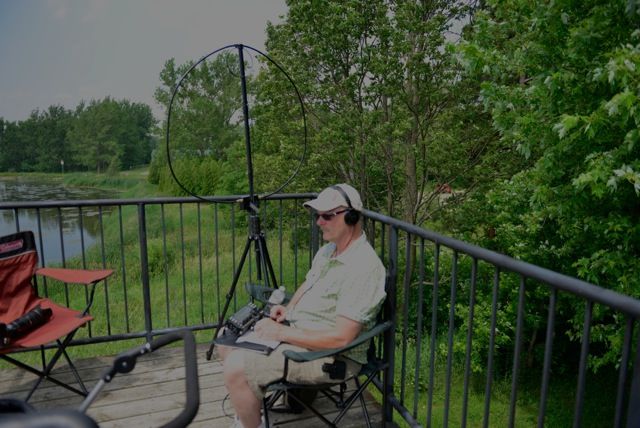 |
| QRP at Luther Marsh... note one of Julies cameras |
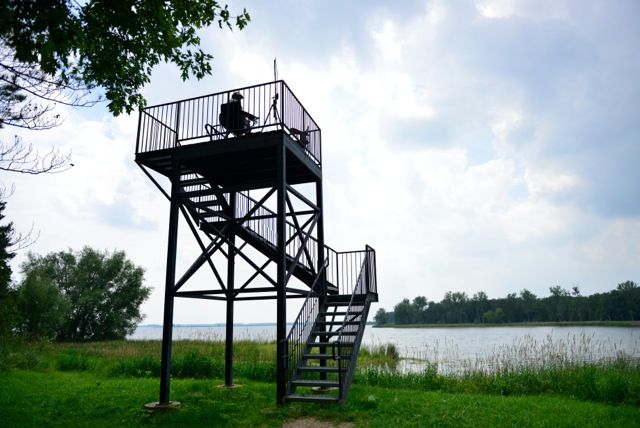 |
| A view from below |
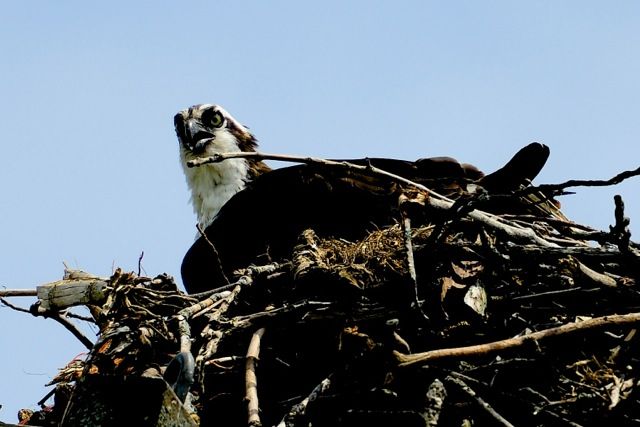 |
| Julie's shot of the day an Osprey |
I took with me my Elecraft KX3, Alexloop, tripod and a spare battery. It was great, there was no noise level at all on the KX3 and one would wonder if the rig had a receive problem. I started to call CQ and it was not long before VE1AB in Nova Scotia came back to me. John gave me an RST of 559 and we had a nice long CW chat it seemed that John had been to Luther Marsh several times when in Ontario. I did have to say 72 to him as my batteries had to be changed in the KX3. I then called CQ again on 20m and WW2SUB came back to me.......hey guess where he was???? This was the first time EVER I had contacted a Submarine . He was on the USS batfish. I thought my CW was off and it was supposed to be copied as battleship. When I got home and did a QRZ.COM search....it was in fact called the USS Batfish!
 |
| Camera and ham gear stroller (mainly camera gear) |
Mike Weir, VE9KK, is a regular contributor to AmateurRadio.com and writes from New Brunswick, Canada. Contact him at [email protected].
Waited a long time for this!
72 de Larry W2LJ
QRP – When you care to send the very least!
Larry Makoski, W2LJ, is a regular contributor to AmateurRadio.com and writes from New Jersey, USA. Contact him at [email protected].
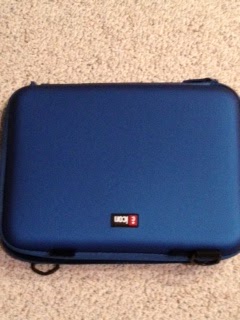
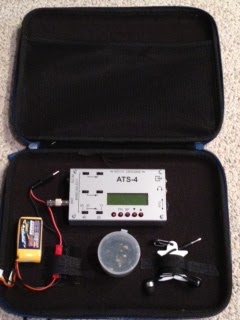
My New SOTA Portable Station
I purchased an ICON portfolio designed to carry an iPad or similar notebook. It is hard sided and the inside lining can hold on to velcro.
Mike Crownover, AD5A, is a regular contributor to AmateurRadio.com and writes from Texas, USA. Contact him at [email protected].
QRP ARCI Summer Homebrew Sprint
Is this coming Sunday from 20:00 to 24:00 UTC. That’s from 4:00 to 8:00 PM EDT for those of us here on the East Coast. I will have to participate as W2LJ/2 (technically), as I won’t be home. Tomorrow we’re leaving for our yearly sojourn to Lake George, NY.
Of course, the KX3, Buddistick, and PAR ENDFEDZ 40/20/10 will be accompanying me. Not sure if I’ll operate from near the cabin with the Buddistick, or perhaps from a park, or even from a nearby mountaintop with the PAR.
In any event, I am looking forward to some well deserved R&R. I anticipate a lot of reading, and a lot of radio in addition to all the fresh mountain air and cool lake breezes.
I have some good books loaded on my kindle, including James Rollins’ new one, “The Eye of God”. If this Sigma Force novel is as good as his others, I should burn through it in two or three days. For the past several years, I have been able to read two books during our time up north. In addition to Rollins’ new one, I also have several of David Baldacci’s novels loaded on the kindle.
FYI, any requests for Skeeter numbers will be processed when I return. So if you send me an e-mail, I will acknowledge it, and I may even issue you a number. However, I won’t be able to update the online roster until I return.
72 de Larry W2LJ
QRP – When you care to send the very least!
Larry Makoski, W2LJ, is a regular contributor to AmateurRadio.com and writes from New Jersey, USA. Contact him at [email protected].
How to Save Ham Radio – Parts 4 & 5 – N1IC – The Easiest Two!
How to Save Ham Radio – Parts 4 & 5 – N1IC – The Easiest Two!
So first of all let me say that I had a started 4 and 5 a long time ago when I was writing this series but due to some personal challenges with my health I had to take a step back from blog posting and this series … with that said I wanted to close it out. 4 and 5 as I started writing them were both serious topics but I wanted to combine them since one will be a little more controversial than the other and hopefully 5 will help bring everyone back from their thoughts on the 4th part 🙂
http://nicktoday.com/how-to-save-ham-radio-parts-4-5-n1ic-the-easiest-two/
Nick Palomba, N1IC, is a regular contributor to AmateurRadio.com and writes from Florida, USA. Contact him at [email protected].
Doing the splits
At the end of last month I was testing a new version of WSJT-X for Joe, K1JT, under NDA. The program has now been released, so I can write about it.
 |
| WSJT-X 1.1 can decode both JT65 and JT9 at the same time |
The major new feature is that WSJT-X 1.1 supports both JT65 and JT9. What is even more remarkable about it is that it can decode both modes at the same time! Enabling dual modes is optional, but if you use the feature and double-click on a station to reply to it the program will switch to the correct mode for the reply.
Another thing about this new version is that it can decode signals in a bandwidth 4kHz wide. If you have a transceiver that can receive such a wide bandwidth – Flex SDR radios can do this, as can the Kenwood TS2000 and my Elecraft K3 with FM filter installed – then you can take advantage of this capability. I didn’t think my K3 could go that wide, but all that was needed was to run the K3 Utility and enable the FM filter in DATA mode.
If you’re sharp then you will have thought of a snag. What happens if you reply to a station on the right hand side of the bandwidth? Receiving may be OK through the FM filter but on transmit the 2.7KHz SSB filter is used. The solution is clever: you keep the audio in the range 1 to 2kHz, engage SPLIT mode and set the transmit frequency to shift the signal up or down so that it matches the frequency of the station you are working.
I must admit that this perplexed me at first as I didn’t understand the significance of operating in split mode. My audio tones (heard with the K3 monitor turned up a little) were often lower or higher than the station I was replying to, and I was afraid I was replying on the wrong frequency. In fact, I was: I had forgotten to switch SPLIT on!
To avoid mistakes in future I created a Windows shortcut using a little utility I wrote to send a CAT SPLIT ON command before starting WSJT-X 1.1 and equally importantly, set SPLIT OFF when I had finished a session with WSJT-X. It’s just too much to expect me to remember to do this manually! I suggested to Joe that WSJT-X itself should send the split commands, but apparently it’s not that simple when you have to cater for every transceiver under the sun. So if you are working JT9 or JT65 and stations reply to you one or two kHz off-frequency don’t be surprised.
I should make it clear: WSJT-X 1.1 doesn’t decode both modes across 4kHz. It decodes JT65 in the lower half and JT9 in the upper half. You get to decide where the dividing line lies.
Joe K1JT thinks that JT9 users will move down a bit into the top end of the JT65 range, to enable people whose transceivers don’t give them 4kHz bandwidth to take advantage o9f the ability to work dual modes. In fact, at the moment, the result seems to be to have enabled JT65 users to spread out over 3kHz or more as is clearly illustrated by my screenshot. Time will tell.
Julian Moss, G4ILO, is a regular contributor to AmateurRadio.com and writes from Cumbria, England. Contact him at [email protected].
I did it!

I did it! I got New Hampshire and Maryland for the sweep! New Hampshire in the morning, and Maryland in the afternoon. All stations were worked on 40 Meters and three were worked with CW, the rest SSB. This has been the most SSB work that I have done in decades.
I have to say that this was a lot of fun, especially for something I really hadn’t planned on taking on. But the other evening, when I had worked the first 8 Colonies before I had really even realized it, I became hooked.
There’s still plenty of time for you to complete this, or even get started if you haven’t already. The 13 Colonies event runs until midnight Sunday morning, so get behind the radio and start spinning the dial!
76 de Larry W2LJ
QRP – When you care to send the very least!
Larry Makoski, W2LJ, is a regular contributor to AmateurRadio.com and writes from New Jersey, USA. Contact him at [email protected].
 Ham Radio Deluxe |
 W5SWL Electronics |
 Ham Radio Prep |
 KB3IFH QSL Cards  Hip Ham Shirts  HamRadioAuctions HamRadioAuctions Reliance Antennas Reliance Antennas Enigma Shop Enigma Shop |  morseDX  Ni4L Antennas  R&L Electronics R&L Electronics antennas.us antennas.us QRV QRV |
- Matt W1MST, Managing Editor
