 |
 Hunting For NDBs In CLE291
 20 April 2023 | by
 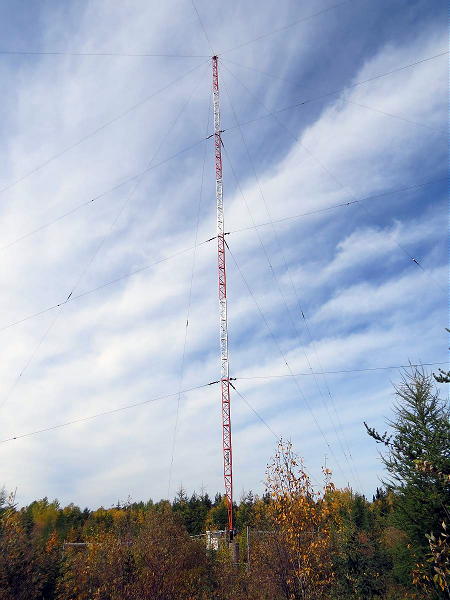 |
| ZSJ-258 Sandy Lake, ON (ve3gop.com) |
This coming weekend brings CLE 291. This is a challenge for all NDB hunters, both new and old and the ultimate test of your medium frequency receiving capabilities. Can you meet the challenge?
When tuning for NDBs, put your receiver in the CW mode and listen for the NDB's CW identifier, repeated every few seconds. Listen for U.S. NDB identifiers approximately 1 kHz higher or lower than the published transmitted frequency since these beacons are modulated with a 1020 Hz tone approximately.
For example, 'AA' near Fargo, ND, transmitted on 365 kHz and its upper sideband CW identifier was tuned at 366.025 kHz while its lower sideband CW ident could be tuned at 363.946 kHz. Its USB tone was actually 1025 Hz while its LSB tone was 1054 Hz.
Often, one sideband will be much stronger than the other so if you don't hear the first one, try listening on the other sideband.
Canadian NDBs normally have an USB tone only, usually very close to 400 Hz. They also have a long dash (keydown) following the CW identifier.
All NDBs heard in North America will be listed in the RNA database (updated daily) while those heard in Europe may be found in the REU database. Beacons heard outside of these regions will be found in the RWW database.
From CLE organizers comes the following info:
Hello all,
This coming weekend we have another chance to enjoy a Coordinated Listening Event. All CLE logs will be very welcome, short or long.
Days: Friday, 21st April – Monday, 24th April
Times: Start and end at midday, local time at the receiver
Searching for: NDBs in the ranges
240.0 - 259.9 kHz and 420.0 - 439.9 kHz
BOTH frequency ranges are for ALL listeners.
REU and RNA show that the number of NDBs, each
of them heard by at least 10 or more listeners in the
last 12 months, was:
240-259.9 kHz 420-439.9 kHz
REU 30 116
RNA 54 54
Please log the NDBs you can identify that are listed in the ranges, plus any UNIDs that you come across there.
You can find details, lists and maps of the beacons in those ranges, if you go to https://rxx.classaxe.com/cle.
Send your final CLE log to ndblist'at'groups.io with “CLE291” and
“FINAL” in the email Subject.
Please show on EVERY LINE of your log:
# The full Date (or Day no.) e.g. ‘2023-04-21’ (or just ‘21’)
and UTC (the day changes at 00:00 UTC)
# kHz (the beacon's nominal published frequency if you know it)
# The Call Ident.
Other optional details - Location, Distance, etc. - go LATER in the same line (or in footnotes). Please make your log useful to old and new members alike by ALWAYS including your own location (and 6-character Locator if you know it) and brief details of the equipment and aerial(s) that you were using.
We will send an 'Any More Logs?' email at about 20:00 UTC on Tuesday evening so you can check that your log has been found OK.
To be included in the combined results your log must have arrived by 09:00 UTC on Wednesday 26th April at the very latest.
We hope to complete making the Combined Results within a day or two.
Good listening
Joachim and Brian
(CLE coordinators)
If you would like to try some remote listening - you could use any one remote receiver for your loggings, stating its location (and with the owner’s permission if required).
A remote listener may NOT also use another receiver, whether local or remote, to make more loggings for the same CLE.
CLE's provide several purposes. They:
• determine, worldwide, which beacons are out-of-service or have gone silent since the last CLE covering this range
• will indicate the state of propagation conditions at the various participant locations
• will give you an indication of how well your LF/MF receiving system is working
• give participants a fun yet challenging activity to keep their listening skills honed
Final details can be found at the NDB List website, and worldwide results, for every participant, will be posted there a few days after the event.
The NDB List Group is a great place to learn more about the 'Art of NDB DXing' or to meet other DXers in your region. There is a lot of good information available there and new members are always very welcome. As well, you can follow the results of other CLE participants from night to night as propagation is always an active topic of discussion.
You need not be an NDB List member to participate in the CLEs and all reports, no matter how small, are of much value to the organizers.
Remember - 'First-time' logs are always VERY welcome!
Reports may be sent to the NDB List Group or e-mailed to CLE co-ordinator, Brian Keyte (G3SIA), whose address appears above. If you are a member of the group, all final results will also be e-mailed and posted there.
Please ... give the CLE a try ... then let us know what NDB's can be heard from your location! Your report can then be added to the worldwide database to help keep it up-to-date.
Have fun and good hunting!
Steve McDonald, VE7SL, is a regular contributor to AmateurRadio.com and writes from British Columbia, Canada. Contact him at [email protected].
Portable Ops in Comfort
 |
| Working my rolling shack portable station from air-con comfort |

 |
| Early try with a military fiberglass pole mast |
 |
| Now I use a Flagpole Buddy with a 30 foot telescoping mast |
 |
| Gone RF fishing with a 30 foot pole and a big sinker. |
 |
| Palm Radio Single Paddle |
 |
| On the Eagle the Palm Radio Single magnetically attaches to the side |
 |
| Note the power and antenna connections under the table |
Richard Carpenter, AA4OO, is a regular contributor to AmateurRadio.com and writes from North Carolina, USA. Contact him at [email protected].
AmateurLogic 180: Cheap Old Geaux Baux
AmateurLogic.TV Episode 180 is now available for download.
Emile builds a Geaux Baux. Software for NanoVNA analyzers. Dual Band Satellite Yagi, The Sequel.
George Thomas, W5JDX, is co-host of AmateurLogic.TV, an original amateur radio video program hosted by George Thomas (W5JDX), Tommy Martin (N5ZNO), Peter Berrett (VK3PB), and Emile Diodene (KE5QKR). Contact him at [email protected].
Amateur Radio Weekly – Issue 281

The RFNM: A next generation SDR
10 MHz to 7200 MHz tuning range, 12-Bit ADCs and up to 612 MHz bandwidth.
RTL-SDR.com
DIY portable ops truck desk
The desk is comfortable to use and the truck can be driven when the desk is installed.
KK4Z
GridTracker receives 2023 Amateur Radio Software Award
The award recognizes software projects that enhance Amateur Radio.
ARSA
NTIA identifying spectrum to be repurposed
Agency is seeking public input on identifying new spectrum bands for potential repurposing.
CQ Newsroom
Ofcom hints at license changes
“We will consult on proposals to simplify our licensing framework for amateur radio licensing.”
Essex Ham
Tuning a Mag Loop via smartphone
You normally have an adjustment capacitor to tune the antenna to different frequencies.
Hackaday
Voice of America Museum of Broadcasting open additional hours for Hamvention
New exhibits include a dedicated room for Amateur Radio.
VOA Museum
Get in shape for Hamvention
Start walking a little each day and be in better shape for walking Hamvention.
KB6NU
Video
How to wind a toroid inductor
The real trick is often how to hold the toroid core.
W2AEW
How I’m logging my Parks on the Air (POTA) contacts
Getting back to basics by looking at key parts of a Parks on the Air activation.
KB9VBR Antennas
Build a DIY Dipole Antenna
A 10m dipole without a balun or commercial center insulator.
RADIO STATION AD0IM
5G to 6G cellular technology
The evolution of cellular technology in relation to First Net & ARES.
WB7OML
Get Amateur Radio Weekly in your inbox.
Sign-up here
Amateur Radio Weekly is curated by Cale Mooth K4HCK. Sign up free to receive ham radio's most relevant news, projects, technology and events by e-mail each week at http://www.hamweekly.com.
ICQ Podcast Episode 400- Show 400 Celebration
In this episode, we join Martin Butler M1MRB, Chris Howard (M0TCH), Martin Rothwell (M0SGL), Frank Howell (K4FMH), Bill Barnes (WC3B) and Leslie Butterfields (G0CIB) to discuss the latest Amateur / Ham Radio news. Colin Butler (M6BOY) rounds up the news in brief and in the episode's feature is Our Recollections of 400 Shows.
We would like to thank ICQPodcast 400 Club Member Winston Lawrence, KD2WLL, Neil Connor (M6CUE), Malcolm Heath (KS0T), Ed Efchak (WX2R), one-off donors Michael Rosenberg (N9YB), Gary Bridges (WA0VMV) and our monthly and annual subscription donors for keeping the podcast advert free. To donate, please visit - http://www.icqpodcast.com/donate
- New Australian Ham Licences Delayed
- ISS Time Traveller
- Broadcaster Shuts Longwave Radio Transmitter in Iceland
- American Clubs Grow with Collaboration
- Ofcom Plan of Work
Colin Butler, M6BOY, is the host of the ICQ Podcast, a weekly radio show about Amateur Radio. Contact him at [email protected].
Amateur Radio Weekly – Issue 280
Ria Jairam steps down from ARRL board, joins ARDC board [PDF]
“Ria is a powerful voice in amateur radio…”
ARDC
HamTestOnline to shut down
Owner, John, W1AI, will shut down the site on June 30th unless a buyer can be found.
W2LJ
New digital mode: FreeData
A new digital mode that uses the OFDM modem code from FreeDV for having keyboard to keyboard chats.
marxys musing on technology
Code execution exploit via APRS
An exploit targeting WinAPRS and WIndows XP allows code execution on remote PC.
Coalfire
How times have changed for portable ops
In the 60s, you wouldn’t operate for long off a battery with the amperage needed to warm all those tubes.
QRPer
Benefits of the Yaesu XF-130CN 300 Hz Crystal Roofing Filter
From the video you can hear that there is a very small demonstrable difference in strong signal rejection.
Ham Radio QRP
Delta loopy ideas
A delta loop has multiple possible feedpoints and the choice has to be made very carefully.
Ham Radio Outside the Box
World Amateur Radio Day is April 18
The day is being celebrated with a 2-week operating event occurring April 11 – 25.
ARRL
Military reliance on HF on the rise?
HF, unlike landline connections and submarine cables, cannot be blocked.
The SWLing Post
LIFEPO4 batteries for portable operations
For the same capacity they are more than half the weight of SLA batteries.
VE3IPS
Video
1944 soldering iron training film
1944 US Office of Education black-and-white training film.
PeriscopeFilm
Homemade spy transmitter
Designing a small spy transmitter using two tubes.
Helge Fykse
PCB Yagi antenna for 2.4GHz
WA5VJB PCB based antenna tested.
IMSAI
Get Amateur Radio Weekly in your inbox.
Sign-up here
Amateur Radio Weekly is curated by Cale Mooth K4HCK. Sign up free to receive ham radio's most relevant news, projects, technology and events by e-mail each week at http://www.hamweekly.com.
Bacon and Eggs…not radio but very interesting.

My dad passed while I was at a very young age but through my mom, I learned that he was a Lancaster bomber pilot in England during WW2. I remember asking her questions but she did not know much as he spoke of his time in the war very little.
What I did know was he was a commercial pilot in Ireland and then joined the Air Force during the war. At the time he was asked to train as a tail gunner as at the time there were too many pilots and not enough Lancaster aircraft. He completed his training but never sat in the tail gunner turret as he was called up as a pilot. That's all I know of his military time but I have always had an interest in that part of his life. When I lived in Ontario just outside Toronto is the home of the Canadian Warplane Heritage Museum. They have one of the very few flying Lancaster bomber aircraft. In the book the sound of the Rolls-Royce Merlin engines of the Lancaster were often mentioned. I can somewhat understand this, when the museums Lancaster was out flying as it did often you could hear the rich sound of the 4 engines.
This brings me to the book I just finished reading called Bacon and Eggs the story of a Lancaster bomber crew. It is a fictional story based on real crew and actual events. This book goes over the events of the formation, training and missions of one Lancaster crew. It's a short read and is available on Amazon as a book and ebook. If you subscribe to Kindle Unlimited then it is a free read. In closing, after reading the book I look at sitting down to a meal of bacon and eggs in a different light now.
Mike Weir, VE9KK, is a regular contributor to AmateurRadio.com and writes from New Brunswick, Canada. Contact him at [email protected].
 Ham Radio Deluxe |
 W5SWL Electronics |
 Ham Radio Prep |
 KB3IFH QSL Cards  Hip Ham Shirts  HamRadioAuctions HamRadioAuctions Reliance Antennas Reliance Antennas Enigma Shop Enigma Shop |  morseDX  Ni4L Antennas  R&L Electronics R&L Electronics antennas.us antennas.us Ears to Our World Ears to Our World |
- Matt W1MST, Managing Editor
