 |
 Do QRP’ers Have an Identitiy Crisis?
 12 August 2013 | by
 Mike Crownover, AD5A, is a regular contributor to AmateurRadio.com and writes from Texas, USA. Contact him at [email protected].
Real World Measurements of a Multi-Band End Fed Antenna using a 9:1 Un-Un
Real World Measurements of a Multi-Band End Fed Antenna
using a 9:1 Un-Un
Excited as I was to get on the air with my new antenna, I didn’t take record any data regarding its SWR, radiation resistance (RR) and resonant point (X) with my antenna analyzer. Satisfied that the antenna worked by making QRP contacts in the WAE this weekend, I pulled out the analyzer and recorded some data for bands 40 through 10.
SWR should be 1.0 RR should be 50 X should be 0
This is the ideal but is not often the case in real life set ups especially in the field when operating portable!
I found one strange thing on 40 meters. The readings were markedly different if I held the analyzer in my hand or set it on a table by itself. The readings were better if I held the instrument in my hand. Holding the analyzer or setting it down made very little difference on the other bands with 17 Meters the exception, so I didn’t post those here.
MHz SWR RR X
7.030 4.3 104 101 Not touching
7.030 2.4 66 50 Touching
10.116 2.0 27 10
14.062 1.8 30 16
14.280 1.7 39 25
18.085 2.1 35 31 Not Touching
18.085 1.7 35 19 Touching
21.058 1.5 45 21
21.430 2.3 20 3
24.905 4.2 41 75
28.062 2.2 30 30
28.560 2.5 38 42
My antenna wire is 35 feet long and 30 feet above the ground and its orientation is horizontal, (perpendicular to the ground!)
Building the 9:1 UnUn was fun and I was eager to have a multi-band antenna!
This antenna got a lot of bad press among the ‘Antenna Guru’ crowd on E-Ham. They said their (facts) were from computer modeling programs, but there was a lot of opinion written their too and a lot of disparaging remarks toward anyone who would stupid enough to actually use one of these antennas. Their facts and data in no way came close to my real world measurements!
I plan to take this antenna into the field and test it as a sloper, both with the analyzer and on the air. I’ll post the results here.
I hooked up a tuner and took readings on 20 meters. I was able to get the SWR down to 1:1 and the RR to 57 using the tuner which is very close indeed to the ideal. The readings are sensitive to whether I held the analyzer in my hand when looking through a tuner. That bothers me. There seems to be some (not a lot) but some, RFI in the shack here too.
All antennas have trade off’s!
73
de AA1IK
Ernest Gregoire
Ernest Gregoire, AA1IK, is a regular contributor to AmateurRadio.com and writes from Florida, USA. Contact him at [email protected].
Not much time, but loads of fun!
So as I previously wrote, I did not get to spend a lot of time in the Skeeter Hunt today. But the time I did spend? Yowza!
My first 45 minutes, before leaving for the soup kitchen yielded only five QSOs. I was a bit disappointed, thinking it was going to be one of those days.
Then, the second session was night and day different from the first. I got home later than expected, and got on the air with only 25 minutes remaining. But I threw out my call on 40 Meters, and it was like dropping a baited line into a school of fish! QSO after QSO after QSO, with only a few CQs between each. I got a total of 11 QSOs in the last 20 minutes, for a total of 16 for the event. Makes me wonder how well I could have done if I had the full four hours. Participation seemed decent.
Thank you to all of you who got on the air and made the contacts. I think the 2nd Annual Skeeter Hunt was a huge hit! Sign ups for Skeeter numbers went from 123 last year to 154 this year. Now, for the log summaries, photos and soapbox comments! You have 14 days, folks. I look forward to you filling up my Inbox!
73 de Larry W2LJ
QRP – When you care to send the very least!
Larry Makoski, W2LJ, is a regular contributor to AmateurRadio.com and writes from New Jersey, USA. Contact him at [email protected].
NJ QRP Skeeter Hunt in Hill Village
It was a perfect afternoon for the NJ QRP Club Skeeter Hunt. I operated for an hour in Old Hill Village and made 13 contacts. Five QSOs were with fellow QRP operators. The rest were with DX stations from Finland, Germany, Romania, the Ukraine, Croatia and Italy.

This place has been abandoned since the 1940’s to make room for a flood control area. It was once a village. As I ride the bicycle along this road, I am transported back to the 1930’s. It has an old world feeling.

I turn east into a field that used to be the old elementary school grounds. One can almost hear the sounds of children playing from those years… or is it the crickets?
Up the slope several hundred yards is an ancient maple tree. This old tree certainly holds many secrets.

I throw my line over a high branch and pull up 33 feet of wire. I sit in the grass below with the KX3 and a notebook for logging. At first I go to 20 meters and work AB9CA and N0SS. But I don’t hear the QRP gang, and I start working the European stations in the WAE contest. I work both 15 and 20 meters. I stop by 40 meters and work K3RLL in the QRP sprint. Then I go back to 20 meters and log NK9G and WB4MNK. But I don’t hear many of the skeeter stations so I go back to the WAE.
Here is my log:
11 Aug-13 1822 14.060 AB9CA CW 559 559 AL 125
11 Aug-13 1825 14.060 N0SS CW 559 559 MO 20
11 Aug-13 1832 21.046 9A1AA CW 599 599 Croatia
11 Aug-13 1837 21.034 IR2C CW 599 599 Italy
11 Aug-13 1840 21.012 UU7J CW 599 599 Ukraine
11 Aug-13 1842 10.120 W3LN CW 549 579 PA ABE
11 Aug-13 1855 7.040 K3RLL CW 559 579 PA 25
11 Aug-13 1858 14.061 NK9G CW 559 559 WI 18
11 Aug-13 1900 14.060 WB4MNK CW 559 559 FL 95
11 Aug-13 1902 14.041 OH2XX CW 599 599 Finland
11 Aug-13 1903 14.042 DD2ML CW 599 599 Germany
11 Aug-13 1908 21.050 DJ8EW CW 599 599 Germany
11 Aug-13 1909 21.038 YP9W CW 599 599 Romania
After less than one hour, I pack up and head back down to the road for a bike ride.

I ride along the Pemigewasset River surrounded by the greenest green imaginable. The stillness of the afternoon is punctuated only by the sound of birds and crickets. Is there a nicer place in all the world?
Jim Cluett, W1PID, is a regular contributor to AmateurRadio.com and writes from New Hampshire, USA. Contact him at [email protected].
Two SOTA Activations: W0/SP-099 and SP-115
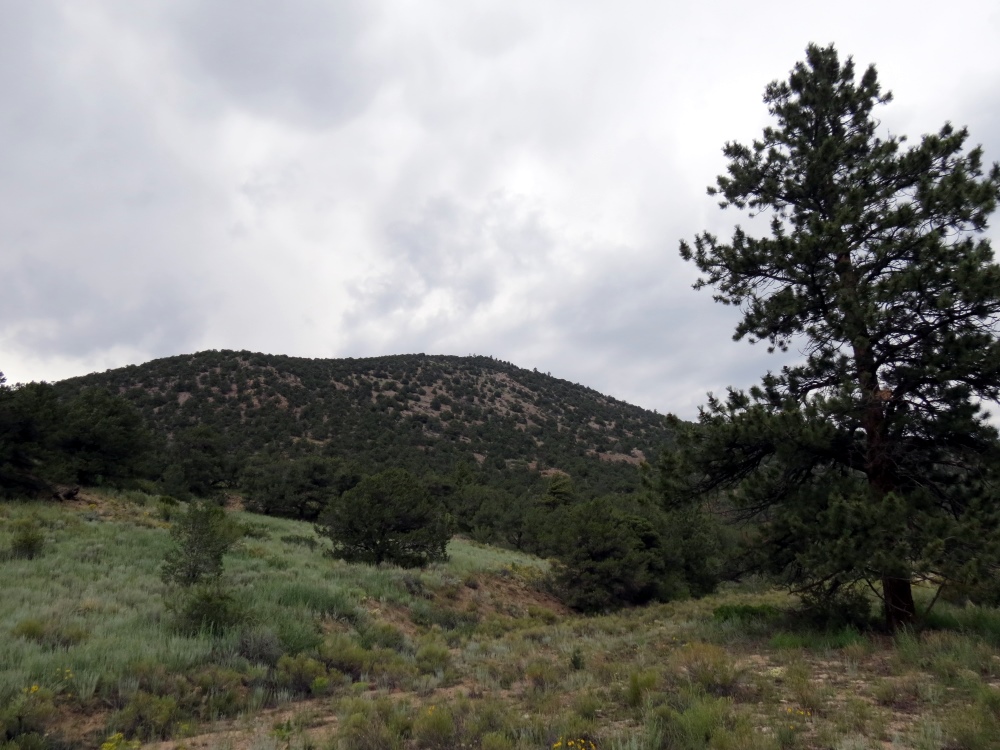
Bald Mountain (W0/SP-115)
Lately, I have been focusing on activating the SOTA (Summits On The Air) peaks near our cabin in the mountains. The basic idea is to identify a SOTA summit, hike to the top and make a few contacts on VHF. On Friday, my spousal unit (Joyce, K0JJW) and I decided to head out to an unnamed peak (W0/SP-099), southeast of Buena Vista, CO. By no coincidence, this summit had not been activated yet, so we’d get the esteemed honor and glory of being the first.
For lesser known summits, a bit of research is required to figure out the route. My first stop is to check the SOTA database for basic information on the summit. I’ll usually have to dig further using ListsOfJohn and SummitPost. ListsOfJohn is an incredible database of topographical information, listing every summit along with information such as elevation, lat/lon, rise, etc. (The Colorado SOTA information was gleaned from ListsOfJohn.) SummitPost will usually have more detailed information on a summit but only for the more popular ones. The SOTA Mapping Project is another excellent resource with very useful interactive topo maps. And, of course, I also dig out the US Forest Service map for the area, which often gives the best view of access roads.
We drove the Jeep to within a mile of the summit and started hiking up. I posted our route information on ListsOfJohn, so take a look there for that information. The summit is unnamed, so it is referred to by its elevation: 10123. I had my Yaesu VX-8GR burping out APRS packets which were plotted on aprs.fi when we reached the summit.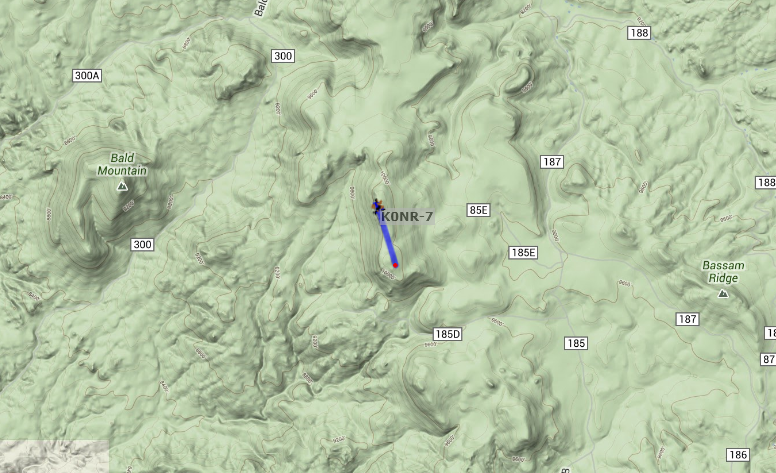
When we reached the summit, I spotted myself on the SOTAWatch web site using the SOTA Goat app on my smartphone. More importantly, the night before the hike, I sent an email to some of the radio amateurs that were likely to be within VHF range. That paid off and I worked Jim KD0MRC, Walt WZ0N and John K3NOQ on 146.52 MHz FM. Jim was hiking to Harvard Lakes above 10,000 feet, so it was special to be able to contact him on the trail. A little later, I caught KV4AL who was mobile near the top of Mount Evans. While only one contact is required to “activate” a summit, four contacts are needed to earn SOTA points, so I was happy to make these four QSOs. My gear was a Yaesu FT-60 driving a 3-element Arrow yagi antenna.
In addition, Joyce and I generally work each other on the SOTA the summit. The SOTA rules say that “QSOs with others within the same Activation Zone do not count towards the QSO total” which means that one of us needs to hike down a bit to get outside of the activation zone (75 feet vertical feet from the summit). We take turns doing this so that each of us activates the summit and makes a contact with the summit.
We took a round about path back to the Jeep and headed for Bald Mountain. At this point, we were both very tired and the thunderstorms were moving in. We decided to at least check out the access to Bald Mountain (Wo/SP-115) even if we didn’t climb it that day. It turns out that there is a 4WD road that goes to the top of the mountain, so we drove to the summit. The road is very rough in a few spots but the Jeep handled it nicely. At the top, we hiked back down a bit to meet the non-motorized ascent requirement for SOTA. We also did our “work each other” technique while on the mountain so that we each had a contact. I was not able to raise anyone on 146.52 MHz but I did catch Carl K5UK on the 146.745 MHz repeater and worked him on simplex. By this time, it was raining with lightning getting closer, so we abandoned the summit and headed back to the cabin.
Thanks to the guys that took the time to contact us on the two summits.
73, Bob K0NR
Bob Witte, KØNR, is a regular contributor to AmateurRadio.com and writes from Colorado, USA. Contact him at [email protected].
Series Six Episode Sixteen – Off Centre Fed Dipole
Series Six Episode Sixteen of the ICQ Amateur / Ham Radio Podcast has been released. The latest news, Listener Mailbag, Leslie Buttersfield, G0CIB reports in from the Essex Amateur Radio Camping event and Martin discusses Off Centre Fed Dipoles.
- Ham Radio Operators prepare to host ham radio 'Olympics'
- UHF and VHF spectrum planning - Call for inputs
- No more KW for VK LicenceMidland Amateur Radio Club Inc. Changes name
- Netherlands Special Event
- The 3rd World ATV QSO Party
- New 6 metre beacon
- One hundred years of licensed Amateur Radio in Queensland, Australia
- The sun's magnetic field is about to flip

Colin Butler, M6BOY, is the host of the ICQ Podcast, a weekly radio show about Amateur Radio. Contact him at [email protected].
DX from East Andover Bike Trail
This afternoon my wife and I took a quick bike ride along the old Northern Rail route in East Andover. I worked Spain, Paraguay, Italy, Poland, the Netherlands, and Luxembourg in 20 minutes of operating.

A mile or so down the trail is an old picnic table under a couple of pine trees… it’s a perfect spot for some quick operating. I heaved a line up about 40 feet and pulled up a wire. I set up the KX3 and opened the notebook. I started on 17 meters.

There were lots of strong stations and I logged three in a row. Then I switched to 20 meters where the WAE contest was going on. I worked three more and packed up to continue the ride. Here’s the log.
10 Aug-13 2053 18.070 EA8/DL7VOA CW 599 599 Spain
10 Aug-13 2058 18.075 ZP6CW CW 579 579 Paraguay
10 Aug-13 2105 18.079 I0JX CW 549 599 Italy
10 Aug-13 2111 14.019 SP9MZH CW 599 599 Poland
10 Aug-13 2114 14.010 PG2AA CW 599 599 Netherlands
10 Aug-13 2115 14.012 LX7I CW 599 599 Luxembourg
It was such a beautiful afternoon with warm sunshine filtering through the trees as we rode along. These glorious summer days are growing precious as August advances toward September. May this weather last…
Jim Cluett, W1PID, is a regular contributor to AmateurRadio.com and writes from New Hampshire, USA. Contact him at [email protected].
 Ham Radio Deluxe |
 W5SWL Electronics |
 Ham Radio Prep |
 KB3IFH QSL Cards  Hip Ham Shirts  HamRadioAuctions HamRadioAuctions Reliance Antennas Reliance Antennas Enigma Shop Enigma Shop |  morseDX  Ni4L Antennas  R&L Electronics R&L Electronics antennas.us antennas.us QRV QRV |
- Matt W1MST, Managing Editor
