 |
 I’m having fun!
 16 August 2013 | by
 I know that band conditions aren’t the best. And I also know that this Sunspot Cycle 24 maximum, as compared to other sunspot cycle maximums has been kinda “meh”. But you know what? I’m having fun despite the band conditions!
You can sit around and pee and moan about “How this sure wasn’t like the cycle we had back in ’57 when you could work the world with a 1/2 Watt and a wet string!”, or you can get on the air and choose to operate. I choose the latter.
Today was another successful lunchtime QRP session. The KX3 and Buddistick successfully netted S564EB, which is a special event station commemorating the European Basketball Championships in Slovenia. A little later, still on 17 Meters, I bagged IS0GQX, Bruno in Sardinia for that country on a new band.
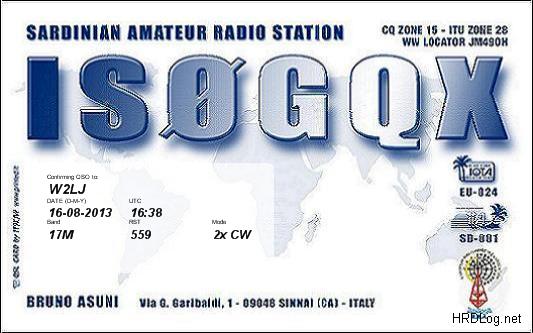
When the sunspot cycle does finally dwindle to weeks and months of little or zero spots, I’m sure that this “not so great” maximum is going to look mighty fine from the rear view mirror. As long as it lasts, I am going to keep at it. 5 Watts to a Buddistick plopped on top of my Jeep – every QSO amazes me!
Now, to another matter. The period for submitting log entries for the Skeeter Hunt is entering the halfway mark. Next Sunday, August 25th at 11:59 PM EDT, is the absolute final deadline for log submissions. So far, I’ve received 55 log summaries. That’s about 1/3 of the people who signed up for Skeeter numbers. In fact, I’ve received two log summaries from Non-Skeeters! So if you participated, please send me a log summary.
For some VERY preliminary results, you can go to – http://www.qsl.net/w2lj/index%20page%205
If you submitted a log and you don’t see your numbers next to your call, then I didn’t get them. Please send them again! Soapbox comments and photos will appear after next Sunday.
So far here are some standings:
Top 5 finishers:
KX9X
N5GW
KX0R
NK9G
N0SS – who is also top multi op finisher so far.
Top multi op, multi transmitter is WQ4RP (so far).
Top mixed (SSB and CW) – W9LR
Top SSB – a tie between KK4NWC and KC5FM.
Hope to see your numbers soon!
72 de Larry W2LJ
QRP – When you care to send the very least!
Larry Makoski, W2LJ, is a regular contributor to AmateurRadio.com and writes from New Jersey, USA. Contact him at [email protected].
Hiram’s Father
There’s an interesting BBC article involving Hiram Stevens Maxim, the father of Hiram Percy Maxim who was the founder of ARRL and a mover and shaker in the nascent world of wireless back in the early 20th century. Both Hiram junior and senior were inventors. Hiram senior invented several items but was known most for the Maxim machine gun, the first portable firearm of its kind. Outside of the radio work we know him for, Hiram Percy Maxim also invented a silencer for firearms and what was essentially a muffler for car exhaust systems.
A contemporary firearms engineer and inventor in Europe named William Cantelo mysteriously disappeared in the 1880s when he went on a road show to sell his new invention to investors and manufacturers, a repeating firearm. Cantelo, his body, or evidence of foul play was never found, however rumors of him being in America were circulated.
To add to the mystery, the resemblance between Hiram Stevens Maxim and William Cantelo is quite striking. The similarities in appearance along with their common talents in firearm inventions led to claims that Maxim was really Cantelo. This has never been proven, and it’s been written that Hiram Stevens Maxim was not interested in engaging the Cantelo family’s questions about his identity.
The Mystery of the Vanishing Gun Inventor

Anthony, K3NG, is a regular contributor to AmateurRadio.com.
Programming the UV-5R to operate with the SO-50 satellite
Julian, G4ILO just asked me a question about how I’d programmed the UV-5R to work through SO-50.
I’ve set up 6 different memories, just as you would for a repeater, except that in this case, the input and output frequencies are on different bands. For each memory, I have left the transmit frequency as 145.850 (it might be a bit out towards the beginning and end of the pass, but hopefully not too far off). On transmit, I have the CTCSS tone set to 67hz. I have seen documentation that SO-50 likes this, and other people saying it doesn’t really matter! I also programmed one memory which is not used for QSOs with a CTCSS tone of 74.4Hz. This can be used to ‘wake’ the satellite up if the radios have switched off. I’ve not done this myself yet.
Receive frequencies are 436.805, 436.800, 436.795, 436.790 and 436.785. I also programmed up 436.780, but have not used this one so far.
On the basis that a picture speaks a thousand words, here’s a picture from the programming software of what the setup looks like.

Tim Kirby, G4VXE, is a regular contributor to AmateurRadio.com and writes from Oxfordshire, England. Contact him at [email protected].
A poor antenna has infinite gain over no antenna – with thanks to K2TK
Yesterday, Chris KQ2RP tweeted K2TK’s line ‘A poor antenna has infinite gain over no antenna’ and it made me smile. It encapsulates so much about my whole approach to radio (and actually more than that).
Some people like everything to be perfect before they embark on a project. Every little last thing needs to be just right. That’s not me. In radio terms, I’d far rather try and lash something together to get it going and try it out than wait for something to be perfect (in my case, it would never happen!).
As a VHF enthusiast, I very often hear, I don’t have an antenna for 50MHz, or whatever. If you’re a 160m enthusiast, you probably hear the same thing! There’s usually some sort of antenna that you can bodge into service, even if it’s a grotty wire dipole twisted together. It’s rare that you can’t get it to radiate SOME sort of signal, and I’m sure I’ve made hundreds of QSOs on antennas where bits of wire were just twisted together.
I often hear people say of the data modes, such as PSK31 – ‘I don’t have a data modes interface’. To get started – just hold the microphone over the speaker of the computer as it transmits the PSK31 tones – and use the microphone on the computer to decode the tones from the radio. It works fine – even if there’s a little juggling to do. You can even use apps on your mobile phone to decode the PSK31!
Having proven that you can make something work simply, you may be enthused to get a more elegant solution going. Or you may not – sometimes, just the simple matter of having made something work is enough and you don’t need to come back to it.
Give it a go (what ever it is!) I bet it will be fun…
Tim Kirby, G4VXE, is a regular contributor to AmateurRadio.com and writes from Oxfordshire, England. Contact him at [email protected].
Amateur Radio Newsline Report 1879 August 16 2013
- Somali pirates who killed 3 hams sentenced to life in prison
- Philippine hams respond to yet another killer cyclone
- Three Balkin national ham radio societies sign EmComm MoU
- Australian hams to loose their temporary high power privileges
- Bringing ham radio to primetime network television
First SO-50 QSOs with the UV-5R
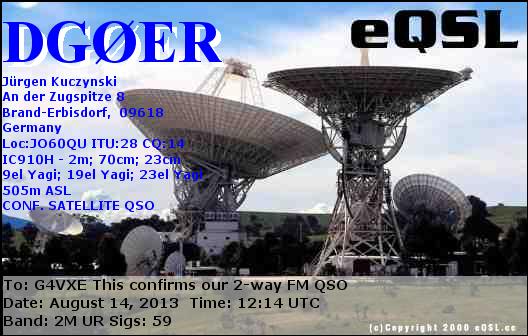
The experiments with the UV-5R and the Nagoya NA-771 were encouraging for listening, but being a bit impatient I thought I could use the Elk yagi to get a bit of gain to make some QSOs.
What was needed was an adapter from the UV-5R (SMA-F) to the Elk – I’d used a PL259 to connect to the FT817. I decided I would use a pigtail lead rather than a straight adapter, to avoid putting undue strain on the antenna connector. Various US outlets listed the leads on Amazon, but wouldn’t ship to the UK. I was pleased to find that Sinotel Ltd had stock in the UK, so I placed an order.
The adapter arrived this morning and I was able to get set up for an SO-50 pass. It was raining hard – so I opened the patio door and waved the antenna outside. Signals were good. If anything, I felt the UV-5R might have been more sensitive at 436.800MHz than the FT817 – just a guess. I was able to have a tentative QSO with Simon G6AHX, an old friend from Cheltenham days. For some reason the satellite dropped out with me, so the contact was a bit stilted, but think we got there in the end.
So the UV-5R and Elk looks like a very viable portable FM SAT setup. At over £100, though, the Elk is a lot more expensive than the UV-5R! It works well, but will probably put off the casual experimenter. Perhaps a homebrew tape measure antenna might be an option?
Tim Kirby, G4VXE, is a regular contributor to AmateurRadio.com and writes from Oxfordshire, England. Contact him at [email protected].
Great propagation last night 20m
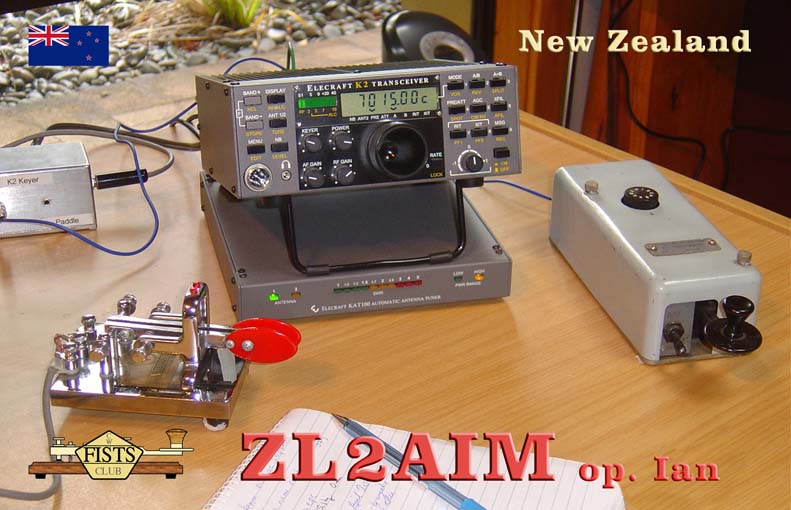
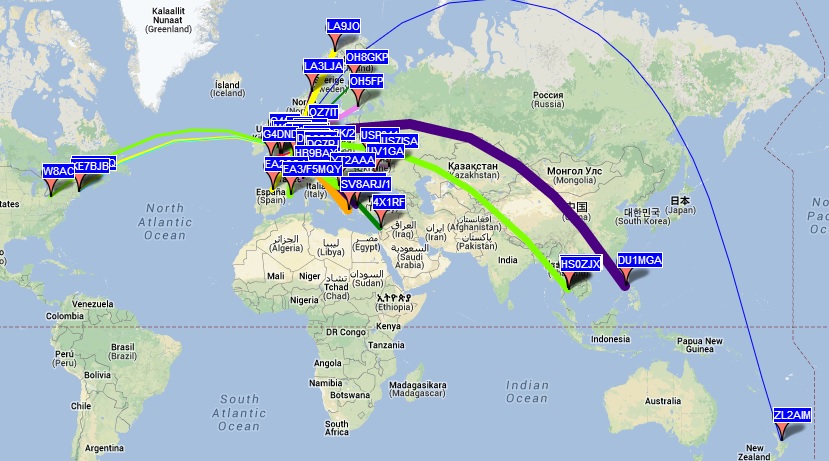
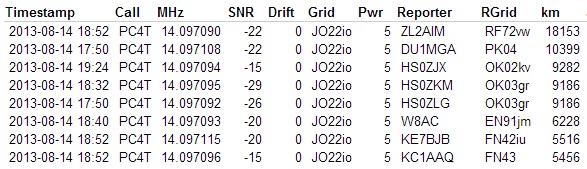
Paul Stam, PC4T, is a regular contributor to AmateurRadio.com and writes from the Netherlands. Contact him at [email protected].
 Ham Radio Deluxe |
 W5SWL Electronics |
 Ham Radio Prep |
 KB3IFH QSL Cards  Hip Ham Shirts  HamRadioAuctions HamRadioAuctions Reliance Antennas Reliance Antennas Enigma Shop Enigma Shop |  morseDX  Ni4L Antennas  R&L Electronics R&L Electronics antennas.us antennas.us QRV QRV |
- Matt W1MST, Managing Editor
