 |
 Apologies
 28 September 2013 | by
 for not posting all week. Whew! What a week! It was so busy this week, that I only managed to get one lunch time QRP session in. The other days, I ended up either working through lunch, or got saddled with “must attend” conference calls during lunch hour.
Last Monday, I had to serve out a jury duty summons. Here in Middlesex County, you are summonsed for “either one trial or one day”. You report to the county courthouse with your juror badge, which is mailed to you ahead of time. The badge has your name and a juror number. People are randomly picked throughout the day in groups of 20 or 30 or more. If your number gets called, you go into a courtroom as part of a “panel” where you may or may not be selected to serve on that jury. If your number isn’t selected for any panels and you’re not picked from a panel to be on a jury that day – you go home. My number wasn’t selected for any panels, so I came home and now I don’t have to concern myself for reporting for jury duty for another three years.
Since the week was so busy, I rewarded myself this morning by attending the OMARC Fall Hamfest, down in Wall Township, NJ. I attended their Spring Hamfest, which was held on Dayton weekend. I liked it enough to go back. Again, it’s a small event, but it’s very nice, nonetheless. Attendance was decent and the people there were really nice, and the weather was absolutely gorgeous, so it made for a pleasant morning. (Great job, folks from OMARC! I’ll be back next year, for sure.) My only purchase was a 25 foot length of RG-8X coax with a male PL259 on each end. This will be used to connect my PAR ENDFEDZ when it is sufficiently high up in a tree.
But, I was given a great idea by two guys who were selling military surplus fiberglass antenna masts. In particular, I really like this:
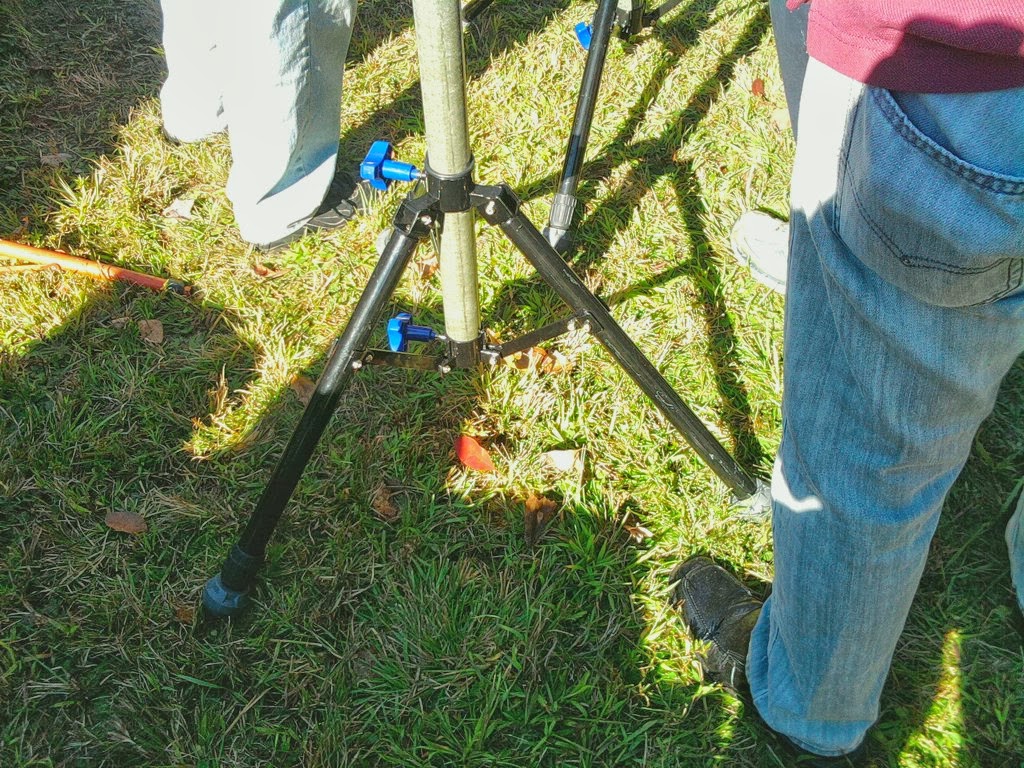
They anchored the bottom section of mast in these tripods. I asked them if they were selling them, as one of these puppies would be just perfect for holding my Jackite pole. They informed me that they don’t sell them, and they acquired theirs at Lowe’s. They are the tripods used to support quartz work lights. Perfect! I have to look into getting one of these. The two gentlemen had 26 feet worth of mast being held by this particular tripod. It was slightly breezy and yet it was anchored like a rock. Looks like a promising concept.
The other thing I noticed at the Hamfest was just a personal observation. Something that to me, is one of the marked differences between CW and Phone operation. A little background – you all know that many times I have stated that I am not a big VHF/UHF talker. I have my handheld mounted in my Jeep because I do enjoy listening to the local repeaters on the way to work and on the way back. If you’re like me and you do mostly listening, you get accustomed to “the regulars” on the different repeaters and you get to know voices and the personalities behind the voices – and after a while, you form a picture in your mind of what you think the face must look like that goes with the voice you are hearing.
I was walking around this morning and amongst the various conversations going on, I heard some familiar voices – some of the guys I listen to each morning and each afternoon. I looked up and, Wow! In each case, the face that I had mentally pictured looked absolutely NOTHING like the actual person!
Then I realized, that this is not something that happens while operating in the CW Mode …… at least for me. Conversing with a guy in code does not cause me to conjure up the face behind the fist. I love looking at QRP Quarterly and the photos from FDIM and the various QRP “Cons” because I can finally see the faces behind the fists. But for some reason, I am never taken aback by seeing a photo of some QRP op, or other CW op and saying to myself, “He just doesn’t look the way I pictured him”. The only thing that I can think of that may be the reason behind this (for me at least) is because voices are distinctive in tonal quality, while CW fists are distinctive in rhythm and pattern.
Crazy, huh? These are some of the thoughts that run through my head while mowing the lawn. Maybe I should see someone about this! 😉
Oh, before I forget …… tomorrow is the inaugural Peanut Power QRP Sprint. Hope to catch you all on the air tomorrow afternoon!
72 de Larry W2LJ
QRP – When you care to send the very least!
Larry Makoski, W2LJ, is a regular contributor to AmateurRadio.com and writes from New Jersey, USA. Contact him at [email protected].
We Discover a New Trail (and work some DX)
Hanz W1JSB and I hiked along the river in Bristol this afternoon. We worked Germany, Lithuania and the Balaeric Islands.

On the Old Back Road there are lots of unused mill buildings along the river. Hanz discovered a trail there last year and we went to explore it today. We walked along a narrow footpath across some rocks and cement dam structures that hung out over the river. Soon we came to a trail that lead south right along the river. It was glorious.

After walking a mile or so we started looking for a place to set up our gear. We found a flat outcropping that just happened to be under a large, over-hanging maple tree. Voila! Hanz threw his water bottle over the branch and hauled up a half wave wire for 20 meters. He used the Par End-Fedz and had a perfect SWR. He operated with his souped up SWL rig.

After tuning around a bit, he made a quick contact with DF5DM, Wilfred in Germany. Happy smiles!
Then I set up my KX3 and clipped onto his antenna. I listened on 15 and 17 meters, but didn’t hear much, so I switched to 20. That was very active and I made two quick contacts. The first one was with Pranas, LY2J in Lithuania. He was a 599 and gave me a 559. Then I worked Keith EA6/G3SZU in the Balaeric Islands. Keith was 589 and he gave me a 459. With that we packed up our gear and headed back toward Bristol.
As we got there, the sun was just setting and I snapped a quick shot of the falls above the river.

Jim Cluett, W1PID, is a regular contributor to AmateurRadio.com and writes from New Hampshire, USA. Contact him at [email protected].
Ever been to Cornbread Road?
 My favorite amateur radio blog comes from Jeff Davis, KE9V. If you have been following Jeff’s blog through the years you’ll have seen a constant evolution of his site and content. In addition to his ponderings of the current state of ham radio, Jeff has produced a number of engaging podcasts. Long Delayed Echoes was Jeff’s podcast series that covered a great deal of the early history of amateur radio. It featured selections from Clinton B. DeSoto’s 200 Meters & Down as well as other significant historical sources of ham history. In addition to his written contributions to QST (see the May 2005 issue on page 56) Jeff has also shared his talent for fiction with us. He has several other ham radio related stories that he posts now and again on his blog (… it is worth checking his blog frequently because once in a blue moon he will put links up to his stories… my favorites are QRP Christmas and Tragedy on the Trail).
Besides his blog, Jeff prodigiously uses social media and you would likely enjoy his ham radio musing that can be read via Twitter and Google +.
Jeff combined his podcast talents along with his fiction writing skills with the production of Cornbread Road. All 13 episodes of the serial are currently available and on the 30th of September, Jeff has promised us a final installment. I’m looking forward to that!
Scott Hedberg, NØZB, is a regular contributor to AmateurRadio.com and writes from Kansas, USA. Contact him at [email protected].
Ever been to Cornbread Road?
My favorite amateur radio blog comes from Jeff Davis, KE9V. If you have been following Jeff’s blog through the years you’ll have seen a constant evolution of his site and content. In addition to his ponderings of the current state of ham radio, Jeff has produced a number of engaging podcasts. Long Delayed Echoes was Jeff’s podcast series that covered a great deal of the early history of amateur radio. It featured selections from Clinton B. DeSoto’s 200 Meters & Down as well as other significant historical sources of ham history. In addition to his written contributions to QST (see the May 2005 issue on page 56) Jeff has also shared his talent for fiction with us. He has several other ham radio related stories that he posts now and again on his blog (… it is worth checking his blog frequently because once in a blue moon he will put links up to his stories… my favorites are QRP Christmas and Tragedy on the Trail).
Besides his blog, Jeff prodigiously uses social media and you would likely enjoy his ham radio musing that can be read via Twitter and Google +.
Jeff combined his podcast talents along with his fiction writing skills with the production of Cornbread Road. All 13 episodes of the serial are currently available and on the 30th of September, Jeff has promised us a final installment. I’m looking forward to that!
Scott Hedberg, NØZB, is a regular contributor to AmateurRadio.com and writes from Kansas, USA. Contact him at [email protected].
A New French Station in the Log Book
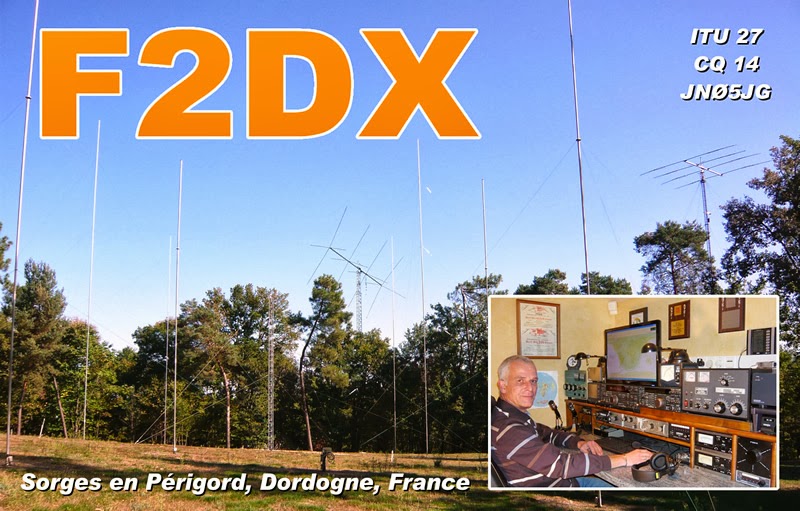
This latest French station (F2DX) has quite an aluminum farm and space to spare. (yes, I’m envious)
John Smithson, Jr., N8ZYA, is a regular contributor to AmateurRadio.com and writes from West Virginia, USA. Contact him at [email protected].
APRS On Your Phone
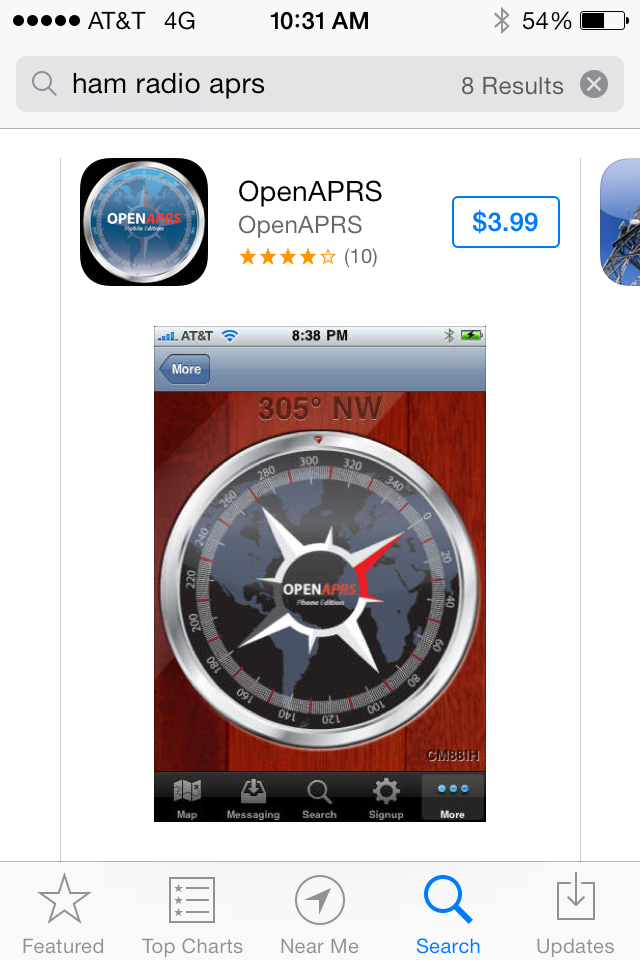
Periodically, I peruse the app store on my iPhone to see what new cool ham radio apps have been developed. I will admit it has been a while since I've done that so this is probably old news to many of you. As I scrolled through the apps I came across an APRS application for the iPhone. APRS (Automatic Packet Reporting System), developed by Bob Bruninga WB4APR, combines packet radio technology with GPS technology to allow you to transmit your coordinates to a digi-peater that then posts your position on the internet. This allows others to know your location for any number of reasons, i.e., to follow progress up a mountain or simply for others to know that you are safe and to follow your progress to your destination. However, previously, to enjoy this functionality required a special radio with the GPS built in or a modification to add GPS functionality to your radio. However, with the apps now available you can accomplish the same thing with your iPhone. Of course you have to have cell service for the system to work and it can use up battery power, but the functionality can now be used without a radio.
So if you are a SOTA activator and have avoided the expense of getting a VHF APRS set-up, you can now accomplish the same thing with your phone. You can avoid battery degradation by only turning your phone on at intervals and allow the system to register your position, then turning it off again.
Very cool.
Mike Crownover, AD5A, is a regular contributor to AmateurRadio.com and writes from Texas, USA. Contact him at [email protected].
Amateur Radio Newsline Report 1885 September 27 2013
- Hams in Australia may keep access to part of the 2300 MHz band
- Amateur radio operators in Portugal get new spectrum
- Congress asks why radios failed during Washington Navy Yard shooting
- The FCC says no to encrypted ham radio communications
- Researchers admit that Solar Cycle 24 is quite puzzling
 Ham Radio Deluxe |
 W5SWL Electronics |
 Ham Radio Prep |
 KB3IFH QSL Cards  Hip Ham Shirts  HamRadioAuctions HamRadioAuctions Reliance Antennas Reliance Antennas Enigma Shop Enigma Shop |  morseDX  Ni4L Antennas  R&L Electronics R&L Electronics antennas.us antennas.us QRV QRV |
- Matt W1MST, Managing Editor
