 |
 Amateur Radio Newsline Report 1888 October 18 2013
 17 October 2013 | by
 - Ham radio responds as a major cyclone hits India
- Radio amateurs respond to an earthquake in the Philippines
- The FCC returns to work following end of government shutdown
- IARU Monitoring Service says that Russia iintruding on 15 meters
- AMSAT to celebrate 30 years of manned ham radio in space
- A bit of early DX history from down-under
LHS Episode #114: Steamed Orca Tails
 They’re coming fast and furious now! After a long period of not having the time or energy to edit episodes, we’re finally getting around to pushing out the backlog. In this action-packed installment, your intrepid hosts tackle gaming on Linux using the Steam platform, accessible computing, mention a site listing more than 50 places you can download Free Software and more. We also revisit the products of Sierra Radio Systems and Pignology, and wish Fedora a happy birthday. All THIS WEEK, on Linux in the Ham Shack!
73 de The LHS Guys
Russ Woodman, K5TUX, co-hosts the Linux in the Ham Shack podcast which is available for download in both MP3 and OGG audio format. Contact him at [email protected].
A nice QRP surprise this morning
We’re getting ready to hit the road for vacation. It’s been a whole year since KD2CHE and I tied the knot on a cliff overlooking Lake Tahoe.

Xiegu X1M
We’re not going to be heading back there yet, but wandering through New York’s North Country a bit. I’m expecting to get a little portable QRP operation in as we poke around up there. In anticipation of the trip, I picked up a spare power supply from my brother a few weeks ago to use with the Xiegu X1M, and any other 12V items I have or may acquire when I’m not near my main setup. I decided to assemble the “motel room” version of my QRP setup here to see how it works. I have the Xiegu, my Emtech ZM2 tuner, mic, the spare PS, and a small amplified speaker sitting here on the couch. A string of 2 alligator leads is running from the ZM2 to the feed-thru from my random wire up near the window. Everything powered up, and tuned up, so I decided to answer a couple of calls on 15M.
I made USB contacts with UT7UJ in Kiev, and S51ZZ in Slovenia from my test station on the couch here in Long Island. Not bad for 5 Watts. This little rig is full of surprises. I also just found out from Ed at Import Communications through a post to the Xiegu X1M Yahoo group that he is going to be offering upgrade kits for the earlier X1M to upgrade the front panel and display to the newer version, as well as a strong possibility of a firmware upgrade that will cure many of this rig’s little issues. The firmware upgrade has already been released for the newer model.
Now, time to pack it back up, and hit the road. 73s de Neil, W2NDG
Neil Goldstein, W2NDG, is a regular contributor to AmateurRadio.com and writes from New York, USA. Contact him at [email protected].
LHS Episode #113: Eye to the QScope
 Yes, that's right: It's another brand-new episode of Linux in the Ham Shack! We know it's been a while since your RSS feed has been filled with the joy of our show, but we're back and aiming to stay on track (now that Richard is safely tucked into his cardboard box again). In this action-packed installment, your hosts discuss promoting Linux in the classroom, a wedding interrupted by a radio transmission from above, WA0EIR's updated suite of Open Source ham radio tools, and a novel analytics tool for hams called QScope. See you all down the dial very soon!
73 de The LHS Guys
Russ Woodman, K5TUX, co-hosts the Linux in the Ham Shack podcast which is available for download in both MP3 and OGG audio format. Contact him at [email protected].
Digital Voice at Pacificon
Last weekend, I had the privilege of attending the Pacificon amateur radio convention in Santa Clara, something I have been trying to do for several years now. It is a great event, with good technical programs and a super venue.
The most interesting presentation I saw was the one on digital voice (DV) technology by Bruce Perens K6BP. The presentation was mostly about the digital voice known as FreeDV, an open source approach to DV that uses the Codec 2 voice codec for digitally processing/compressing speech.
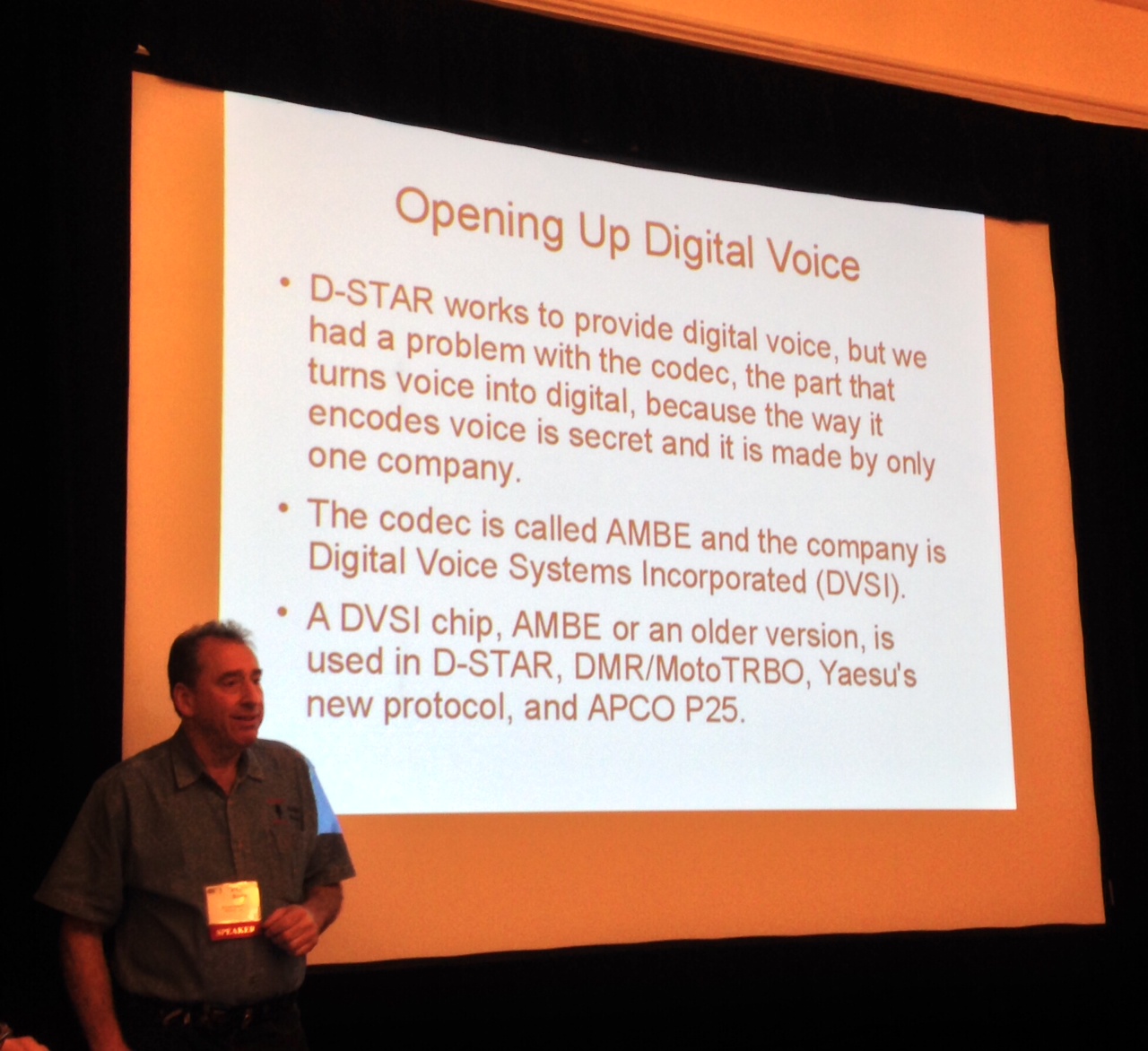
Bruce Perens K6BP talking about FreeDV
I won’t cover all of the technical details here but you can follow the links above to go deeper on the topic. The initial FreeDV efforts are focused on the HF bands, using the sound card plus computer approach to implementing DV. This is a good approach since it is a relatively easy way to adopt this technology. (Compare this to VHF/UHF where you need to solve the repeater infrastructure problem to make progress.) FreeDV operates with a bandwidth of 1.25 kHz, narrower that the standard 3 kHz or so SSB signal. FreeDV also has the benefit of degrading gracefully as the signal-to-noise ratio is decreased, with less of a digital dropoff that we see with D-STAR and other DV technologies.
Like many hams, Bruce pointed out the concerns and limitations of the proprietary AMBE chip used in D-STAR, DMR and now the new Yaesu DV system. I totally get this point and support the idea of a an open source codec. On the other hand, this work is coming more than a decade later than the creation of D-STAR. I like to refer to this phenomenon as ”our ideas are better than their products.”
Bruce introduced Chris Testa KB2BMH to talk about the “HT of the Future”. This is a handheld transceiver implemented using Software Defined Radio (SDR) and inspirations from the world of smartphones. As Bruce said, “Why isn’t your HT as smart as your smart phone?” This is similar to the Android HT idea that I blogged about a while back. See Chris’s blog and this HamRadioNow video for more information.
Another presentation that I attended was about D-STAR with several speakers, including Robin AA4RC. The innovation continues to happen in the D-STAR world with a strong theme of using Raspberry Pi computers to create D-STAR hotspots and repeaters. Robin described the “DV Pi” being developed…a DVAP-like daughter board that plugs into a Raspberry Pi. Jim Moen K6JM talked about the many ways you can implement a D-STAR Hotspot. For more info on that see his D-STAR Hotspot page.
There’s much innovation happening in the area of Digital Voice. It got me thinking about it again so I dug out my ICOM D-STAR HT and put my DVAP back on the air.
73, Bob K0NR
Bob Witte, KØNR, is a regular contributor to AmateurRadio.com and writes from Colorado, USA. Contact him at [email protected].
RadioKitGuide.com ch-ch-ch-changes
Here are the changes at RadioKitGuide.com so far:
- -Coming Soon- TJ4A MK II 4 Band SSB Transceiver. No other info yet
- –New- TJ2B MK II SSB Handheld Transceiver. YouKits combined the A and B models into one with a good choice of bands. So far only available assembled.
- –New- EK1A and EK1B 3 band QRP CW kits. Power output 4-5 Watts. Built in Keyer. SMD parts all finished. Assemble in about 2 hours. A model: 40, 30, and 20 Meters. B model: 20, 17 and 15 Meters. $179 + S&H
-Ten-Tec
- The 1254 Superhet SW receiver has been discontinued.
-JUMA
- Juha tells me that they are in the process of transferring logistics to a new company. They hope to have kits available again by the end of the year
-Small Wonder Labs
- As many of you have heard, Dave Benson has retired from kit production. The famous RockMite transceiver is supposed to be moving to QRPme.com. You can also check out the Super RockMite from AliExpress further down this listing.
-Wilderness Radio
- Bob from Wilderness Radio informed me that the SST and Sierra have been officially discontinued due to a parts availability issue.
-Dan’s Small Parts and Kits
- Dan doesn’t seem to have any kits listed on the website anymore, but is selling some of them on eBay. See the listing at radiokitguide.com for more info
-QRPme
- As stated above, QRP.me is rumored to be the new source for RockMite kits. Stay tuned.
-Walford Electronics
- -NEW- The Lydford SSB Phone Transceiver.
- -NEW- The FiveFET Simple Regen TRF Receiver.
-Kanga Products UK
- -NEW- Open QRP Transceiver. Similar to the Ten-Tec 506 Rebel. Based on the OPen QRP design from Steve K1EL.
-Kits By EA3GCY
- -NEW- EGV-40 CW QRP 40M Transceiver. 40M CW Band.
-BLEKOK QRP by YD1JJJ
- -NEW- Micro 40S QRP 30 Watt SSB Kit.
-The Ham QRP DIY Kit Shack on AliExpress.
- -NEW-Pixie Kit (Improved).
- -NEW-Frog QRP Kit.
- -NEW-Super RockMite Kit.
See RadioKitGuide.com for all details on these, and many more!
Please leave any additions you may have in the comments.
Neil Goldstein, W2NDG, is a regular contributor to AmateurRadio.com and writes from New York, USA. Contact him at [email protected].
Smartphone SSTV
Yesterday at work, whilst I was waiting for a bit of code to finish running, I was idly looking at some apps on my phone. In particular, I noticed that the icon for my SSTV app had changed.
It’s the SSTV app for iPhone/iPad by Black Cat Systems. I got it a while ago thinking about using it to receive SSTV on the 28MHz rig in the car but hadn’t really got around to doing much with it.
Looking at the app yesterday I noticed that there was now the facility to take a photo with the iPhone and send it via SSTV. That got me thinking. You know how I’m not one for complicated interfaces! Well, I wondered if there would be any mileage in using a handheld and the iPhone together and just using audio coupling.
It struck me it could be fun, if you were out portable on a hilltop, to send an SSTV picture from the phone, through your handheld, just by holding the speaker of your phone in proximity to the microphone of the handheld.
Though I didn’t try it from a hilltop, I did try sending a picture from the iPhone through the Icom E92 (on FM) to the iPad with the Baofeng UV-5R on receive close by. The picture isn’t excellent, but it’s a reasonable approximation of what was sent!
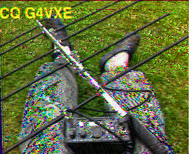
If you’re an Android user, there’s DroidSSTV to do the same as SSTV!
See you on SSTV from a hilltop?
Tim Kirby, G4VXE, is a regular contributor to AmateurRadio.com and writes from Oxfordshire, England. Contact him at [email protected].
 Ham Radio Deluxe |
 W5SWL Electronics |
 Ham Radio Prep |
 KB3IFH QSL Cards  Hip Ham Shirts  HamRadioAuctions HamRadioAuctions Reliance Antennas Reliance Antennas Enigma Shop Enigma Shop |  morseDX  Ni4L Antennas  R&L Electronics R&L Electronics antennas.us antennas.us QRV QRV |
- Matt W1MST, Managing Editor
