 |
 My Second Contact to Alaska
 16 November 2013 | by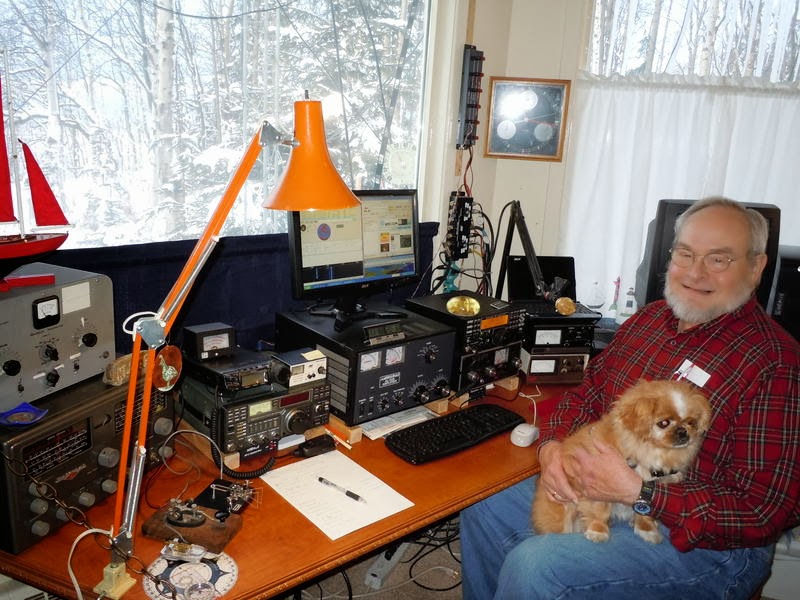
It’s unusual for me to work a station in Alaska, so I’ve been very happy to make a contact with KL7QZ in Anchorage, on the 12 meter band and at a distance of 3,242 miles @ 3 watts, makes this contact even better…..
I’ve only worked a station in Alaska twice in all the years I’ve been on the radio and I had a great copy (599) on him. He was hearing me at the 339 level but we completed a QSO.
In Alaska they were experiencing a real “heat wave” with the temp being -3 (C) and going down to -10 (C) tonight.
Propagation was terrible according to all the usual forecasts, but I still worked KW7D in New Mexico and I also found HC2IMP in Ecuador (again) on the 10 meter band.
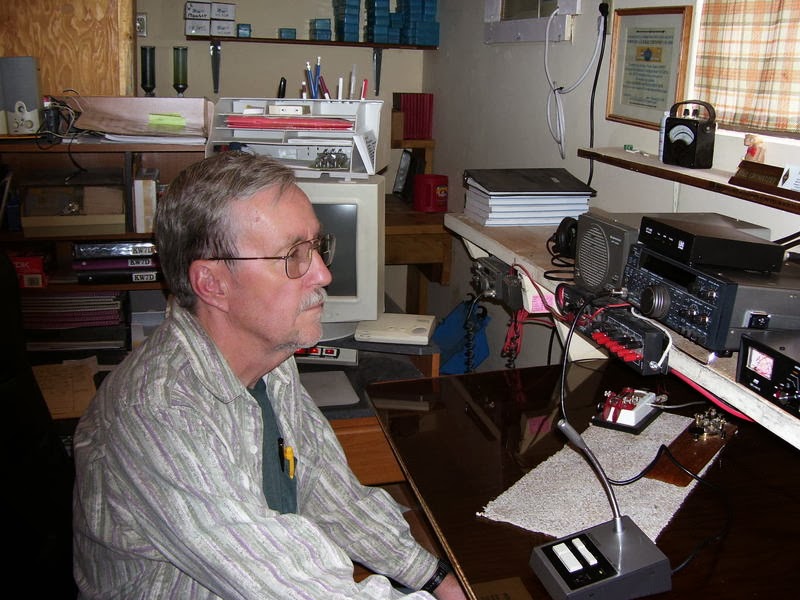

I was pleasantly surprised to hear a “nice crisp chirp” from him this time. If you remember a post from our WV Chapter outing from Hurricane WV, on the first of November, I was hearing a real “growler” at that time.
I’ve not worked a lot of long distance stations the last few months because I’m focusing my energy on the new club; so it was enjoyable to work these unusual stations although they’re not very distant.
I’ve actually enjoyed the QRP contacts even more than in the past.
They’re much more personal than the “handshakes” for DX contacts. Yesterday, after completing a QSO with a QRP station on 30 meters, I was contacted by WV4TN in Knoxville TN. Wayne had many friends living here in Charleston, so knew exactly where I lived, and asked me to say hello to Dave Ellis (WA8WV).
Dave is the guy with a “very nice beam” who offered it’s use to me for some of my QRP contacts when we met at the Parkersburg Hamfest. I was happy to talk to Dave by phone and say hello to him from his friend in Knoxville.
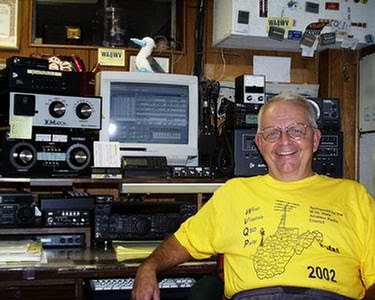
I’m working a lot more stations this year, since 2010, when I first started keeping track of all my contacts.
To date, I have 2,349 QSO’s in the log book. My numbers are also up from “last year” from 472 in the year 2012— to 656 in this year of 2013. (with still 2 months to go before the end of the year).
Not surprisingly, I’ve worked 413 NAQCC members now out of a total of 462 QRP QSO’s.
I might not be working as many DX stations as previously, but with 667 in the log book and 90 countries, I’m OK with those numbers. I’m liking those nice QRP QSO’s very much and they’re equal to all the handshakes I’ve made the last few years.
John Smithson, Jr., N8ZYA, is a regular contributor to AmateurRadio.com and writes from West Virginia, USA. Contact him at [email protected].
Out of it
This afternoon I ventured on the air for the first time in several weeks. Indeed it is the first time I’ve felt like switching on the radio since my brain tumour removal operation. It was not entirely a good experience.
I thought I’d try digimodes since I would only need to click a few buttons to complete a QSO. But I found the whole experience a bit bewildering. I made two contacts on 20m thinking I was on 10m! And a couple of times I left the other guy waiting for me to send something.
About the only way I can describe how I felt is “out of it” – the phrase sometimes used to describe a person who is so drunk that they don’t know what they are doing. Only unfortunately in this case the demon drink was not to blame.
Somehow I think it is going to take some time for things to get back to normal.
Julian Moss, G4ILO, is a regular contributor to AmateurRadio.com and writes from Cumbria, England. Contact him at [email protected].
Verticals … radials … what’s the right thing to do?
Even though I have a Butternut vertical in the antenna arsenal, this .pdf file from SteppIR, is one of THE best articles about radials that I have ever read. It’s in “plain ol’ English” and doesn’t require you to have a Doctorate in RF Theory to understand it. Just thought I would share!
http://www.steppir.com/wp-content/uploads/2013/07/Radial-Systems-for-Verticals-Rev2.1.pdf
I currently have about 50 radials under my Butternut. Looks like I could stand to add some more next Summer – although I’m currently close to the point of “no extra benefit”. Looks like with about 25 more, I can get a bit closer to that 90% efficient point. And “next time” (if there ever is one), I will seriously consider NOT ground mounting my next vertical.
72 de Larry W2LJ
QRP – When you care to send the very least!
Larry Makoski, W2LJ, is a regular contributor to AmateurRadio.com and writes from New Jersey, USA. Contact him at [email protected].
A SOTABeams desk stand – so much better than propping the rig up!
There’s never quite enough room in the shack, no matter how much space you are lucky to have! So it is that whatever VHF/UHF rig is in use here, tends to perch on top of the FT1000MP. To prevent scratching, a piece of junk mail had been placed between the two rigs!
However, SOTABeams have a very nice range of desk stands for various rigs, including Baofeng UV-3R, Elecraft and Yaesu FT-817. They’re very reasonably priced and rather attractively, have your callsign on the front. Handy for when you forget it!
The rstand is made of good quality plastic and was nicely finished, no rough edges. There’s some edging strip provided to use as feet and a backstop which clips into the back of the stand, to prevent the rig falling off the back.
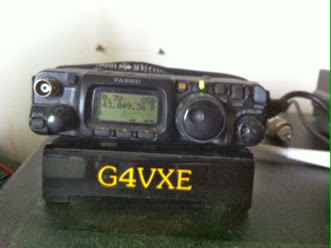
The rig is presented at a good angle and distinctly better than propping it up on a
– pen
– case of jewellers screwdrivers
– book
Another benefit I found was that although the stand is designed for the FT817, I found that the FT8900 fitted nicely too – a little overhang, but the rig is solidly placed on it and won’t go anywhere at all.
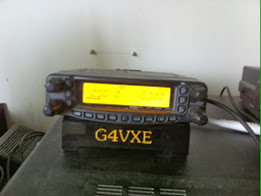
Excellent!
It’s good to read of SOTABeams success. Started by Richard G3CWI with products aimed at lightweight portable operation (SOTA operation, of course!), they have grown and grown and have recently moved to larger premises
Tim Kirby, G4VXE, is a regular contributor to AmateurRadio.com and writes from Oxfordshire, England. Contact him at [email protected].
St. Vincent on 3 Bands QRP
This afternoon I took a quick hike up Shute Hill. I had a great two-way QRP QSO with N0UR and then I worked J88HL on three bands.

I walked down the range road and turned into the woods. Farther on I came to Will Ellis’s field. I sat down near the east edge and turned on the KX3. I heard Jim N0UR in MN calling CQ on 14.060. He was booming in, and he gave me a good report too. “UR portable ANT doing FB,” he sent. I had the ten meter wire over a branch with the earchi.org 9:1 unun. He was running a K2 at 5 watts to a 3-element beam. His signal was over S9. What fun to have a 2-way QRP QSO.

After that I went up to 15 meters. A group of Polish operators was running a DXpedition from St. Vincent. J88HL was working split with a pretty large pileup. But it was orderly and his signal was strong. I had no trouble making the QSO.
When I switched to 10 meters, there was the St. Vincent station again working split. So I worked J88HL on 10 meters and moved to 17 meters. I was surprised to hear them again on another band. Once again I made the QSO. So I worked them on 3 bands in the course of 15 minutes.
With that I packed up and headed back down the hill. What a beautiful afternoon for a quick outing… sunny with temps at nearly 50F.
Jim Cluett, W1PID, is a regular contributor to AmateurRadio.com and writes from New Hampshire, USA. Contact him at [email protected].
New QSL Card for 2014

As part of my 2014 challenge to have at least one QSO each day (as I successfully accomplished in 2012), I decided my old QSL card (which I’ve used for five years) needed a facelift. Without hesitation I contacted Randy Dorman, (KB3IFH QSL Cards). Randy does excellent work printing QSL cards. His services are quick and reasonably priced. If you are looking to have cards printed, contact Randy. You’ll be pleased.
I wanted my new card to represent Colorful Colorado as I’m always proud to represent the centennial state when I take to the airwaves. However, I do truly lack in creativity and imagination. This is really where Randy made it easy for me. He helped me find this postage stamp image, he cleaned it up a bit and I’m very pleased. A Colorado postage stamp QSL card. I love it! If you want one of these, catch me on the bands starting in 2014.
As I have stated before, I really enjoy collecting QSL cards. So much so that it’s really made me re-evaluate my QSL policies. For the past several years I’ve almost always sent along an SASE (self-addressed stamped envelope) with my QSL card. But in the early days I didn’t send that many cards and when I was first licensed, first class postage was a whopping 5 cents cheaper.
Now don’t misunderstand me, my decision is not based on the rising cost of postage. If it were, I would just stop QSL’ing all together and only use the online services. Which by the way, I do use both eQSL and LoTW…but the excitement factor just isn’t the same as when I walk to the mailbox and find an envelop with a QSL card from a nearby or far away location.
Really what has driven my decision is what appears to be a duplication of effort between most of the hams I work on the bands. What do I mean by this?
First, if I’m going to send a QSL card…I typically do this within a day or two (at the most) of the QSO. I have discovered, the majority of the stations I work also do the same. Many times our QSL cards must pass each other in the USPS sorting process. If I’ve sent along an SASE and the other station has done the same thing…then we’ve both received an envelope with a stamp which may or may not be useable again. But sadly, I’ve found many stations do not send SASE.
Yes, I understand why some stations may request an SASE and I understand why most DX stations will want a greenstamp or two to help cover postage. But for most of the average US based stations and for casual QSO QSL’ing I will gladly cover the return postage should you want to exchange cards with me.
I’m not going to change the minds of everyone, and I’m not going to try. If you absolutely require an SASE and I want your card bad enough, then I’ll comply. However, I believe my new process will certainly equal things out a little bit. The paper QSL card process is part of the old customs of amateur radio that I truly hope will never go away.
Now I must take a short walk to the mailbox and drop off a few outgoing QSL cards and fingers crossed, I have some incoming cards waiting. I truly hope to work you either in the remaining days of 2013 or certainly in 2014. YES, I QSL 100% and absolutely no SASE is required.
Until next time…
73 de KD0BIK (Jerry)
Jerry Taylor, KD0BIK, is a regular contributor to AmateurRadio.com and writes from Colorado, USA. He is the host of the Practical Amateur Radio Podcast. Contact him at [email protected].
Hey, My Yaesu Beeps When I Transmit!
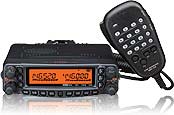 I own a variety of Yaesu ham radio transceivers and like them a lot. Except for that one little annoying feature that the FM rigs have: WIRES.
About once every two weeks, one of the local radio hams gets on the repeater with a DTMF beep at the start of every transmission. We’ve come to expect it now, so the first question to the ham is “are you by chance using a Yaesu radio?” They always say “yes” and then we talk them through the process of turning off the WIRES “feature.”
The WIRES function sends a DTMF signal at the start of every transmission for use with Yaesu’s version of internet repeater linking (which is not used much in the US). The problem is that it is very easy to bump the wrong button on your radio and accidently get it into this mode. This means that this is mostly a nuisance feature in the US.
I recently came across a way to disable this feature on your Yaesu radio so that it won’t sent the DTMF tone even if you activate it by accident. Basically, you set the WIRES tone to be empty, so nothing is transmitted if you accidentally turn on WIRES. I did not come up with this clever hack…in fact, I am not sure who put this together. (If you do, let me know and I’ll give them credit.) Take a look at this pdf file and follow the instructions to de-WIRES your radio: Turn Off Wires
73, Bob K0NR
Bob Witte, KØNR, is a regular contributor to AmateurRadio.com and writes from Colorado, USA. Contact him at [email protected].
 Ham Radio Deluxe |
 W5SWL Electronics |
 Ham Radio Prep |
 KB3IFH QSL Cards  Hip Ham Shirts  HamRadioAuctions HamRadioAuctions Reliance Antennas Reliance Antennas Enigma Shop Enigma Shop |  morseDX  Ni4L Antennas  R&L Electronics R&L Electronics antennas.us antennas.us QRV QRV |
- Matt W1MST, Managing Editor
