 |
 Day Four
 14 January 2014 | by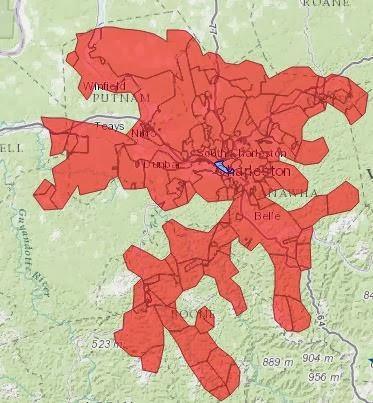
After four days without potable water in the neighborhood, it was worth every penny we spent to get a shower and do the laundry. Unfortunately, we had to drive eighty miles (round trip) to achieve the goal of cleanliness and civility. We spent the night in the closest town we could find with a hotel and a nearby laundry.
Today is the fourth day without water for nearly 300,000 people in the immediate area of Charleston.

Our dog traveled with us on this trip. To him it was like going to an amusement park but to us it was something quite different. When we arrived in the town of Barboursville, the 24 hour laundromat was “overwhelmed” with people from Charleston, who were doing like us, and making the best of a bad situation.
In addition to my dual band HT, I took my “tablet” with me which I found very useful. I keep an app (IARL) on it which shows all the ham repeaters which are centered on my “current” location. The map features were very useful too. I also carry a small SWL (Tecsun PL-380) radio with me which is really nice for hearing foreign broadcast and local AM and FM broadcasts.
We drove back early this morning, spent most of the day with friends, and this evening, happily, we got the “OK” to start flushing out the water lines in our home.
This amounted to depleting all the hot water from our water tank for 15 minutes, and running the cold water for an additional 5 minutes. Then we ran both the washing machine and the dishwasher for a complete cycle with clean water.
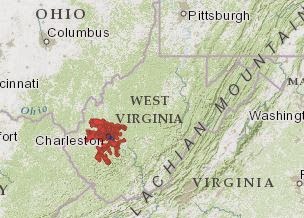
I can’t express how happy I am to again use something (H2O) most people in the world take so much for granted. Contamination levels are now tolerable in the small area where I live. We live the closest to the immediate spill. Three hospitals, the largest shopping mall, and the state capitol are in this area.
As you can see in the above picture, there’s still a large area which needs to be flushed with clean water. Only then can the process of household purging begin. For us this trial has finally ended; but it will take even longer for the entire area to finally be purged of this coal cleaning compound.
I’ve always been a strong advocate for clean water, clean air, and a clean environment in this state. I’ve known for years the dangers of depleting our natural resources. This state, and I might add, this entire tri-state area, has an ugly history of human and environmental catastrophes. I can’t imagine the amount of water than has been wasted in this event.
Fortunately this latest catastrophe only caused an inconvenience for most (not all) of these 300,000 people. We’re on the way to recovery now, but not entirely there yet!
John Smithson, Jr., N8ZYA, is a regular contributor to AmateurRadio.com and writes from West Virginia, USA. Contact him at [email protected].
More WSPR with 20mW
I’ve been WSPRing on 30m today, still with a power of 0.2W. I think WSPR is more interesting when you use low power: it’s always interesting to see how far you can get.
20mW is not the lowest power you can use, though, it’s just the lowest power the K3 will comfortably produce. (You can set the output power to 0.0W but I’m not sure how accurately the rig will maintain the power at such a low level – something to check.
Today my 0,02W into the MFJ magnetic loop in my attic was received by 30 different stations. Here’s the list:
| Timestamp | Call | MHz | SNR | Drift | Grid | Pwr | Reporter | RGrid | km | az |
|---|---|---|---|---|---|---|---|---|---|---|
| 2014-01-13 11:52 | G4ILO | 10.140243 | -11 | 0 | IO84hp | 0.02 | ON7KO | JO21ce | 637 | 124 |
| 2014-01-13 11:52 | G4ILO | 10.140209 | -23 | 0 | IO84hp | 0.02 | DL8HAF/P | JO53dm | 899 | 92 |
| 2014-01-13 12:32 | G4ILO | 10.140206 | -26 | 0 | IO84hp | 0.02 | DK6UG | JN49cm | 973 | 121 |
| 2014-01-13 12:54 | G4ILO | 10.140217 | -22 | 0 | IO84hp | 0.02 | DC5EO | JO31ed | 760 | 117 |
| 2014-01-13 12:54 | G4ILO | 10.140210 | -18 | 0 | IO84hp | 0.02 | G8CRB | JO02bf | 355 | 138 |
| 2014-01-13 13:18 | G4ILO | 10.140195 | -19 | 1 | IO84hp | 0.02 | G0GSJ | IO84jc | 61 | 170 |
| 2014-01-13 14:20 | G4ILO | 10.140199 | -19 | 0 | IO84hp | 0.02 | G4ILR | JO02pp | 379 | 124 |
| 2014-01-13 14:20 | G4ILO | 10.140224 | -29 | 0 | IO84hp | 0.02 | M0BLP | JO02ad | 359 | 139 |
| 2014-01-13 14:30 | G4ILO | 10.140210 | -20 | 0 | IO84hp | 0.02 | OH8GKP | KP24rt | 1945 | 43 |
| 2014-01-13 14:30 | G4ILO | 10.140203 | -19 | 0 | IO84hp | 0.02 | GM4SFW | IO77sn | 331 | 349 |
| 2014-01-13 14:30 | G4ILO | 10.140199 | -11 | 2 | IO84hp | 0.02 | OH3HTI | KP21ag | 1760 | 54 |
| 2014-01-13 14:30 | G4ILO | 10.140182 | -13 | 0 | IO84hp | 0.02 | LA5GOA | JO29oi | 737 | 41 |
| 2014-01-13 14:38 | G4ILO | 10.140197 | -23 | 0 | IO84hp | 0.02 | OZ7IT | JO65df | 1001 | 80 |
| 2014-01-13 14:38 | G4ILO | 10.140194 | -13 | 0 | IO84hp | 0.02 | SA6BSS | JO68 | 1084 | 60 |
| 2014-01-13 14:48 | G4ILO | 10.140189 | -21 | 0 | IO84hp | 0.02 | SM6WZI | JO67mp | 1067 | 65 |
| 2014-01-13 14:56 | G4ILO | 10.140208 | -21 | 0 | IO84hp | 0.02 | DC8SE | JN48xi | 1155 | 122 |
| 2014-01-13 14:56 | G4ILO | 10.140180 | -7 | 0 | IO84hp | 0.02 | ON7KB | JO21ei | 634 | 122 |
| 2014-01-13 15:04 | G4ILO | 10.140204 | -11 | 0 | IO84hp | 0.02 | DK4TJ | JO31fc | 768 | 117 |
| 2014-01-13 15:04 | G4ILO | 10.140236 | -25 | 0 | IO84hp | 0.02 | PA1GSJ | JO22da | 586 | 117 |
| 2014-01-13 15:14 | G4ILO | 10.140238 | -21 | 0 | IO84hp | 0.02 | DL1WER | JN58dd | 1189 | 122 |
| 2014-01-13 15:24 | G4ILO | 10.140195 | -13 | 0 | IO84hp | 0.02 | DL1KCQ | JO33uc | 746 | 99 |
| 2014-01-13 15:36 | G4ILO | 10.140188 | -25 | -1 | IO84hp | 0.02 | M5LMY | IO91oi | 405 | 154 |
| 2014-01-13 15:36 | G4ILO | 10.140197 | -12 | 0 | IO84hp | 0.02 | PI4THT | JO32kf | 729 | 107 |
| 2014-01-13 15:36 | G4ILO | 10.140196 | -15 | 0 | IO84hp | 0.02 | LA9JO | JP99gb | 1949 | 26 |
| 2014-01-13 15:36 | G4ILO | 10.140191 | -20 | 0 | IO84hp | 0.02 | SM0FGT | JO89xg | 1384 | 60 |
| 2014-01-13 15:36 | G4ILO | 10.140182 | -12 | 0 | IO84hp | 0.02 | LA5GOA/RX2 | JO29oi | 737 | 41 |
| 2014-01-13 15:46 | G4ILO | 10.140222 | -12 | 0 | IO84hp | 0.02 | DC0DX | JO31lk | 776 | 113 |
| 2014-01-13 15:46 | G4ILO | 10.140215 | -17 | 0 | IO84hp | 0.02 | DC4LC | JN48np | 1088 | 123 |
| 2014-01-13 16:22 | G4ILO | 10.140208 | -17 | 0 | IO84hp | 0.02 | DK4LA | JO54ae | 868 | 88 |
| 2014-01-13 16:48 | G4ILO | 10.140196 | -23 | 0 | IO84hp | 0.02 | HB9FGQ | JN36kk | 1163 | 137 |
Julian Moss, G4ILO, is a regular contributor to AmateurRadio.com and writes from Cumbria, England. Contact him at [email protected].
A new batch of QSLs

Julian Moss, G4ILO, is a regular contributor to AmateurRadio.com and writes from Cumbria, England. Contact him at [email protected].
News for kit builders
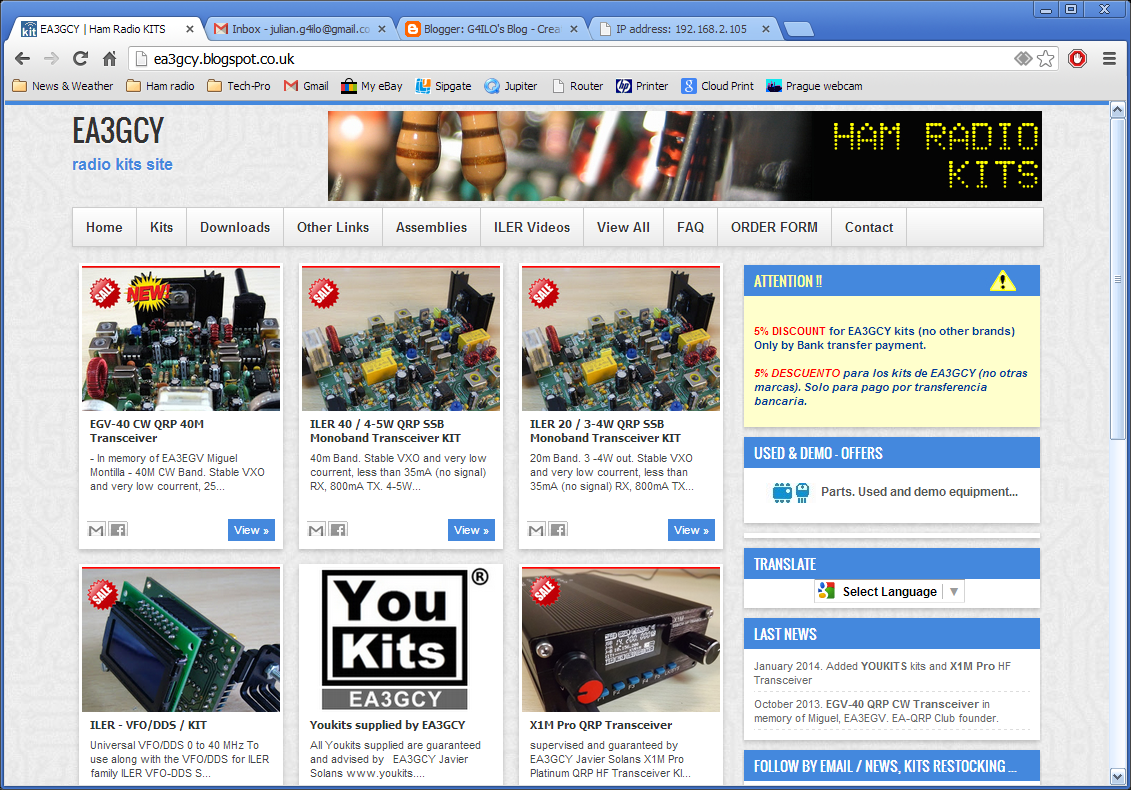
Javier Solans, EA2GCY, maker of the Iler 20 and 40 kits is now selling a range of kits from YouKits. The new kits are already listed on his very impressive-looking web site. If this means that the Chinese-made kits will now have building instructions to the same high standard as Javier’s own kitsit is very good news for kit-builders.
Julian Moss, G4ILO, is a regular contributor to AmateurRadio.com and writes from Cumbria, England. Contact him at [email protected].
Who needs more power?
Paul Stam, PC4T, is a regular contributor to AmateurRadio.com and writes from the Netherlands. Contact him at [email protected].
A warm day calls for mobile HF!
 |
| Setup in the car |
 |
| A shot from the car of the lake |
Mike Weir, VE9KK, is a regular contributor to AmateurRadio.com and writes from New Brunswick, Canada. Contact him at [email protected].
Series Seven Episode One – Glues and Adhesives (12 January 2014)
Series Seven Episode One of the ICQ Amateur / Ham Radio Podcast has been released. The latest news, Martin (M1MRB) and Colin (M6BOY) discuss the future of shortwave radio and Martin reviews Glues and Adhesive.
- New CATfix software for the Kenwood TS-590S and TS-990S
- Hong Kong radio hams lend a helping hand
- Tokyo Hy-Power ceases trading
- InnovAntennas acquires Force 12
- Amsterdam Island DXpedition
- W100AW active for ARRL's Centennial Year
- Limerick Radio Club Special Event Callsign EI4LCC
- Successful Ham Radio DF Hunt
Colin Butler, M6BOY, is the host of the ICQ Podcast, a weekly radio show about Amateur Radio. Contact him at [email protected].
 Ham Radio Deluxe |
 W5SWL Electronics |
 Ham Radio Prep |
 KB3IFH QSL Cards  Hip Ham Shirts  HamRadioAuctions HamRadioAuctions Reliance Antennas Reliance Antennas Enigma Shop Enigma Shop |  morseDX  Ni4L Antennas  R&L Electronics R&L Electronics antennas.us antennas.us QRV QRV |
- Matt W1MST, Managing Editor
