 |
 AmateurLogic.TV 64 live stream test
 7 March 2014 | by
 Looking for something to do Friday night? We will be conducting another live stream test while we shoot episode 64 of AmateurLogic.TV.
Streaming begins at 7:00 PM CST Friday, March 7th.
You can watch it here:
NOTE: This show went great. Thanks to all who watched live and participated in the chat room. Look for it to be posted around Wednesday March 12th.
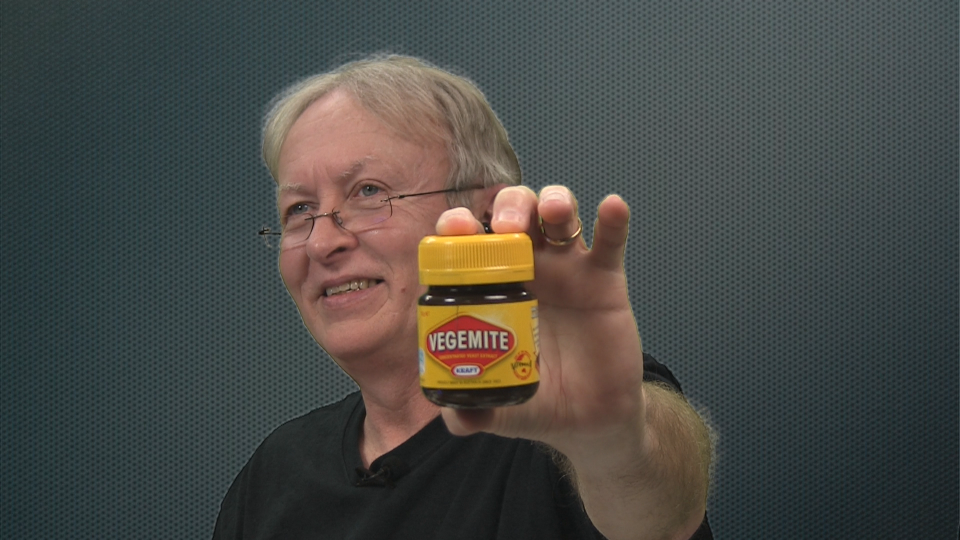
George Thomas, W5JDX, is co-host of AmateurLogic.TV, an original amateur radio video program hosted by George Thomas (W5JDX), Tommy Martin (N5ZNO), Peter Berrett (VK3PB), and Emile Diodene (KE5QKR). Contact him at [email protected].
Amateur Radio Newsline Report 1908 March 7 2014
- 200 tiny 70 CM satellites to be orbited in one launch this month
- ARRL requests member comments on digital High Frequency operations
- IARU announces the theme for Amateur Radio Day 2014
- FCC issues some stiff fines for broadcast o commercial with EAS tones
- Oregon ARES group donates a ham station to a mobile response clinic
- US ham is honored for expanding the SOTA program to this nation
10 meter again
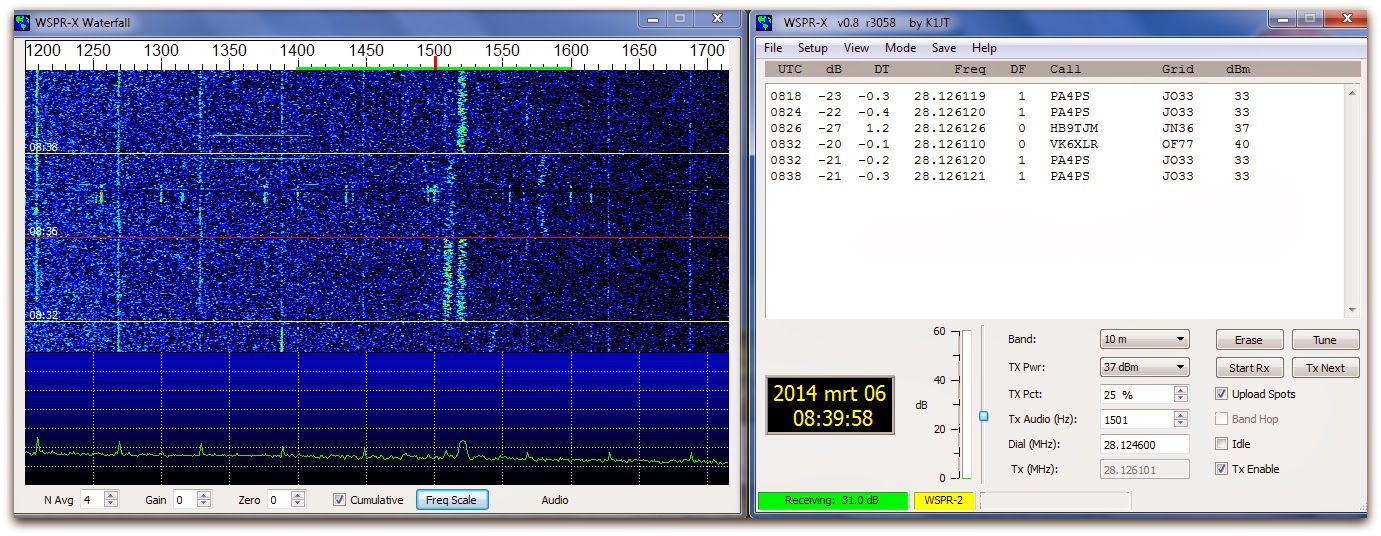
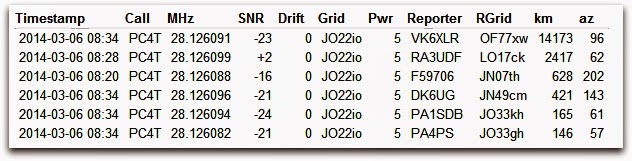
First I received only PA4PS. He must have a good antenna I suppose. Suddenly propagation was very good. VK6XLR was rolling in with 10 watts (40dB) with report -20 dB. In return he reported me with -23 dB. Almost a QSO. Hi. Today I am using WSPRX-2 see what the results are today.
Paul Stam, PC4T, is a regular contributor to AmateurRadio.com and writes from the Netherlands. Contact him at [email protected].
10 meter today
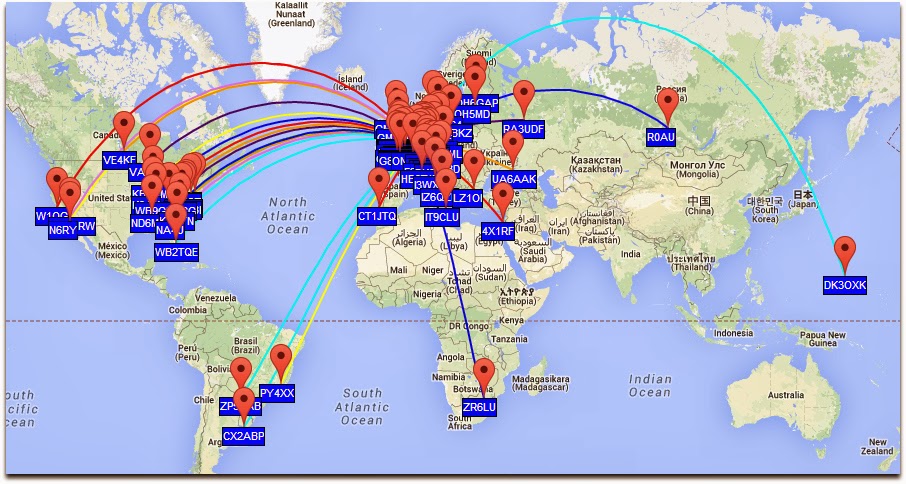
10 meter WSPR today. A lot of Es short skip from Europe as well. New DXCC was Paraguay (ZP5BAB).
Paul Stam, PC4T, is a regular contributor to AmateurRadio.com and writes from the Netherlands. Contact him at [email protected].
A Brief Rant on LoTW
If I had a dollar for every tirade I read or heard from a U.S. amateur regarding the “difficulty of setting up ARRL’s LoTW” software, I’d at least be able to buy another roofing filter for the K3. These tirades are almost invariably qualified by the assertion that the complainer is “an IT professional.”
Personally, I find LoTW’s security simple and logical: they are simply trying to make it hard for one individual to generate a lot of untraceable certificates (to sign enough falsified logs to get on the “Honor Roll”). And, since they optimized the database last (?) year, the processing and web interface are pretty good, too. I kinda just followed the directions and it worked.
I don’t believe in Karma, but every time I read one of these rants by “an IT professional,” I feel a small amount of revenge has been exacted on them for all of the frustrating interactions (mercifully few, all things considered) I’ve endured with incompetent IT drones over the years…
This is the photo I wanted to headline this post, but I refuse to hotlink or copy it. Positive, regularly-scheduled programming will return to the blog shortly, including a couple of construction projects…$50 HF triplexer, anyone?
Ethan Miller, K8GU, is a regular contributor to AmateurRadio.com and writes from Maryland, USA. Contact him at [email protected].
Antarctica
Last night I had another encounter with Antarctica, namely a QSO with RI1ANC, stationed at the Russian Vostok base. Previous contacts with the land way down under were on 20 meters, but Alex had a nice signal on 12 meters in CW. He didn’t have many takers, so an QSO was easy. Unfortunately it was only a quick exchange, just like the ones with 8J1RL and RI1ANT.
VK0JJJ – Craig, in the Australian Antarctic base of Mawson – doesn’t want any of that and I had the great fortune to have a couple of very lenghty QSOs with him. Olivia was the mode we used, which is especially suited for rag chew QSOs. If you want to catch him try Olivia 32/1000 on one of the 20 meter Olivia channels (14106.5 kHz, then 1 kHz up for the next channel). Even if he is in QSO with another radio amateur it is still fun to read along. When not behind the radio I follow his blog, where you can read interesting things like how they grow vegetables on Antarctica and how they get their supply of water. Fascinating stuff and heartily recommended to visit. He is going back home early May this year, so catch him while you can.

Hans "Fong" van den Boogert, BX2ABT, is a regular contributor to AmateurRadio.com and writes from Taiwan. Contact him at [email protected].
Nancy, WZ8C/SK – It’s a sad sad day

Msg from Dennis, K6DF follows:
To All FISTS Members: Early this afternoon I received a phone call from Tim, Nancy’s husband. I am very sad to report that Nancy WZ8C, is now a silent key. Nancy passed away last night and will be missed very much by all FISTS members worldwide.
If you wish to send condolences to her family, please send them to the following address:
Tim Lange and Family
P.O. Box 47
Hadley, MI, 48440.
Please send this notice to any and all FISTS groups and members to disseminate this information as much as possible.
I sadly send 73, God’s Speed Nancy, 88’s . . . Dennis Franklin K6DF FISTS Awards Mgr /Webmaster
End MSG
Nancy was only 58 according to her obituary. Way too young to pass. She will be missed by all FISTS members.
73, Nancy de Larry W2LJ
FISTS #1469- dit dit
Larry Makoski, W2LJ, is a regular contributor to AmateurRadio.com and writes from New Jersey, USA. Contact him at [email protected].
 Ham Radio Deluxe |
 W5SWL Electronics |
 Ham Radio Prep |
 KB3IFH QSL Cards  Hip Ham Shirts  HamRadioAuctions HamRadioAuctions Reliance Antennas Reliance Antennas Enigma Shop Enigma Shop |  morseDX  Ni4L Antennas  R&L Electronics R&L Electronics antennas.us antennas.us QRV QRV |
- Matt W1MST, Managing Editor
