 |
 Series Seven Episode Four – US Ham Survey (23 February 2014)
 23 February 2014 | by
 Series Seven Episode Four of the ICQ Amateur / Ham Radio Podcast has been released. The latest news, Martin (M1MRB) and Colin (M6BOY) discuss the an emergency box for local weather disasters and Frank Howell (K4FMH) reviews US Ham Survey.
- Outernet - Shortwave radio from space
- New Amateur Radio bands in Europe
- RaDAR Contest
- New Worcester UHF repeater goes on-air
- EURAO Party - Winter 2014 Promoting HF Digital Voice
- Second Amateur Radio Skills Workshop in Chelmsford (February 2014)
- Fully licensed in 57 days
- VK5 SOTA & Parks Symposium
- New Medium Wave Beacon
- Bristol's Cabot Tower sends out Morse code
Many thanks to this episodes donor, Andreas Genemans, KB3WGO and our monthly donors for keeping the podcast advert free. To donate, please visit http://www.icqpodcast.com/donate
Colin Butler, M6BOY, is the host of the ICQ Podcast, a weekly radio show about Amateur Radio. Contact him at [email protected].
Series Seven Episode Four – US Ham Survey (23 February 2014)
Series Seven Episode Four of the ICQ Amateur / Ham Radio Podcast has been released. The latest news, Martin (M1MRB) and Colin (M6BOY) discuss the an emergency box for local weather disasters and Frank Howell (K4FMH) reviews US Ham Survey.
- Outernet - Shortwave radio from space
- New Amateur Radio bands in Europe
- RaDAR Contest
- New Worcester UHF repeater goes on-air
- EURAO Party - Winter 2014 Promoting HF Digital Voice
- Second Amateur Radio Skills Workshop in Chelmsford (February 2014)
- Fully licensed in 57 days
- VK5 SOTA & Parks Symposium
- New Medium Wave Beacon
- Bristol's Cabot Tower sends out Morse code
Many thanks to this episodes donor, Andreas Genemans, KB3WGO and our monthly donors for keeping the podcast advert free. To donate, please visit http://www.icqpodcast.com/donate
Colin Butler, M6BOY, is the host of the ICQ Podcast, a weekly radio show about Amateur Radio. Contact him at [email protected].
Raspberry Pi repeater controller
http://www.youtube.com/watch?v=FrtHzsZMfm8
Aaron Crawford, N3MBH, is in the process of designing a repeater controller using his Raspberry Pi. He’s moved into testing on the RPi and toward designing and refining the circuitry for the radio interface.
What makes this different than other projects I’ve seen is the polish of his web interface. You can tell he’s a web developer — it’s definitely slick!
Aaron describes the project here:
In setting out to develop this project my primary goals and features are to develop a low-cost, low-power, but feature rich duplex repeater controller suitable for setting up a temporary / emergency repeater systems with radios that can be run on portable power. However with a more complete feature set and a modular design, it could also be used as a primary or a backup controller for a permanent installation repeater. With the low cost, modular design, it would make it easy to keep backup hardware (Raspberry Pi, repeater control board, and a cloned SD card) on site for easy service swap-outs.
This is definitely a project to keep an eye on. Kickstarter, anyone?
Matt Thomas, W1MST, is the managing editor of AmateurRadio.com. Contact him at [email protected].
Five Summits in Three Days
To feed my addiction I made a trip to my QTH in Santa Fe, NM. I arrived there on my birthday February 13th. I had been planning this trip for more than a month and was worried about how the weather would be since the long weekend in Santa Fe would be my only chance to activate summits for a while. The weather forecast was for highs in '60's. Perfect.
. I had a different strategy for this trip, since none of the hikes would be more than a mile one way, I carried my FT-817 and an Elecraft T-1 tuner with plans to get on the WARC bands since the ARRL DX-CW contest would be going on the weekend. The FT-817 is fresh from getting modified with the W4RT on-board filter for both SSB and CW and the DSP as well.
DAY 1
So on Friday the 14th, I met up with Fred, KT5X aka WS0TA. We had two summits on the agenda, Peak 7119, W5N/PW-037 and Glorieta Mesa, W5N/PW-032. The day was windy, but the temps were comfortable. While the climbs were short, they were very steep to both summits. There were probably easier ways up, but what the heck, we were looking for adventure.
Propagation was good on the first summit, Peak 7119, I worked 5 EU stations, OH9XX, DJ5AV, EA2LU, ON4LI and G4OBK. My antenna was an LNR Trail Friendly 40-20-10 EFHW strung over as high a limb as my pole could reach and then to my carbon fiber fishing pole and down to the rig, an inverted L configuration. the antenna tuned great on the WARC bands. Fred and I employed a strategy that maximized available bands. I started on 12m and worked my way down to 20m while Fred started on 20m and move down to 30m and 40m. So as a team we made the summit available in several bands. I made 20 QSO's; 11 on 12m, 3 on 17m, 5 on 20m and 1 on 30m. I did have a couple of S2S's, one with N6JZT and another with N7CW, both with huge signals. Thanks guys.
The Glorieta Mesa expedition was executed in a very similar manner, same radio, same antenna configuration, except this time I made 25 QSO's on the following bands; 10 on 12m, 5 on 15m, 2 on 17m and 8 on 20m. The only DX was DJ5AV on 15m.
It was a good day, 45 QSO's, two nice hikes and 20 SOTA points.
DAY 2
Fred was unable to go on Saturday, so my buddy Jeff from Red River, NM was visiting, so he set out with me for the days activities. Again, there were two summits on the agenda, Peak 8409, W5N/PW-027 and Peak 9420, W5N/PW-020.
Peak 8409 is a relatively easy summit, with only about a 75 vertical feet ascent required to get into the activation zone. I used an AlexLoop on this summit as I wanted to get set up quickly. Propagation must have been in the process of warming up. I only made 9 QSO's 8 on 12 meters and 1 on 30 meters. The stations I heard were loud, but there weren't many of them. I never was spotted on RBN. I tried to self spot on SMS but put a slant bar in the summit reference which is the incorrect format. I didn't figure this out until later. So, I had to pack up to make the scheduled time on Peak 9420, so Jeff and I made our way down the hill to the car and were on the way to the next summit.
Peak 9420 is an excellent SOTA Summit. It climbs 800 feet over a distance of about one mile, which is relatively steep, but the hike is only a mile to the summit and it has a nice trail with lots of switchbacks to take some of the sting out of the hill. I'm in relatively good shape and it took me 23 minutes to get to the top. The weather was cooler and the wind was blowing at a stiff clip. There was some snow on the ground at the top, but not too much. It was too windy right on top, so I moved down a little to get out of the wind. I used my FT-817 with the Elecraft T1 tuner and the EFHW. I netted 31 QSO's , 11 on 12m, 9 on 20m and 11 30m. During my run on 30m, I heard a faint but copiable signal and a slow but sure fist calling. It is K7NIT, Rachel, calling for an S2S, followed soon thereafter by K7ATN. Thanks guys. Another fun thing happened, after my first run on 12 meters I didn't work either W4DOW or AE4FZ both of which are well up the standings on the 12 meter challenge. I worked AE4FZ on 20m so I knew he was out there. So after the pile-ups died down I went back to 12m and threw out the bait. Like two big trout after a fly, very quickly after calling CQ I worked both W4DOW and AE4FZ. I knew then it was okay to QRT.
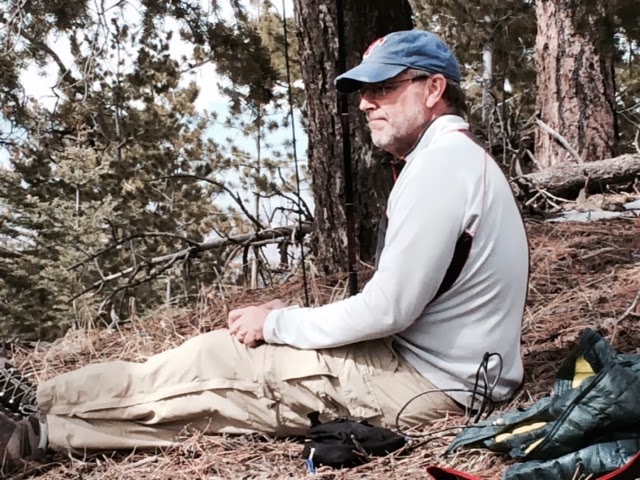
For the day, 40 QSO's and 22 SOTA points (including bonus points)
DAY 3
Day 3 would require a little driving. I was headed to Sandia Crest, W5N/SI-001. Sandi Crest is dominant peak in Albuquerque, NM. My XYL accompanied me on this trip. It is a drive up to the summit which sits at ~10,600 feet. We also wanted make the drive on HWY 14 out of Santa Fe which is a beautiful drive. In addition to the views it goes through Madrid which is where much of the Tim Allen film, "Wild Hogs" was filmed. Its a very cool little town. We didn't have time to stop, but will make a special trip next time.
At the summit it was cold. In the 30's and very windy. I would have to find a spot out of the wind. Because of the cold my wife decided to sit this one out, in the gift shop. Now this was probably a mistake on my part, because when I was done with the activation she had found several nice things to put in our house. Another way of looking at this is that it's a small price to pay for a SOTA pass:-).
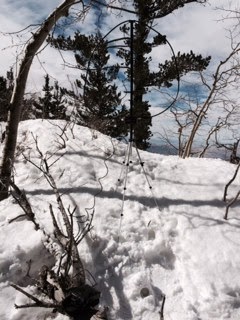
I hiked about a quarter of a mile south of the summit structures and found a place where I could sit on a log, out of the snow, be sheltered from the wind but yet give my antenna a good look at the world. The picture below is what I found. The log in the foreground was where I sat and the Alexloop, with the tripod anchored in the snow, has a nice look over the snow bank. I again used the 817.
Mike Crownover, AD5A, is a regular contributor to AmateurRadio.com and writes from Texas, USA. Contact him at [email protected].
The Minima
There are dozens of QRP rig designs and new kits that pop up each year, the majority of which are reiterations of previous designs. For the past ten years it seems we’ve been in a bit of a rut building NE602 based direct conversion and superhet rigs. But once in awhile a groundbreaking design is released, and everyone follows. Rigs like this are truly memorable, like the W7ZOI Ugly Weekender, the NEophyte, the Norcal 40, the 2N2/40, and the K2. I think the Minima, a new transceiver designed by Ashhar Farhan is one such design. The design has really impressive and innovative features:
- 1 to 30 Mhz coverage
- CW and SSB operation
- Si570 DDS local oscillator
- 20 Mhz IF
- KISS Mixer
- Arduino controlled, with open source software
- Other than a few ICs, most of the active components are general purpose NPN and PNP transistors
- A relatively simple and reproducible design
Looking at the schematic, you can see immediately how unique it is starting at the front end. From the antenna jack, you go into a high pass or low pass filter and then hit a mixer with two FETs. After that is an IF amplifier constructed from bipolar transistors, a BFO mixer and then the audio chain, again built from bipolar transistors. The transmitter chain works essentially the same, in reverse, with the mixer as the final active stage and providing a one watt output.

I’ve been eager to build something ugly style on a sheet of copper clad PC board, and this is just the ticket. And it’s Arduino controlled which is icing on the cake!

Anthony, K3NG, is a regular contributor to AmateurRadio.com.
Worst snow winter since 1958 and an indoor Yagi antenna

Norway has had its fair share of precipitation this winter. Along the coast most of it has been in the form of rain. But that is different in the mountains. Our cabin at 800 m above sea level is now about to disappear in the snow and we can hardly see out of the windows anymore. This is a result of having had to shovel the snow off the roof three times so far this winter. And there is yet more to come.
They say that one has to go back to the winter of 1958 for more snow than we have had this winter, and we are still only in February. The snow has also given us an unexpected problem. Our digital TV signal is now gone. The TV transmitter is at Mount Gaustadtoppen at 1883 m ASL which is about 10 km to the North and with almost free line of sight. It used to be possible to receive the signals from the national TV provider (Riks-TV) with just a simple indoor dipole, i.e. two wires each of length 13-14 cm connected to a coaxial cable. But not so anymore after all the snow has accumulated outside the windows.
Therefore I had to find a good Yagi-antenna calculator and make a better antenna. I put it on a cardboard of length 45 cm and used the antenna calculator of K7MEM (Martin Meserve). It is a little hard to figure out the exact frequency as there are 5 multiplexes in the TV system and for that particular transmitter they range from 506 to 620 MHz (http://www.finnsenderen.no/finnsender). I therefore just designed the antenna for the multiplex in the middle, 563 MHz. The wavelength is 53.3 cm and typical antenna element length is half of that.

The antenna calculator gave me a design with one reflector behind the receiver element, and four directors in front of it. In the picture, the reflector is to the left and the antenna points to the transmitter to the right.
I made the elements from thick wire, and just taped them to the cardboard. The connector to the coaxial cable is under the cardboard and attached to the center of element two from the left – the one which is split into two.
The Yagi antenna was first described by H. Yagi in the paper “Beam Transmission of Ultra Short Waves“, (Proceedings of the Institute of Radio Engineers, 1928). But as the contribution from his colleague Uda was at least as great as Yagi’s, the antenna should really be called the Yagi-Uda antenna. I seem to remember that Uda could not write English (both of them were Japanese), so the article was written in the name of Yagi only.
But what about my Yagi, eh Yagi-Uda antenna, did it work? Yes, actually it did! With digital signals there is a threshold effect and above a certain signal level the signal quality quickly goes to 100% with a low BER (bit error rate) and with this antenna I came above that threshold. The gain of this antenna is in the order of 8 dB or about 6 dB more than the old single element antenna. Luckily, that was enough to compensate for the attenuation through the snow pile. And as you can see, one doesn’t need aluminium to make a working TV antenna.
[In Norwegian: Verste snøvinter i manns minne og en innendørs TV-antenne]
Sverre Holm, LA3ZA, is a regular contributor to AmateurRadio.com and writes from Norway. Contact him at [email protected].
Amateur Radio Newsline Report 1906 February 21 2014
- A ham in the United Kingdom hears China’s lunar rover
- US public is invited to comment on FCC Process Reform
- Canadian hams get permanent access to a very low frequency band
- ZS hams told that they must use 12.5 kHz spacing for 2 meter repeaters
- Two teens bring a dormant AMSAT net back to life
- A trip back in time and space to the beginnings of the universe
 Ham Radio Deluxe |
 W5SWL Electronics |
 Ham Radio Prep |
 KB3IFH QSL Cards  Hip Ham Shirts  HamRadioAuctions HamRadioAuctions Reliance Antennas Reliance Antennas Enigma Shop Enigma Shop |  morseDX  Ni4L Antennas  R&L Electronics R&L Electronics antennas.us antennas.us QRV QRV |
- Matt W1MST, Managing Editor
