 |
 How To Do a VHF SOTA Activation
 13 June 2014 | by
 The Summits On The Air (SOTA) program has really taken off in North America. SOTA originated in the UK in 2002, so it took a little while for it to make it across the Atlantic to this continent. The basic idea of SOTA is to operate from a designated list of summits or to work other radio operators when they activate the summits. The list of designated summits are assigned scoring points based on elevation and there are scoring systems for both activators (radio operators on a summit) and chasers (radio operators working someone on a summit). See this blog posting for links to tons of information.
Most of the operating is on the HF bands but there are quite a few VHF contacts on SOTA. Obviously, HF has the advantage of being able to work longer distances without too much trouble. Typically, the HF station is your classic portable QRP rig, portable antenna and battery power. (A portable power source is required and the use of fossil fuels is prohibited.) Being a VHF enthusiast, I prefer the challenge of making contacts above 50 MHz, so my SOTA contacts are usually on 2 Meters or 70 cm.
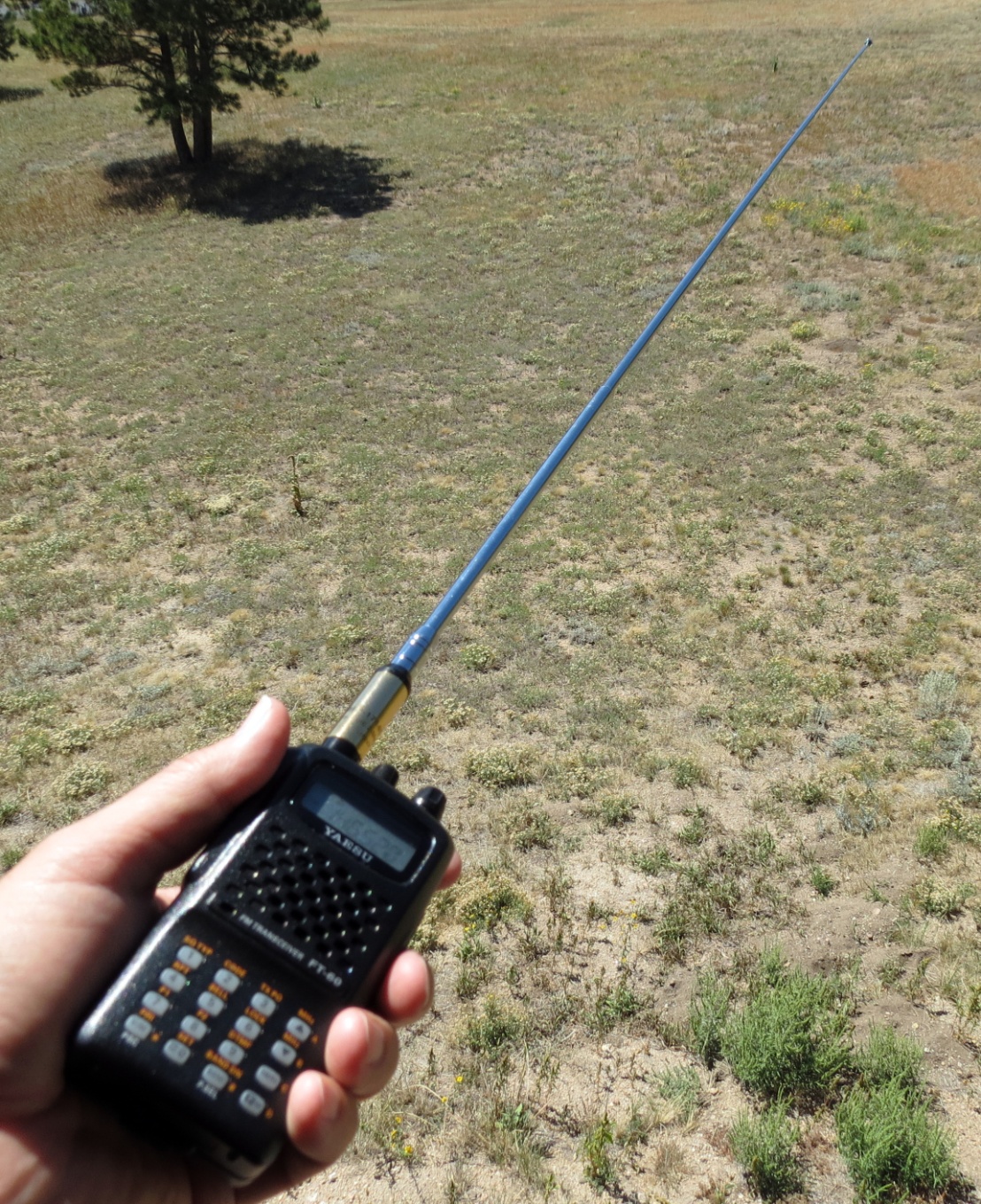
Handheld radio with 1/2-wave antenna
My basic VHF SOTA station is a handheld FM transceiver with a ½-wave telescoping antenna. The standard rubber duck on a handheld transceiver (HT) is generally a poor radiator so using a ½-wave antenna is a huge improvement. This simple station is an easy addition to my normal hiking routine…just stuff the HT and antenna in my backpack along with the usual hiking essentials and head for the summit.
To count as a SOTA activation, you need to make a minimum of 4 contacts from the summit. If I am hiking a summit within range of a major city, I can usually just make some random contacts by calling CQ on the National Simplex Calling Frequency, 146.52 MHz. However, operating in more remote areas requires a little more planning. I’d hate to hike all that way and come up short on the required contacts, so I use a few tactics to rustle up some VHF contacts. Of course, I will post my planned activation on the SOTAwatch site in advance, to let people know that I’ll be on the air. While this goes out worldwide, it may not reach the right radio amateurs within VHF range. The next thing I do is send an email to some of VHF-equipped hams I know will be within range. Many people respond to such a request to work a summit, even if they are active in SOTA. When on the summit, my first call is on 146.52 MHz or some other popular simplex frequency. If I don’t raise anyone there, I will make a call on a few of the 2M repeaters in the area to see if someone will come over to “five two” to make a contact. SOTA does not recognize repeater contacts but it is OK to solicit simplex contacts using a repeater. These techniques and a little patience have always gotten me at least four contacts, and usually quite a few more.
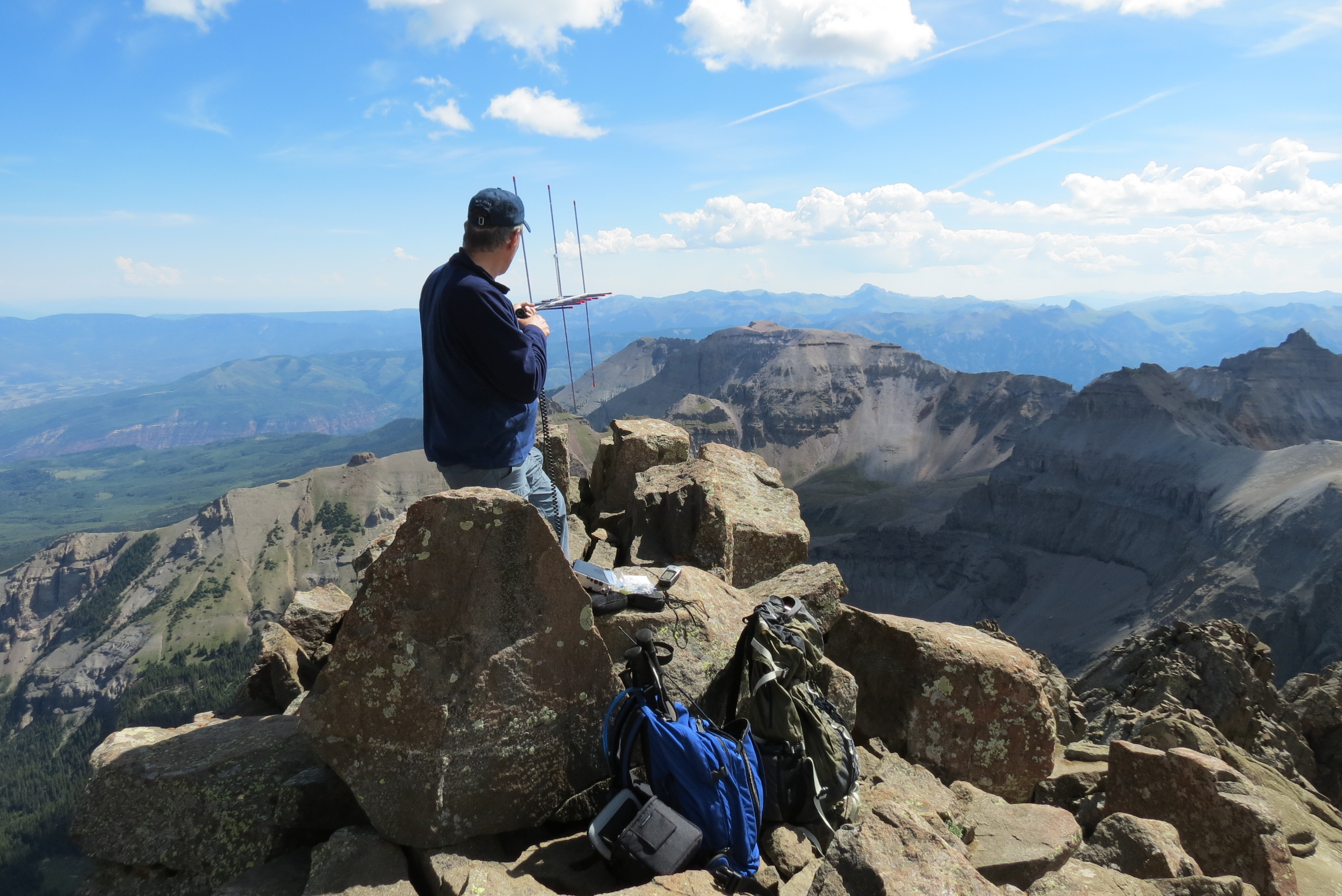
K0NR operating with 2M yagi antenna on Mt Sneffels
The omnidirectional antenna of the basic VHF SOTA station will make some contacts, adding some antenna gain can really help your signal. There are a number of compact directional antennas that are easy to take hiking. Elk Antennas makes a log-periodic antenna that covers 2 Meters and 70 cm. Another popular antenna is the 2 Meter / 70 cm Yagi antenna made by Arrow Antenna. These antennas are lightweight and assemble/dissemble easily, which is important to hiking radio operators.
So far, most of the SOTA VHF activity in North America is on on 2m FM, the utility mode. Everyone seems to have a 2m HT, so tossing it in a backpack and heading out is a natural thing to do. Using my FT-817, I have made some VHF contacts on CW and SSB. See this posting about a recent SSB activation. These modes are much efficient than FM and the station on the other end is likely to be a big weak-signal station. Nothing like a big gun station with huge antennas to help pull your QRP signal out of the noise! I expect the use of CW and SSB to increase on VHF as SOTA becomes more popular. While FM activity uses vertical polarization (antenna elements are vertical), most SSB/CW activity uses horizontal polarization (antenna elements are horizontal).
Summits On The Air is a great way to take ham radio outdoors. So get off the couch, find a summit and have some fun with ham radio.
See my other SOTA postings here.
73, Bob K0NR
Bob Witte, KØNR, is a regular contributor to AmateurRadio.com and writes from Colorado, USA. Contact him at [email protected].
K7AGE explains PSK-31 at SEA-PAC
Very informative presentation by Randy K7AGE (with George W5JDK behind the camera). Worth watching if you’re interested in expanding into this very effective low-power mode popular on 20-meters.
Matt Thomas, W1MST, is the managing editor of AmateurRadio.com. Contact him at [email protected].
AmateurLogic 67: Dayton Hamvention 2014

AmateurLogic.TV Episode 67 is now available for download.
Join George and Tommy as they visit the Mother of all Hamfests, Dayton Hamvention. We met many old and new friends. Plus lots of information on all the new digital products on the horizon.
1:27:56 in the magical world of Hamvention.
George Thomas, W5JDX, is co-host of AmateurLogic.TV, an original amateur radio video program hosted by George Thomas (W5JDX), Tommy Martin (N5ZNO), Peter Berrett (VK3PB), and Emile Diodene (KE5QKR). Contact him at [email protected].
Amateur Radio Newsline Report 1922 June 13 2014
- FCC announces changes to Amateur Radio licensing and modes
- Hams take issue with users of indoor grow lights
- A pair of X Class flares erupt on the Sun
- Marines learn how to T-hunt from a North Carolina radio club
- Dayton announces 2014 Hamvention attendance
- Part two of our look at ARIS
East Coast USA 6m WSPR stations – where are you?
One of these spring/summer days, 6m is going to open across the Atlantic again by Es, but unless there are active 6m WSPR stations along the east coast of the USA any openings will probably be missed on WSPR. This would be a great shame as WSPR is some 12-14dB better than CW, so WSPR would be a great mode to winkle out fleeting openings. Even modest antennas and low power should do.
So, if you have WSPR and live along the east coast of the USA and Canada PLEASE come on 50.293MHz USB dial. You may be part of some historic firsts.
I don’t believe 6m WSPR has crossed the Atlantic yet, but I’m sure I’ll be told if wrong. I worked a station on CW in the USA with QRP CW in summer 2007 with around 1W ERP and the V2000 vertical. WSPR should be 12-14dB easier.

Roger Lapthorn, G3XBM, is a regular contributor to AmateurRadio.com and writes from Cambridge, England.
Return to 6m
Just after midday local time I returned to 6m having switched off last night. So far, only G4IKZ (18km) is spotting me on WSPR and at excellent strength (+10/+11 dB S/N despite cross-polarisaton). No Es (yet) and no GDX (yet) but there is a lot of time today still to come.
UPDATE 1542z: Just spots all afternoon from G4IKZ and no-one else so far.
UPDATE 1800z: CN8LI (2113km) and I have exchanged WSPR spots 7 times since 1604z, many at great strength again. Es I assume although this propagation is almost predictable! No EAs active on WSPR so if multi-hop Es I shall never know.
Again there is a distinct lack of east coast USA stations, so any E-W multi-hop Es events across the Atlantic will go unnoticed on 6m WSPR today. A crying shame. East coast USA WSPR stations – where are you? We need YOU on and active!
UPDATE 1808z: First Es in the other direction today – OH5MD (1757km) has spotted my 1W ERP at 1800z.

Roger Lapthorn, G3XBM, is a regular contributor to AmateurRadio.com and writes from Cambridge, England.
New portable paddle
I decided that I wanted to try something new paddle-wise for my lunchtime QRP portable operations. The main criteria was that it had to be on the inexpensive side. That seems to be my main criteria these days where a lot of things are concerned. Besides working well, it would also be nice if the paddle was light in weight.
Palm paddles would probably be the ultimate, but are way too expensive and would not fit within my meager budget right now. I needed to keep it under $50 if at all possible. That really narrows down the possibilities, let me tell you. I have a Whiterook MK-33 single lever paddle. It works well and it also fits the bill, but it tends to get a bit sloppy around the 22-23 WPM mark.
I had a Bulldog paddle back when I had my K1 and I liked it. However, I included it as part of the K1 package when I sold that radio to raise money for my KX3. So, relying on my memory, I decided to give another Bulldog a try. I went to the Website: http://www.amateurradioproducts.com/, only to find out that they no longer manufacture the model I had. Mine was the one on a small triangular wooden base that had three tiny suction cups.
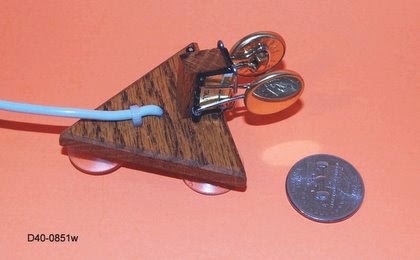
They have several different models now, and I decided to go with the BD6, the Mini-Iambic. It arrived on Saturday through the mail, and tonight was the first chance I had to try it out.
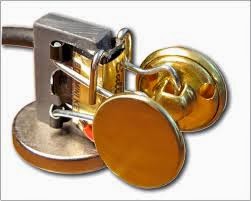
I have to admit that I was skeptical when I opened up the package that it came in. It is indeed ‘mini” – in fact, it gets lost in the middle of the 1.5 inch fender washer that serves as a base! But as usual, it turns out that looks are quite deceiving. This little paddle is smooth and is great to use just as it is, no adjustments were required, although the accompanying instruction sheet tells you how to go about that, if needed. I worked both W1AW/5 and W1AW/0 tonight at about the 21 WPM range. The paddles acquitted themselves nicely there. Then I turned up the speed a notch to work EV1R and LZ1WR and C6ATT. Even at the speed where the Whiterook goes kaflooey on me, the Bulldog stays sharp, smooth and flawless and had great feel to it. The fact that it was only $35 was icing on the cake. I will definitely bring these along for Field Day. They may be too small for some of our guest operators, but they work great for me!
72 de Larry W2LJ
QRP – When you care to send the very least!
Larry Makoski, W2LJ, is a regular contributor to AmateurRadio.com and writes from New Jersey, USA. Contact him at [email protected].
 Ham Radio Deluxe |
 W5SWL Electronics |
 Ham Radio Prep |
 KB3IFH QSL Cards  Hip Ham Shirts  HamRadioAuctions HamRadioAuctions Reliance Antennas Reliance Antennas Enigma Shop Enigma Shop |  morseDX  Ni4L Antennas  R&L Electronics R&L Electronics antennas.us antennas.us QRV QRV |
- Matt W1MST, Managing Editor
