 |
 Polyakov Pixie
 7 July 2014 | by
 Peter DL3PB has sent details of his version of the Pixie transceiver. He claims no broadcast breakthrough by using this configuration and lots of QSOs.
|
| Peter DL2PB’s Polyakov Pixie |


Roger Lapthorn, G3XBM, is a regular contributor to AmateurRadio.com and writes from Cambridge, England.
The best laid schemes o’ Mice an’ Men
The best laid schemes o' Mice an' Men, Gang aft agley,That sums up my weekend perfectly.
An' lea'e us nought but grief an' pain, For promis'd joy!
After becoming licensed my eagerness got the better of me and in a moment of weakness I'd purchased a couple of 10m ready made cables from a major supplier only to discover quite quickly they were made from low grade RG58 coax (you can literally count the number of strands in the braid) and the connectors while serviceable were so poorly fitted they fell off!
 |
| James that PL259 has fallen off again! |
I had refitted the connectors using some solder this time and had managed to blag a 20m length of good quality RG58 (this actually has some braid) and I am ashamed to say these cables have been the weak link in my set up for far too long and needed to be upgraded.
I also needed to sort out the mounting for my aerials. Up till now I have been using a 5 meter telescopic painting pole that had cost around £16 from B&Q, it was okay when I was just clamping one aerial at a time to it but with the purchase of the rotator I has been chancing my luck with the loading, narrowly avoiding catastrophe when pushing the pole. I also couldn't fully extend the top section as the tube and joint were potentially weak. It was guyed quite well but was far from aesthetically pleasing, even in the summer sunshine!
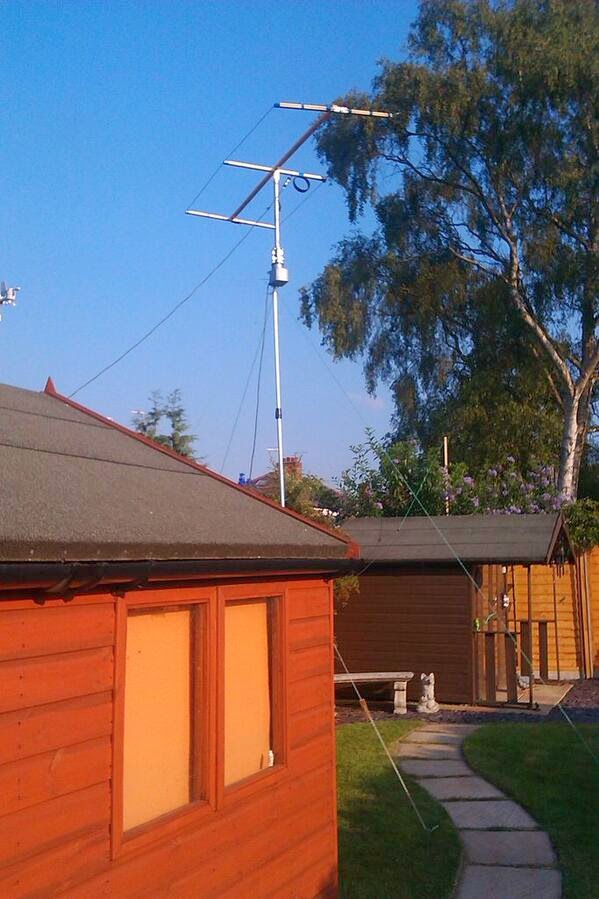 |
| 6M Moxon up on temporary pole |
Never fear I had a plan, a 20ft (6m) scaffold pole bolted using swivel joints on to to an another pole concreted in the ground in the back garden. The garden was extensively landscaped a few years back but it was before I became licensed, so I hadn't planned ahead. With careful negotiations with the station manager I secured a location where I could put it.
Thanks to my local handy man I now have two 10ft scaffold poles, sunk to a depth of nearly 5ft and encased in concrete in the corner of the lawn. A few inches of soil was left on the top to allow the grass to grow. They have been left for over a fortnight to completely set.
 |
| Scaffold pole sunk in ground |
I ordered a 100M reel of RG213 coax from Nevada Radio along with plenty of high quality N-Type connectors and various clamps and intended to sort out my antenna set up this weekend and banish the abysmal RG58 coax and PL259 connectors to some dark corner of the shack.
Before I took everything down on Saturday I managed to make contact with GB0TDF the special event station being run by the Denby Dale Radio Society from Cartworth Moor, Holmfirth for the Tour de France Grand Départ
A few months back I picked up a cheap rotator at the Dambusters Hamfest. It is designed for television aerials and isn't heavy duty but I was sure it would cope turning with the small 2M, 70cm Yagi and a 6M antenna on the same pole, with the X-50 collinear on the very top. However I was concerned by the potential lateral loading.
The rotator is a generic design and I spotted that an optional support bearing is available as an accessory. I chanced on one via Ham Radio Deals and had salvaged several good lengths of galvanised pole from a skip where I work. So the plan arrangement was as shown.. simple right?
 |
| Planned arrangement |
It turned it a frustrating morning after cutting the metal pole to length, bolting and clamping everything together I tested it at ground level with no antennas and the rotator refused to turn correctly and I narrowly avoided burning it out.
I checked poles and they were true, the rotator was free running as was the bearing. I unbolted, fettled and just couldn't make it work. I went away and had a beer while watching some of the Tour de France on the TV and in a moment of clarity realised what the issue was.
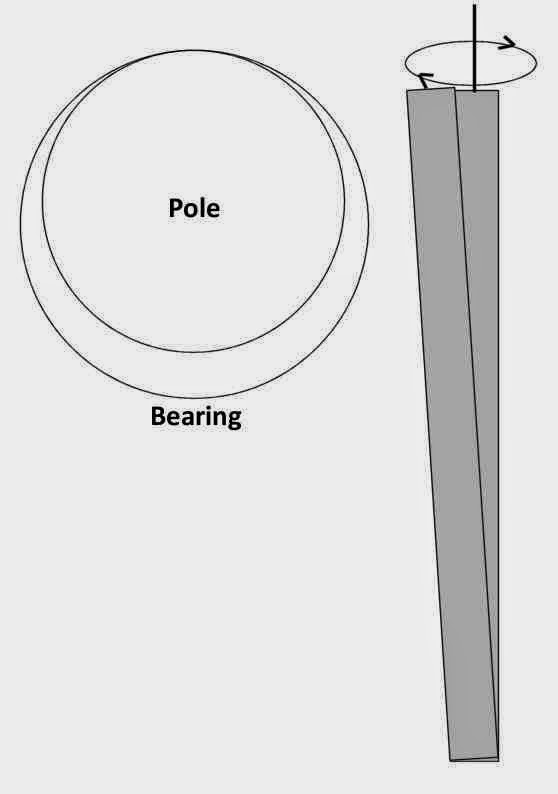
The problem was the diameter of the salvaged pole I was using. It was was slightly narrower (a couple of millimetres) than the hole in the bearing. I'd assumed it would line up with the rotator as it was similarly clamped, however when all clamped up top and bottom the pole wasn't perfectly perpendicular and wouldn't turn due to the eccentricity, Hopefully the drawing illustrates the problem.
Annoyed by this basic school-boy error I reverted to Plan-B for the short term, no support bearing! I was in bad mood now and so decided to leave the rewiring to another day. So I quickly put the 2M yagi on the existing coax as a test on the new scaffold pole to make a few contacts for the VHF NFD.
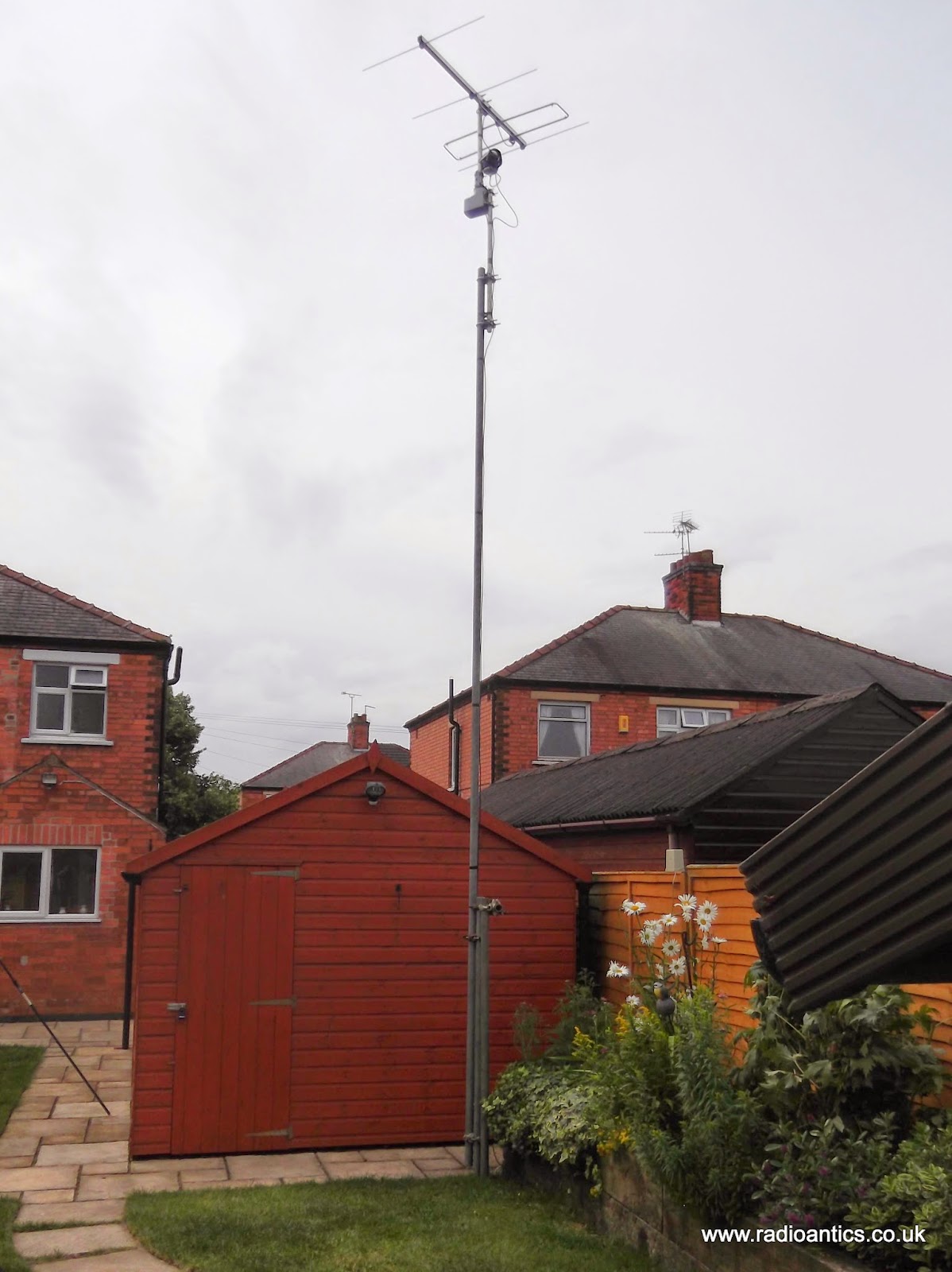 |
| Temporary installation to test scaffold pole |
Walking up the scaffold pole is straight forward, I have bolted a small cut off of scaffold across the top of support poles to act as a safety stop, lowering it likewise easy and I will certainly build up the muscles!
I managed to grab just 8 QSOs but was otherwise engaged for the rest of the weekend, however I was encouraged by the distances.
A few 2M QSOs during the NFD, Tour de France, Grand Prix and fixing a dripping tap took priority ;-) pic.twitter.com/BECaepRIlu
— Andrew Garratt (@nerdsville) July 6, 2014 I hope to get the 70cm antenna up tonight on the RG513 ready for the 432MHz UKAC on Tuesday evening.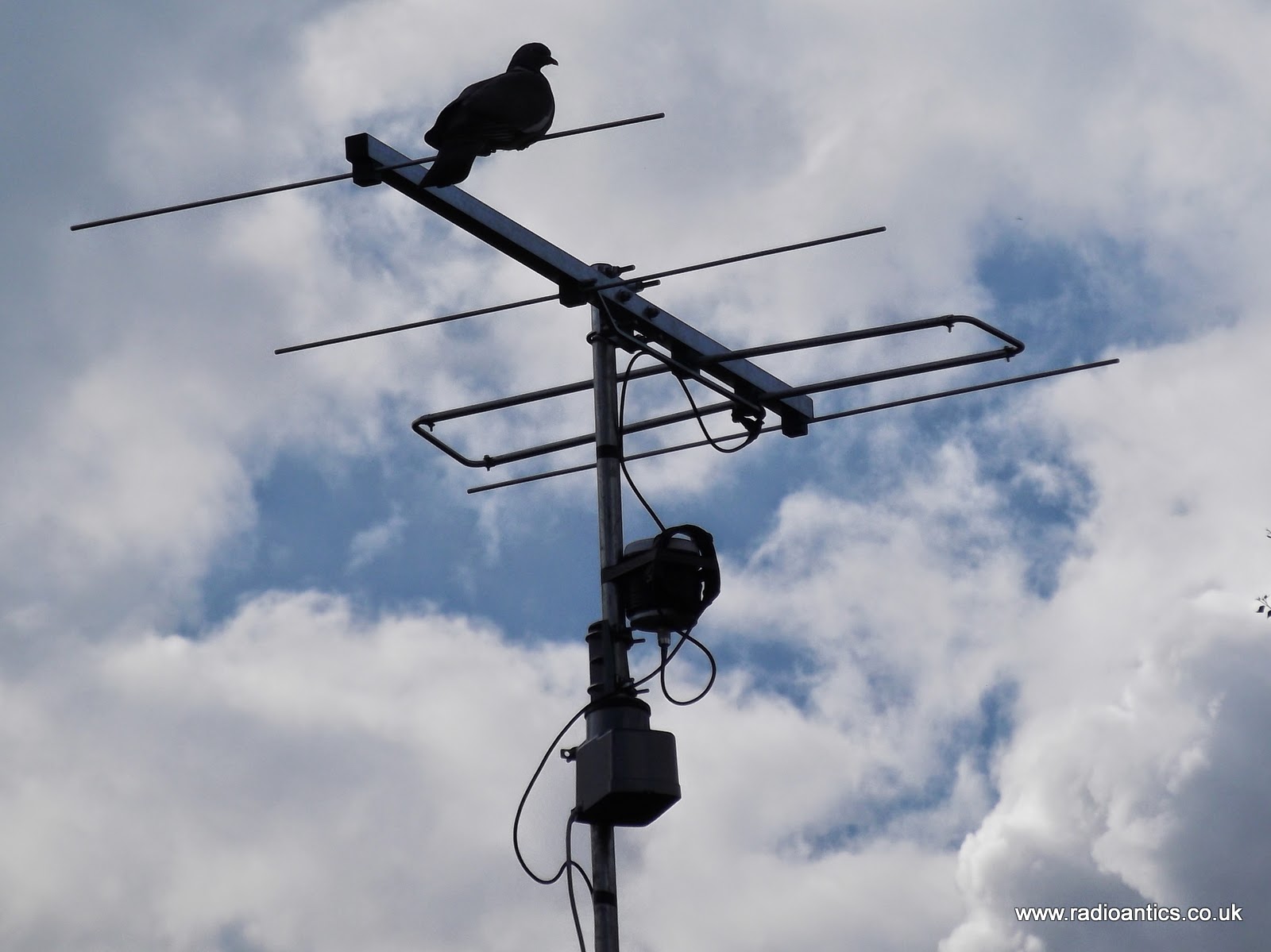 |
| The birds like the new setup |
Andrew Garratt, MØNRD, is a regular contributor to AmateurRadio.com and writes from East Midlands, England. Contact him at [email protected].
6m – past the best?
I am beginning to think that 6m is now past its best both for Es opportunities and, of course, for F2 propagation. Almost zero Es on 6m in the last few days, mainly locals and a little GDX. I may give it a few more days before QSYing back down to 10m where both Es and F2 DX are more plentiful.
10m conditions should be good for N-S F2. Sunspot count is 256 (high) and 20-30MHz propagation is forecast to be “normal”.
If anything, solar activity has staged a bit of a comeback lately, but this may be just a blip.
UPDATE 1545z: As if to persuade me to stay on 6m, CN8LI (2113km) was spotted at 1450z.
UPDATE 1810z: No more Es here since CN8LI at 1450z. One blog reader tells me that I should try JT65 as there is more activity. JT9-1 worked well for me on MF with international 2-way QSOs with very low mW ERP. I think JT65 is more commonly used on 6m?

Roger Lapthorn, G3XBM, is a regular contributor to AmateurRadio.com and writes from Cambridge, England.
Making Plans for the Colorado 14er Event
 The Colorado 14er Event (Aug 3) is less than a month away so it is time to get ready. This event was born out of the basic observation that many hiking hams were taking along their radios (typically, a VHF/UHF handheld) when they climbed the Colorado 14,000 foot mountains. So we thought “let’s all climb on the same day and see who we can contact.” The typical 2m FM contacts have expanded to other frequencies and modes, including the high frequency bands, with the potential for worldwide propagation. We’ve also embraced the Summits On The Air (SOTA) program, opening up over 1700 summits in Colorado for ham radio activity.
How can you join in the fun? The most active way to participate is to operate from a summit. If you are interested in climbing 14ers, then you may want to operate from one of the 54 14,000 foot mountains. In my opinion, all of the 14ers are strenuous hikes, so be sure to assess your ability and check out the challenge of any summit you attempt. There are a few that you can drive up, Pikes Peak, Mount Evans and Mount Bross (4WD only). Note that a “non-motorized final ascent” is required if you want to qualify as a SOTA activation, which is encouraged. See this web page for some great tips on activating a SOTA peak. If you want to try something less difficult, consider one of the easier SOTA peaks (more than 1700 in Colorado). Everyone can find a SOTA peak that fits their particular hiking ability.
If you can’t get out and operate from a summit, you can still have fun trying to contact the radio hams on the various summits. There will be quite a bit of activity on 2m FM, starting with 147.42 MHz and moving up from there using the standard Colorado band plan. You’ll want to be roughly within “line of sight” to as many peaks as possible for working them on VHF. Many radio operators will be on the HF bands, too. See the recommended frequency list here.
Summits On The Air has some great infrastructure that we can use during the event. The SOTAwatch web site is using for “spotting” SOTA stations so that you know who is on the air. Spotting yourself is encouraged and can be done from many peaks using a mobile phone. SOTA Goat is a great iOS app for making and tracking spots.
Take a look at this posting for some additional SOTA resources. There’s quite a bit of information out there so take advantage of it. Remember, the Colorado 14er Event is based on the fundamental purpose of ham radio: to have fun messing around with radios. But be careful out there, we don’t want anyone to get hurt.
Questions, comments, let me know.
73, Bob K0NR
Disclaimer: Climbing mountains in Colorado can be dangerous. Only you are responsible for your safety. In particular, be very aware of the lightning danger if you are hiking above treeline.
Bob Witte, KØNR, is a regular contributor to AmateurRadio.com and writes from Colorado, USA. Contact him at [email protected].
European Vacation – Friedrichshafen

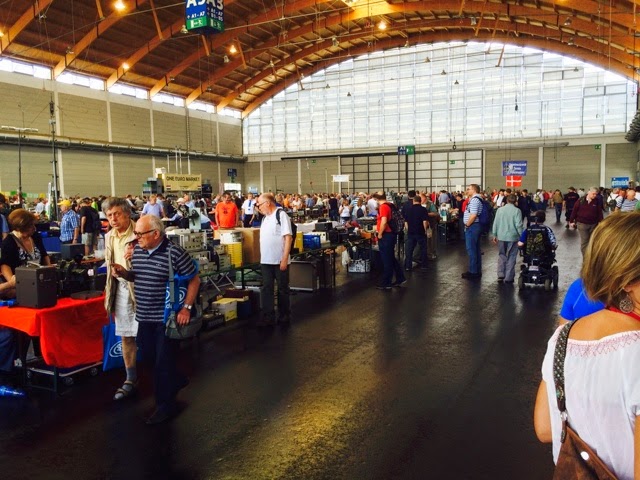
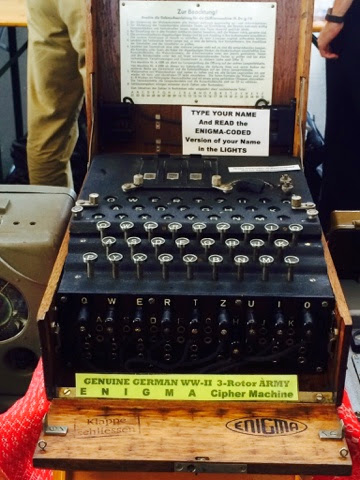
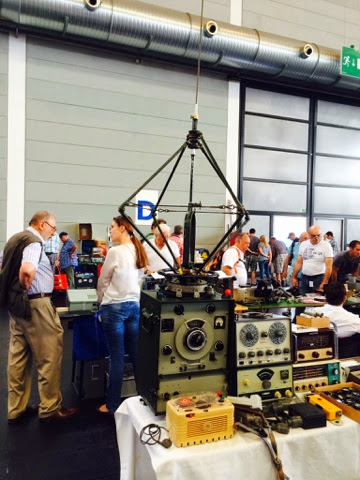
Mike Crownover, AD5A, is a regular contributor to AmateurRadio.com and writes from Texas, USA. Contact him at [email protected].
Pixie and Micro 80
These little QRP transceivers first made an appearance some 20 odd years ago. They are extremely simple transceivers that use the TX PA as the RX mixer to save parts.
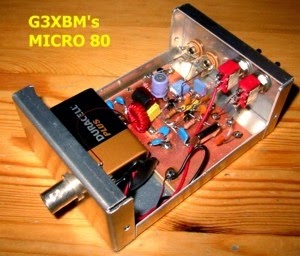
I built a Micro 80 some years ago and my best QSO was around 300km. Biggest issue (for me) was broadcast breakthrough from strong broadcasters just above the 80m band. Variations included the Pixie 2 which added some refinements at the expense of more parts. Kits are available, but the circuits are so simple it is not work paying over the odds for these. The Micro 80 uses all discrete components whereas the Pixie and Pixie 2 use an LM386 for the RX audio.
If you build one, be prepared to fight for contacts. It is not the TX power that is the problem: it is the receiver that is the limitation.Given good conditions and little broadcast breakthrough, these rigs work.
See https://sites.google.com/site/g3xbmqrp3/hf/pixie .
The same basic schematic will work on any HF band with changes to the output filter. Watch out for chirp on the higher HF bands: don’t be tempted to try to pull the crystal too much, especially on the higher HF bands.

Roger Lapthorn, G3XBM, is a regular contributor to AmateurRadio.com and writes from Cambridge, England.
West Coast Day For 6m
 |
| Courtesy DXMAPS.COM |
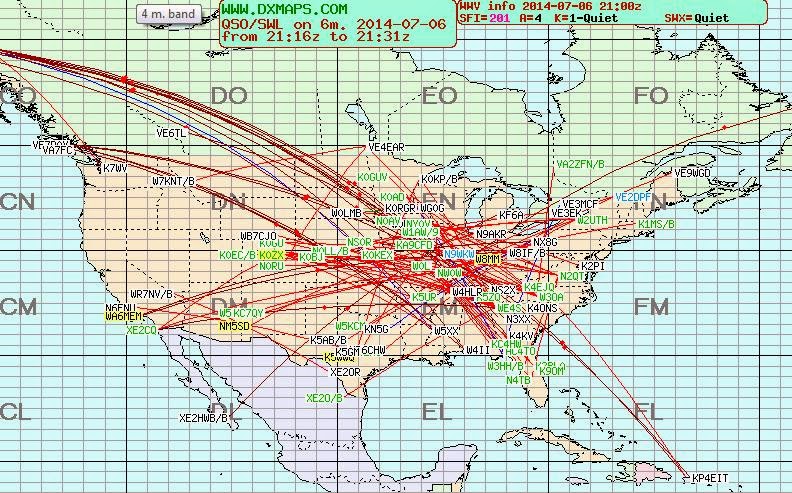
At 0700 I began to hear bits and pieces of CN8KD in Morocco while he was working 4's and 5's ...every once in a while his CQ's would briefly rise out of the noise but never long enough or loud enough for me to reply. He eventually faded and the band shifted to a more northerly path and at around 0900 local time, EA8DBM (Canary Islands, AF) showed up on SSB, while working into the SE U.S.A. He was much louder further to the south but at 1632z I was able to work him on phone and a few minutes later on CW, down the band. In over 40 years of being on 6m, this was only my second African QSO, with my other one also being into EA8.
The best part of the opening today was the number of west coast stations that were able to put rare Africa into the log....and, for a number of them, it was the completion of WAC on 50MHz....very tough from the left coast. VE7DAY, K7SS and NA6XX will all be celebrating today!
As I post this at 2130z, the KL7's are cashing-in on the magic while working across the U.S. as far south as Florida! I've always thought the first week of July to be the best of the season for 6m...lets hope it keeps going.
Steve McDonald, VE7SL, is a regular contributor to AmateurRadio.com and writes from British Columbia, Canada. Contact him at [email protected].
 Ham Radio Deluxe |
 W5SWL Electronics |
 Ham Radio Prep |
 KB3IFH QSL Cards  Hip Ham Shirts  HamRadioAuctions HamRadioAuctions Reliance Antennas Reliance Antennas Enigma Shop Enigma Shop |  morseDX  Ni4L Antennas  R&L Electronics R&L Electronics antennas.us antennas.us QRV QRV |
- Matt W1MST, Managing Editor
