 |
 KX3 antenna failure
 27 July 2014 | by
 I read on the M1KTA blog that an antenna lead on one of his Elecraft KX3 units has failed. I know these have seen some harsh portable field use but I would not have expected this. I have owned an FT817 for close on 14 years and, touch wood, it has never once failed me – still the same PA, same everything.
In my view, the KX3 is overpriced (over here in the UK) and not well built for rugged field use. I don’t doubt it has excellent features and an excellent receiver, but it is still over twice as much as an FT817ND which covers DC to blue light, out of the box ready built. The KX3 is a mess for leads, coming out all over the place. The FT817 is neat, rugged, and compact.
For me, the FT817 still wins.

Roger Lapthorn, G3XBM, is a regular contributor to AmateurRadio.com and writes from Cambridge, England.
The Noise Whisperer

This past Friday, I had a very pleasant visit from Roy Charlesworth from B.C. Hydro. Roy is the Hydro's noise mitigation man for naughty power lines and made his way to Mayne Island on the morning ferry from the mainland.
For the past several years, I have been plagued with severe power line noise to my northwest, virtually killing my opportunity to take part in most 6m openings to Asia. The one or two small rain showers that we might get here in the Gulf Islands during the sporadic-E season, will often wash away enough of the power line crud to quieten things down for a few hours but as soon as the sun is back and the day heats-up, the noise always returns. For the same reason, the lines don't seem to get noisy until around 10 a.m., giving me some early-morning opportunity to listen to a dead-quiet band.
Earlier this spring, I contacted Roy and was added to his list of places to visit. He assured me that he would be over to check out my situation sometime during the summer. Roy is now officially 'retired' from Hydro and was doing similar noise mitigation work at that time. Once retired, Hydro found that his unique skills were still very much in demand and have rehired him on a 'work when you want' contract basis, allowing Hydro to still chip away at the list of complaints.
I recall, not too may years ago, when any complaints to B.C. Hydro about power line noise where just ignored and the only way they would act was if ordered to do so by Industry Canada. With the confusing bureaucratic channels involved, most amateurs just gave up and lived with the noise. Fast track to modern times, where all responsibility for noise mitigation has been placed in Hydro's hands and they are bound by IC mandate to deal with customer noise complaints.
It was apparent when first meeting Roy that he was very familiar with amateur radio 'noise problems' and very knowledgeable about their causes. After demonstrating the noise being heard on 6m on my own receiver, he then deployed a rather unique piece of test gear, a Radar Engineers Model 240 RFI Locator receiver. The 240 tunes from 1.8-1000MHz and is capable of displaying and saving the spectral display of the offending noise signal.
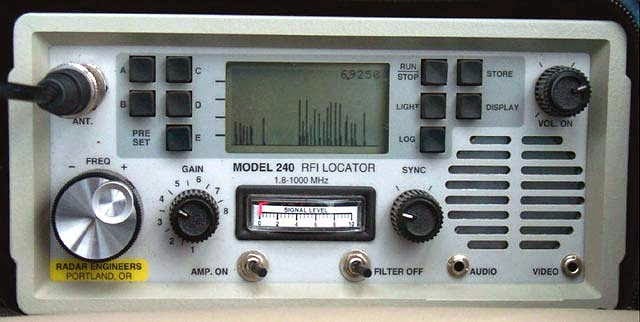
 Being able to see the signature and compare it to the actual suspected source goes a long way in helping to find and cure the problem. Before departing to search the local area, Roy's final check was to check my own house for any possible noise. A quick sweep of the electrical service panel using yet another receiver indicated all was well.
Roy also mentioned that he prefers working with hams since, compared with non-ham noise complainants, they seem very knowledgeable about noise in general and often have narrowed down the source for him...even providing the number of the offending power pole. I had also provided Roy with the numbers of two different poles. I was pretty sure about my number-one candidate pole but not so sure about number-two. Using the sharper pattern of my 9 element 2m Yagi, I was able to get a very good bearing on the noise source.
After being gone for most of the afternoon, Roy returned to explain what he had found. To my delight, he had found three noisy poles within my local neighbourhood, but to my surprise, none were the poles I had suspected! All three however, were on the same bearing as my prime candidate pole, but much further away than I had thought. He also confirmed what I had told him earlier, that all other directions were very quiet. He explained that he would file his findings with Hydro who would create a work order for eventual physical inspection and (hopefully) resolution of the problem. He would also contact me again once that had been done, to see if the noisy poles had been fixed.
I think we are most fortunate, here in B.C., to have a dedicated one-man power line noise mitigation man, in the person of Roy Charlesworth. He is clearly passionate about his task and understands just how devastating power line noise can be for radio amateurs. Unlike many regions in the U.S. where utility companies can stonewall amateurs for years and years, we presently have a very efficient recourse when power lines behave badly.
I sure hope Roy doesn't retire for 'real' anytime soon as I'm not sure he would be easily replaced!
To learn more about power line noise see:
Steve McDonald, VE7SL, is a regular contributor to AmateurRadio.com and writes from British Columbia, Canada. Contact him at [email protected].
Continuing JT65/JT9 today
When we get back from shopping I shall return to JT65-HF and JT9-1 modes hoping to work more stations. Yesterday, staying on 20m, I worked 4 Europeans running 2.5 or 5W. JT65-HF is very intuitive and works well. Althought I have had JT9-1 QSOs on 10m in the past, I suspect the rig stability is “challenging” and JT65-HF gives me a better chance. JT65-HF is some 4dB worse than WSPR but the TX period is only 48 secs (1 minute TX period but actual TX is less) so may be better with QSB? JT9-1 is a narrower bandwidth mode than JT65-HF and is about 2dB worse than WSPR. Of course, JT65 and JT9 are proper QSO modes.
Sunspot count today is 76 (decent) and 20-30MHz conditions are supposed to be “normal” so there could well be some F2 (as well as Es) on 10m today. JT65-HF and JT9-1 on 10m are calling I think.
The great advantage of WSPR is you can set the rig running and monitor things in another room. JT65 and JT9 seem to require “hands on” operation, which is fine.

Roger Lapthorn, G3XBM, is a regular contributor to AmateurRadio.com and writes from Cambridge, England.
Battery problems and a solution
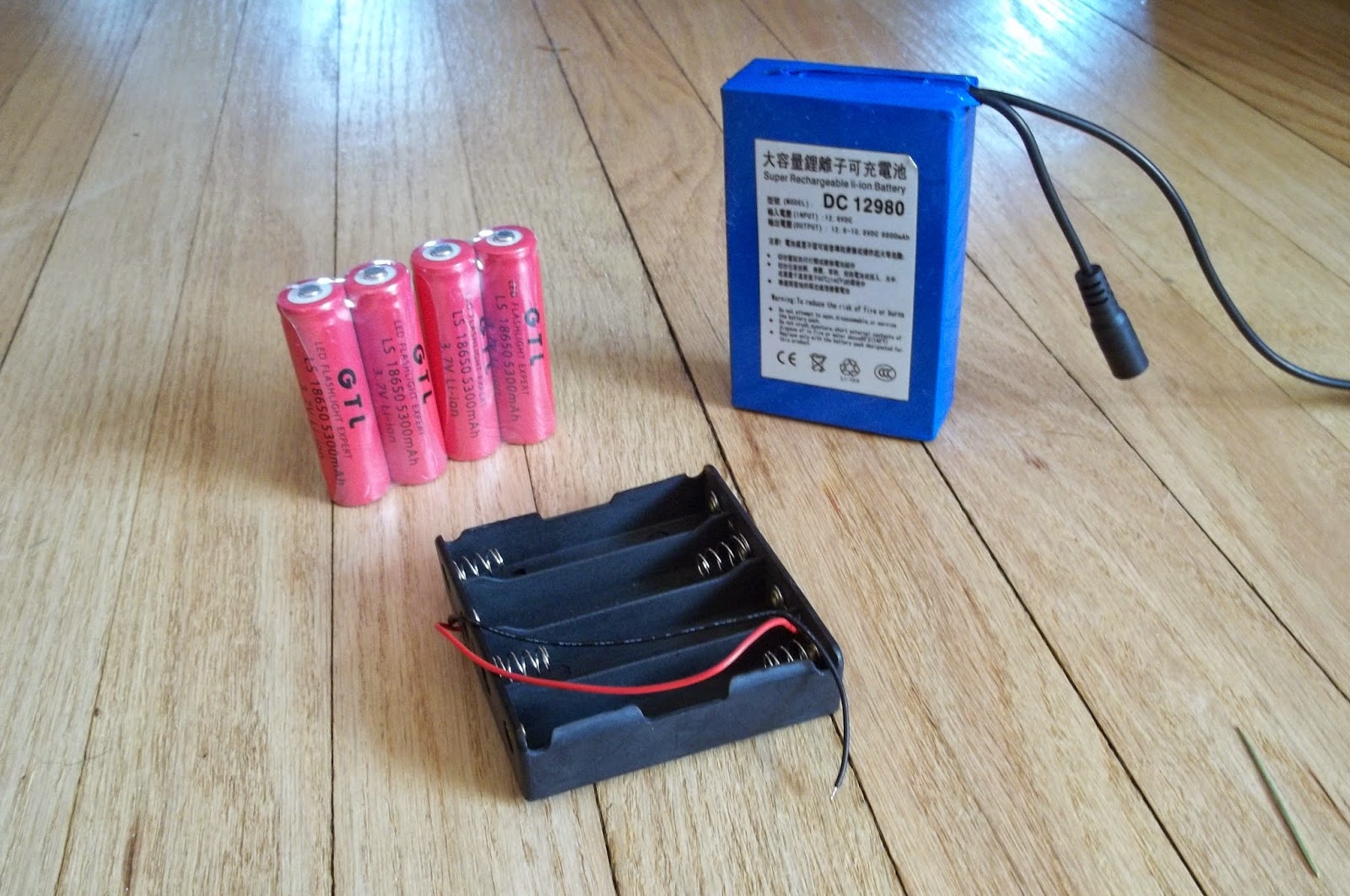
My Chinese Li Ion battery “ol’ Blue” (upper right) has given up the ghost, much the same as Mike VE3WDM has written over at his blog. In my case, the battery will not take a charge. The output from the wall wart charger is perfect, but no matter how long it’s connected to the battery, the battery itself will not charge.
I suspect either a faulty cell or perhaps a fault with the little regulator board that’s inside the blue shrink wrap. So the decision had to be made. Even though the price is relatively cheap, do I buy another Chinese battery or try something else? Do I go back to hauling around my small, but heavy, 5 Ah sealed lead acid battery?
I have a charger that will handle 18650 type Li Ion batteries, as these are what go into the tactical flashlights that I keep in my CERT pack and my radio “Go Pack”. So I figured that since I already have half of what I need, that I would go a different route this time.
I purchased a pack of 10 type 18650 batteries (upper left) from an American vendor. The ones I bought are 3.7V and have a rating of 5300 mAh. I also purchased two of the 4 cell holders that you see above. This gives me two 14.8V, 5300 mAh batteries. All I had to do was solder on the connector that goes directly into the KX3.
I tried them out today and they seem to work without any problems. I will use a fresh charged pack tomorrow for FOBB and will see how long one pack lasts before I have to switch over to the backup pack.
72 de Larry W2LJ
QRP – When you care to send the very least!
Larry Makoski, W2LJ, is a regular contributor to AmateurRadio.com and writes from New Jersey, USA. Contact him at [email protected].
Series Seven Episode Fifteen – Programming with Chirp (27 July 2014)
Series Seven Episode Fifteen of the ICQ Amateur / Ham Radio Podcast has been released. The latest news, Martin (M1MRB & W9ICQ) and Colin (M6BOY) discuss the joy of working and operating a special event station as GA214CG comes live and Martin (M1MRB & W9ICQ) reviews Programming with Chirp.
- Thai hams get special permission for 6 metres
- UK CubeSail Amateur / Ham Radio Satellite
- Wirral Grammar School for Girls launch 434 MHz balloon
- Top Ten finish for UK Team in WRTC
- Spanish 5 MHz experimental period extended
- Andorra joins 5MHz allocations
- New Zealand Amateur / Ham radio Brass Monkey Contest
- Communicate with 'walkie talkie' dongle
- New Amateur / Ham radio Licences in Ireland
- 144 MHz channels to be used for the Commonwealth Games
- 20th Commonwealth Games, Galsgow 2014 Special Event
Colin Butler, M6BOY, is the host of the ICQ Podcast, a weekly radio show about Amateur Radio. Contact him at [email protected].
Series Seven Episode Fifteen – Programming with Chirp (27 July 2014)
Series Seven Episode Fifteen of the ICQ Amateur / Ham Radio Podcast has been released. The latest news, Martin (M1MRB & W9ICQ) and Colin (M6BOY) discuss the joy of working and operating a special event station as GA214CG comes live and Martin (M1MRB & W9ICQ) reviews Programming with Chirp.
- Thai hams get special permission for 6 metres
- UK CubeSail Amateur / Ham Radio Satellite
- Wirral Grammar School for Girls launch 434 MHz balloon
- Top Ten finish for UK Team in WRTC
- Spanish 5 MHz experimental period extended
- Andorra joins 5MHz allocations
- New Zealand Amateur / Ham radio Brass Monkey Contest
- Communicate with 'walkie talkie' dongle
- New Amateur / Ham radio Licences in Ireland
- 144 MHz channels to be used for the Commonwealth Games
- 20th Commonwealth Games, Galsgow 2014 Special Event
Colin Butler, M6BOY, is the host of the ICQ Podcast, a weekly radio show about Amateur Radio. Contact him at [email protected].
More JT65 QSOs
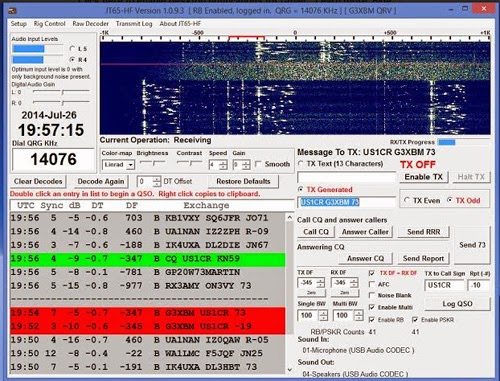
This evening I went on 20m JT65 again and managed a couple of European QSOs in reply to the CQs of others. I am using JT65-HF software that is very simple to use. So far I have used the FT817 at either 2.5 or 5W.
 |
| JT65-HF screenshot |
If you see a station calling CQ (shows up in green) you just click on it to start a QSO with that station. If he copies you and replies then the started QSO shows up in red – all very simple. Wonder if there is a similar (easy) package for JT9-1 on HF?
Looking on PSK Reporter I see plenty of USA stations were copying me too, so it should not be too hard to work DX with just a little effort even with my compromise antenna. When 10m and 6m are open, DX should be easier still.
With JT65-HF and JT9-1, I have to be in the shack, but at least there is no speaking, saving my poor voice.

Roger Lapthorn, G3XBM, is a regular contributor to AmateurRadio.com and writes from Cambridge, England.
 Ham Radio Deluxe |
 W5SWL Electronics |
 Ham Radio Prep |
 KB3IFH QSL Cards  Hip Ham Shirts  HamRadioAuctions HamRadioAuctions Reliance Antennas Reliance Antennas Enigma Shop Enigma Shop |  morseDX  Ni4L Antennas  R&L Electronics R&L Electronics antennas.us antennas.us QRV QRV |
- Matt W1MST, Managing Editor
