 |
 Video from the ARRL Centennial Convention
 8 August 2014 | by
 Randy Hall, K7AGE, is a regular contributor to AmateurRadio.com , produces amateur radio videos, and writes from California, USA. Contact him at [email protected].
472kHz – improvements?

Using the strapped feeder to my Par 10/20/40m as my 472kHz antenna rather than my 2m/70cm feeder, the antenna current has nearly doubled with the antenna current meter now showing 30-33uA whereas it was 18uA before. This suggests ERP has increased by around 4-5dB (ERP proportional to I^^2), but we’ll see later. The Par antenna itself is lower than the 2m/70cm antenna and runs horizontally to a tree. Average height is around 3-4m AGL. The losses may be greater.
The picture shows the 472kHz coil used (a ferrite rod would be fine but since moving it is “lost”), the 472kHz homebrew transverter (left) and the 3C90 matching coil between transverter and antenna (towards centre, LHS of coil). The small meter measures antenna current and registered 18uA last night and 30-33uA now with the Par antenna with strapped feeders.
UPDATE 1420z: G8HUH (250km) is copying in daylight a full 8dB S/N better than last night. Encouraging.
UPDATE 1448z: M0PPP (182km) seems to be coming in stronger than last night too and in broad daylight.
UPDATE 1700z: M0PPP is now spotting me at 1456z, 1538z and 1620z i.e. in daylight. He was not copying me at all last night, so I think my signal IS stronger.

Roger Lapthorn, G3XBM, is a regular contributor to AmateurRadio.com and writes from Cambridge, England.
Amateur Radio Newsline Report 1930 August 8 2014
- Targeted shortwave broadcasting may come end from the United States
- ARRL issues an update on the Amateur Radio Parity Act
- Ham radio floater balloon completes a trip around the world
- Students get introduced to amateur radio in India
- Ham radio will again celebrate Hollywood this September
Rocky Mountain Rendezvous
We had a Dutch cookout on Friday night which attracted all the finest people including, Bryan N0BCB w/XYL and friends,Walt W0CP w/XYL, Dave NN5K w/XYL. Seems like some others, but these are who I can remember. We had a great time grilling burgers, steaks, brats, etc... and swapping SOTA stories.
The RMR coincided with the 14er event put together by Bob K0NR, who stopped by the SOTA house on Saturday night along with his XYL Joyce, K0JJW. The event is an annual event (ham14er.org) which encourages hams to actuvate one of the 14,000 ft. summits in Colorado. As a SOTA chaser and activator, it is a cool event with lots of activity on both HF and VHF.
While in Colorado I was able to active 3 Summits, Kaufman Ridge (10,700 ft. ASL) W0C/SP-081, Horseshoe Mountain (13,900 ft. ASL) W0C/SR-064 and Mt. Sherman (14,034 ft. ASL) W0C/SR-061.
My grandsons and I were fortunate to be able to climb Kaufman Ridge with Steve, WG0AT and he two SOTA Goats, Barley and Acorn. We had a great hike and my grandsons loved interfacing with the goats. Steve did a video of our climb and it can be found at the link below.
https://www.youtube.com/watch?v=EcWGh7Wl3Gw
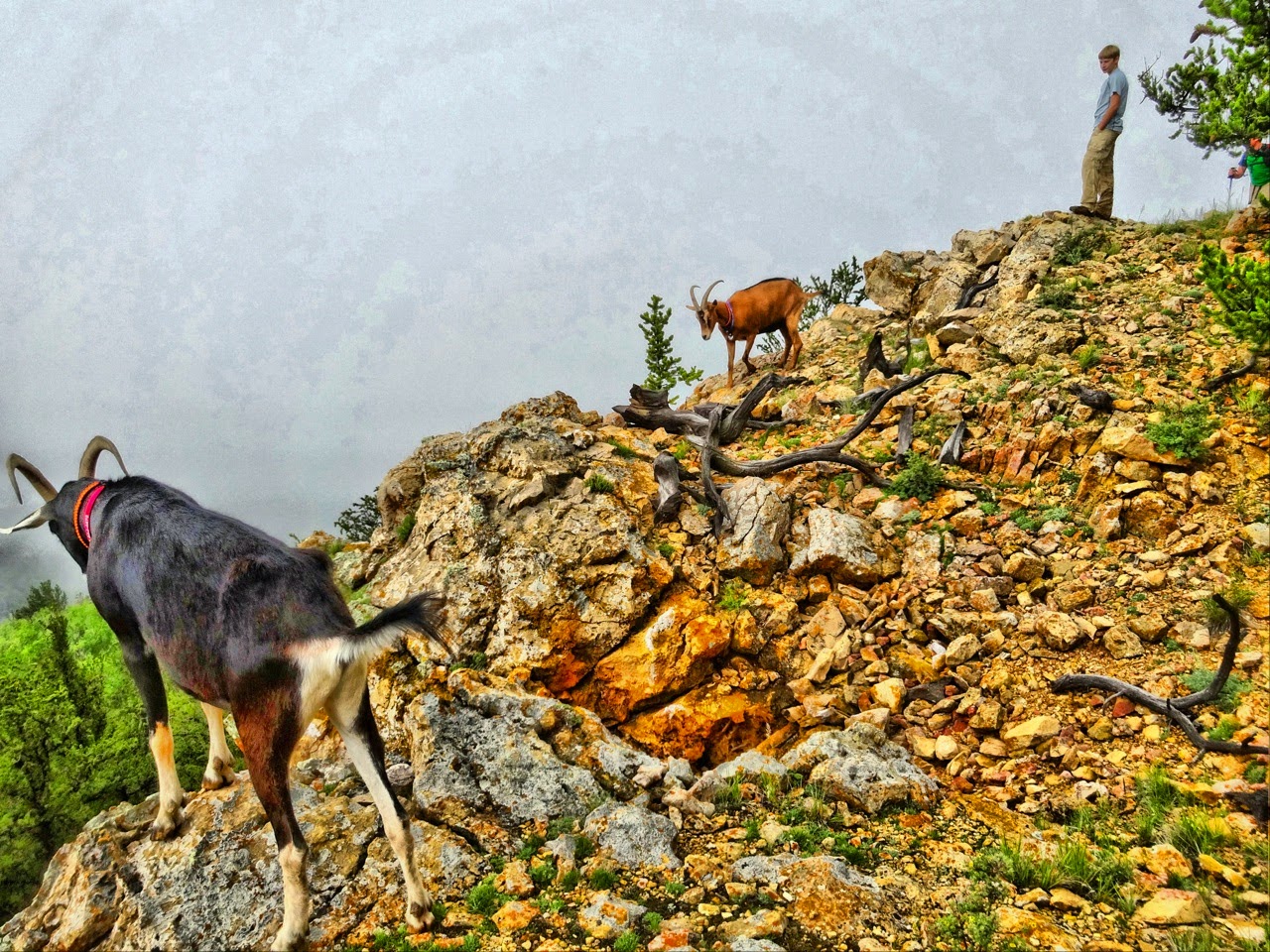
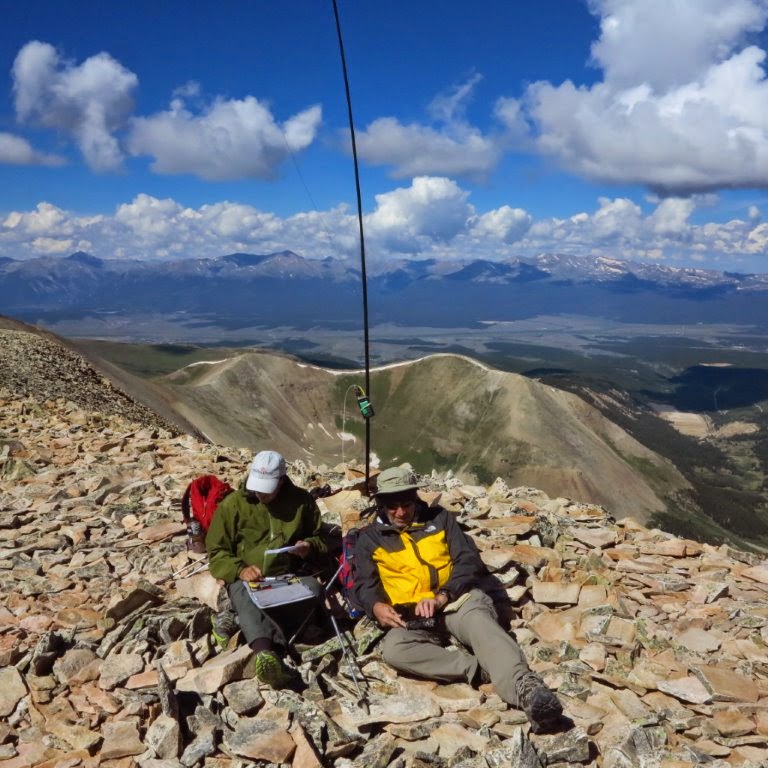

It was a great trip and something all SOTA activators should consider doing.
Mike Crownover, AD5A, is a regular contributor to AmateurRadio.com and writes from Texas, USA. Contact him at [email protected].
WSPR on 5 bands
For the first time ever I have been spotted on all the five bands that my Ultimate3 QRSS/WSPR kit (G0UPL design) is transmitting on. This is after 2-3 days of transmitting.
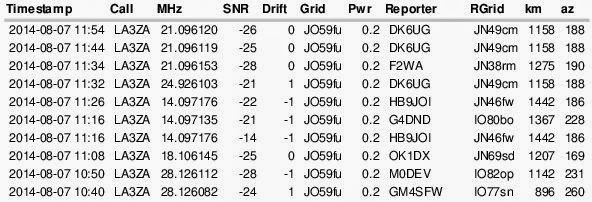
Right now I am using the beacon for discovering if the bands should open up on 24 and 28 MHz. The other three bands, and especially the 14 MHz band, serve as references to tell me that the transmitter is working. My antenna is not so optimal so I would be surprised if I am spotted far outside Europe. It is an end-fed 5 m long half wave vertical dipole which isn’t too bad for 28 and 25 MHz, and probably not very good at all on 21, 18, and 14 MHz.
Sverre Holm, LA3ZA, is a regular contributor to AmateurRadio.com and writes from Norway. Contact him at [email protected].
AmateurLogic 69 Live Stream
We will be shooting AmateurLogic 69 Saturday August 9th at 7:00 PM CDT, 0000 UTC.
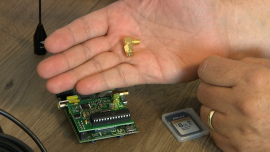
Tommy’s got something special to show you this time!
You can watch the live stream at live.amateurlogic.tv.
And join us in the chat room at amateurlogic.tv/chat.
George Thomas, W5JDX, is co-host of AmateurLogic.TV, an original amateur radio video program hosted by George Thomas (W5JDX), Tommy Martin (N5ZNO), Peter Berrett (VK3PB), and Emile Diodene (KE5QKR). Contact him at [email protected].
Your LF Station’s Best Friend – The Scopematch PT.II
 As mentioned in Part I, my construction of the MØBMU-designed Scopematch has proven to be the most valuable piece
of test gear in my LF station. If you plan to become active on our new 630m
band, it is well worth taking a few hours to build as it will make antenna
tuning much, much easier than trying to get your antenna tweaked using other
methods.
As mentioned in Part I, my construction of the MØBMU-designed Scopematch has proven to be the most valuable piece
of test gear in my LF station. If you plan to become active on our new 630m
band, it is well worth taking a few hours to build as it will make antenna
tuning much, much easier than trying to get your antenna tweaked using other
methods.After building and installing the new Scopematch, a quick check of what I thought had been a properly-tuned system, surprisingly revealed that my 2200m antenna was neither matched correctly nor tuned to resonance! In spite of my poor-tuning (using the system shown in my last post), I had still received a number of encouraging reception reports from VE6, Washington and Oregon, giving me false and undeserved confidence in my earlier tuning attempts. The Scopematch soon changed all that.
The complete building instructions and operating description for the Scopematch may be found in "Tuning Aids for the 136kHz and 500kHz Bands" by Jim Moritz, MØBMU.
 |
| Source: Tuning Aids for the 136kHz and 500kHz Bands by Jim Moritz, MØMBU |
As can be seen, a small RF sample taken by the Scopematch is coupled to the inputs of a dual-trace oscilloscope...one channel displaying the antenna current waveform and the other displaying the voltage waveform. When the antenna system has been tuned to resonance and matched to 50 ohms, both sine waves will be equal, in both phase and magnitude as shown below.
Such a condition is ideal and virtually guarantees that your transmitter is looking into a non-reactive 50 ohm load. Many transmitter designs utilized on LF employ inexpensive switching MOSFETs operating in either class-D or class-E modes that cannot tolerate any reactance in their output load. The end result of such a condition quickly produces a growing pile of dead MOSFETs!
 | |||
| Source: Tuning Aids for the 136kHz and 500kHz Bands by Jim Moritz, MØMBU |
If the system is not tuned to resonance, the phase of the waveforms will not be the same and one waveform will lead the other. Whichever waveform is doing the leading indicates whether the antenna is tuned above or below the desired frequency so that proper corrective measures can be taken to achieve resonance.

| Source: Tuning Aids for the 136kHz and 500kHz Bands by Jim Moritz, MØMBU |
The condition shown above illustrates the smaller waveform (V) lagging the larger current waveform (I) which indicates the antenna is capacitive or too high in frequency.With 'I' being greater than 'V', the resistive component of the load measures about 20 ohms.
The condition shown below indicates resonance but with 'V' being greater than 'I', the resistive component of the load measures about 80 ohms.
 |
| Source: Tuning Aids for the 136kHz and 500kHz Bands by Jim Moritz, MØMBU |
The impedance match will be indicated by the amplitude of the two waveforms. Depending on which waveform is higher or lower indicates if the resistive impedance component is higher or lower than 50 ohms. Actual impedance values can be calculated from Ohm's Law using the sampled
waveform values.
It is fascinating to watch the scope patterns during windy conditions when the antenna's large tophat section is being blown around, causing slight changes in impedance and resonance. The two waveforms will expand and contract as well as shift phase slightly...almost as if the system is alive and breathing!
 |
| My 2200m antenna - resonant and matched & a thing of beauty! |
Jim's article goes into much more depth as well as showing alternative methods of construction and is very much worth studying. Over the last few years I have suggested the Scopematch to several LFers who, like me, now wonder how they ever lived without it!
Steve McDonald, VE7SL, is a regular contributor to AmateurRadio.com and writes from British Columbia, Canada. Contact him at [email protected].
 Ham Radio Deluxe |
 W5SWL Electronics |
 Ham Radio Prep |
 KB3IFH QSL Cards  Hip Ham Shirts  HamRadioAuctions HamRadioAuctions Reliance Antennas Reliance Antennas Enigma Shop Enigma Shop |  morseDX  Ni4L Antennas  R&L Electronics R&L Electronics antennas.us antennas.us QRV QRV |
- Matt W1MST, Managing Editor
