 |
 Smoke Testing The GW3UEP 630m Transmitter
 7 September 2014 | by
  |
| Drain (top) vs Gate (lower) on testbed Class-E GW3UEP TX |
I've just completed the Muppet-styled printed circuit version of my previously breadboarded GW3UEP 630m transmitter. The earlier version was built "ugly style" in order to optimize part values and measure circuit parameters.
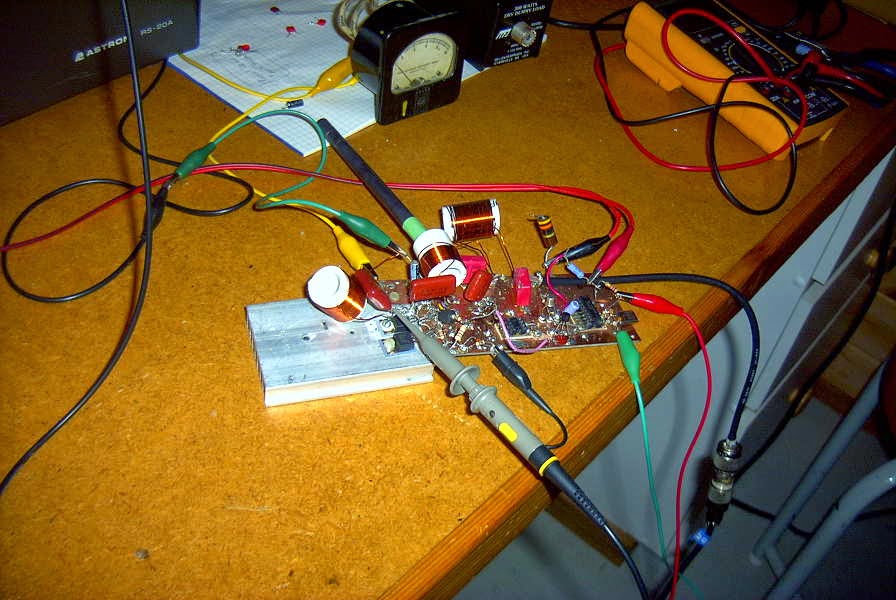 |
| Testbed (Ugly-Style) |
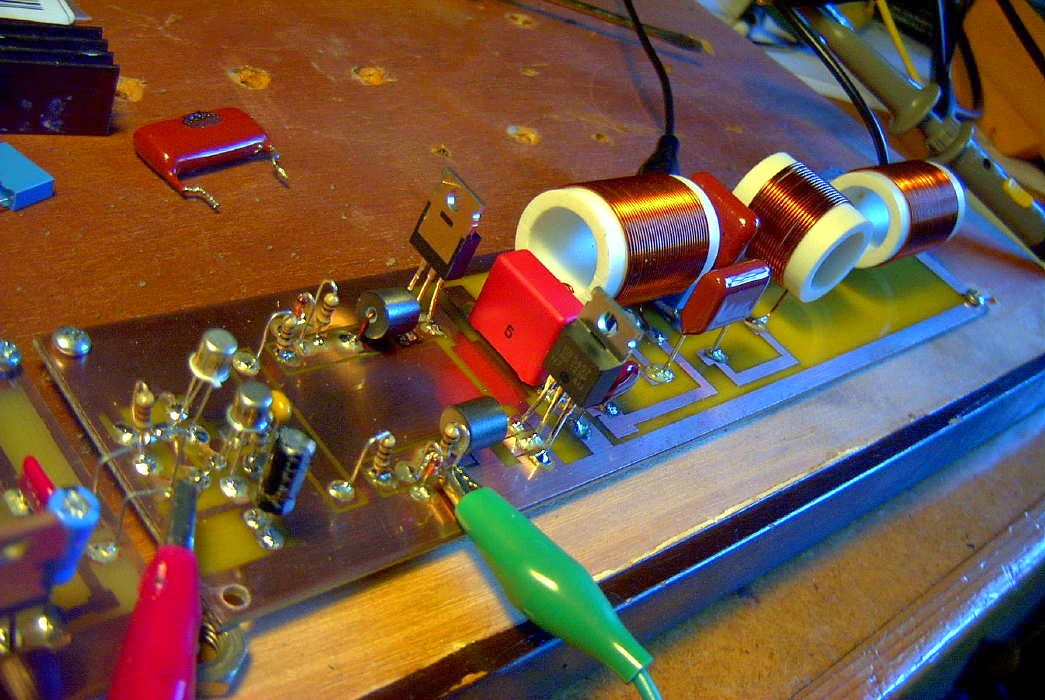 |
| Final Version (Muppet-Style) |
Running the TX at 12.8VDC on the drain(s) at 2.3A produces an input power of 29W. The measured power out, after the LPF, is 23W into a 50 ohm load. This represents an efficiency of 80%. When run in the normal speed CW mode, the FETs run cool enough that they would probably not even need a heatsink but if run in any of the QRSS (long keydown periods) modes, would certainly benefit from heatsinking.
Running the TX at a higher voltage of 22.6VDC (on the amplifier only) yields a current of 4A for an input of 90W. Measured output power is 71W for an efficiency of 79%.
Heatsinking would be required at this power level, even for normal speed CW but the finals seem to run just slightly warm. A larger heatsink or possibly a small fan as well would be required for any QRSS CW modes.
I suspect that the efficiency could be further improved yet with very fine tweaking of the output circuit L/C network but the extra few watts gained would not be significant.
At either power level, this easy-to-build transmitter would make a great "first 630m transmitter" for anyone wanting to get started on our new band.
Steve McDonald, VE7SL, is a regular contributor to AmateurRadio.com and writes from British Columbia, Canada. Contact him at [email protected].
Series Seven Episode Eighteen – Bill Meara N2CQR (07 September 2014)
Series Seven Episode Eighteen of the ICQ Amateur / Ham Radio Podcast has been released. The latest news, Martin (M1MRB & W9ICQ) and Colin (M6BOY) the history of Amateur Radio Exam passes and Martin (M1MRB & W9ICQ) interviews Bill Meara N2CQR.
- Sotabeam End Fed Tuner Kit
- Schedule for RSGB Convention released
- The first Greek microsatellite is a fact!
- Yaesu FT-991 KW/50/144/430 MHz Transceiver
- Southend & District Amateur Radio Special Event
- New Zealand's Prohibited Equipment Notice updated
- Western Australia gets Summits on the Air
- 90th Anniversary of first UK-NZ contact
Colin Butler, M6BOY, is the host of the ICQ Podcast, a weekly radio show about Amateur Radio. Contact him at [email protected].
Series Seven Episode Eighteen – Bill Meara N2CQR (07 September 2014)
Series Seven Episode Eighteen of the ICQ Amateur / Ham Radio Podcast has been released. The latest news, Martin (M1MRB & W9ICQ) and Colin (M6BOY) the history of Amateur Radio Exam passes and Martin (M1MRB & W9ICQ) interviews Bill Meara N2CQR.
- Sotabeam End Fed Tuner Kit
- Schedule for RSGB Convention released
- The first Greek microsatellite is a fact!
- Yaesu FT-991 KW/50/144/430 MHz Transceiver
- Southend & District Amateur Radio Special Event
- New Zealand's Prohibited Equipment Notice updated
- Western Australia gets Summits on the Air
- 90th Anniversary of first UK-NZ contact
Colin Butler, M6BOY, is the host of the ICQ Podcast, a weekly radio show about Amateur Radio. Contact him at [email protected].
Here’s a little something I came up with
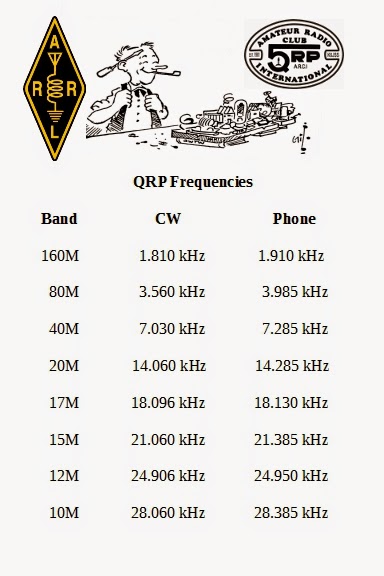
Feel free to save the JPG as an image on your own computer and print it out, if you like. I also have it as a doc file if you'd like to edit to suit your needs. An e-mail request will get it sent to you.
72 de Larry W2LJ
QRP - When you care to send the very least!
Larry Makoski, W2LJ, is a regular contributor to AmateurRadio.com and writes from New Jersey, USA. Contact him at [email protected].
I was asleep at the wheel
Jim shared his thoughts on the changing face of Amateur Radio in celebration of the ARRL's 100th anniversary, but yet focused on the things that remain the same through the changes. The joy, the excitement, the satisfaction, the fun.
Good article, Jim and I'm glad the Newington Bunch had the good sense to publish it!
72 de Larry W2LJ
QRP - When you care to send the very least!
Larry Makoski, W2LJ, is a regular contributor to AmateurRadio.com and writes from New Jersey, USA. Contact him at [email protected].
Yaesu FT991 prices?
Has anyone any idea of the likely UK price of this new radio?
It would be excellent if they released one of the low powered versions (normally available in Japan) for UK and Europe too. I think the lower powers are for some Japanese licence classes? It is a lower powered version I quite fancy. 10W or 30W max.
My FT817 units have been excellent buys as have the VX1 and VX2 handhelds. You could call me a Yaesu fan.
I want to concentrate on operating for the next few years. My stroke currently gives me little choice as building and real field experimentation are out of the question, sadly, for a while.

Roger Lapthorn, G3XBM, is a regular contributor to AmateurRadio.com and writes from Cambridge, England.
Tuggle-Style LF Regens
 If the name sounds familiar, you may recognize it from reading about the DX crystal radios that Mike Tuggle has created over the past several years. Some might even say that his state-of-the-art and very elegant "Lyonodyne 17" crystal radio re-kindled the modern day interest in crystal radio DXing, once the mainstay of all radio adventures.
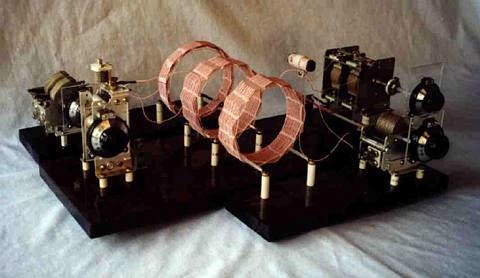 |
| Mike Tuggle's Lyonodyne 17 Crystal DX Tuner |
The challenge was too hard to resist for many and the contest was popular for several years running. Some of the inventive entries for individual years may be seen here. The contest logbooks also make for interesting reading and demonstrate the capability of some of these simple radios.
Although the contest has not been run for the past few years, there is still much interest and discussion of "1AD" radios on Dave Schmarder's "RadioBoard" forum.
Mike's LF tuner is a prime example as he uses it daily and continues to post some amazing DX to the Yahoo "ndblist" Group. His furthest ndb catch in North America with the regen has been "YY" in Mont Joli, Quebec.
Now, "YY" is a good catch for me, from B.C., but Mike is listening from Kaneohe, Hawaii !
You can read about Mike's original design here, while his latest version shown below, incorporates a dedicated LF antenna tuner.
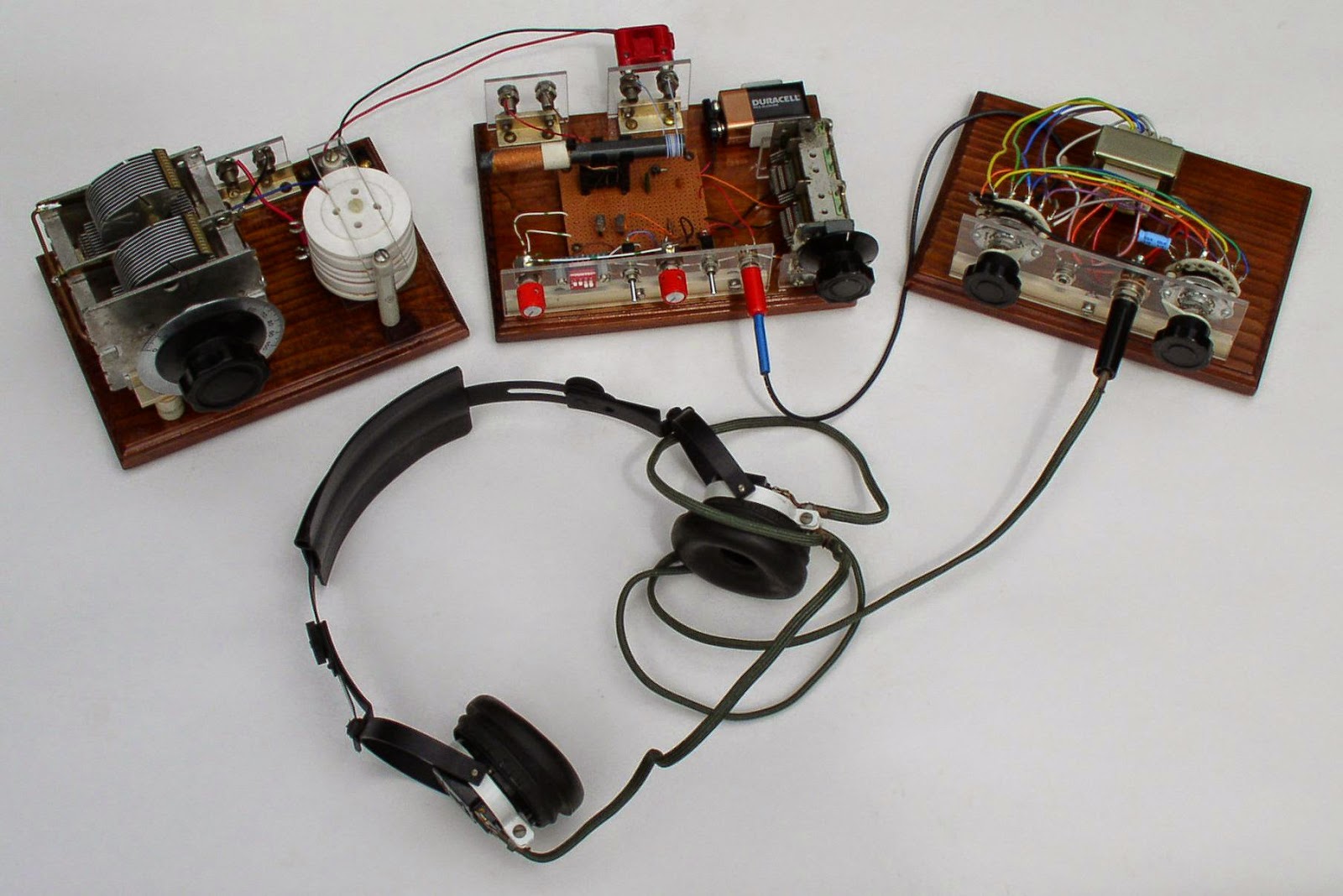 |
| LF Regen (Courtesy Mike Tuggle) |
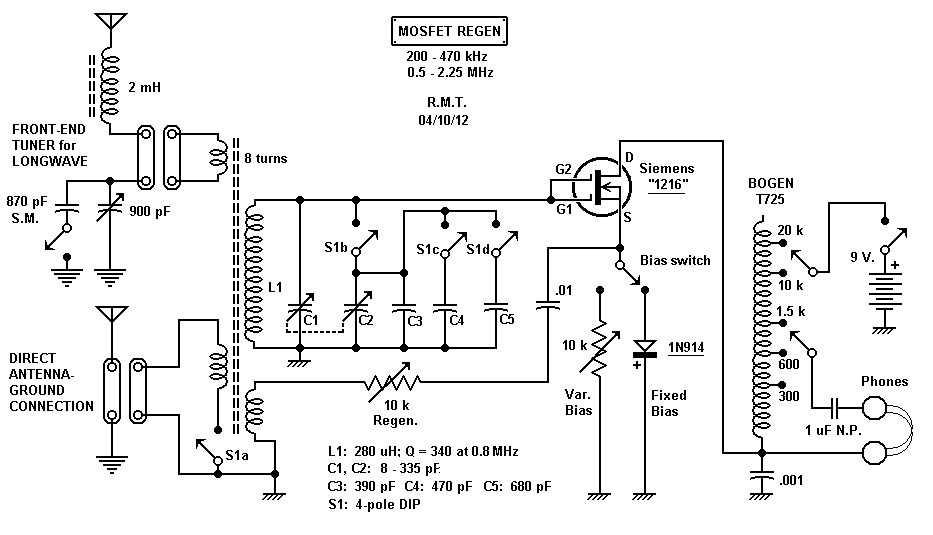 |
| LF Regen Schematic (courtesy Mike Tuggle) |
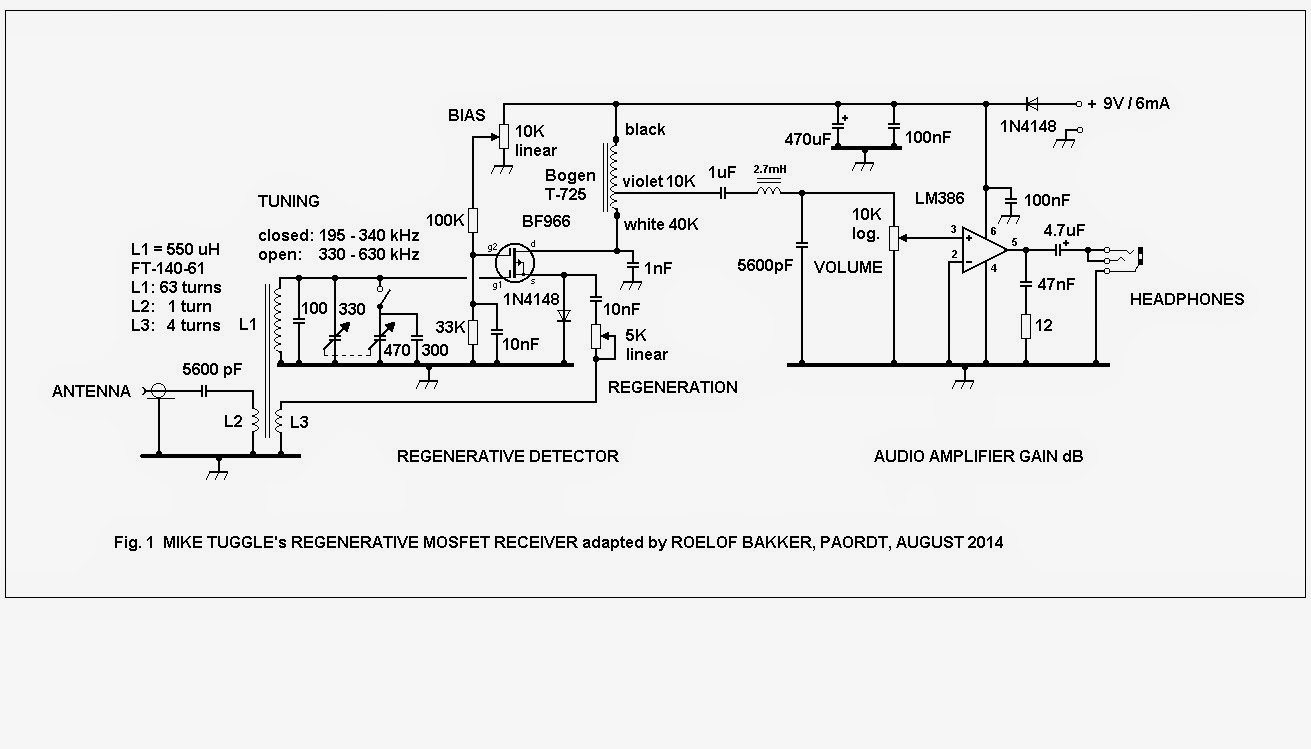 |
| Courtesy: Roelof Bakker, PAØRDT |
Roelof has also published a nice write-up describing the project which sparked a lot of "must build" discussion within the group.....even enough to make Mike get out his soldering iron and build the European-version!
As old and as simple as they are, regenerative receivers still hold much fascination amongst radio builders and dollar-for-dollar are amazingly good performers, especially on LF.
Steve McDonald, VE7SL, is a regular contributor to AmateurRadio.com and writes from British Columbia, Canada. Contact him at [email protected].
 Ham Radio Deluxe |
 W5SWL Electronics |
 Ham Radio Prep |
 KB3IFH QSL Cards  Hip Ham Shirts  HamRadioAuctions HamRadioAuctions Reliance Antennas Reliance Antennas Enigma Shop Enigma Shop |  morseDX  Ni4L Antennas  R&L Electronics R&L Electronics antennas.us antennas.us QRV QRV |
- Matt W1MST, Managing Editor
