 |
 GQRP Club and SPRAT
 30 November 2014 | by
I have many times said that if all radio magazines had to go, then GQRP Club’s SPRAT would be the very last to go. This quarterly magazine is low in cost, very high in simple projects to build and the back page always has GQRP Club sales items.
Of ALL the magazines I see, SPRAT is without doubt the best. Back numbers of this excellent magazine are available on a DVD.
This is a little (sized) magazine but it is excellent value. The best in fact.

Roger Lapthorn, G3XBM, is a regular contributor to AmateurRadio.com and writes from Cambridge, England.
Series Seven Episode Twenty-Four – Baofeng BF-888 Review and Repair (30 November 2014)
Series Seven Episode Twenty-Four of the ICQ Amateur / Ham Radio Podcast has been released.In this episode, Martin M1MRB / W9ICQ is joined by Ed Durrant DD5LP, Martin Rothwell M0SGL and Matthew Nassau 2E0MTT to discuss the latest Amateur / Ham Radio news. Colin M6BOY rounds up the news in brief, and this episodes feature is Baofeng BF-888 repair / review by Martin Butler M1MRB, W9ICQ and Chris Howard M0TCH.
- Why is ham radio more popular than ever?
- December is YOTA month
- RSGB Youth Committee Chair announced
- OSCAR Locator App
- Schofield School Radio Club nears Top for Contacts
- Worked All Ireland Amateur / Ham Radio Award
- Electronic Coins via Ham Radio?
- Real-time Amateur / Ham Radio Band Conditions Website
- New Radio Propagation Questions Forum
- Advanced Distance Learning Course
- Steve Unger named acting Ofcom Chief Executive
Colin Butler, M6BOY, is the host of the ICQ Podcast, a weekly radio show about Amateur Radio. Contact him at [email protected].
Series Seven Episode Twenty-Four – Baofeng BF-888 Review and Repair (30 November 2014)
Series Seven Episode Twenty-Four of the ICQ Amateur / Ham Radio Podcast has been released.In this episode, Martin M1MRB / W9ICQ is joined by Ed Durrant DD5LP, Martin Rothwell M0SGL and Matthew Nassau 2E0MTT to discuss the latest Amateur / Ham Radio news. Colin M6BOY rounds up the news in brief, and this episodes feature is Baofeng BF-888 repair / review by Martin Butler M1MRB, W9ICQ and Chris Howard M0TCH.
- Why is ham radio more popular than ever?
- December is YOTA month
- RSGB Youth Committee Chair announced
- OSCAR Locator App
- Schofield School Radio Club nears Top for Contacts
- Worked All Ireland Amateur / Ham Radio Award
- Electronic Coins via Ham Radio?
- Real-time Amateur / Ham Radio Band Conditions Website
- New Radio Propagation Questions Forum
- Advanced Distance Learning Course
- Steve Unger named acting Ofcom Chief Executive
Colin Butler, M6BOY, is the host of the ICQ Podcast, a weekly radio show about Amateur Radio. Contact him at [email protected].
630m Resources – Part 3

Probably the most-often discussed ham radio topic is that of 'antennas' and with LFers it is no different.
When it comes to antennas used for receiving,
you might be surprised to learn that even small, simple antennas, can be very effective on 630m. Small loops are easy to build and work well as they are often quieter than wire antennas and with preampflication, will usually yield a better signal-to-noise ratio.
The shielded Burhan's loop described here, is a good performer on 630m and below, while a tuned wire loop can be just as effective if resonated to 630m.
Easily built active antennas are also popular and once situated in a quiet spot in your backyard, can work extremely well, considering their size and simplicity. The PAØRDT active antenna is popular worldwide and offers good performance, if properly placed, as shown in this LF bandscan from Japan.
Several of the stations that I recently worked on crossband, from 630m to HF, were using their normal HF dipoles to listen on 630m. Often times a non-resonant antenna, such as an 80m dipole, can give reasonably quiet performance and is worth trying should you just want to listen. Others have used HF dipoles with the feedline shorted and fed as a top-loaded vertical (T), and resonated to 630m against a small radial ground. Try what you presently have and you may be surprised at what you can hear.
Transmitting antennas need not be large to enjoy 630m propagation. For most backyards, an inverted 'L' antenna would probably be the easiest to configure.
If you have a tower, the vertical portion of the 'L' could be hung from a support arm off of the tower, with the horizontal portion as long and as high as possible. If you have some trees to hang wires from, a center-fed 'T' antenna would also be effective.
 |
| Top-loaded 'T' Antennas. Courtesy: http://en.wikipedia.org/wiki/T-Antenna |
In both of these examples, try and get as much 'vertical' as possible and then work on the top-hat portion. Top-hats with multiple wires will also increase antenna efficiency. An interesting paper by VK2DX, explains the process that he used to build and match a simple inverted 'L'.
 | |
| Courtesy: VK2DX |
As well, JUMA publishes an informative application note on building an 'L' for 630m.
If you don't have room for one of these types of antennas, effective results can also be had with short top-loaded radiators as used at many NDB installations. Try to go as high as you can and make the top-hat as large as possible.
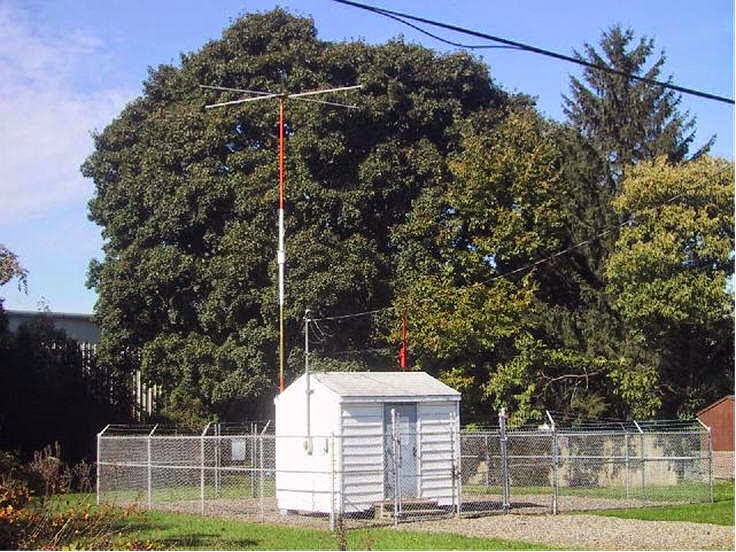
Any of the transmitting antennas described above will require sufficient series inductance (base loading usually) to bring them to resonance as well as some form of variometer to fine-tune exactly. As well, they all require some form of ground system to radiate.
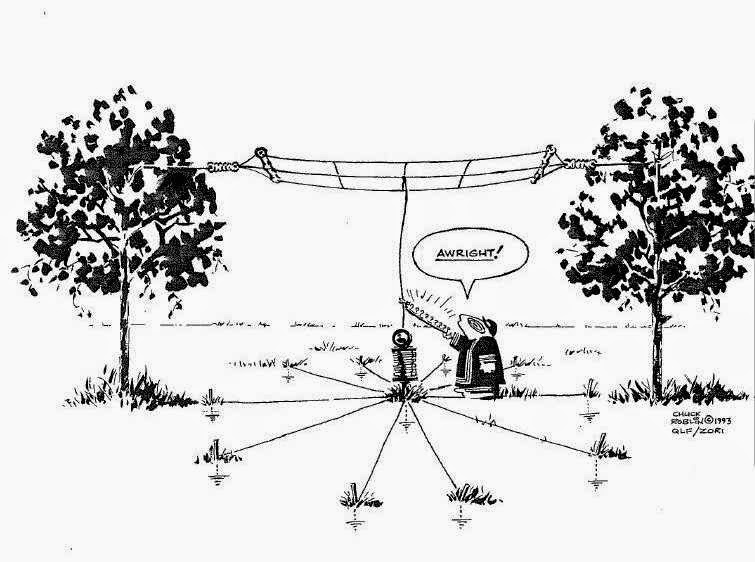
Since most backyards will never be large enough for an efficient ground system on 160m, let alone on 630m, just do the best that you can. You might be surprised at the results achieved with just a simple system of a few buried radials but the more you can lay down, the better. Radials can be effectively hidden beneath the grass with a few days of effort. Some have noted an increase in antenna current when ground rods were driven in at the far end of the radials.
 |
| Courtesy: http://www.auroralchorus.com/ |
This well-written series of articles describing simple antenna systems for the 1750m band is chalk-full of neat ideas and practical information...all applicable to the 630m band.
For an even more in-depth look at practical LF and MF antennas, the ON7YD site is hard to beat...again, all applicable to 630m.
Canada's new 630m band is a wonderful opportunity to build and experiment with all aspects of your station and it's crying out for activity!
It's still not too late to be the first station on 630m from most parts of Canada and the VE7's are waiting to work you!
Steve McDonald, VE7SL, is a regular contributor to AmateurRadio.com and writes from British Columbia, Canada. Contact him at [email protected].
The Spectrum Monitor — December, 2014

Stories you’ll find in the December, 2014 edition:
The Radio Rovers of the 1920s
By John Schneider W9FGH
Americans spent $60 million on radio sets and parts in 1922, and businessmen and hobbyists fed the radio craze by building hundreds of new broadcasting stations. Almost overnight, the radio spectrum was packed with signals from all around the country—the number of licensed stations went from 28 in January to 670 by the end of the year. But there were still many smaller cities and towns that did not yet have their own broadcast stations. To serve these cities a special class of “portable” station license was created.
Mystery Regenerative Radio
By Rich Post KB8TAD
Rich Post spotted a radio at an antique radio swap meet and was immediately drawn to it. From a distance, he thought it looked like a Lafayette Explor-Air KT-135 regenerative receiver. It used the same tubes as the Lafayette, but so did nearly all regenerative sets from the 1950s and 60s, including the Allied Knight-kit Space Spanner and the Heathkit GR-81. But who actually manufactured the set?
Testing Those Capacitors
By Rich Post KB8TAD
If you ask most radio restorers, what part or parts most often need replacement, they will answer “capacitors.” Rich has been repairing radios for over half a century, and, back in the day, often had to replace some of the capacitors. Now, those capacitors are often themselves a half-century or older. What could happen to that circuit if the capacitor was leaky or shorted? How likely is it to short? How can you test it to be sure?
Vint Hill Farms Cold War Museum Traces History of Cutting-edge Communications
By Cory Koral K2WV (Photos courtesy of Gary Morgan, Founding Member, The Cold War Museum)
Current simmering East-West tensions brings to many minds the Cold War era. At the center of electronic technology of that time was a sprawling top-secret complex in the Virginia countryside known as Vint Hill Farms, where the fine art of modern spying via HF and satellite was directed. Now, it’s a museum dedicated to remembering Cold War lessons.
Old-Time Radio Today
By Ken Reitz KS4ZR
What’s the point of having a restored vintage radio if all you can listen to are today’s ear-numbing AM talk shows? Now you can get the most out of your vintage radio by streaming the top shows of yesterday. Even if you don’t have an old-time radio you can get close to the same experience.
AmateurRadio.com Editor’s Note:
If you are a current subscriber to The Spectrum Monitor (or are interested in becoming one), don’t forget to sign up for your 2015 subscription. It’s well worth $2/month to keep this great little publication “on the air”!
Ken Reitz, KS4ZR, is publisher and managing editor of The Spectrum Monitor. Contact him at [email protected].
Nevada bargain on 10m Multi-mode radios
See http://www.nevadaradio.co.uk/amateur-radio/transceivers/mobile-transceivers/alinco-dr-135dx-uk .
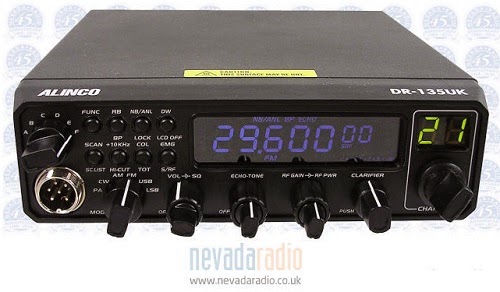
Nevada is selling Alinco multi-mode 28-29.7MHz radios on special deal at £99.95. For “export only” they can be expanded to also cover CB frequencies. Such expansion is not legal in the UK. At less than £100, this is a very good price for a 10m multi-mode rig.
I admit I “lifted” the original image from the Nevada website. As it was Javascript, I was unable to link, as I had wished, to the original images. If using this image on this blog is a problem, it will be immediately removed, although I hope Nevada see this as free publicity.

Roger Lapthorn, G3XBM, is a regular contributor to AmateurRadio.com and writes from Cambridge, England.
72 Club Blog from Russia with love
http://qrp-club72.blogspot.ru/
Alternative server link:http://qrp-club72.blogspot.co.uk/
Some may know Oleg for his small QRP design the Micro 80 that featured in Sprat 72 (Autumn 92). This is a very small and simple 80m CW Transceiver http://www.indianapolis.net/QRPp-I/micro-80.htm and is very easy to construct. A UK revised component circuit I found at:http://www.qsl.net/g3pto/micro80.html
Maybe worth thinking about if your starting out in the QRP route of Amateur Radio.
Steve, G1KQH, is a regular contributor to AmateurRadio.com and writes from England. Contact him at [email protected].
 Ham Radio Deluxe |
 W5SWL Electronics |
 Ham Radio Prep |
 KB3IFH QSL Cards  Hip Ham Shirts  HamRadioAuctions HamRadioAuctions Reliance Antennas Reliance Antennas Enigma Shop Enigma Shop |  morseDX  Ni4L Antennas  R&L Electronics R&L Electronics antennas.us antennas.us QRV QRV |
- Matt W1MST, Managing Editor
