 |
 Seasons Greetings
 24 December 2014 | by
73's & 88's from G1KQH
Steve, G1KQH, is a regular contributor to AmateurRadio.com and writes from England. Contact him at [email protected].
Merry Christmas: SSTV, ISS Packet, SatPC32 and other stuff
No posts for the last little while! Like most people, I guess, the run up to Christmas has been busy. But since finishing work on Friday, in between visiting and other Christmassy things, I have been playing radio in the downtime.
One day last week, I had a nice QSO on the way to the station with Paul G0HWC. We talked about digital SSTV and in particular, Easypal. I told Paul that I had never managed to get it going on my PC and he kindly gave me some ideas (wipe it out completely, clean the registry and then reinstall). Did that and unfortunately it still crashes on load and there are no clues. What a shame! It probably doesn’t like something on this old laptop.
Thinking about SSTV did encourage me to get MMSSTV (analog SSTV) going again and I put it on 28.680 one afternoon and received some nice pictures from TA1BM in particular and VA2PGQ and some others. I then wondered if I could get it going on 145MHz through the FT-8900. I rigged up the interface and fired up MMSSTV and actually it worked well! I haven’t made any QSOs on there so far, but I did use my phone and a Baofeng handheld to check the signal and it seemed to be working fine.
.jpg)
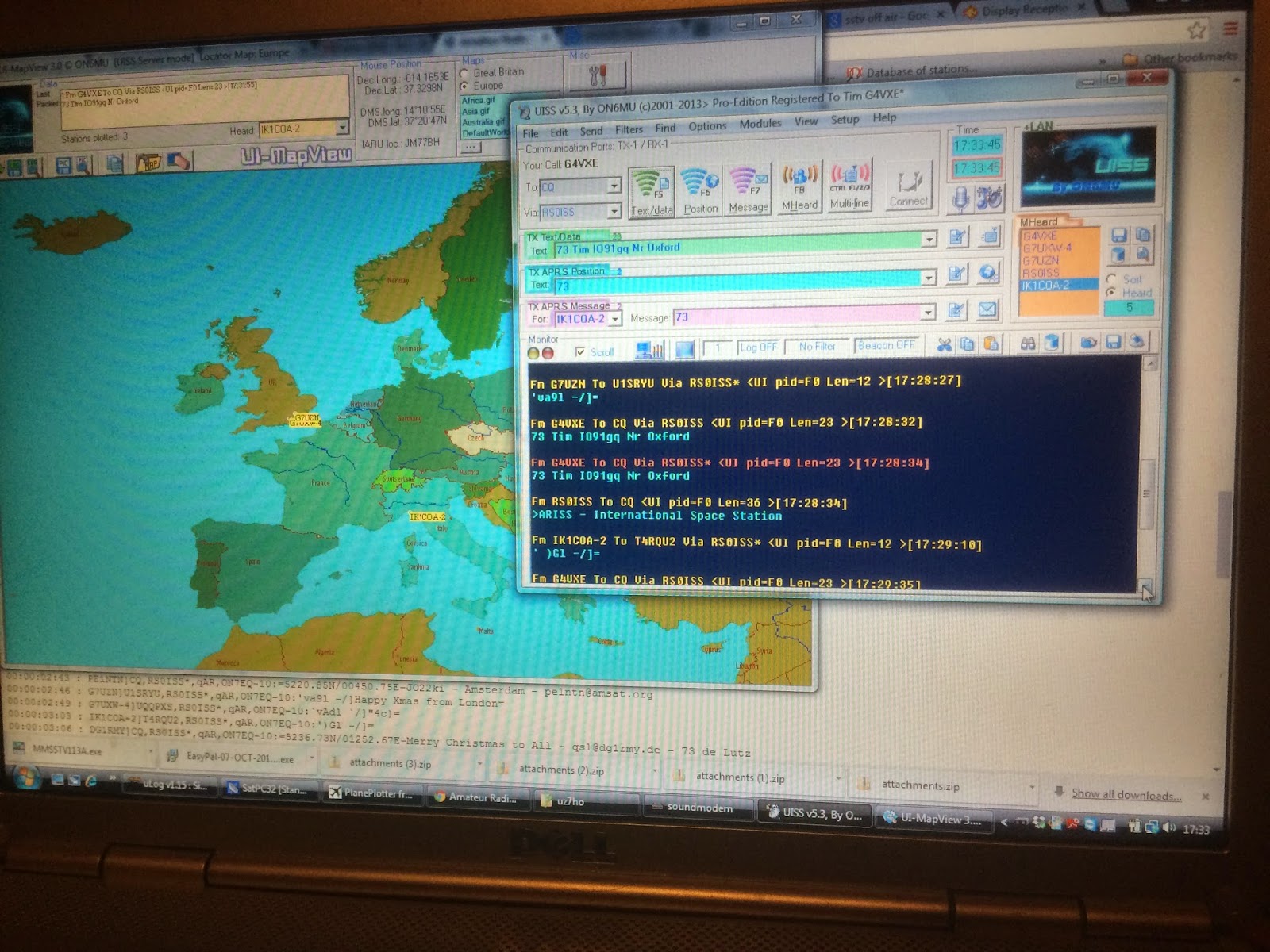
Tim Kirby, G4VXE, is a regular contributor to AmateurRadio.com and writes from Oxfordshire, England. Contact him at [email protected].
Merry Christmas: SSTV, ISS Packet, SatPC32 and other stuff
No posts for the last little while! Like most people, I guess, the run up to Christmas has been busy. But since finishing work on Friday, in between visiting and other Christmassy things, I have been playing radio in the downtime.
One day last week, I had a nice QSO on the way to the station with Paul G0HWC. We talked about digital SSTV and in particular, Easypal. I told Paul that I had never managed to get it going on my PC and he kindly gave me some ideas (wipe it out completely, clean the registry and then reinstall). Did that and unfortunately it still crashes on load and there are no clues. What a shame! It probably doesn’t like something on this old laptop.
Thinking about SSTV did encourage me to get MMSSTV (analog SSTV) going again and I put it on 28.680 one afternoon and received some nice pictures from TA1BM in particular and VA2PGQ and some others. I then wondered if I could get it going on 145MHz through the FT-8900. I rigged up the interface and fired up MMSSTV and actually it worked well! I haven’t made any QSOs on there so far, but I did use my phone and a Baofeng handheld to check the signal and it seemed to be working fine.
Tim Kirby, G4VXE, is a regular contributor to AmateurRadio.com and writes from Oxfordshire, England. Contact him at [email protected].
Getting ready for 60 meter
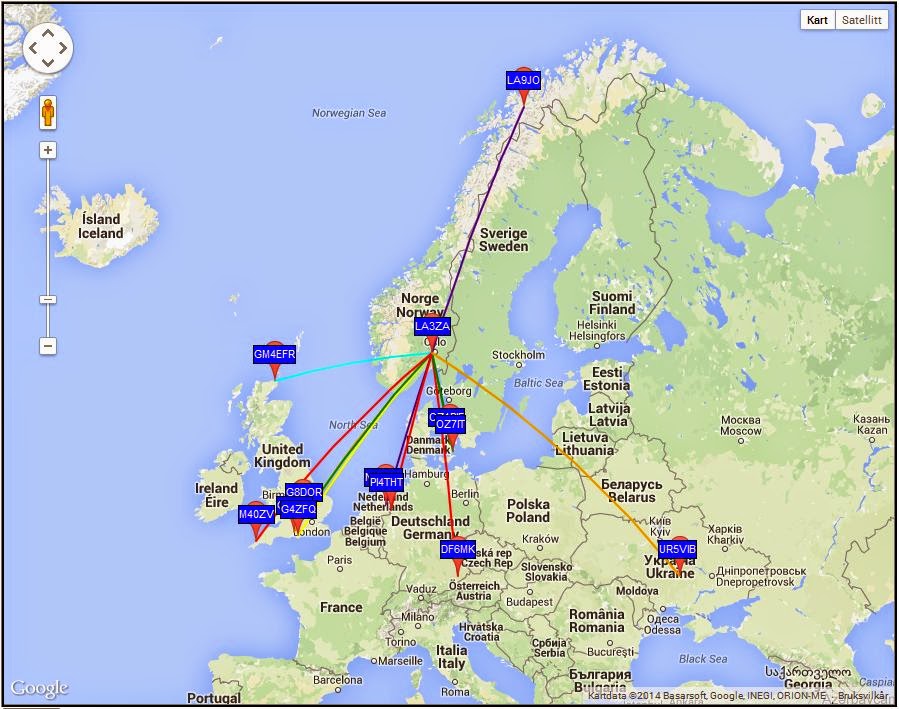
I have never had any contacts on the 5 MHz or the 60 meter band. But I guess it’s time for that now.
Both my K2 and my K3 support it and about 40 countries now have access to this band according to K1ZZ in his column “It seems to us” in this month’s QST.
As a first test I ran my 0.2 W Ultimate 3 GPS-controlled WSPR transmitter over night and the image shows the result. I am using an 80 m long loop skywire antenna (horizontal loop) tuned to 60 m.
The results were encouraging with the best DX being UR5VIB in Ukraine at a distance of 1887 km. By the way, considering that it is 1093 km to LA9JO in the north of Norway, one sees the distortion in the map projection used for the Google map.
I have also operated the antenna as a vertical (about 8 meters) with top-hat loading by tying both feed-line conductors together and feeding it against a ground plane. The result is quite similar. The article by Dave Fischer, W0MHS called “The Loop Skywire” in QST November 1985 is the reference for both uses of the loop. The article starts out with this catchy phrase: Looking for an all-band HF antenna that is easy to construct, costs nearly nothing and works great DX? Try this one! This matches my experience exactly as this antenna has been instrumental for my 8 band DXCC.
Sverre Holm, LA3ZA, is a regular contributor to AmateurRadio.com and writes from Norway. Contact him at [email protected].
Japanese Amateurs To Get 630m!
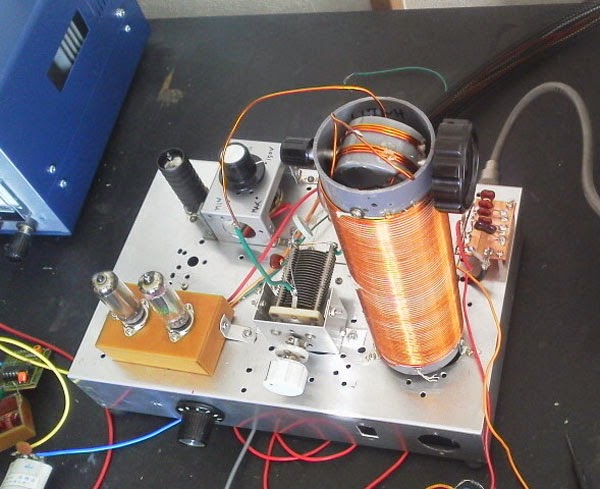 |
| Courtesy: http://blogs.yahoo.co.jp/sapporo50w |
Add Japan to the growing number of countries now allowing their radio amateurs access to the 630m band. A recent note from JA8JPO and others, indicates that JA stations will have access to the band as of January 5th, 2015. Operation on their new band however, comes with a few provisos.
Operations on 630m will be permitted at 1W EIRP, not as high as some jurisdictions, but adequate for plenty of exciting experimentation and for some DX opportunity. Additionally, there can be no operation if there is a house or an office within a 200m radius of the station, unless it is owned by the station operator. This restriction can be lifted if permission from the home or property owner is received. As well, the station will be subject to inspection by Telecom authorities before the licence is granted. No reason for these additional caveats have been offered as of yet but JA amateurs speculate that it may be for fear of disruption (by radiated harmonics) to broadcast-band reception or with possible interruptions to ADSL modems, still commonly used in rural Japan....time will tell.
In the meantime, it is reported, that hundreds of excited amateurs in Japan are now readying their stations for two-way 630m work, happy to have the band under any restrictions...if only the same level of excitement were seen among Canadian amateurs for their new band!
Steve McDonald, VE7SL, is a regular contributor to AmateurRadio.com and writes from British Columbia, Canada. Contact him at [email protected].
Second batch Xiego X-108 Radio debut, well almost
X108 HF Radio Second run
Those who have already received the updated radio say it is like night and day between the first batch and the second. Audio on SSB is much cleaner and clearer and the over-driving of the front end has been fixed. AM is also much better sounding according to those using the radio.
The firmware has been changed as well so the microphone buttons can be programmed by the end user to their choice and option for buttons on the microphone, as well a cw side-tone volume control has been added into the menu options.
So see what the mailman brings on Wednesday, if nothing I will update my blog once the radio arrives and load some videos to my YouTube Channel of its performance.
Merry Christmas and Happy New Year one and all.
Fred
VE3FAL
Fred Lesnick, VE3FAL, is a regular contributor to AmateurRadio.com and writes from Thunder Bay Ontario, Canada. Contact him at [email protected].
A Christmas Story – Shep style!

I hope you enjoy it as much as I do!
72 de Larry W2LJ
QRP - When you care to send the very least!
Larry Makoski, W2LJ, is a regular contributor to AmateurRadio.com and writes from New Jersey, USA. Contact him at [email protected].
 Ham Radio Deluxe |
 W5SWL Electronics |
 Ham Radio Prep |
 KB3IFH QSL Cards  Hip Ham Shirts  HamRadioAuctions HamRadioAuctions Reliance Antennas Reliance Antennas Enigma Shop Enigma Shop |  morseDX  Ni4L Antennas  R&L Electronics R&L Electronics antennas.us antennas.us QRV QRV |
- Matt W1MST, Managing Editor
