 |
 This Spewed Out of the Internet #30
 13 December 2014 | by
  Reporting on more critical information spewing forth from the interwebz, here’s some stuff you just can’t live without.
In a surprise move, Baofeng introduces yet another dualband HT, but this one might be the best yet. Maybe. See the PD0AC first impressions of the GT-3 Mark II.
Yaesu has announced a new dualband HT, the FT2DR, that has a Big Honking Display and touchscreen interface.
The crack reporting team over at Ham Hijinks keeps cranking out ham radio news: Turkey Takes Toll on Ham.
The ARRL is looking into changing some of the VHF contest rules. The first proposal includes allowing self-spotting and the use of non-amateur assistance. I say “heck yeah!”
If you ever thought it would be a good idea to use a banana as a Morse code keyer, check out this video. Meanwhile, Burger King has recognized the importance of ham radio for space communications (video).
The QRZNow web site got caught “borrowing” content from other ham radio web sites without permission or providing attribution.
Stu W0STU over at HamRadioSchool.com has been straining his brain on the topic of complex impedance. If you need some help understanding this (ahem) complex topic, take a look at his three part article on the subject: Part 1, Part 2, Part 3.
If you are worried about exposure to excessive EMF (Electromagnetic Field), you’ll want to consider this device over at Amazon.com. Be sure to read the reviews to get the full entertainment value.
73, Bob K0NR
The post This Spewed Out of the Internet #30 appeared first on The KØNR Radio Site.
Bob Witte, KØNR, is a regular contributor to AmateurRadio.com and writes from Colorado, USA. Contact him at [email protected].
ARRL 10m contest this weekend
A reminder that the annual ARRL 10m contest is this coming weekend. Conditions are likely to be good on 10m, so this is a good chance to work some worldwide DX. Next year with the decline in sunspot numbers, this is not likely to be as good. Unfortunately my operating time will be very limited because of visitors.

Roger Lapthorn, G3XBM, is a regular contributor to AmateurRadio.com and writes from Cambridge, England.
Congratulations to Logbook of the World

Congratulations to the ARRL Logbook of the World (LOTW) which just reached 100 million confirmed contacts. This is the same as an impressive 200 million QSL cards out of about 630 million uploaded contacts on LOTW.
LOTW was established way back in 2003. This was only 2 years after I got my license. Since I have never enjoyed much to fill in QSL cards I embraced LOTW very quickly. I have to say though that I will of course respond with a paper QSL for those who ask for one.
But LOTW has been my primary means of confirming contacts for a decade. My DXCC was confirmed with LOTW.

Now at the same time that LOTW is celebrating 100 millions confirmations, I am celebrating 8 bands with 100 or more contacts all confirmed via Logbook of the World. This is on all bands from 3.5 to 28 MHz. This has been my goal for many years. The last confirmation came from the TC0A contest station in Turkey on 80 m after last month’s CQ World Wide CW contest.
I consider myself lucky to have reached 100 confirmations even on the elusive 12 m band which we all know will shut down soon not reopen again until the next solar maximum in about 11 years time.
But as the saying goes “The journey is the reward“, so what to do next as a radio amateur?
Sverre Holm, LA3ZA, is a regular contributor to AmateurRadio.com and writes from Norway. Contact him at [email protected].
Amateur Radio Newsline Report 1948 December 12 2014
- Hams in the Philippines respond to yet another typhoon
- Ham radio as a way to inform fishing fleet of imminent danger
- UK regulator Ofcom evaluating future of the 420 to 470 MHz band
- 2½ minute video shows how the ISS was put together in orbit
TJ5A on air QRP and 3 great QSO’s at 5 watts
So this afternoon I was playing with the YouKits TJ5A Hf Transceiver running 5 watts and using my Chameleon Hy-Brid up on a 15′ pole feeding coax to my shack and running about 135′ of wire across the yard with far end up 20′ in the air. The base of the Hy-Brid and pole are grounded with a ground rod.
I called cq on 21.050 after watching the RBN to see where I was being heard, I was pleasantly surprised to hear Ted in Stockton,ME SKCC#1312 call me, he gave me a 579 with my 5 watts. QSB came in as we finished our exchange.
Then out of the blue I heard KZ5OM Jerry SKCC#10415S in California, Jerry was a 339 and he gave me a 569 and then QSB took us both down.
I then went to 20 meters and tuned the antenna and was called by Rich K4DJ in N.C., he is SKCC#11060S, he was a 569 and I was a 459 so not too bad at all..
The Hy-Brid tunes super for me and I use this set up on 160 meters as well.
Giving the new TJ5A a workout and I can say that the power stays solid and does not move and it receives very well without the filter, will be a great test when filter is installed.
Thanks to the 3 operators, Ted, Jerry and Rich for a great hour on the air.
Fred
VE3FAL
SKCC#50

Fred Lesnick, VE3FAL, is a regular contributor to AmateurRadio.com and writes from Thunder Bay Ontario, Canada. Contact him at [email protected].
We’re Giving Away 20 Free Software-Defined Radio (SDR) Receiver Sets!
NooElec and AmateurRadio.com have teamed up to give away
SDR (Software Defined Radio) receiver packages to TWENTY hams!
Over $1,200 in free prizes and they’ll pay the shipping worldwide!
The deadline to enter is 18 December 2014 20:00 UTC.
We’ve announced the winners!
Click Here
Read the rest of this post
Matt Thomas, W1MST, is the managing editor of AmateurRadio.com. Contact him at [email protected].
The Importance of 1929 – Part 3
 |
| Drum Dial Rx Tuning Courtesy: http://www.arrl.org/ |
As the leader of the ARRL's Technical Development Program and its assault on 1929 preparedness, Hull continued his relentless pace of construction and publication in the November 1928 issue of QST...turning now to receivers. The detailed article analyzed three receivers of varying complexity to see how they might fare in the busy "international bands" of 1929...and where improvements might be gleaned.
In "High-Frequency Receivers for the Coming Year / Incorporating Thoroughly Practical and Satisfying Selectivity, Open Scales, and a New Ease in Handling", editors proudly announced that,
"...practical selectivity for 1929 has been secured; it is within the reach of every amateur." [QST November, 1928]
 |
| QST Oct '28 Courtesy: http://www.arrl.org/ |
Another equally important issue was addressed in QST's October 1928 edition, once again by Ross Hull.
"In view of the present off-band operation, it is not surprising that amateurs have been wondering how it will be possible for them to stay within the relatively narrow confines of the 1929 bands and to know definitely and at all times that the frequency of their transmitters is legal." [QST October, 1928]
"The Frequency Measurement Problem / Applications of the Monitor in Transmitter Setting and Signal Checking" described, in exacting detail, the construction and calibration of a combined monitor and frequency meter that would fulfill the new rules regarding frequency allocations...but only if hams used them regularly.
 |
| QST Sept '28 Courtesy: http://www.arrl.org/ |
With the ARRL's reliance on QST's significant advertising revenue as a major source of income, the urgent 'need' to rebuild was not overlooked by the ad-men, as more building would mean that more parts had to be purchased. A skeptic might even suggest that the possibility of increased advertising revenue may have been just as much of a driving-force for the need of new construction than the new rules themselves!
 |
| QST 1929 Courtesy: http://www.arrl.org/ |
Advertisers in QST were not shy about reminding amateurs of the coming deadline as well as promising easy solutions to compliance.
In early 1928, QST published several of the Convention articles that would apply to amateurs. Chief amongst them were the frequency allocations. North American amateurs lost about 40% of the spectrum space that they had previously enjoyed but...the harmonically-related bands, although slimmed-down, were retained along with exclusive access to the new and largely unwanted territory of 28-30mc.
Many amateurs at the time complained about the loss of older frequencies and that the League representatives had dropped the ball. In light of the times, and in view of the commercial feeding-frenzy for new broadcasting allotments, they fared very well.
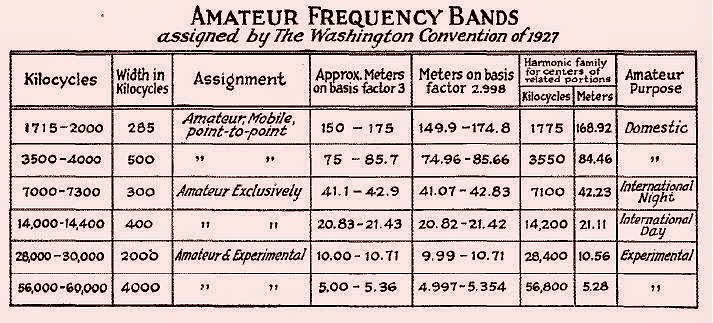 |
| 1929 Band Plan - QST Jan '28 Courtesy: http://www.arrl.org/ |
But it wasn't just frequency assignments that were changing...1929 operators would need to change their crummy old operating habits as well! ....(cont'd)
Steve McDonald, VE7SL, is a regular contributor to AmateurRadio.com and writes from British Columbia, Canada. Contact him at [email protected].
 Ham Radio Deluxe |
 W5SWL Electronics |
 Ham Radio Prep |
 KB3IFH QSL Cards  Hip Ham Shirts  HamRadioAuctions HamRadioAuctions Reliance Antennas Reliance Antennas Enigma Shop Enigma Shop |  morseDX  Ni4L Antennas  R&L Electronics R&L Electronics antennas.us antennas.us QRV QRV |
- Matt W1MST, Managing Editor
