 |
 Narrow Band TV (NBTV)
 10 February 2015 | by
 Partly because bandwidths are very low, there has been a revival of interest in NBTV systems similar to the early TV transmissions by Baird in the 1920s and 1930s.
There is even a Televisor kit available for about £40 delivered (in the UK) with a CD with some still and moving images and its own test card generator. I am quite tempted!
The televisor kit is available for £35.94 + shipping from http://www.mindsetsonline.co.uk/Site/Home (search for televisor). This is compatible with the 32 line standard of the NBTV Association. The NBTV Association home page is at http://www.nbtv.wyenet.co.uk/index.htm .
Bandwidths are audio only, so a tape recorder or CD are fine. Over the air transmissions only require audio bandwidths too. Of course, with just 32 lines don’t expect brilliant images!

Roger Lapthorn, G3XBM, is a regular contributor to AmateurRadio.com and writes from Cambridge, England.
Motorola for sale?
Is the end in sight for Motorola?
When I was at work (I retired 7 years ago) Motorola was our greatest rival. Since coming into existence in the early years of this century, my own company Sepura has been in profit every year. The demise of Motorola is a salutary lesson never to be complacent. How the mighty have fallen.

Roger Lapthorn, G3XBM, is a regular contributor to AmateurRadio.com and writes from Cambridge, England.
VHF AM and the RSGB
Recently, I wrote to the “Last Words” column in Radcom. I very much doubt my letter will be published. The main thrust of the letter is the (very negative) attitude of the RSGB to the AM mode.
My letter (as sent) is reproduced here. I’d be interested to hear your views.
At the present time G6ALB is experimenting with very low cost 70cms AM modules as the heart of a possible short range (3km) voice transceiver. We have had some success already.
“Thank you for publishing the latest Band Plans in the February 2015 RadCom. Although because of my poor voice (stroke) I tend to use digital techniques, I still enjoy the occasional outing using AM. Like many, I have worked transatlantic AMers on 29-29.1MHz with real QRP and simple antennas.
Yet again, one could be forgiven for thinking AM, especially 28MHz and up, is a dirty word at the RSGB. AM gets no mention on 28MHz and 50MHz and gets a (begrudging?) comment as a footnote only in the 144MHz Band Plan when other modes get “centres of activity” mentions. For the avoidance of any doubt, AM is alive and well in the 29-29.1MHz sub-band. AM on the 144MHz (2m) band can be found on and around 144.550MHz. There has been AM on 29-29.1MHz for years and years and years! Yes, this is the all-mode section, but why not say this is the 28MHz (10m) AM sub-band? Also, why are 144MHz AM users asked to “consider adjacent channel activity”? AM should easily fit in 6kHz!!
Sorry, yet again, AM is being treated as a dirty and outdated mode. May I remind readers that ex-PMR AM rigs ripe for use on VHF can be picked up for virtually nothing and that there is room for AM on all bands from 28MHz upwards. AM has its enthusiasts on other bands too, but yet again the RSGB seems hell bent on killing off this mode. Why?
73s
Roger Lapthorn G3XBM”

Roger Lapthorn, G3XBM, is a regular contributor to AmateurRadio.com and writes from Cambridge, England.
Cambridge on a winter day
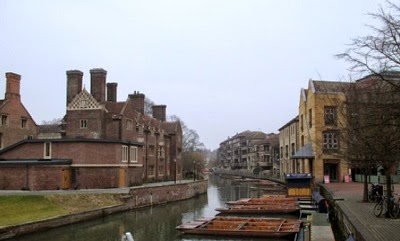 |
| Cambridge Punts |
Every Tuesday I travel into Cambridge for my weekly U3AC course called “Maps in the Computer Age”. I am enjoying the course very much.
Usually I drive to the “Park and Ride” car park at Newmarket Road and get the bus into town. The U3AC course is at the U3AC headquarters in Bridge Street, which is about 30m from where the punts are on the River Cam. At this time of the year the punts are quiet. Come the summer and this spot is very busy. Cambridge has lots of foreign visitors when the usual students go home. If you see a foreigner with a map wobbling along on a pink bicycle it is a good idea to be well clear!
 |
| Round Church – very old building |
From the punt place you can punt right up via St John’s, Trinity, Clare and Kings College. Kings College Chapel is lovely from the river. The secret is not to leave your punt pole behind. It is easily done. Luckily the Cam is not too deep. If you prefer, you can pay someone else to do the punting so you can just sit back and enjoy a timeless Cambridge moment.
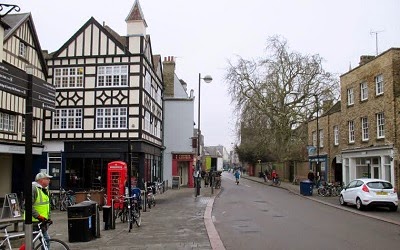 |
| Bridge St, Cambridge |
Some of the views have not changed much in centuries. The Backs in Cambridge are very beautiful and it is little wonder people travel from all corners of the Earth to visit this beautiful centre of learning. It is all too easy just to take it all for granted. Certainly, when I worked in the city, I did. Now being retired, I properly enjoy it. It is still a very beautiful city with fine very old buildings and the River Cam winding its way up behind the colleges. If you have never been, you are unlikely to be disappointed.
Many years ago I was with a friend who parked at the multi-storey car-park just off Bridge Street. We worked a VK6 (S.W. Australia) from the car on 10m SSB.

Roger Lapthorn, G3XBM, is a regular contributor to AmateurRadio.com and writes from Cambridge, England.
Upcoming 37th Anniversary of Packet Radio
At around 9PM on May 31, 1978 were the first KNOWN transmissions of Packet over Amateur Radio. The location was Bill Wong’s Restaurant in Montreal, Canada.
The Montreal Packet Net Group C/O:
Bob Rouleau VE2PY; Norm Pearl VE2BQS; Fred Basserman VE2BQF; Bram Frank VE2BFH; Jacques Orsali VE2EP; Ted Baleshta VE3CAF; Ian Hodgson VE2BEN; among others not mentioned.
They operated on a single 220Mhz channel using start-stop ASCII with the Ethernet CSMA/CD protocol. The protocol was modified for amateur applications by Robert T. Rouleau, VE2PY, and implemented by Fred Basserman, VE2BQF. Montreal Packet Net (MP-Net) Operated at 2400 bit/s using home-built modems.
A detailed description of the Montreal Protocol and hardware used in the experiments is given in the TAB book #1345 “PACKET RADIO” by Bob Rouleau and Ian Hodgson published in 1981. An interesting note is that the Montreal Modem design used the Exar XR-2206/2211 chip set. I am told that a sample of the Montreal Modem was sent to the Vancouver group (VADCG) in the fall of 1978 and it is probably no coincidence that the same chip set appeared in the TAPR TNC modem of which Doug Lockhart of VADCG had a hand in designing.
After an initial spurt of activity in amateur packet, Bob Rouleau and several others in the group turned to commercial applications for packet radio. The resulting company, DATARADIO Inc, today is building and marketing commercial packet radio systems around the world. A typical application is the Canadian Weather Radio packet service introduced some years ago using DATARADIO equipment specially designed for the application.
Bob was inducted in the CQ Magazine Amateur Radio Hall of Fame in 2003.
Jack, W4JBR, is a special contributor to AmateurRadio.com and writes from Georgia, USA.
Finally got my Ultrafire WF-501B as I wanted it

As I wrote in my blog post a few days ago, I got the intensity down for night vision for my red flashlight. But I wasn’t quite happy with the level and wanted to reduce it even more. To do that I had to unsolder 6 of the 8 AMC7135 350 mA constant current ICs on the PCB of the AMC7135*8 2800mA 4-Group 5-Mode Circuit Board.

These constant current chips are all run in parallel with the VDD input for control. The 8-pin Atmel ATtiny13A chip controls all VDD inputs in parallel from its pin 6. When the VDD pin is low there will be now light. I haven’t measured this, but I am assuming that this pin is pulsed in order to reduce current down from the maximum.
My measurements for the High, Medium, and Low settings are:
- 8 chips: 2,8 A, 0.83 A, 0.14 A
- 4 chips: 1,4A, 0.45 A, 0.08 A
- 2 chips: 700 mA, 225 mA, 42 mA
This scales as expected with the number of 350 mA chips and the 100%, 30%, and 5% settings of the controller. Now only Q1 and Q3 remain, and Q2, Q4-8 have been desoldered.
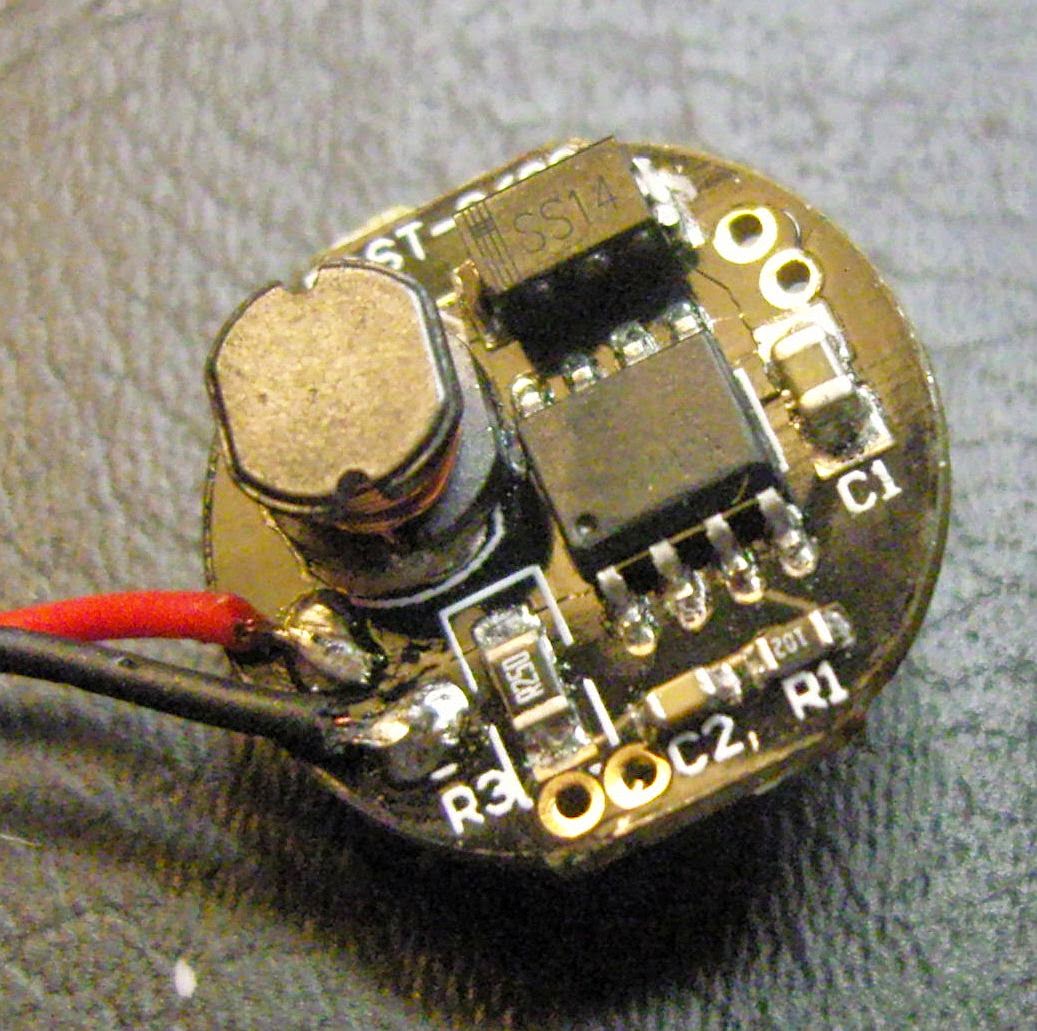
One could have obtained en even more battery-friendly version if somehow the original controller could have been modified. The step-down circuit is quite standard with an inductor, a Shottky diode (SS14), and a controller chip of unknown origin. But it seems to me that if R23 of value R250 (0.25 ohm) was increased, output current would probably go down.
As it is I am much more happy with the intensity of the settings I have now. It will be a good companion night light which will preserve night vision well when used with a telescope.
Sverre Holm, LA3ZA, is a regular contributor to AmateurRadio.com and writes from Norway. Contact him at [email protected].
A Fun Weekend
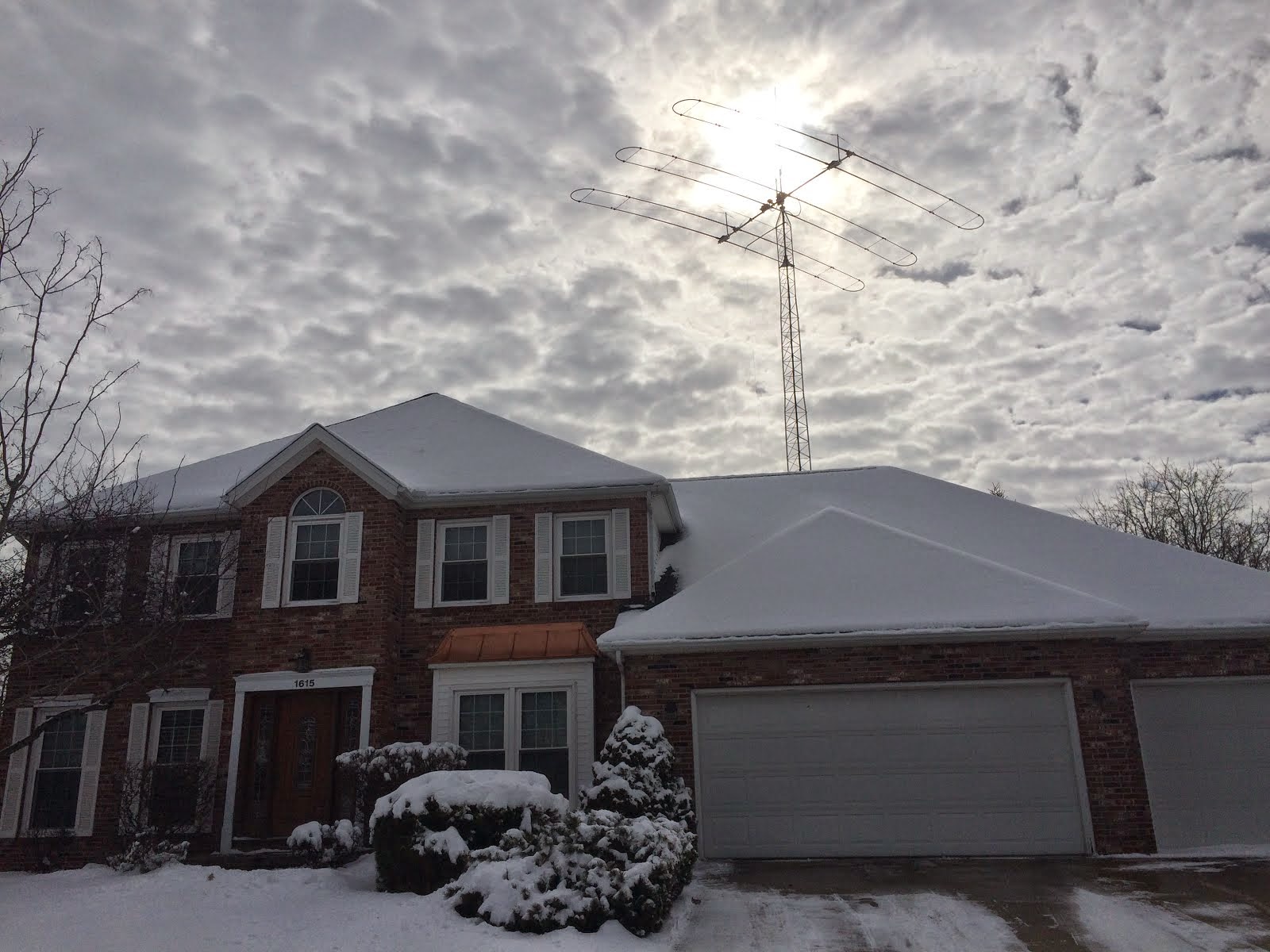
The weekend started with a great surprise on Friday at lunchtime. My good friend Dennis KE9UA invited me over to his QTH to try to work K1N. Dennis is a serious DXer. The picture above shows the gorgeous SteppIR in his backyard. This picture was taken as I headed out after working K1N on my first call. Yep, barefoot at 100 watts on 20m. What a hoot! I smiled the rest of the weekend, and I’m smiling now writing this three days later.
Saturday morning brought me back to the big city to take a look at the WX9WX dstar machine. Coverage wasn’t as good as expected, and because of the great logging of the G4KLX software I could see that we had a problem. The duplexer we were using wasn’t providing enough isolation, resulting in receiver desense. I usually check this when building a new system but somehow forgot this step this time. A quick swap to a much better duplexer and the problem was solved.
Sunday was a day of rest…church then grilling of steaks, took a nap, then tinkered in the barn until it was too cold to be outside. A nice 2M net with friends on the Clinton IL repeater rounded out a fun weekend. I love this hobby!
Michael Brown, KG9DW, is a regular contributor to AmateurRadio.com and writes from Illinois, USA. Contact him at [email protected].
 Ham Radio Deluxe |
 W5SWL Electronics |
 Ham Radio Prep |
 KB3IFH QSL Cards  Hip Ham Shirts  HamRadioAuctions HamRadioAuctions Reliance Antennas Reliance Antennas Enigma Shop Enigma Shop |  morseDX  Ni4L Antennas  R&L Electronics R&L Electronics antennas.us antennas.us QRV QRV |
- Matt W1MST, Managing Editor
