 |
 Some PMR fun
 5 May 2015 | by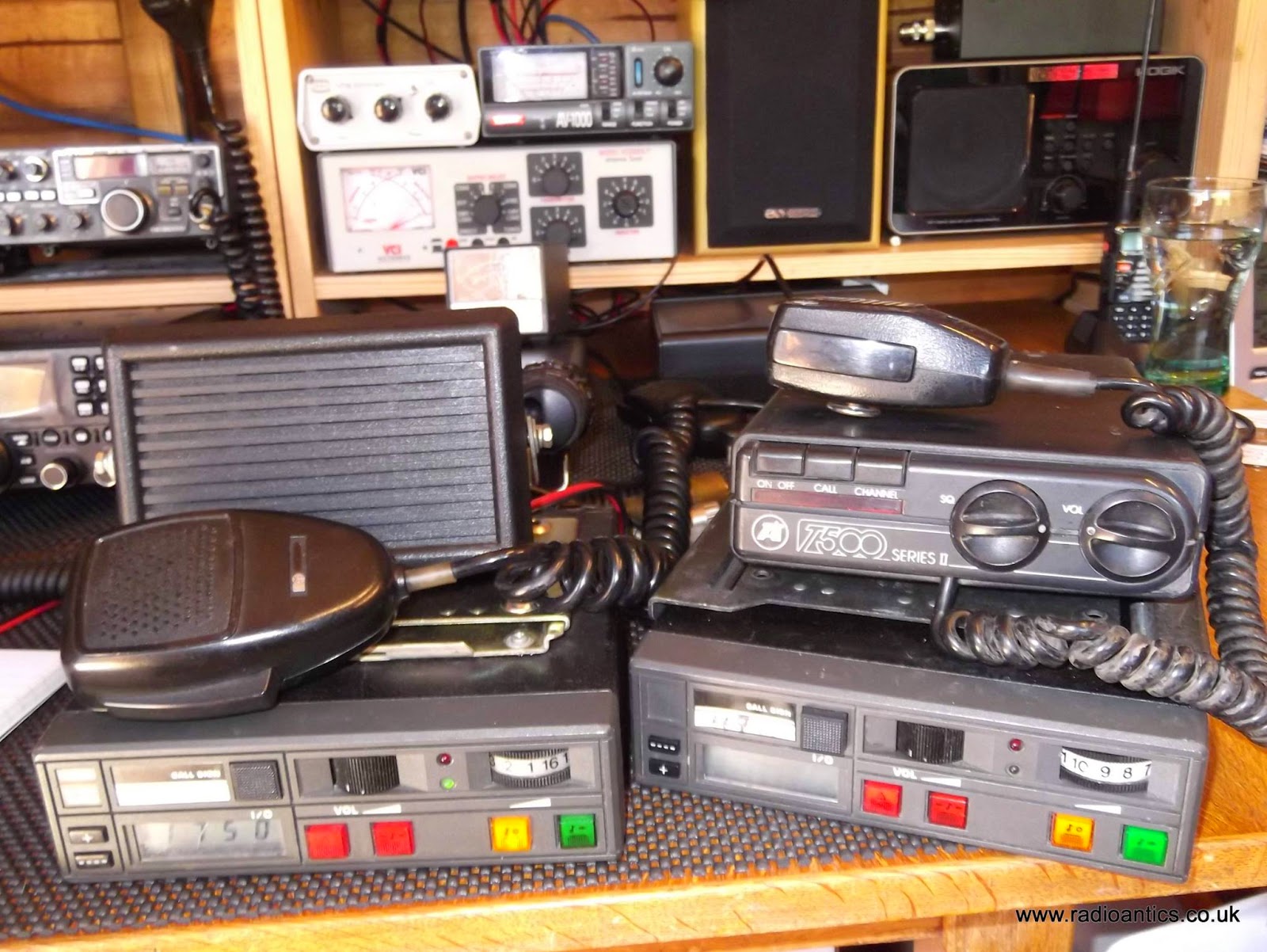
One is a Tait T535 2-Channel Mobile PMR which can be converted to amateur 2m operation relatively easily. Details are available on the internet including David Pye's website. I intend to use this unit to set up a permanent APRS internet gateway/digipeater.
While walking around with the Tait I attracted the attention of another seller who had some PYE MX294 units for sale. One was already converted to work on the 25kHz spaced simplex and repeater channels with CTCSS. The other was only partly converted and they came with a box full of spare boards and mounting plates and an original microphone and speaker. I wasn't really looking for any more units but seemed a bargain for £20.
The PYE MX294 was indeed converted and seemed to work fine on the simplex channels, and while it was receiving and transmitting on the repeater channels it wasn't transmitting the CTCSS sub-tone. With some sage information from Ian MW0IAN on twitter it was a simple issue to solve, using the oscilloscope I confirmed the tone was being generated it was the pot controlling the level that was set too low.
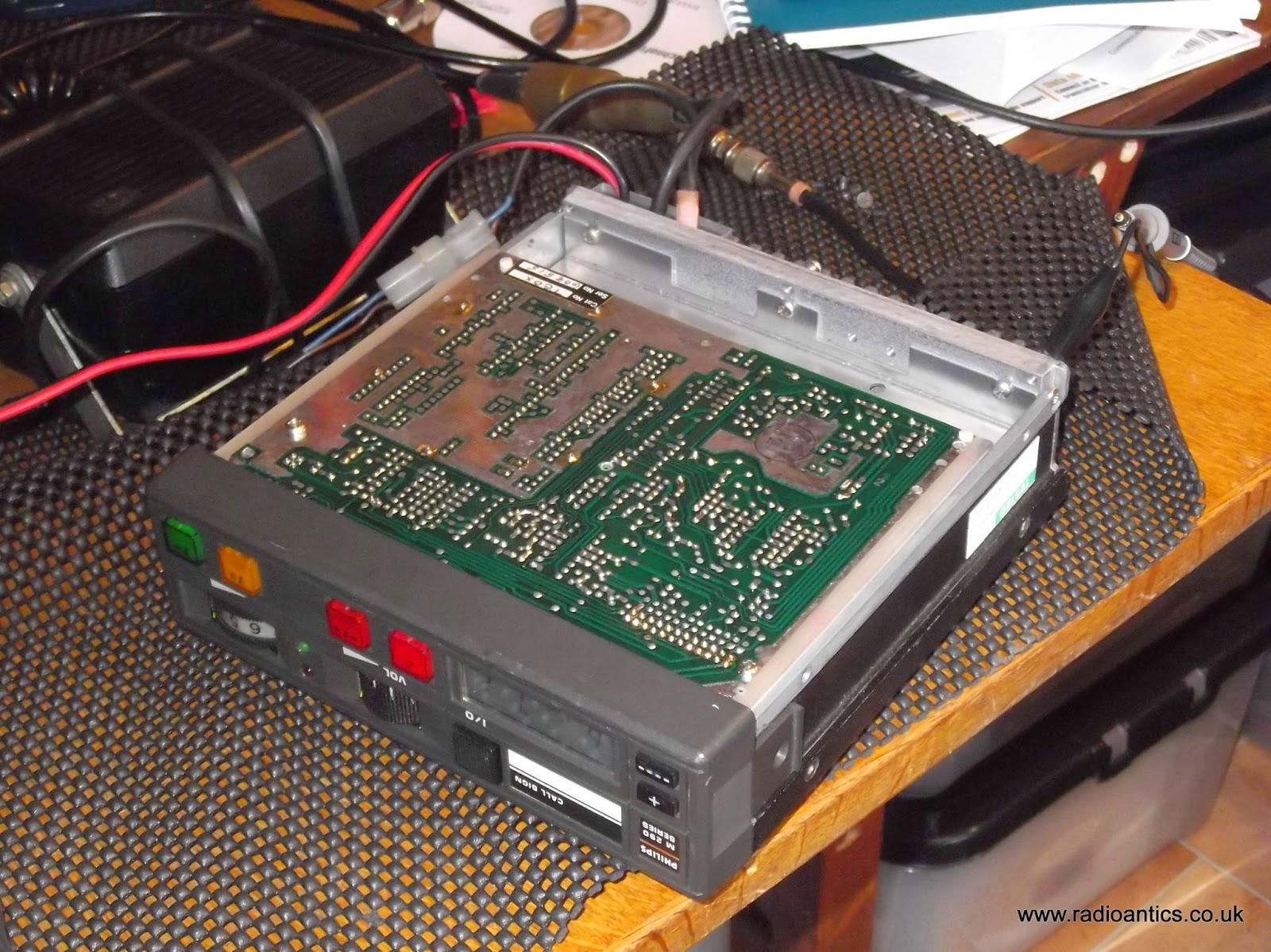
The Tait is proving a little more involved. It has a diode matrix board to set the Tx/Rx frequencies which has been set incorrectly. It also had a CTCSS board that was hard-wired in rather than socketed which I have now removed. The information of which diodes to link/unlink is freely available, however I decided to create a small windows utility to simplify the calculation. This is available for download from my website, it is supplied as is and with no warranty.

There are a number of modifications to add multi-channel to this radio by the use of eproms, but I am considering devising an Arduino solution to allow setting of frequencies and possibly selection of CTCSS.
Andrew Garratt, MØNRD, is a regular contributor to AmateurRadio.com and writes from East Midlands, England. Contact him at [email protected].
Fredbox – 2m transceiver

Many years ago I designed and made the 2m AM Fredbox 2m AM transceiver. At the time it was the smallest 2m transceiver I’d ever seen or used. Several close copies were made. It worked some impressive DX including several 60 mile handheld contacts and one over 100 miles to Brittany from the South Devon coast. All these were with whip antennas on the rig and not beams. Most QSOs were with locals. The power was only 10mW AM. It was ideal for contacts around Cambridge where I lived at that time.
Some years ago, I rebuilt the transceiver and had some decent QSOs yet again.
As with the Sixbox, I would suggest the design is taken as a springboard for your own version. It is certainly ripe for further development.
See https://sites.google.com/site/g3xbmqrp3/vuhf/fredbox .

Roger Lapthorn, G3XBM, is a regular contributor to AmateurRadio.com and writes from Cambridge, England.
Heathkit?
 Some of you might remember me talking about the return of Heathkit.
There has been a lot of mystery surrounding the status of Heathkit, as they popped up a couple of years ago and announced that they were returning. There was a survey posted online for a long time asking people what they wanted to see from a new Heathkit. The new Heathkit management hosted a Q and A session on Reddit speaking more about their plans to return. Then, nothing. No announcements, no news. There was brief mention in December when the folks at Adafruit (a company that supports the MAKER community) were briefly in touch with the new Heathkit, and were told that things are still progressing, and there will be no information on what the products will be until they are ready. All through this, I have been skeptical, as many people would be, since we have heard this story before.
Now, there are changes over at Heathkit.com. They are clearly gearing up for products, and support. They have even started an eBay store where they are selling parts, and some classic equipment.
Cross your fingers.
–Neil W2NDG
Neil Goldstein, W2NDG, is a regular contributor to AmateurRadio.com and writes from New York, USA. Contact him at [email protected].
Weekly Propagation Summary – 2015 May 04 16:10 UTC
Here is this week’s space weather and geophysical report, issued 2015 May 04 0612 UTC.
Highlights of Solar and Geomagnetic Activity
27 April – 03 May 2015
Solar activity was at very low to low levels during the period. Very
low levels were observed on 27 April and on 02 May. Solar activity
was in decline during the beginning of the period as Region 2331
(S10, L=021, class/area Dai/240 on 26 Apr) rotated around the SW
limb on 29 April. Only isolated low level C-class flaring was
observed for the majority of the period until new Region 2335 (S15,
L=192, class/area Dai/220 on 02 May) rotated around the SE limb on
30 April. This region slowly developed in both area and magnetic
class during its first few days on the visible disk and culminated
in seven C-class flares; the largest of which was a C2 flare at
01/0257 UTC. Other activity of note included an 18 degree filament
eruption, centered near S46E09, observed lifting off the visible
disk between 02/1500-1830 UTC. Associated with this eruption was a
partial-halo coronal mass ejection (CME) first observed in
SOHO/LASCO C2 imagery at 02/2036 UTC with an approximate speed of
473 km/s. Although the majority of the ejecta appeared to be
southward of the ecliptic plane, WSA/ENLIL modelling of the event
showed a potential impact after midday on 06 May.
No proton events were observed at geosynchronous orbit.
The greater than 2 MeV electron flux at geosynchronous orbit was at
normal to moderate levels. Moderate levels were observed on 27-29
April and again on 02-03 May.
Geomagnetic field activity was mostly quiet through late in the
period. At approximately 30/0515 UTC, total field showed an increase
from 6 nT to 11 nT with a weak increase in solar wind speed from
approximately 280 km/s to 350 km/s. Further increases in speed to
around 450 km/s occurred on 01 May as a weak, positive polarity
coronal hole high speed stream (CH HSS) became geoeffective. CH HSS
influence continued through the end of the period. The geomagnetic
field responded with quiet to unsettled conditions on 02-03 May.
Forecast of Solar and Geomagnetic Activity
04 May – 30 May 2015
Solar activity is expected to be at very low to low levels with a
chance for M-class (R1-R2, Minor-Moderate) flare activity from 04-21
May and again from 28-30 May with the return of old Regions 2322
(N11, L=116) and 2325 (N05, L=050).
No proton events are expected at geosynchronous orbit.
The greater than 2 MeV electron flux at geosynchronous orbit is
expected to be at normal to moderate levels with high levels
possible from 07-08, 13-21, and 29-30 May due to CH HSS activity.
Geomagnetic field activity is expected to be at quiet to unsettled
levels from 05-07 May with active periods likely on 06-07 May due to
a combination of CH HSS effects and the arrival of the 02 May CME by
mid to late on 06 May. Unsettled to active conditions with likely
minor storm periods (G1-Minor) are expected from 12-15 and 17-20 May
due to a recurrent CH HSS. A weak CH HSS is expected to become
geoeffective from 27-30 May causing quiet to unsettled conditions.
Don’t forget to visit our live space weather and radio propagation web site, at: http://SunSpotWatch.com/
Live Aurora mapping is at http://aurora.sunspotwatch.com/
If you are on Twitter, please follow these two users:
+ https://Twitter.com/NW7US
+ https://Twitter.com/hfradiospacewx
Get the space weather and radio propagation self-study course, today. Visit http://nw7us.us/swc for the latest sale and for more information!
Check out the stunning view of our Sun in action, as seen during the last five years with the Solar Dynamics Observatory (SDO):
https://www.youtube.com/watch?v=zXN-MdoGM9g
We’re on Facebook: http://NW7US.us/swhfr
Visit, subscribe: NW7US Radio Communications and Propagation YouTube Channel
CW
 Since Christmas I have been attempting (again) to learn CW. There are plenty of people to whom this comes naturally. I, on the other hand, had a promising career as a CW radio operator cut short by a tragic lack of talent (to steal someone else’s joke).
So, why bother? Well to be honest I quite like the simplicity, portability and cost of rigs that focus on CW. As the price and complexity of rigs increase it moves me to reduce my interest in this exotica. So to keep the hobby alive in my shack and to carry on learning about RF I thought it’d be nice to try some new stuff out. I can use what I have as a base (Icom IC-7000) and get out and about for UKAC VHF contests when I fancy it. But CW was always a bit of a step beyond me.
I’ve used a bunch of resources to help but by far the most useful was hooking up with a group on twitter called @lids_cw. Along with the plethora of software the encouragement from them has been excellent. What I have found out is that my sending has improved no end by getting on air but my receiving is stubbornly refusing to come together. Practice make perfect. The Goal for me is a Morse proficiency test at the Norbreck rally next year. Hopefully at 15wpm
Alex Hill, G7KSE, is a regular contributor to AmateurRadio.com and writes from Cumbria, UK. Contact him at [email protected].
LF / MF – Next Step For U.S. Amateurs (Part 3)

Continuing with the important sections of NPRM (FCC 15-50) affecting the future of LF/MF assignments in the U.S.A. ...
174.
We also seek comment on the applicability of IEEE 1613-2009 – IEEE Standard Environmental and Testing Requirements for Communications Networking Devices Installed in Electric Power Substations ... ARRL claims that PLC systems complying with IEEE-1613 “would virtually guarantee that there would be no interaction between amateur stations and PLC systems,” and that compliance with the standard has been required by the Commission’s since 2002. As background, the Commission’s rules require that PLC systems conform to engineering standards promulgated by the Commission and adhere to industry approved standards designed to enhance the use of PLC systems. Is compliance with this IEEE standard required by the Commission’s rules (i.e. is this an industry approved standard designed to enhance the use of PLC systems)? Would compliance of PLC systems with this standard facilitate the sharing of these bands between amateur stations and PLC systems? Are there PLC systems deployed that do not comply with this standard?
Would compliance with this standard obviate the need for amateur stations to maintain a specific separation distance from transmission lines?
175.
We recognize that the separation distance required for PLC systems and amateur stations to coexist will depend on the power at which the amateur stations are permitted to transmit. We propose that amateur stations in the 135.7-137.8 kHz band be limited to a maximum EIRP of 1 W, as is required by footnote RR 5.67A, and which we adopted in the WRC-07 R&O. Is this EIRP limit appropriate for facilitating sharing between PLC systems and amateur stations? For the 472-479 kHz band, we propose to adopt transmitted power limits consistent with RR 5.80A. Amateur stations will be limited to an EIRP of 1 W in the portion of Alaska within 800 km of the Russian Federation and will be permitted to transmit at up to 5 W EIRP elsewhere. Is this EIRP limit appropriate for PLC systems and amateur stations to share this band? Should amateur stations be required to reduce their EIRP below 5 W when close to transmission lines and at what distances? We seek comment on these proposals.
176.
We also seek comment on the practical application of a separation distance requirement, and, specifically, what resources and information amateur radio operators will need to comply with our rules. Amateur licensees will have to determine the location of transmission lines in their vicinity to determine if they are permitted to operate stations using these frequency bands. The amateur licensees will need to differentiate transmission lines from the electric distribution lines that connect distribution substations to customer or house wiring. High voltage transmission lines are typically attached to large steel towers that are easy to identity. However, lower voltage transmission lines are typically attached to wooden poles. Although the wooden poles used for transmission lines are usually taller than the wooden poles used for distribution lines, we recognize that distinguishing the two types may not always be straightforward. We seek comment on whether amateur licensees will be able to identify the transmission lines in their locality. If amateur licensees are not able to reliably identify transmission lines, should we require amateurs or ARRL to affirmatively verify the locations of transmission lines with utilities or UTC before an amateur station begins transmitting?
178.
Lastly, we seek comment on additional service and operational rules that would be appropriate for amateur operations in these bands. According to ARRL, the tallest antenna that should reasonably be considered for an amateur station is 200 feet, because antennas with greater heights would
be required to obtain prior FAA approval and have to comply with FAA painting and lighting requirements. We note that adopting a maximum antenna height for amateur stations in these bands will aid in sharing of the spectrum with PLC systems by limiting the number of transmission lines that would potentially be in direct line-of-sight of amateur station antennas. We seek comment on what maximum antenna height, if any, we should adopt for amateur stations in these bands.
179.
We also invite comment on whether to adopt transmitter power limits for amateur stations, in addition to the EIRP limits we are proposing. If so, we seek comment on what the power limits should be. We observe that, in the 2002 Amateur Radio NPRM, the Commission proposed to limit the maximum transmitter power in the 135.7-137.8 kHz band to 100 W PEP because of the possible difficulty of measuring the EIRP of an amateur station in this frequency range. Also, in 1998, ARRL submitted data for the 135.7-137.8 kHz band showing that relatively short antennas can only produce ranges of EIRP that are well below the ITU’s 1 W EIRP limit (i.e., 10-40 mW for a 100 foot antenna and 1-4 mW for a 50 foot antenna) with a transmitter power output of 200 W PEP. The Commission did not consider either power limit at that time, because, as noted above, it decided not to adopt an allocation for amateur operations in this band. Given that we have adopted such an allocation in the WRC-07 R&O above, do either the 2002 Amateur Radio NPRM or ARRL’s 1998 study provide a basis for determining transmitter power limits now? Should these transmitter power limits vary depending on antenna height – e.g. we could allow a 200 W PEP limit for antenna heights not exceeding 30.5 meters while permitting only 100 W PEP for taller antennas. Should the transmitter power limits differ between the 135.7-137.8 kHz band and the 472-479 kHz bands?
180.
In response to the WRC-07 NPRM, commenters addressed a number of steps that could facilitate amateur use of the 135.7-137.8 kHz band. Amateur operator John H. Davis (Davis) proposed that no amateur station should be automatically controlled to ensure that the amateur operator is able to quickly terminate transmissions if necessary. Davis also suggested that it may be appropriate to also prohibit software-driven modes that determine their own operating frequency without human intervention.
Should we adopt Davis’s suggestions? ARRL’s states that there is no rationale for limiting the occupied bandwidth in the 135.7-137.8 kHz band to less than the full 2.1 kilohertz, and that a stricter limit would not be conducive to experimentation with narrowband data emission modes in the future. Should we adopt any bandwidth limitation for either of the frequency bands? In the WRC-07 NPRM, the Commission requested comment on whether it should limit operating privileges in the 135.7-137.8 kHz band, e.g., to Amateur Extra Class licensees. None of the commenters believe that such a restriction would better facilitate Amateur/PLC sharing of the band. In particular, we note that ARRL states that it would be consistent with Commission policy to make this frequency band available to Amateur Extra, Advanced, and General Class licensees. Should we limit operating privileges for these bands in accordance with ARRL’s statement? Should we propose to authorize CW (international Morse code telegraphy), RTTY (narrow-band direct-printing telegraphy), and data emissions throughout the 630 and 2200 meter bands as we did for our 2200 meter band proposal in 2002? We also seek comment on amending Section 97.3 by adding definitions for the terms effective radiated power, isotropically radiated power, and LF.
181.
Other Allocated Uses. Other radio services use the 135.7-137.8 kHz band. In the U.S. Table, the 130-160 kHz band is allocated to the fixed service (FS) and maritime mobile service (MMS) on a primary basis for Federal and non-Federal use ... The 126.7-141.7 kHz band is also used to track tagged salmon in the Pacific watershed. We seek comment on whether we need
to adopt exclusion zones or use other methods to protect these Federal uses of the band. Should we delete the unused non-Federal allocations from this band? To be consistent with the International Table, we also propose to require that amateur fixed stations operating in the 2200 meter band not cause harmful interference to stations in the FS and MMS that are authorized by other nations and require that these amateur stations take any and all corrective action, if harmful interference is reported to us. We seek comment on these proposals.
It would appear that the nature of enquiry is extensive but it is the next step needed before the LF / MF bands will become a reality in the U.S.
Following publication of the NPRM in the Federal Register (see daily updates here to see when it appears), stakeholders will have 60 days to make comments. Comments can be written or posted via their online comment page once it is opened. A thirty-day reply-to-comments period then ensues.
One source that I have read indicates that there is usually about 12-18 months before NPRM publication and rule enactment, should there be no major stumbling blocks. Whenever the final decision to implement comes will depend on how the enquiry proceeds.
I would urge all those interested in seeing these band become a reality to file comments when the opportunity becomes available, following the Federal Register posting. Comments could include your opinions on power levels, methods of stating / measuring power levels, restrictions on operating near power transmission lines, modes allowed, etc. It is particularly important for U.S. experimental stations to file a detailed report on their operations, including accurate descriptions of antenna systems and transmitter details. As well, I would urge Canadian amateurs that have had experience operating on either of these two bands, to file comments regarding your experiences, with particular emphasis on the lack of interference caused to PLC signals and the lack of interference caused by PLC signals to your own operation. Rest assured that U.S. power authorities will be putting their resources ($$) into one last lobby for as many restrictions as possible and it is not in our interest for the NPRM comments to be one-sided in their favor.
Lets all hope for a swift outcome to something that has been taking far too long.
Steve McDonald, VE7SL, is a regular contributor to AmateurRadio.com and writes from British Columbia, Canada. Contact him at [email protected].
LHS Episode #146: Interview with Christian Jacobs
 Hello, LHS listeners! In this episode we have a very special treat in store for you all. We have a personal talk with Dr. Christian Jacobs, though I suspect he'd be upset that we labeled him doctor. He's a Ph.D., done a great deal of work with fluid dynamics, and he also happens to be a ham radio operator. He programs using Python and he's written PyQSO, a great lightweight logging application. We talk to him about all these things and much, much more. Please enjoy.
73 de The LHS Guys
Russ Woodman, K5TUX, co-hosts the Linux in the Ham Shack podcast which is available for download in both MP3 and OGG audio format. Contact him at [email protected].
 Ham Radio Deluxe |
 W5SWL Electronics |
 Ham Radio Prep |
 KB3IFH QSL Cards  Hip Ham Shirts  HamRadioAuctions HamRadioAuctions Reliance Antennas Reliance Antennas Enigma Shop Enigma Shop |  morseDX  Ni4L Antennas  R&L Electronics R&L Electronics antennas.us antennas.us QRV QRV |
- Matt W1MST, Managing Editor
