 |
 Some great news
 21 May 2015 | by
 My initial reactions were thus:
1) Wow! It's great to hear from John.
2) John's writing again - fantastic!
3) I know diddly squat about motorcycling.
4) This ties into QRP, so how can this be a bad thing?
5) Even though #3 is true, #4 is also true, so maybe I can learn something here.
6) Boy, it's good to have John back again.
So even if you're like me (and don't know squat about motorcycling), you do know about QRP and you do like the way John writes - it's still a win/win situation. AND if you DO know about motorcycling, then you've really hit pay dirt! (Win/win/win).
I have added John's new blog to the blog roll on the right, and the hyperlink above will take you right there. Please take the time to read his work, and if you like what you're reading - let him know. We bloggers appreciate the feedback and love hearing from you, good, bad or indifferent. Just do ME a favor and tell him W2LJ sent you.
72 de Larry W2LJ
QRP - When you care to send the very least!
Larry Makoski, W2LJ, is a regular contributor to AmateurRadio.com and writes from New Jersey, USA. Contact him at [email protected].
160m indoor loft antenna
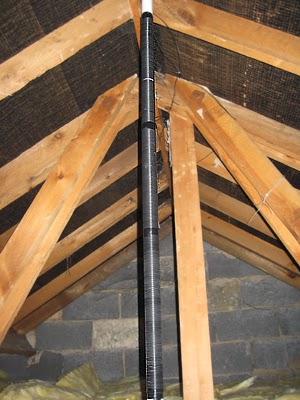
Some years ago G6ALB and I wanted a simple talkback link that we could use when co-operating on experiments. We were 3km apart with Andrew being in the next village. We immediately thought about simple AM rigs for topband (160m).
As I had no 160m antenna, I built the design linked here. This antenna works well with best WSPR spots being over 1000km.
We decided that topband was too noisy for our simple AM rigs for our intended purpose. The noise floor at both our locations is very high on 160m. I have since moved QTH but we are still thinking about this link. We are now 3.3km apart. Probably 6m would be a better choice as less noisy and we both have vertical antennas.
See https://sites.google.com/site/g3xbmqrp3/antennas/160m_loft_ant .

Roger Lapthorn, G3XBM, is a regular contributor to AmateurRadio.com and writes from Cambridge, England.
Skeeter Hunt 2015

Yes! There will be a Skeeter Hunt in 2015. It will be held on Sunday, August 9th. Skeeter numbers will be issued starting on the "First Day of Summer", which will be Sunday June 21st - the weekend before Field Day.
There is one major rule change for this year - there will be no extra bonus points for working DX stations this year. As many of you know, the Skeeter Hunt seems to always coincide with the "Work All Germany" contest, and in years past, working a DX station was worth 3 points. Several Skeeters in the Mid-West and on the West coast pointed out that this is an unfair advantage to East coast Skeeters. After considering it, I have come to agree with this, and have eliminated that extra DX bonus. The playing field will be much more equal this year.
The Bonus word for this year is "CULICIDAE", which is the Latin word for the family of insects that mosquitoes belong to. Work enough call signs that include those letters and you can garner yourself another 100 points. There's an "L" in there and I will be happy to be the official "L" provider for the Hunt. Hi! (I think Don K3RLL among others, will also be happy to give away "L"s, too.)
I am having a bit of trouble with the QSL.NET webpage, so for all the details of this year's Skeeter Hunt, you can go to my Skeeter Hunt page of this blog - http://w2lj.blogspot.com/p/njqrp-skeeter-hunt.html.
I am hoping to have the QSL.NET problems ironed away by this weekend, but then again, you never know.
72 de Larry w2LJ
QRP - When you care to send the very least!
Larry Makoski, W2LJ, is a regular contributor to AmateurRadio.com and writes from New Jersey, USA. Contact him at [email protected].
Amateur VLF DXing
Operating an amateur station at VLF is a very specialised area of experimentation. There are basically 2 different threads (1) earth-mode or utilities assisted earth-mode with propagation mainly along or close to roads and (2) radiated DXing in which a VLF signal is actually radiated and propagated to great distances. With (1) I have managed 6km with QRSS3 with 5W from a TDA2003 audio IC at 8.97kHz. Earth-mode gear can be low powered and simple to build.
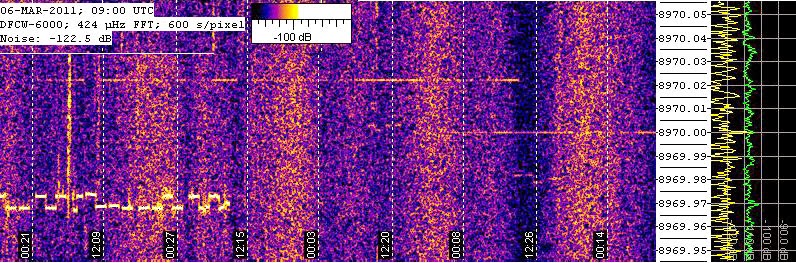 |
| VLF amateur signals |
With (2) the Atlantic Ocean has now been crossed, i.e. quite remarkable distances with amateur powers and antennas. Usually very large loading coils are needed and making these can be “challenging”. As high voltages are likely, great care is needed. Of course, most DXing is done with very long stable transmissions in very narrow bandwidths. Most amateur VLF gear is home made with free PC software to allow signals to be seen. Casual listening is not effective. Most operation is now around 8.300kHz as this is unallocated in many countries.
News of VLF activity may be found at https://sites.google.com/site/sub9khz/ .

Roger Lapthorn, G3XBM, is a regular contributor to AmateurRadio.com and writes from Cambridge, England.
AmateurLogic 78: Live from Dayton Hamvention 2015

AmateurLogic.TV Episode 78 is now available for download.
Join George, Tommy, Ray and a host of special guests at Dayton Hamvention 2015. Shot in front of a live audience at the Icom booth.
1:54:27
George Thomas, W5JDX, is co-host of AmateurLogic.TV, an original amateur radio video program hosted by George Thomas (W5JDX), Tommy Martin (N5ZNO), Peter Berrett (VK3PB), and Emile Diodene (KE5QKR). Contact him at [email protected].
Inexpensive Kit From China
 |
| courtesy: http://www.banggood.com/ |
A recent posting to the GQRP Yahoo Group brought my attention to another inexpensive offering from China. This time it's Bangood's complete "Pixie" type 40m QRP transceiver for the incredible sum of $4.16 (U.S.)! The price includes all components, a nicely silk-screened PCB and free shipping. One really wonders how it is possible to make any profit with such an offering but it obviously is. However, all may not be what it seems. One purchaser, IK1ZYW (Paolo) who built the kit, described his findings in a recent blog posting of his building experience.
In spite of the problems noted above (with some now corrected), the kit still seems a bargain, if one takes the necessary care with construction.
Playing with QRP can often provide ham radio's best "fun for the money" as DX- capable transmitters can often be built for just a few dollars. I vividly recall the fun I had one winter while pursuing the first-ever Tuna Tin W.A.S. endeavour on 7040kHz.
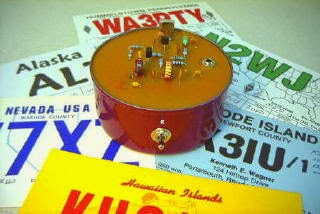
I made many new friends on 7040 that winter and every weekend many of them would listen-in or call to see how my progress was going. The highlight of the adventure was late one Saturday night when I had three New England stations all answer the same CQ ... what amazing fun for a handful of parts at less than $10 ... not including the cost of a can of Tuna!
The little Pixie kit offered above has a power level fully capable of W.A.S. on 40m and with the decrease in solar conditions, 40m will just keep improving. If you purchase and build one of these kits, please let us know how your experience went. The 'interesting' construction notes may be found here.
Steve McDonald, VE7SL, is a regular contributor to AmateurRadio.com and writes from British Columbia, Canada. Contact him at [email protected].
Hooray NJ2SP – SPARC Rookies!
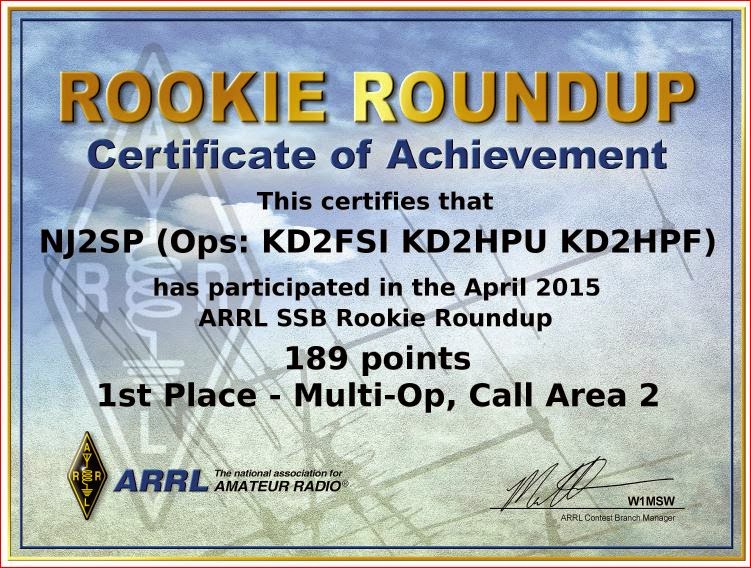
Great job by the South Plainfield Amateur Radio Club Rookies who activated NJ2SP - and an equally great job by Marv K2VHW who mentored the event.
Can't wait 'til Field Day!
72 de Larry W2LJ
QRP - When you care to send the very least!
Larry Makoski, W2LJ, is a regular contributor to AmateurRadio.com and writes from New Jersey, USA. Contact him at [email protected].
 Ham Radio Deluxe |
 W5SWL Electronics |
 Ham Radio Prep |
 KB3IFH QSL Cards  Hip Ham Shirts  HamRadioAuctions HamRadioAuctions Reliance Antennas Reliance Antennas Enigma Shop Enigma Shop |  morseDX  Ni4L Antennas  R&L Electronics R&L Electronics antennas.us antennas.us QRV QRV |
- Matt W1MST, Managing Editor
