 |
 Dayton 2015 – Part 2 of ?
 25 May 2015 | by
 (…continued from Part 1)
This year I stayed in downtown Dayton, at the Dayton Marriott. It was my first experience driving in downtown Dayton as last year I stayed at a hotel close to Hara north of town. Dayton has obviously seen better days, and folks walking the streets living in poverty is a common sight. Driving through downtown Friday morning I wondered what the locals thought of all the vehicles with antennas driving by for one weekend out of the year. Do they know anything about amateur radio? The word Dayton to us means amateur radio Mecca, but to them Dayton is just the place they live day in and day out, trying to eek out a living. They were likely born here, will die here, and probably will not get to see much of the world outside of Dayton. I think back to my childhood growing up in backwoods Pennsylvania, and I’m thankful for the people and opportunities I had that made me successful and steered me away from several perhaps less fortunate alternative realities. Amateur radio was undoubtedly a positive influence, one that got me to where I am technically and professionally today.
Dayton has overhead electric wires for trolleys. I can’t recall ever seeing this in my travels. I didn’t see any trolleys, however there were several city buses using the overhead electric wires. I wondered what it would take to equip an electric car with poles to attach to the electric lines and and get free energy for your vehicle (evil grin). 
Electric Avenue
Last year I promised myself that in 2015 I would spend less time on the flea market and more time on the floor and in forums. I was partially successful, attending one additional forum this year, the Clandestine Spy forum. This was a standing-room only presentation covering the equipment and techniques used by the Resistance during WWII. There were a lot of photographs.
The AMSAT forum covered all the activities and projects the organization is working on, of which there are many. In the Fox 1 program there are four or five satellite projects in progress and at various phases. The big news was the potential for a geosynchronous payload, something satellite aficionados have been fantasizing about for decades. The amount of work that goes into these projects from an engineering, fundraising, political, and project management perspective is mind-boggling. It can’t be understated how complex this is. It is indeed rocket science. The expertise and human resources behind all this is impressive, and I can’t imagine the amount of time AMSAT volunteers and officers spend on this, as most undoubtedly have day jobs in engineering, technology, and science fields. 
AMSAT Forum
One speaker in the AMSAT forum presentation touched upon something that really struck a cord with me and others. Kids often see amateur radio operators as just operators. What really sparks interest in kids are experimenters and experimentation. What AMSAT is doing is experimentation, and at an extreme level. Space is interesting to kids, but it’s difficult to be hands on with it due to the very nature of it, and these satellites and the projects AMSAT is leading gives them access to this. AMSAT goes beyond providing flying repeaters for amateurs, but also partners extensively with universities, government agencies, and K-12 schools. 
Where to find Fox 1
This is not meant to belittle other activities within amateur radio, but I don’t think most people realize just how complex and far-reaching the activities of AMSAT-NA and other AMSAT organizations around the world are, and the benefit this offers to amateur radio today and into the future. While ragchewing, contesting, and DXing are traditional staple activities within amateur radio, the work of AMSAT has real world impact, and this is a vehicle for getting new people into amateur radio, ones that will likely stick around for the long haul. Case in point, sitting behind me during the presentation were two young guys, both from Virginia Tech and recently licensed. They are involved in an AMSAT project writing software for one of the birds. In talking with them it was clear they were very intelligent and they had a passion for what they were doing. Undoubtedly they will get high-paying engineering jobs upon graduating. Will they ever pick up a microphone or CW key? Maybe not, but satellite work has them hooked and it looks great on a resume. As one AMSAT speaker half jokingly quipped, there is no free launch. All of this costs money, and a lot of it. AMSAT is continually seeking donations and new members. With my annual membership running out, I decided to take the plunge and sign up for a lifetime membership.
The Ballonsat forum was quite interesting and was well attended with a good number of movers and shakers who frequently launch, track, and recover balloons and payloads. A new area covered was pico balloons which are smaller balloons with extremely lightweight and small payloads. Several people have been launching these around the world with great success, some traversing the globe five to ten times.
Friday night I attended the DX Dinner and got to network with movers and shakers in the DX world. It was worth the cost of the meal as I won a Comet antenna analyzer door prize. Not surprisingly, K1N was announced as the the DXpedition of the year.

DX Pileup
While I lamented about about flea market Neanderthals in the first part of this article, there were positive social aspects to the Hamvention. One morning walking in the crosswalk across the road going into Hara I observed an attendee thanking a black police officer stationed in the street for his service as a police officer. At lunch I could strike up a friendly conversation with anyone, total strangers. Folks stopped me to take a picture of my Morse code key tee shirt, many commented and laughed about it. There continues to be a sense of camaraderie in amateur radio. For this I’m thankful. 
Flea Market Pedestrian Mobile
The ARRL area was superb. ARRL folks should be commended on the layout and organization of their area. They have all the bases covered and all booths within the area were well staffed. I brought a stack of QSL cards in for DXCC checking. The staff there did a great job of helping me out, after figuring out I initially screwed up my paperwork. I’ll continue to say it, but despite ARRL’s flaws and our disagreements, we are truly lucky to have such a hardworking organization within amateur radio. 
ARRL Area
Those often annoying, sometimes threatening death machines known as rental scooters continue to roam the Hamvention. I don’t know if it was that I’ve become more accustomed to them or there truly are less of them, but it sure seemed to me that there weren’t as many as last year. What’s happening to the scooter people? Are they dying off? Are they disappearing during the Hamvention? Inquiring minds want to know. Undoubtedly the liability insurance for such an activity would be expensive, but I would love to have a scooter demolition derby some Hamvention afternoon. Folks could rent dilapidated scooters or bring their own pimped-out scooters for a battle royale of destruction and excitement. (Hamvention committee members, I can make this happen, you know where to reach me. I want a cut of the profits from beer sales. :-)
….to be continued…
This article was originally published on the Radio Artisan blog.

Anthony, K3NG, is a regular contributor to AmateurRadio.com.
LHS Episode #147: Radio on the Fringe
 Hello, LHS listeners! We are back again with another exciting installment of our show. In this episode we discuss logging, general purpose and contesting, a new single-board computer project, retro gaming, a pop-up terminal for Linux, digital voice, software defined radio and much more. Thanks for listening, and remember: Get on the air!
73 de The LHS Guys
Russ Woodman, K5TUX, co-hosts the Linux in the Ham Shack podcast which is available for download in both MP3 and OGG audio format. Contact him at [email protected].
How simple?
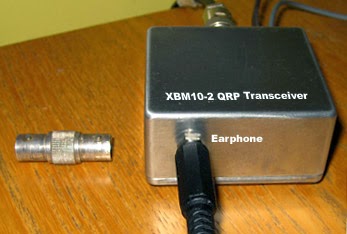
Some years ago I attempted to see how few components were needed to communicate on 10m. The Lesser Chirpy was the best I could manage. This was a derivative of The Chirpy, which worked, but had far too much chirp!
Looking at the circuit I see I could save 1 component by replacing C1 and C2 by preset C’s and shorting out C3. This would allow the TX-RX offset to be set. If one was made a variable rather than a preset the RX-TX offset could be adjustable.
Since being ill I have not tried the rig. A limitation was the limited RX sensitivity, meaning only stronger stations would be workable. However, the rig does work and is very simple. Another possibility is to switch to an external RX but allow the internal RX to be used when signals are strong enough. The TX power is certainly enough to span the Atlantic and work all over Europe.
The secret to low chirp on 10m is the use of FSK rather than CW. Essentially the TX changes frequency rather than go from RX to TX every time. This means full break-in is not possible in such a simple circuit. Can you do better? If so, I’d love to see the schematic please. I make no great claims for my circuit, which is an amalgam of ideas. Pure fun!
See https://sites.google.com/site/g3xbmqrp3/hf/chirpy .

Roger Lapthorn, G3XBM, is a regular contributor to AmateurRadio.com and writes from Cambridge, England.
Stealthy Roof Mast
 |
| courtesy: https://openclipart.org/ |
This time it's his stealthy mast to support some small VHF utility antennas. If you're interested in a simple stealthy mast for the roof-top, you may find some worthwhile hints here. His system would make a very nice stealthy support for a PAØRDT mini-whip which would put your antenna well above the house and its associated noise fields ... have a look.
Steve McDonald, VE7SL, is a regular contributor to AmateurRadio.com and writes from British Columbia, Canada. Contact him at [email protected].
Where can I get APF and DIV stickers for my K3?
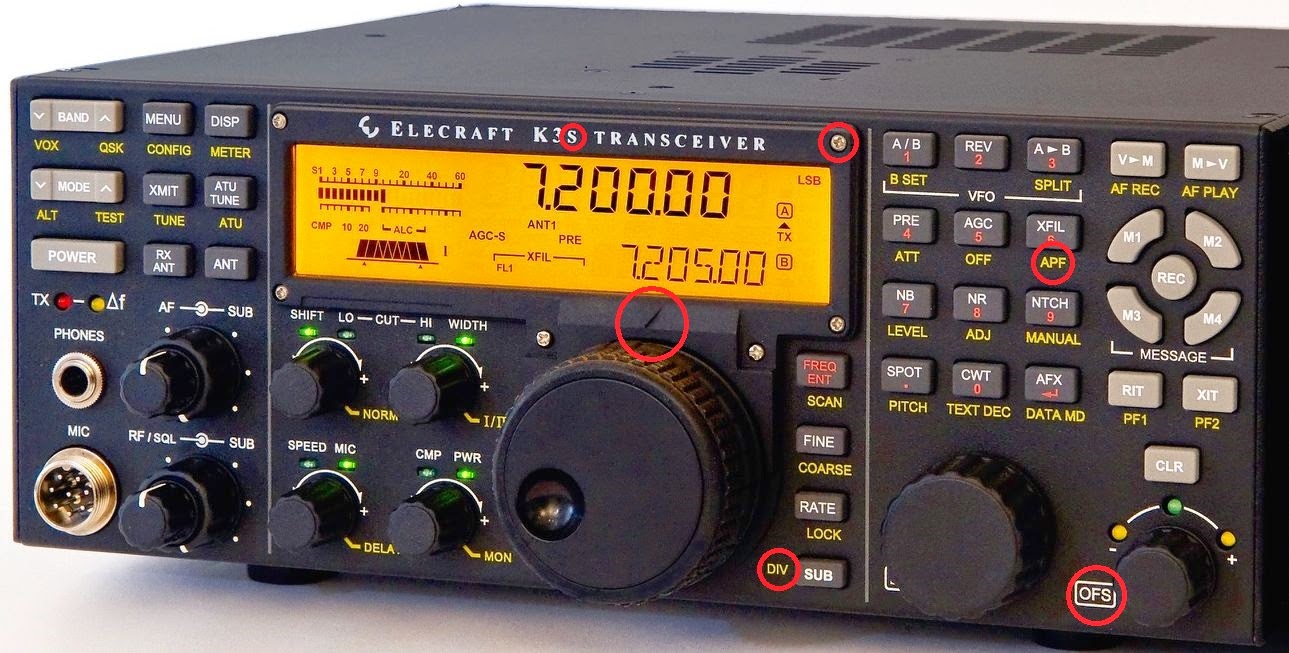
The updated Elecraft K3, the K3S, has some nice improvements that would be nice to have, but which I also can live fine without. But even an old K3 can be updated to some of these improvements. They are detailed on the Elecraft K3S FAQ.
I studied the front panel for differences and put red rings around them. The three to the upper left have to do with the new display bezel with silver instead of black screws, the S in K3S, a built-in marker for the VFO A knob, and a soft-touch VFO A knob.
In addition to the marking with OFS (offset) to the left of the RIT/XIT control, there are two markings that also reflect what my present K3 with the latest firmware does:
- APF instead of DUAL PB (Audio Peaking Filter – Dual Passband) – upper right
- New marker for DIV – Diversity reception – to the left of VFO A
Sverre Holm, LA3ZA, is a regular contributor to AmateurRadio.com and writes from Norway. Contact him at [email protected].
Where can I get APF and DIV stickers for my K3?
The updated Elecraft K3, the K3S has some nice improvements that would be nice to have, but which I also can live fine without. But even an old K3 can be updated to some of these improvements They are detailed on the Elecraft K3S FAQ.
I studied the front panel for differences and put red rings around them. The three to the upper left have to do with the new display bezel with silver instead of black screws, the S in K3S, a built-in marker for the VFO A knob, and a soft-touch VFO A knob.
In addition to the marking with OFS (offset) to the left of the RIT/XIT control, there are two markings that also reflect what my present K3 with the latest firmware does:
- APF instead of DUAL PB (Audio Peaking Filter – Dual Passband) – upper right
- New marker for DIV – Diversity reception – to the left of VFO A
Sverre Holm, LA3ZA, is a regular contributor to AmateurRadio.com and writes from Norway. Contact him at [email protected].
Amateur Radio Weekly – Issue 61

FCC eliminates Amateur Radio vanity call sign fee
“The Commission spends more resources on processing the regulatory fees and issuing refunds than the amount of the regulatory fee payment.”
ARRL
Dayton 2015
The Hara Arena we all know and love continues to be, well, Hara Arena. The good news is renovations are in the works. A Hamvention official told me it’s for real and probably a three to four year project.
Radio Artisan
Pirate SSTV over US Navy satellites
Radio pirates often make use of the Fleetsatcom satellites to send and receive slow scan television (SSTV) pictures over a wide distance.
RTL-SDR.COM
Liquid metal antenna
Boffins have made a liquid metal device which can alter its shape through voltage alone, removing the need for clunky external pumps previously used to arrange such material.
The Register
Wireless door bell adventure [PDF]
433 MHz ASK signal analysis.
Paul Rascagnères
Fox-1 Operating Guide
Fox-1 Operating Guide released at the 2015 Dayton Hamvention. FM transmitter capability on 435 MHz and FM receiver capability on 145 MHz. A full-duplex radio (capable of receiving and transmitting simultaneously) is recommended.
AMSAT
Can I use my Ham Radio on public safety frequencies?
It is widely known that many amateur radios can be modified to transmit outside the ham bands. The answer to this question used to be that amateur radio equipment cannot be used legally on public safety channels because it is not approved for use under Part 90 of the FCC Rules.
K0NR
Enough already!
It’s yet another rant about how most hams nowadays dress like slobs and need to take a bath. I don’t know about you, but I’m getting really sick of this kind of talk.
KB6NU
How to
How to replace a noisy wall power supply
When you purchase a replacement power supply, you must make sure that several properties match that of the device it will power, else you could cause damage.
The SWLing Post
Video
First look at the Flexradio Maestro at Dayton
An early look at the new Flexradio Maestro interface for flex radios. All in one over Wi-Fi touch screen with two waterfalls and physical control interfaces.
YouTube
Amateur Radio Weekly is curated by Cale Mooth K4HCK. Sign up free to receive ham radio's most relevant news, projects, technology and events by e-mail each week at http://www.hamweekly.com.
 Ham Radio Deluxe |
 W5SWL Electronics |
 Ham Radio Prep |
 KB3IFH QSL Cards  Hip Ham Shirts  HamRadioAuctions HamRadioAuctions Reliance Antennas Reliance Antennas Enigma Shop Enigma Shop |  morseDX  Ni4L Antennas  R&L Electronics R&L Electronics antennas.us antennas.us QRV QRV |
- Matt W1MST, Managing Editor
