 |
 Latest on AREDN
 2 June 2015 | by
 The beta test period for the latest release of the Amateur Radio Emergency Data Network (AREDN) firmware is underway. The project released information on the beta that includes details on the new functionality. Some of the new items that are quite exciting include support for 3.4GHz where US hams have no commercial competition, the ability to use low-cost TP-Link hardware, and the ability to use ham-only channels in the 2.4GHz band. For as little as $100 you can have two mesh nodes running to play with…at $50 a piece, you can have a neat little experiment in your neighborhood. If you’re at all interested in data networking and digital communications, take a look at the AREDN project.
Michael Brown, KG9DW, is a regular contributor to AmateurRadio.com and writes from Illinois, USA. Contact him at [email protected].
Latest on AREDN
The beta test period for the latest release of the Amateur Radio Emergency Data Network (AREDN) firmware is underway. The project released information on the beta that includes details on the new functionality. Some of the new items that are quite exciting include support for 3.4GHz where US hams have no commercial competition, the ability to use low-cost TP-Link hardware, and the ability to use ham-only channels in the 2.4GHz band. For as little as $100 you can have two mesh nodes running to play with…at $50 a piece, you can have a neat little experiment in your neighborhood. If you’re at all interested in data networking and digital communications, take a look at the AREDN project.
Michael Brown, KG9DW, is a regular contributor to AmateurRadio.com and writes from Illinois, USA. Contact him at [email protected].
U.S. LF Bands – Rulemaking Ruminations (Part 1)

John Davis of the Longwave Club of America has been doing a good job of keeping us informed of the present 2200/630m application status for U.S. amateurs. It seems that although the NPRM has not yet been published in the Federal Register, the FCC website is open for comments on this issue. I would urge all amateurs with an interest in LF operation to file comments that address the FCC's Notice Of Inquiry (NOI), particularly if you have been operating an experimental station. As well, Canadian LFers operating on either band should consider filing comments as well, describing your system and overall operating results. You can read a full review of the FCC's concerns in three of my earlier blogs:
http://ve7sl.blogspot.ca/2015/04/lf-mf-next-step-for-us-amateurs-part-1.html
http://ve7sl.blogspot.ca/2015/05/lf-mf-next-step-for-us-amateurs-part-2.html
http://ve7sl.blogspot.ca/2015/05/lf-mf-next-step-for-us-amateurs-part-3.html
John's latest information points out what he believes are three crucial points that deserve serious thought. As he indicates, if we don't 'get it right' the first time, it might be very difficult to make any changes after the fact. Please give serious thought to John's information and to filing your own comments at the link provided.
In John's own words:
Rulemaking Ruminations
This is probably a good time to get discussion reactivated on the MF and LF ham proposals. Although I continue not to see publication of the NPRM in the Federal Register as yet, the FCC EFCS Web page for the proceeding is open and accepting filings. Until FR publication, we won't know the closing dates for comments and replies, but you can see what's already been going on at:
http://apps.fcc.gov/ecfs/proceeding/view?name=15-99
While I've been awfully tied up with other things recently, my reading of
the proposal thus far brings to mind three points I believe we earnestly
need to address with the Commission. This proceeding will set the exact US
rules for 2200 m, and very probably also 630 m, so it behooves us to make
the best case we can, now, right up front. If the initial rules are too
restrictive on amateur activity, it could be very difficult and time
consuming to get them changed. Here are my present concerns.
* ONE: In paragraph 168, the FCC states that in addition to separation
distances and power limits, "we propose to limit amateur stations to
operations at fixed locations only to ensure that this separation distance
can be maintained reliably." That's stricter than it may first sound. The
FCC's actual proposed wording for § 97.303(g)(1), for both 2200 and 630 m,
is: "Amateur stations are restricted to use at permanent fixed locations."
Permanent fixed locations. That goes way beyond my suggestion that mobile operation be prohibited. It precludes temporary fixed operation, such as Field Day activities, or tests of ground characteristics for future potential antenna sites, or other legitimate short-term experiments. In my view, this is needlessly restrictive, and could also open the door to more rigid coordination requirements that might paint us into a corner, figuratively and literally, at our original QTHes.
We need to make a strong case that hams are able to identify electric
transmission lines and maintain 1 km separation (or other specified
distance) from them. This further relates to comments the FCC seeks in par. 176: "Amateur licensees will have to determine the location of transmission lines in their vicinity to determine if they are permitted to operate stations using these frequency bands. .... High voltage transmission lines are typically attached to large steel towers that are easy to identity.
However, lower voltage transmission lines are typically attached to wooden poles. Although the wooden poles used for transmission lines are usually taller than the wooden poles used for distribution lines, we recognize that distinguishing the two types may not always be straightforward. We seek comment on whether amateur licensees will be able to identify the transmission lines in their locality."
Obviously, just glancing around a proposed operating site and saying "nope, I don't see a transmission line" is not enough. But I think we're smart enough to do responsible surveys of all lines within a mile or so in all directions, identify any substation locations, and determine which sets of poles have customer connections (practically the definition of distribution lines) and which don't (therefore assumed to be transmission lines). We need to convince the FCC that we can tell the difference.
... to be cont'd
Steve McDonald, VE7SL, is a regular contributor to AmateurRadio.com and writes from British Columbia, Canada. Contact him at [email protected].
Coat hanger 70cm beam

Some years ago, I was in need of a 70cms antenna for portable use and had to improvise by raiding my XYL’s wardrobe! The result was a 2 el Moxon antenna made in about 30 minutes which worked some impressive QRP (2.5W) DX into France on 70cms. Gain is quite low but all you need is a wire coat hanger and a few bits for insulation and to attach the coax feed. Simplicity! It does not look pretty, but it works. The mast was made from a short length of PVC pipe.
See https://sites.google.com/site/g3xbmqrp3/antennas/70cm_moxon .

Roger Lapthorn, G3XBM, is a regular contributor to AmateurRadio.com and writes from Cambridge, England.
Kanga Sudden Arduino Shields
Kanga Products are a kit and component supplier in th UK. They offer all sorts of simple kits for the ham. Notably they supply the Rockmite ][, Foxx and Sudden type TXRX’s.
At the Norbreck rally I bought an Arduino based Sudden TXRX that uses 3 shields. One shield acts as an interface to a AD9850 DDS module, one as a Sudden receiver and the final one as the TX.

Pinched from the Kanga Products website (click to follow)
Assembling the kits was relatively straightforward. There were a couple of small issues but they seem to have been hidden buy what has been a complete disaster with the Arduino. The code looks (to my rather uneducated mind) straightforward as it controls the vfo, a rotary encoder and two push button switches. The implementation of the I2C LCD has been the major issue along with an odd position with another of the libraries call Stdlib.
Try as I might I am having almost no success with the module. I have managed to get it to compile, upload and run a very simple ‘hello world’ after spending 2 evenings on the internet and keyboard. Its a very frustrating thing as with the exception of a bandpass filter the kit is ready to go.
The current error is:
Arduino: 1.6.4 (Windows 8.1), Board: "Arduino Uno"

Build options changed, rebuilding all
Using library Wire in folder: C:Program Files (x86)ArduinohardwarearduinoavrlibrariesWire

C:Program Files (x86)Arduinohardwaretoolsavr/bin/avr-g++ -c -g -Os -w -fno-exceptions -ffunction-sections -fdata-sections -fno-threadsafe-statics -MMD -mmcu=atmega328p -DF_CPU=16000000L -DARDUINO=10604 -DARDUINO_AVR_UNO -DARDUINO_ARCH_AVR -IC:Program Files (x86)Arduinohardwarearduinoavrcoresarduino -IC:Program Files (x86)Arduinohardwarearduinoavrvariantsstandard -IC:Program Files (x86)ArduinohardwarearduinoavrlibrariesWire C:UsersAlexAppDataLocalTempbuild7923519500833479682.tmpsketch_jun01a.cpp -o C:UsersAlexAppDataLocalTempbuild7923519500833479682.tmpsketch_jun01a.cpp.o
sketch_jun01a.ino:12:31: fatal error: LiquidCrystal_I2C.h: No such file or directory
compilation terminated.
Error compiling.
What this tells me is that it can’t find the Library called LiquidCrystal_I2C.h. Believe me Mr Arduino IDE it is exactly where it needs to be! I’m going to get upset in a minute.
Alex Hill, G7KSE, is a regular contributor to AmateurRadio.com and writes from Cumbria, UK. Contact him at [email protected].
Weekly Propagation Summary – 2015 Jun 01 16:10 UTC
Here is this week’s space weather and geophysical report, issued 2015 Jun 01 0141 UTC.
Highlights of Solar and Geomagnetic Activity 25 – 31 May 2015
Solar activity was at very low levels for the majority of the period with the exception of 27 May when low levels were observed. The period was dominated by only low-to-mid level B-class flares with an isolated C1 flare at 2131 UTC on 27 May. The only C-class event of the period originated from Region 2456 (S16, L=199, class/area=Cso/70 on 30 May) but no coronal mass ejection (CME) was observed with this event. Multiple prominence and filament eruptions were observed throughout the period but none resulted in Earth-directed CMEs.
No proton events were observed at geosynchronous orbit.
The greater than 2 MeV electron flux at geosynchronous orbit was normal levels throughout the period.
Geomagnetic field activity was generally quiet throughout the period with an isolated period of unsettled activity observed between 27/1200-1500 UTC.
Forecast of Solar and Geomagnetic Activity 01 June – 27 June 2015
Solar activity is expected to be very low with a chance for C-class flare activity throughout the outlook period.
No proton events are expected at geosynchronous orbit.
The greater than 2 MeV electron flux at geosynchronous orbit is expected to be at moderate levels on 15-19 Jun and high levels on 10-14 Jun with normal levels expected for the remainder of the period.
Geomagnetic field activity is expected to be at active levels on 10 and 14-15 Jun with G1 (Minor) geomagnetic storms likely on 08-09 Jun, all in response to recurrent coronal hole high speed stream influence. Quiet to unsettled geomagnetic field activity is expected for the remainder of the period.
Don’t forget to visit our live space weather and radio propagation web site, at: http://SunSpotWatch.com/
Live Aurora mapping is at http://aurora.sunspotwatch.com/
If you are on Twitter, please follow these two users: + https://Twitter.com/NW7US + https://Twitter.com/hfradiospacewx
Get the space weather and radio propagation self-study course, today. Visit http://nw7us.us/swc for the latest sale and for more information!
Check out the stunning view of our Sun in action, as seen during the last five years with the Solar Dynamics Observatory (SDO): https://www.youtube.com/watch?v=zXN-MdoGM9g
We’re on Facebook: http://NW7US.us/swhfr
Visit, subscribe: NW7US Radio Communications and Propagation YouTube Channel
Where’s The Magic?
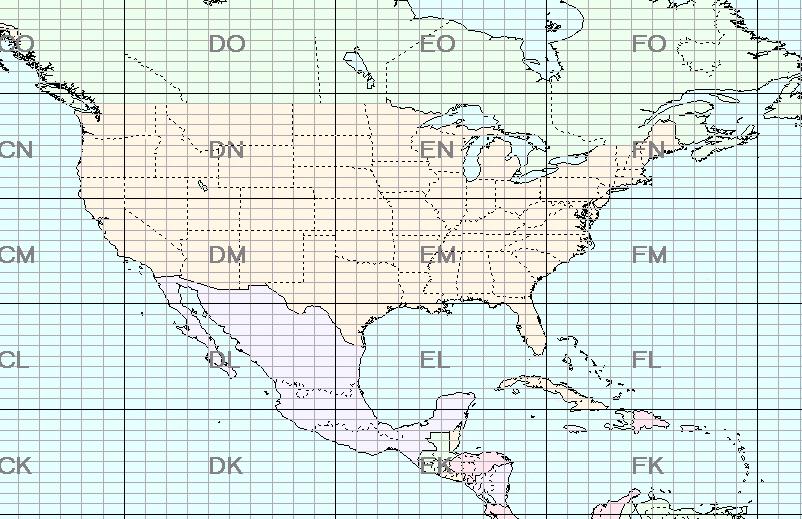 |
| courtesy: http://www.dxmaps.com/ |
Most 6m diehards understand that the cause of summer Es is high-speed wind shear events, way up in the E layer region but a new theory suggests otherwise:
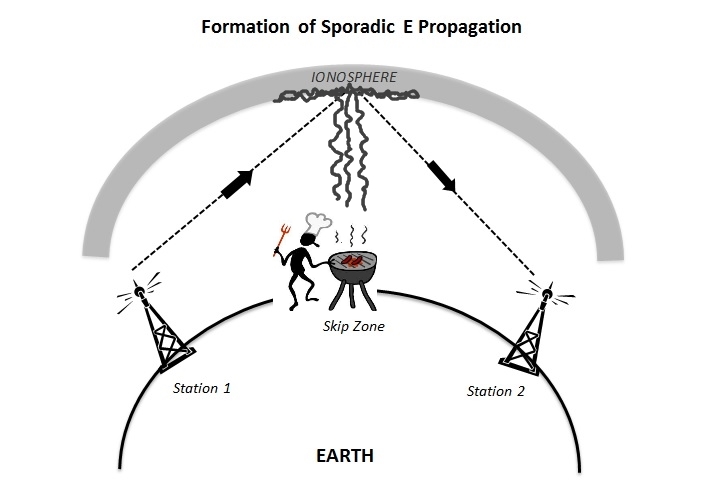 |
| courtesy: nz3m.com |
Steve McDonald, VE7SL, is a regular contributor to AmateurRadio.com and writes from British Columbia, Canada. Contact him at [email protected].
 Ham Radio Deluxe |
 W5SWL Electronics |
 Ham Radio Prep |
 KB3IFH QSL Cards  Hip Ham Shirts  HamRadioAuctions HamRadioAuctions Reliance Antennas Reliance Antennas Enigma Shop Enigma Shop |  morseDX  Ni4L Antennas  R&L Electronics R&L Electronics antennas.us antennas.us QRV QRV |
- Matt W1MST, Managing Editor
