 |
 Pipit 15m transceiver
 7 July 2015 | by
 This rig was designed and built many years ago. It spanned some impressive distances and worked well. The receiver was a direct conversion and the gain adjustment was before the mixer, so RF gain could be reduced easily which helped strong signal handling. No RX-TX offset was needed as this was just about right anyway. For quite a time it was the main rig used and every QSO felt like a million dollars! It was written up in GQRP SPRAT a very long time ago (30 years ago?). It is hard to get much more fun than using something this simple and working a long way regularly with it.
Before I had crystals for the CW part of the band my very first QSO was a USA SSB station that I called that was located near Chicago some 4000 miles away. I nearly fell off the chair when he replied. After than I knew anything was possible. I really should rebuild it someday.
It crossed the Atlantic many times. I even used a 10/15m trap dipole (very low) occasionally and never used anything bigger than a low wire dipole. Output power was 800mW, quite enough I found for solid CW QSOs.
See https://sites.google.com/site/g3xbmqrp3/hf/15m_pipit .

Roger Lapthorn, G3XBM, is a regular contributor to AmateurRadio.com and writes from Cambridge, England.
Andy’s Balloons
 Like Timex watches, the incredible Picosat balloons of Andy, VK3YT, 'take a licking and keep on ticking'. On May 23rd, Andy launched his PS-46 HF Pico balloon and on June 4th it had arrived back home, completing the circumnavigation of the earth in just 12 days ... but it kept on going. Although taking a little longer this time 'round, PS-46 arrived back over its starting longitude exactly one month later, on July 4th, completing its second circumnavigation of the planet! It slowed briefly enough over the Indian Ocean to trace out this interesting ground track.
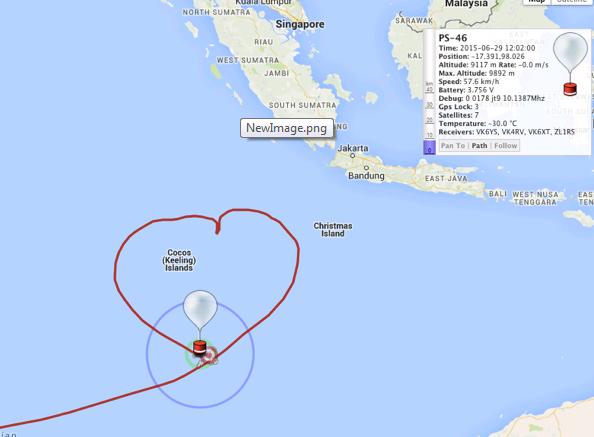 |
| courtesy: http://picospace.net/ |
PS-46 can be tracked via HF packets delivered via JT-9 and WSPR. Frequency information and tracking notes can be found on Andy's website for those interested in tracking the balloon themselves. As well, its track (and other balloons) can be followed on the Spacenear.us website. I think Andy's balloons are very cool and demonstrate a new aspect of amateur radio that was completely unheard of just a few years ago.
Go PS-46!
Steve McDonald, VE7SL, is a regular contributor to AmateurRadio.com and writes from British Columbia, Canada. Contact him at [email protected].
Leaving Dragon Lake

This is the current look of my shack and my antenna farm. Everything packed up and ready to leave Longtan (a.k.a. Dragon Lake). Four years after we moved back to Taiwan we had saved enough money to buy a house and we found one to our liking in neighbouring Daxi (a.k.a. Big Creek). Because the lease of our Longtan house was due we decided to move in even though nothing is finished. Really, we don’t have doors yet and not even one wall is plastered and painted. The best parts of the house are the bathrooms and the kitchen which are 80% done. Radio activity is limited to monitoring local radio, especially the nearby airfield, and the medium wave band with a small loop antenna. Yes, even indoors this is possible now! My summer will be spend plastering and painting, but it will be worth it: my new shack will be 6 by 2.4 meters big. I’ll be back in the fall. Cheerio!
Hans "Fong" van den Boogert, BX2ABT, is a regular contributor to AmateurRadio.com and writes from Taiwan. Contact him at [email protected].
Elecraft K1
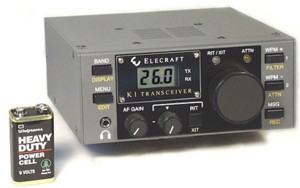
One of my least used rigs (it has still to be used at this QTH!) is my 4-band Elecraft K1 CW transceiver. This covers 40m, 30m, 20m and 15m CW at up to about 7W. It has the auto-ATU built in so just needs a 12-13.8V supply, CW key and end-fed antenna to be on the air.
At my old QTH it has worked lots including the USA on all bands with a simple end-fed wire antenna down the garden. I really should consider selling it or trading it in as it is not being used.

Roger Lapthorn, G3XBM, is a regular contributor to AmateurRadio.com and writes from Cambridge, England.
Conditions sucked yesterday
After completing a bunch of yard work, I got set up for the QRP-ARCI Summer Homebrew Sprint. All I heard was a bunch of nothing. I ended up working K4BAI and N4BP and that was it. Discouraged, and thinking that it might be my portable antennas (which performed just fine for Field Day last weekend), I left the park early and came home. The HF9V and the W3EDP antennas connected to the shack KX3 weren't hearing any more or any better, so I guess it was just a bad propagation day.
So this morning, I noticed a post from another Ham in the Facebook Field Radio group. He didn't have any luck either in his own personal portable ops trip yesterday. He was wondering whether it might be his antennas or a case of an unacceptable SWR ........
So of course, someone had to pipe up with "Try a 100 Watt radio next time. Life is too short for QRP."
That just burns my biscuits. So I fired back with, "Propagation sucked yesterday, and can we do without the "Life's too short for QRP" line? Not only is it untrue, but it's really overused."
A bit later, I got a pang of conscience, feeling that I might have been a bit harsh with that line, so I added, "I've got nothing against QRO (use it myself sometimes). I have been at this Ham Radio thing since 1978 and have been 99 and 44/100ths % QRP since 2003. I'm not trying to make it a "religion" or force anyone into it, but I still get amazed and shake my head sometimes as what 5 Watts will accomplish. But still ...... whatever peels your potato. If you like QRO, fine - QRP, fine - CW, fine - SSB, fine - digital, fine - there's room for all of us. The more the merrier."
Really, there's no reason to ever demean or diminish what someone likes about Amateur Radio. Even if for the life of you, you can't understand why someone would like to spend hours chasing after some little island in the middle of nowhere, or why someone chases signals that you can't even hear with your own ears, or why someone just won't give up on an old, antiquated form of transmission that was invented over 100 years ago and has been dumped by just about everyone else in the world, or why some people seem to get together for hours just to kibbitz about old times or enumerate their aches and pains, or even why someone would "waste" their entire weekend working a contest while simultaneously "clogging up the bands".
If it's what you like, then that's all that's important - and don't let anyone tell you different.
72 de Larry W2LJ
QRP - When you care to send the very least!
Larry Makoski, W2LJ, is a regular contributor to AmateurRadio.com and writes from New Jersey, USA. Contact him at [email protected].
Nifty I Phone Morse Code Decoder
HOT PAW
MORSE CODE DECODER FOR I PHONE

Screen Snap of Hot Paw Morse Code Decoder
I recently installed a ham radio station in my truck. Since then I’ve been having a lot of fun with it, using SSB mostly, since that is a novelty for me. Most of my operating has been using CW, but taking a side trip into PSK occasionally. Logging is somewhat cumbersome in a truck. I used big elastic bands to attach a small clip board to my leg so I could quickly write down a call sign and very basic information. This information would be then transferred to a computer log at home. I tried using the computer in the truck also, and that proved even more cumbersome, having the laptop jammed into the steering wheel.
I like to use a keyboard to send code but no matter what I used, it was a bit awkward in the truck. At the very least, the laptop stays put when its jammed into the steering wheel. Using the passenger seat would require my changing the radio head orientation, the antenna control and paddles which are all set up for easy use from the drivers seat.
Occasionally I’d switch to CW and fumbled for a pen to write down a call sign, time, and band. The guy I was chatting with on 40 meter CW was running just a tad too fast for me to copy ‘everything he sent’, so I missed some of it. It seems that the ‘buffer in my brain’ is smaller than I’d like it to be and with FIFO being the rule, the beginning of a word vanishes as I copy the ending.
(FIFO, First In, First Out’) Some folks may complain that using a ‘decoder’ is cheating somehow. Yes, for a contest, but for every day QSO’s its not cheating at all. If you don’t like it, don’t use it!
I discovered this app and tried it last night for the first time. Wowzah, can it copy code! Just lean it up against your radio, or just near it, and it copies CW. This is a really great help when someone is sending just a ‘tad faster’ than my ability to copy ‘everything’! Its also handy to ‘get the entire call sign’, while I was fumbling with other things in the truck! It works pretty well even in poor band conditions, and has Farnsworth Method as well as regular copy. It has ultra high speed copy, but I have not tried it. 1oo WPM code is hard to come by on the air.
This proves very useful in the truck, but my guess is that other hams will find it handy in other ways.
Ernest Gregoire, AA1IK, is a regular contributor to AmateurRadio.com and writes from Florida, USA. Contact him at [email protected].
Weekly Propagation Summary – 2015 Jul 06 16:10 UTC
Here is this week’s space weather and geophysical report, issued 2015 Jul 06 0524 UTC.
Highlights of Solar and Geomagnetic Activity 29 June – 05 July 2015
Solar activity ranged from very low to moderate levels this period. Low levels were observed during the majority of the period with moderate levels observed on 03 July and very low levels on 05 July. The majority of the C-flare activity occurred from Regions 2373 (N16, L=141, class/area Dso/150 on 01 July), 2376 (N13, L=124, class/area Eai/150 on 01 July) and 2378 (S16, L=086, class/area Cso/090 on 04 July). Region 2378 produced the largest flare of the period, an impulsive M1/1n flare at 03/1251 UTC. New Region 2381 (N15, L=073, class/area Dao/100 on 05 July) emerged near the NE limb on 03 July and grew moderately on 05 July, however had not produced significant flare activity by the time of this report. No Earth-directed coronal mass ejections (CMEs) were noted during the period.
No proton events were observed at geosynchronous orbit, however there was an enhancement from 29-30 July as levels were decaying from the 10 MeV proton event that occurred from 26/0350 UTC through 27/0755 UTC associated with an M7/3b flare at 25/0816 UTC. Another enhancement to 5 pfu (Below S1-Minor) was observed from 01-02 July, likely due to flare/CME activity from beyond the west limb at 01/1436 UTC.
The greater than 2 MeV electron flux at geosynchronous orbit was at high levels from 29 June through 04 July reaching a maximum flux value of 9,670 pfu at 30/1725 UTC. Electron flux decreased to normal levels on 05 July in response to the arrival of a co-rotating interaction region (CIR) preceding a negative polarity coronal hole high speed stream (CH HSS).
Geomagnetic field activity was mostly quiet with solar wind parameters at nominal levels for the majority of the week. Solar wind speeds ranged from 300 km/s to 450 km/s and total field values were between 1 nT and 8 nT. By midday on 04 July, total field, density, solar wind speed and temperature all began to increase indicating the arrival of a CIR preceding the anticipated recurrent negative polarity CH HSS. Total field reached a maximum of 23 nT at 04/1901 UTC with the Bz component reaching a maximum southward deflection of -22 nT at 04/1911 UTC. Solar wind speed increased from the mid 300 km/s to 604 km/s by 04/2023 UTC before declining to just over 500 km/s by the end of the period. The geomagnetic field responded with G1 (Minor) to G2 (Moderate) storm periods late on 04 July though early on 05 July.
Forecast of Solar and Geomagnetic Activity 06 July – 01 August 2015
Solar activity is expected to be at low levels with a chance for M-class (R1-R2, Minor-Moderate) flares from 06 July through 24 July with the return of old Regions 2367 (S20, L=002) and 2371 (N13, L=302). Very low to low levels are expected from 25 July through 01 August.
No proton events are expected at geosynchronous orbit.
The greater than 2 MeV electron flux at geosynchronous orbit is expected to be at high levels from 07-08 July and again from 12-15 July in response to recurrent CH HSS activity.
Geomagnetic field activity is expected to be at active levels on 06 July as a recurrent negative polarity CH HSS persists. Unsettled to G1 (Minor) storm conditions are expected from 10-11 July due to the arrival of a recurrent positive polarity CH HSS. G1 (Minor) to G2 (Moderate) geomagnetic storm conditions are expected once again from 31 July through 01 August due to the return of the recurrent negative polarity CH HSS.
Don’t forget to visit our live space weather and radio propagation web site, at: http://SunSpotWatch.com/
Live Aurora mapping is at http://aurora.sunspotwatch.com/
If you are on Twitter, please follow these two users: + https://Twitter.com/NW7US + https://Twitter.com/hfradiospacewx
Get the space weather and radio propagation self-study course, today. Visit http://nw7us.us/swc for the latest sale and for more information!
Check out the stunning view of our Sun in action, as seen during the last five years with the Solar Dynamics Observatory (SDO): https://www.youtube.com/watch?v=zXN-MdoGM9g
We’re on Facebook: http://NW7US.us/swhfr
Visit, subscribe: NW7US Radio Communications and Propagation YouTube Channel
 Ham Radio Deluxe |
 W5SWL Electronics |
 Ham Radio Prep |
 KB3IFH QSL Cards  Hip Ham Shirts  HamRadioAuctions HamRadioAuctions Reliance Antennas Reliance Antennas Enigma Shop Enigma Shop |  morseDX  Ni4L Antennas  R&L Electronics R&L Electronics antennas.us antennas.us QRV QRV |
- Matt W1MST, Managing Editor
