 |
 LHS Episode #149: Coming Up Lemons
 29 June 2015 | by
  Hello again, and welcome to Episode #149 of Linux in the Ham Shack. In this episode we tackle a number of interesting and diverse topics: Starting with Field Day and an online course on Climate Change, we move to software patent legislation, deep topics like buildroot and custom Linux images, and then to hardware reverse engineering for your benefit and a utility for helping you save battery power on your laptop. We even manage to get in an interview with our ambassador to SELF, Darrell, KI4LLA. Don't miss one action-packed second.
73 de The LHS Guys
Russ Woodman, K5TUX, co-hosts the Linux in the Ham Shack podcast which is available for download in both MP3 and OGG audio format. Contact him at [email protected].
Use SSB on VHF For Better Range on SOTA Peaks
Previously, I had written about how the use of SSB made the difference while activating Prospect Mountain (W0C/FR-069) for Summits On The Air (SOTA). This time I was the SOTA chaser, trying to work Brad WA6MM as he activated two peaks near Breckenridge, Colorado.
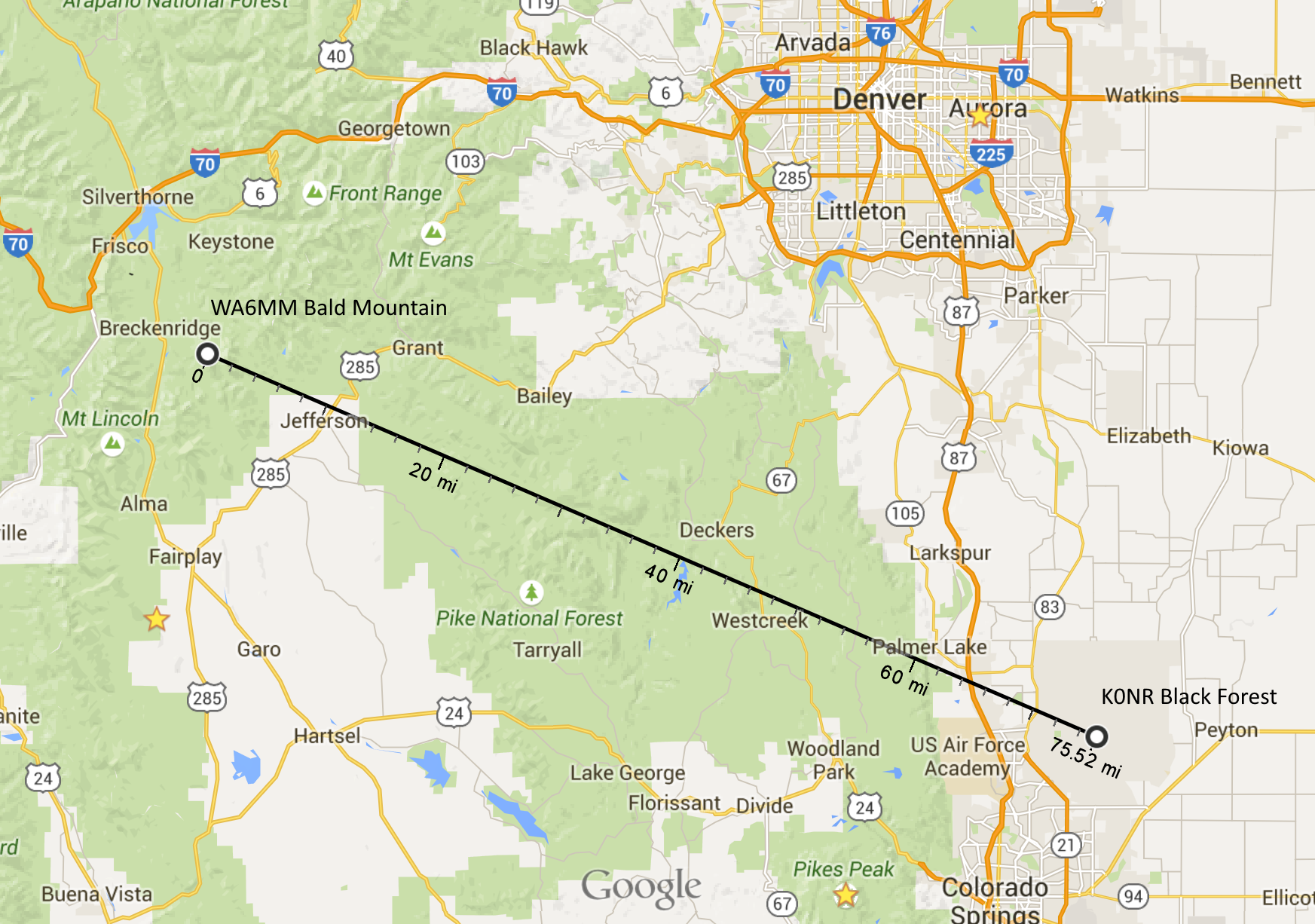
Bald Mountain to Black Forest (click to expand)
It was the Saturday of ARRL Field Day, so I planned to be out at our FD site in Black Forest. Brad and I had coordinated in advance and pretty much concluded that it would be difficult or impossible to make the contact on FM. Brad decided to take his FT-817 along with a homebrew 4-element yagi to give him 2m SSB capability. Out at the FD site, I saw that Brad was spotted on Bald Mountain (W0C/PR-019) via SOTAwatch early in the morning, so I borrowed the FD VHF station to try to work him. It was an FT-897 pushing 50 watts to a 4-element yagi up about 30 feet. I heard Brad clearly on 144.200 MHz (SSB calling frequency) and we made the contact.
I estimate that the contact was about 75 miles. I did not do a careful analysis of the terrain but the the signal had to get over the Rampart Range and quite a few other mountains to get from Black Forest to Bald Mountain. The summit of Bald Mountain is at 13,684 feet, so that certainly helps.
A few hours later, Brad showed up on the summit of Boreas Mountain (W0C/SP-030), another 13er near Breckenridge. By now, the Field Day station was in use, so I pulled out my own FT-817 and a 3-element Arrow yagi. Holding it in my hand, I pointed it towards Boreas Mountain and tuned to 144.200 MHz USB. This time Brad was even weaker but still readable, so we completed the contact.
In both cases, Brad was fair to good copy but just above the noise, I am sure that using FM would not have gotten the job done. For serious VHF work, 75 miles is not that great of a distance but we were running QRP power levels with small yagi antennas.
Brad and I are both concluding we need to encourage the use of SSB for 2m SOTA here in Colorado. It is common to end up on a high peak in the Colorado backcountry and not have enough range to reach the larger population centers. Sure there are more people active on 2m FM, but if no one is within range, it does not matter.
Congratulations to WA6MM for first activations of two more challenging summits in Colorado and thanks for 18 chaser points!
73, Bob K0NR
The post Use SSB on VHF For Better Range on SOTA Peaks appeared first on The KØNR Radio Site.
Bob Witte, KØNR, is a regular contributor to AmateurRadio.com and writes from Colorado, USA. Contact him at [email protected].
Hard reset time
As part of my recovery I usually do a short 5 minute walk morning and night. When out this evening I did a “hard” reset of my 10m and 6m WSPR stations. All power was removed, the PC (used with the FT817 on 6m) was turned off for the duration of the walk. Now home again both the 6m and 10m WSPR kits were turned on again and the whole lot sync’d to Internet time.
I hope to stay on both bands overnight, although, so far, I have not managed to catch any transatlantic Es openings. I remain hopeful. Because of the high thunder risk later in the week I may have to go QRT though, which will be a pity. Hopefully this will be a short break only.

Roger Lapthorn, G3XBM, is a regular contributor to AmateurRadio.com and writes from Cambridge, England.
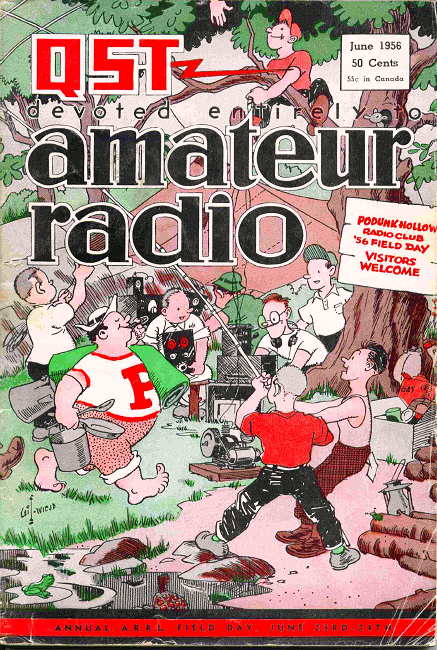
Field Day Memories
 |
| courtesy: arrl.org |
Field Day always followed the end of school and the start of the summer holidays so it was always a weekend that I looked forward to, months in advance.
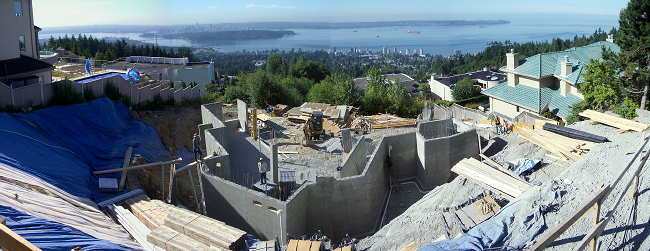
I always went out with the Vancouver Amateur Radio Club (VE7ARV) who used the same spot each year, just above the last street of homes high up on the slopes of West Vancouver ... it was at the base of Hollyburn Mountain and was a spectacular visual site, giving southerly views from east through west. At times it seemed like you could almost see California from up there ... it was a great spot for both HF and VHF. Our Field Day site has long been reclaimed by palatial-sized home in the prestigious 'British Properties' region of Vancouver's North Shore.
Sadly many of the organizers and operators that I remember from my youth are now long gone but they were an enthusiastic group of old-time hams that always had the time to make a young kid feel welcome and part of an important operation. Many of the same fellows were responsible for a lot of teens getting their ticket back in the late 50's and 60's. Tuesday nights were always spent in the basement 'classroom' of Hedley Rendell, VE7XW, who gave so much of his time to Elmering prospective hams as well as providing the trailored crank-up towers for our FD operations. He later established Rendell-Paret Electronics in partnership with Bill Paret, VE7AM, and the contents of Hedley's vast basement collection of parts was the beginning of a business that still flourishes to this day.
Field Day always had many high points for me. One of the best was being able to operate some top-notch equipment compared to my humble home station which consisted of an old Heathkit AT-1 and VF-1 VFO and then later, a much-used DX-35, purchased on one of the family's summer shopping trips to Seattle. In those days, the city was home to several ham radio shops and at least a dozen radio-surplus stores, all now long gone.
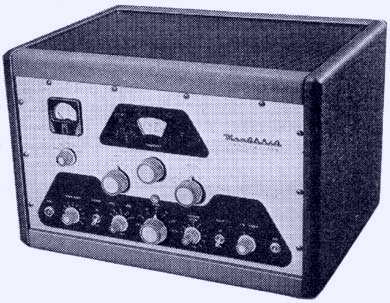
There were usually a couple of Collins 75A4's and later, state-of-the-art Drake 2B's. The Johnson Ranger was always reliable and such a pleasure to operate but there were always a few hundred-pound hernia-makers like the Heathkit DX-100's and the Johnson Viking II's that had to be lugged from back seats to tents every year. That's where us young guys came in handy.
VHF activity back then was mainly FM (at least in the Vancouver area) and every year we would manage to work down to the weekend hilltopers in Oregon, mainly due to our elevated location. 2m FM rigs in those days were all converted taxi rigs, mainly Motorola 5V's, run on their built-in DC vibrator supply or on a homebrewed power supply. There were at least a hundred guys on 147.33 FM, all with old taxi rigs and the frequency was busy 24/7 it seemed. These were the days before repeaters and working 50 miles was a real accomplishment.
I usually took the 40m CW shift and would operate all night. The band was always amazingly crowded with nothing but FD stations throughout the entire activity ... even the 40m phone band was plugged solid with AM action, all working the FD contest. I would never ever sleep at Field Day and would go home exhausted, usually sleeping an entire Monday, to recharge my battery ... fun days.
I haven't been out on Field Day since my late teens as other things in life became more important but I'll never forget those wonderful weekends and the great fun that was had, so many years ago
Steve McDonald, VE7SL, is a regular contributor to AmateurRadio.com and writes from British Columbia, Canada. Contact him at [email protected].
A new 40m DSB kit arrives on the QRP scene
The MDT DSB kit is manufactured by Ozqrp, capable of 2W PEP, it has a full swinging VFO 7.090MHz - 7.130MHz or 7.050MHz - 7.110MHz all for $80 (Aus) including case, less than £40 UK plus carriage, which worked out about $12.50 (Aus) posted to the UK when I quickly did a test and popped it into the shopping trolley.
Further details and manual from http://www.ozqrp.com/MDTindex.html
Steve, G1KQH, is a regular contributor to AmateurRadio.com and writes from England. Contact him at [email protected].
Series Eight Episode Fourteen – Friedrichshafen Review (28 June 2015)
In this episode of the ICQ Amateur / Ham radio Podcast, we start our review of the Ham Radio Friedrichshafen event.
Interviews with
- Paul Bigwood (G3WYW) from Yaesu discussing System Fusion - https://www.yaesu.com/
- Michael Zwingl (OE3MZC) from OEVSV discussing the groups proposal for a more modern radio operating system - http://www.oevsv.at
- Graham Summerfield from BHI - http://www.bhi-ltd.com
- World Radio Team Championship 2018 Announcement - http://www.wrtc2018.de/
- Gerald (K5SDR) from Flex makes a product development announcement - http://www.flexradio.com
Colin Butler, M6BOY, is the host of the ICQ Podcast, a weekly radio show about Amateur Radio. Contact him at [email protected].
Series Eight Episode Fourteen – Friedrichshafen Review (28 June 2015)
In this episode of the ICQ Amateur / Ham radio Podcast, we start our review of the Ham Radio Friedrichshafen event.
Interviews with
- Paul Bigwood (G3WYW) from Yaesu discussing System Fusion - https://www.yaesu.com/
- Michael Zwingl (OE3MZC) from OEVSV discussing the groups proposal for a more modern radio operating system - http://www.oevsv.at
- Graham Summerfield from BHI - http://www.bhi-ltd.com
- World Radio Team Championship 2018 Announcement - http://www.wrtc2018.de/
- Gerald (K5SDR) from Flex makes a product development announcement - http://www.flexradio.com
Colin Butler, M6BOY, is the host of the ICQ Podcast, a weekly radio show about Amateur Radio. Contact him at [email protected].
 Ham Radio Deluxe |
 W5SWL Electronics |
 Ham Radio Prep |
 KB3IFH QSL Cards  Hip Ham Shirts  HamRadioAuctions HamRadioAuctions Reliance Antennas Reliance Antennas Enigma Shop Enigma Shop |  morseDX  Ni4L Antennas  R&L Electronics R&L Electronics antennas.us antennas.us QRV QRV |
- Matt W1MST, Managing Editor
