 |
 CLE 198 Results
 21 September 2015 | by
 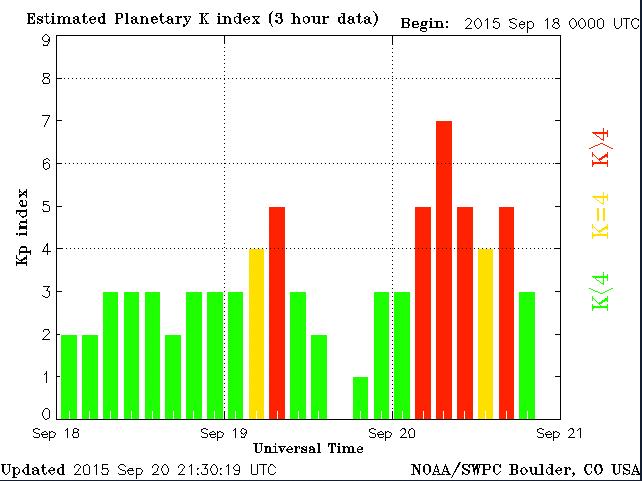 |
| courtesy: http://www.swpc.noaa.gov/ |
For those looking to log Hawaii on the NDB band, 'POA' on 332 kHz is a good bet as it had a strong signal here on all three nights and was heard shortly after sunset in Hawaii.
------------------------------------------------------------------------------------
DD UTC kHz Call mi New Location
--------------------------------------------------------------------------------
19 11:00 323 HJH 1393 Hebron Municipal Apt, NE, USA
19 10:00 325 YJQ 312 Bella Bella (Campbell Island), BC, CAN
19 12:00 326 XJ 522 Fort St. John, BC, CAN
19 09:00 326 MA 1594 FARLY - Midland, TX, USA
20 04:00 326 FO 1531 'Riply' Topeka, KS, USA
19 10:00 326 DC 131 Princeton Municipal Apt, BC, CAN
19 12:00 328 LAC 133 'Lacomas' Fort Lewis, WA, USA
19 12:00 328 5J 564 Coronation, AB, CAN
20 05:00 329 YHN 1730 Hornepayne, ON, CAN
19 12:00 329 YEK 1414 Arviat, NU, CAN
19 12:00 329 X2 590 Athabasca, AB, CAN
19 12:00 329 TAD 1240 Trinidad - Hoehne, CO, USA
19 10:00 329 PMV 1437 Plattsmouth, NE, USA
19 12:00 329 PJ 920 Robinson (Whitehorse), YT, CAN
21 09:00 329 HMA 1851 Hondo Municipal Apt, TX, USA
19 08:00 332 XT 442 Terrace, BC, CAN
19 08:00 332 XH 565 Medicine Hat, AB, CAN
19 08:00 332 WC 25 White Rock (Abbotsford), BC, CAN
20 04:00 332 VVV 1280 Ortonville Municipal Apt, MN, USA
19 08:00 332 POA 2681 Pahoa - Hawaii Island, HWA
20 05:00 332 FIS 2794 Fish Hook - Key West, FL, USA
19 08:00 333 STI 540 'Sturgeon' Mountain Home, ID, USA
19 08:00 334 P2 514 Wetaskiwin, AB, CAN
------------------------------------------------------------------------------------
As usual, all stations were heard using the Perseus SDR.
Hopefully CLE 199 will see the return of quieter band conditions and better propagation ... if the sun can calm down long enough.
Steve McDonald, VE7SL, is a regular contributor to AmateurRadio.com and writes from British Columbia, Canada. Contact him at [email protected].
LHS Episode #154: Sorry, I Kant Today
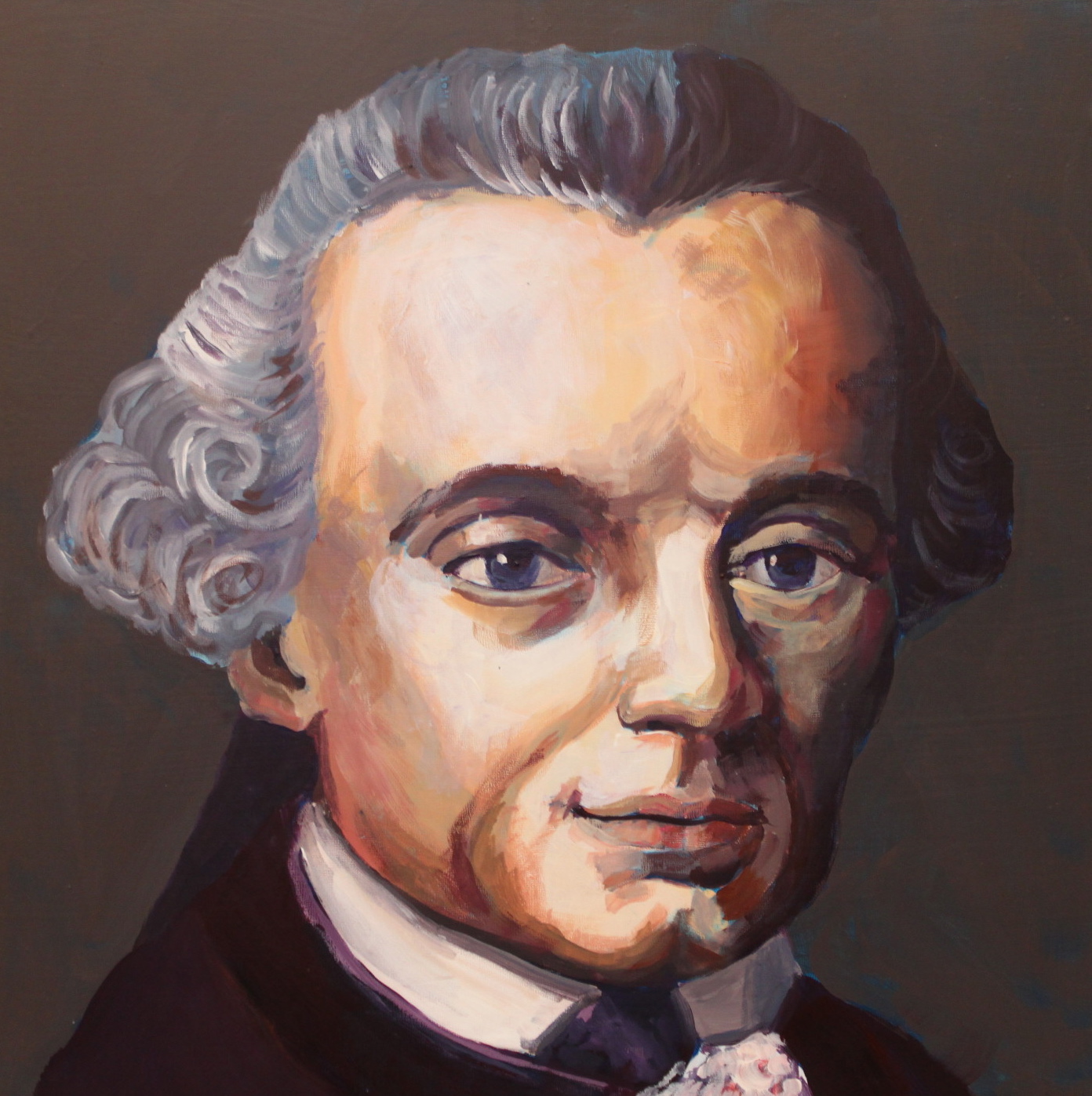 Welcome to the latest installment of Linux in the Ham Shack. In this episode we present some topics of the day related to ham radio and Linux, as well as veer a little off course and put forth a thought experiment, comparing Linux, Windows and MacOS in a purely subjective way. We also look at open pharmacology, Linux distros, German food and a lot more. Thanks for listening, and please let your friends know about us.
73 de The LHS Guys
Russ Woodman, K5TUX, co-hosts the Linux in the Ham Shack podcast which is available for download in both MP3 and OGG audio format. Contact him at [email protected].
Arduino Morse Tutor

In a recent conversation with my good friend Lewis, we started discussing Morse code, training and the old equipment that was used to educate and teach the code to newcomers. In particular we discussed the old Datong D70 practice oscillators. Lewis carried on the tell me that his Datong like so many others started sending odd illegal characters and essentially rendered the kit useless. Of course you could whip of the lid and replace the logic chips, but I thought of recreating the Datong functionality in a new Arduino sketch.
So here is a breakdown of what the Datong offered:
- Either Mixed, letter or number combinations
- Groups of 5 characters
- Variable speed ( up to 37.5 word per minute)
- Variable character spacing (up to 4 seconds)
The Datong also allowed you to connect a telegraph key, and your headphones. But for now I will focus on the code generation element of the project.
The finished project has just a handful of components and can easily be created on a breadboard, or indeed if you have an old broken Datong you can reuse the box and panel to really replicate the old kit. The complete project includes 3 variable resistors (1K LIN) for Character speed, gap and volume. It also needs a 3 way switch to select the mode.
The Arduino I’m using is the UNO. Arguably the most popular Arduino on the market, but I have also tried the sketch on a Nano and it works fine – just some customisation of pin assignments is all that is needed.
On start up the Arduino checks to see which switch is LOW – it also saves the current mode and checks if the saved mode is the same as the current selected switch. If this is different, then the Arduino has had a change in the mode selection and resets.
When generating the tones, the Arduino randomly selects a character from an array. With that chosen letter – it calls a function and plays the corresponding tone functions. 2 functions exist as a DIT and a DAH.
The rest of the functions are dedicated to allowing the speed and gap to alter and also displaying the results on the LCD panel (completely optional).
Here is a short video of the kit working, and a link to the source code.
Dan Trudgian, MØTGN, is a regular contributor to AmateurRadio.com and writes from Wiltshire, England. He's a radio nut, IT guru, general good guy and an all round good egg. Contact him him here.
Arduino Morse Tutor
In a recent conversation with my good friend Lewis, we started discussing Morse code, training and the old equipment that was used to educate and teach the code to newcomers. In particular we discussed the old Datong D70 practice oscillators. Lewis carried on the tell me that his Datong like so many others started sending odd illegal characters and essentially rendered the kit useless. Of course you could whip of the lid and replace the logic chips, but I thought of recreating the Datong functionality in a new Arduino sketch.
So here is a breakdown of what the Datong offered:
- Either Mixed, letter or number combinations
- Groups of 5 characters
- Variable speed ( up to 37.5 word per minute)
- Variable character spacing (up to 4 seconds)
The Datong also allowed you to connect a telegraph key, and your headphones. But for now I will focus on the code generation element of the project.
The finished project has just a handful of components and can easily be created on a breadboard, or indeed if you have an old broken Datong you can reuse the box and panel to really replicate the old kit. The complete project includes 3 variable resistors (1K LIN) for Character speed, gap and volume. It also needs a 3 way switch to select the mode.
The Arduino I’m using is the UNO. Arguably the most popular Arduino on the market, but I have also tried the sketch on a Nano and it works fine – just some customisation of pin assignments is all that is needed.
On start up the Arduino checks to see which switch is LOW – it also saves the current mode and checks if the saved mode is the same as the current selected switch. If this is different, then the Arduino has had a change in the mode selection and resets.
When generating the tones, the Arduino randomly selects a character from an array. With that chosen letter – it calls a function and plays the corresponding tone functions. 2 functions exist as a DIT and a DAH.
The rest of the functions are dedicated to allowing the speed and gap to alter and also displaying the results on the LCD panel (completely optional).
Here is a short video of the kit working, and a link to the source code.
Dan Trudgian, MØTGN, is a regular contributor to AmateurRadio.com and writes from Wiltshire, England. He's a radio nut, IT guru, general good guy and an all round good egg. Contact him him here.
Series Eight Episode Twenty – Software Defined Radio Dongles (20 September 2015)
In this episode, Martin M1MRB / W9ICQ is joined by Leslie Butterfield (G0CIB), Chris Howard (M0TCH) and Edmund Spicer (M0MNG) to discuss the latest Amateur / Ham Radio news. Colin (M6BOY) rounds up the news in brief, and this episodes feature is Software Defined Radio Dongles.
- Bermuda Closes AM / Medium Wave Radio Transmitters
- Acorn II 40m SDR Construction
- Indian Government Employees to learn Amateur / Ham Radio
- Chess Controversy and Morse Code
- Ofcom Suggest 70.5 MHz for Internet of Things
- Reflectorless Yagi Radio Antennas Designs
- Councillors Vote in Favour of Ham Radio Mast
- Malta Digital Repeater
Colin Butler, M6BOY, is the host of the ICQ Podcast, a weekly radio show about Amateur Radio. Contact him at [email protected].
Series Eight Episode Twenty – Software Defined Radio Dongles (20 September 2015)
In this episode, Martin M1MRB / W9ICQ is joined by Leslie Butterfield (G0CIB), Chris Howard (M0TCH) and Edmund Spicer (M0MNG) to discuss the latest Amateur / Ham Radio news. Colin (M6BOY) rounds up the news in brief, and this episodes feature is Software Defined Radio Dongles.
- Bermuda Closes AM / Medium Wave Radio Transmitters
- Acorn II 40m SDR Construction
- Indian Government Employees to learn Amateur / Ham Radio
- Chess Controversy and Morse Code
- Ofcom Suggest 70.5 MHz for Internet of Things
- Reflectorless Yagi Radio Antennas Designs
- Councillors Vote in Favour of Ham Radio Mast
- Malta Digital Repeater
Colin Butler, M6BOY, is the host of the ICQ Podcast, a weekly radio show about Amateur Radio. Contact him at [email protected].
The Gray Line Report
Ham club newsletters exist in abundance. Most to inform members about upcoming events or to celebrate recently concluded activities with words and pictures. But there are those that serve a much larger audience — with timely advice and stories that cover the broader spectrum of amateur radio.

One of my favorites is The Gray Line Report — a quarterly publication of the Twin City DX Association.
The September edition is another good one. I’m reading ‘Adding an Amplifier to a Low Power Contest Station’ by Al Dewey, K0AD.
An there’s plenty more where that came from. Don’t miss it.
Tagged: dx, newsletter, tcdxa 

Jeff Davis, KE9V, is a regular contributor to AmateurRadio.com and writes from Indiana, USA.
 Ham Radio Deluxe |
 W5SWL Electronics |
 Ham Radio Prep |
 KB3IFH QSL Cards  Hip Ham Shirts  HamRadioAuctions HamRadioAuctions Reliance Antennas Reliance Antennas Enigma Shop Enigma Shop |  morseDX  Ni4L Antennas  R&L Electronics R&L Electronics antennas.us antennas.us QRV QRV |
- Matt W1MST, Managing Editor
