 |
 Just good enough 10 MHz GPS reference
 3 October 2015 | by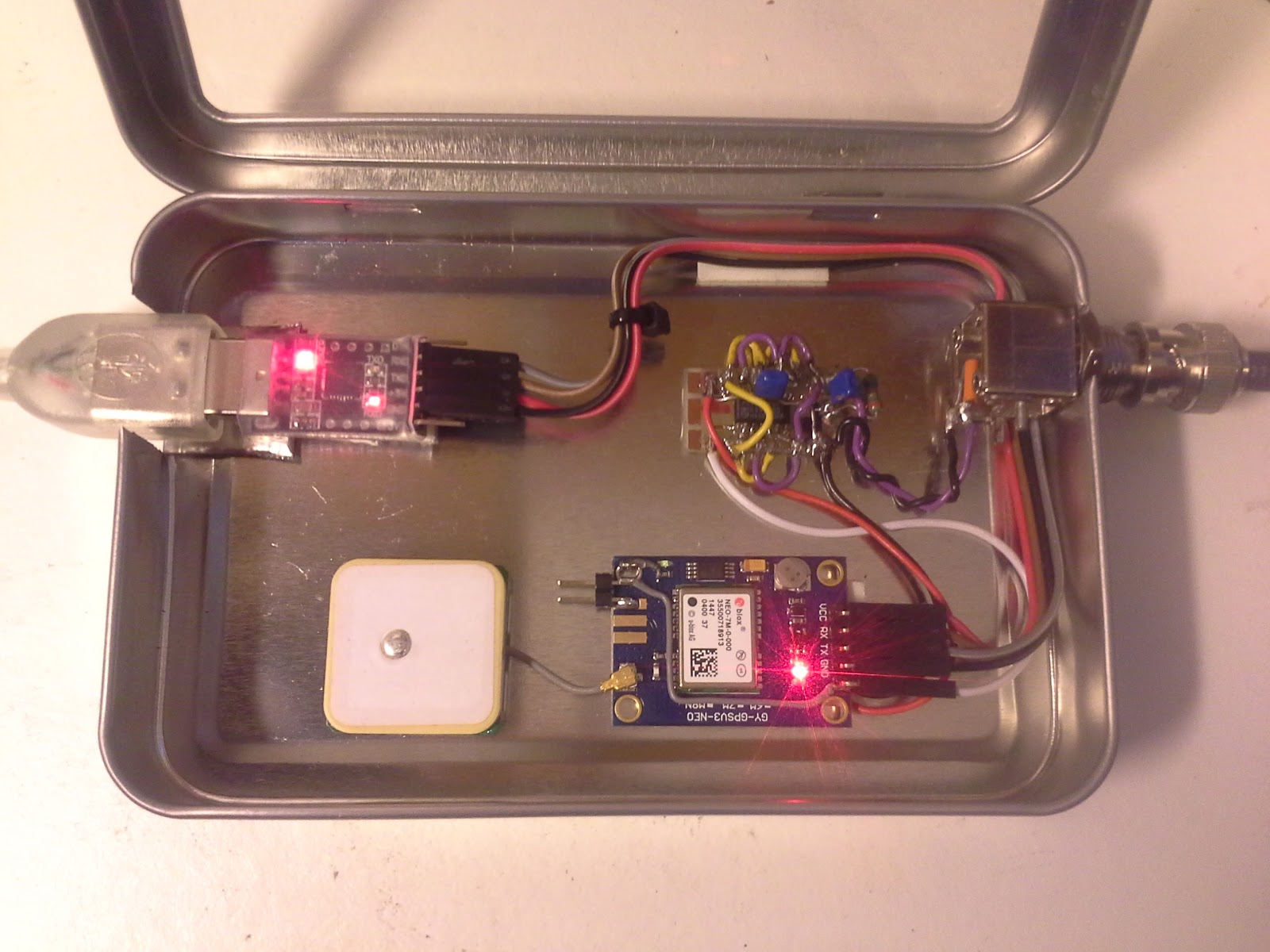
Some time ago I noticed that the Ublox Neo-7M GPS has a 10 MHz output which is locked to the GPS system’s accuracy. Most people kept saying how useless it was due to excessive jitter unless it was cleaned up with a phase locked loop of some sort.
At about the same time I installed the external reference input for my Elecraft K3. The K3EXREF enables the K3’s frequency to be locked to an external 10 MHz reference. What struck me was how its function is described:
- The frequency of the internal oscillator of about 49.38 MHz is continuously measured and averaged, obtaining a value to the nearest 1 Hz.
- The K3EXREF does not phase lock the K3’s reference oscillator and the external 10 MHz source has no impact on the K3’s phase noise performance.
This got me wondering if the Neo-7M would be just good enough as a reference and that all the averaging internally to the K3 would take care of the jitter. I ordered one from Ebay for USD 12-13 together with an USB interface (USD 1.5) and hooked it up. (Actually the NEO-7M already has a built-in USB interface, but my board doesn’t support it). The result is shown above as assembled in a clear top tin. In my wooden house I can receive GPS indoors, so I have no need for an external antenna
 The K3 accepts the input and I see the star in REF*CAL blinking. Just after turn-on of the K3 my 49.38 MHz reference frequency ends in …682 and after 10-15 minutes it has fallen and stabilized to …648, i.e. 34 Hz down in frequency. This is just 8 Hz off the reference value I determined manually was the right one when my K3 was new in 2009 (49.379.640).
All this taken together indicates to me that the K3 finds this 10 MHz acceptable for locking. The measurement to the nearest Hz, implies a measurement time of the order of 1 second and that seems to be enough to smooth out the jitter from the Neo-7M.
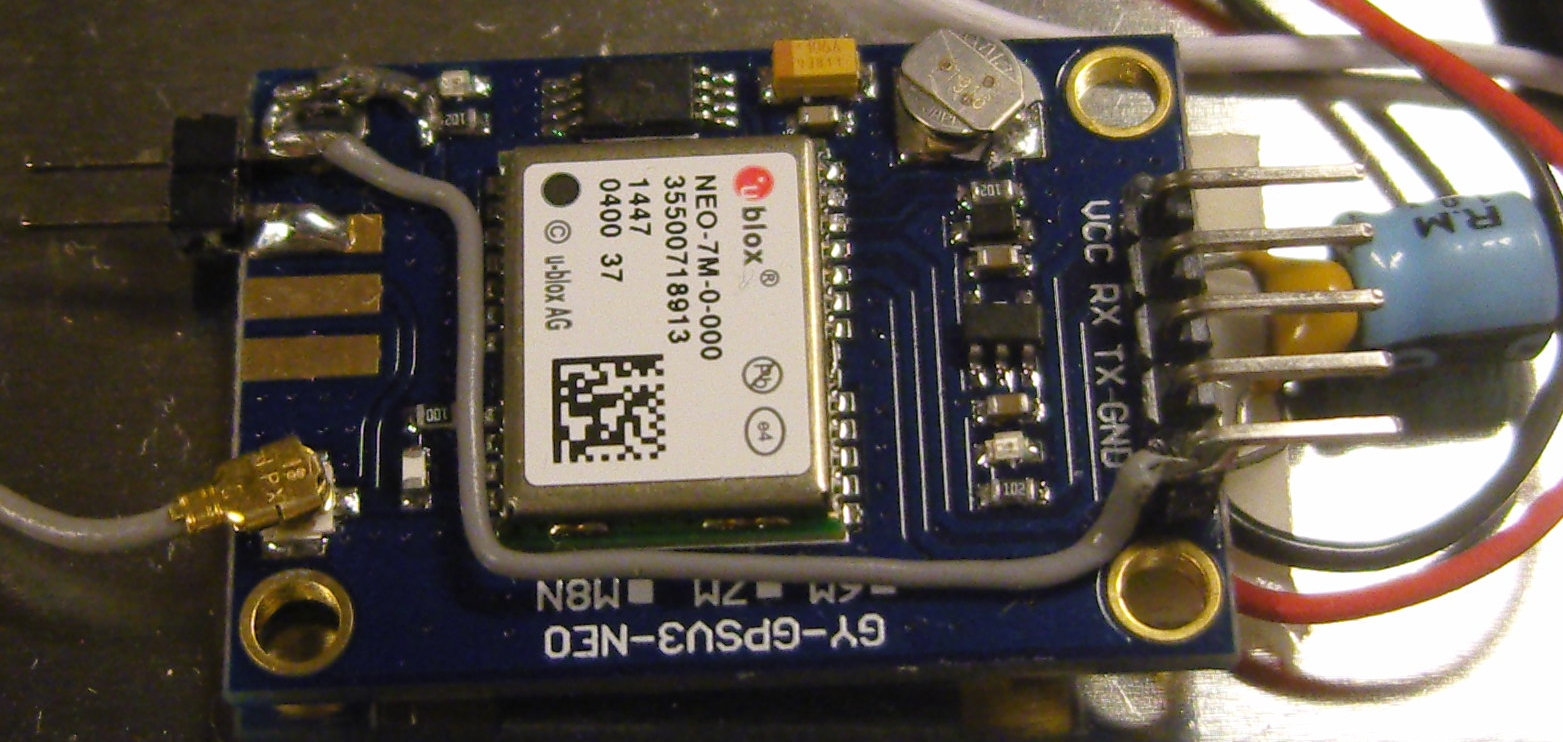
In order to get this to work I had to do some modifications to the GPS unit. First I had to get access to the timepulse on the chip’s pin 3. My connection is inspired by that of G4ZFQ and consists of a small wire from the left-hand side of the 1k resistor to the upper left hole. From there another grey wire goes below the chip and to the 5-pin header which is soldered to the Vcc, Rx, Tx, Gnd pins. The 5th pin is cut off and is just attached to the other pins through the plastic hardware.
The second modification was required in order to get it to run from the somewhat noisy USB 5 Volt supply. That took some decoupling between the Vcc and Gnd pins (220 uF and 0.1 uF in parallel), visible to the right in the image above, using good engineering practice to keep the wires as short as possible.
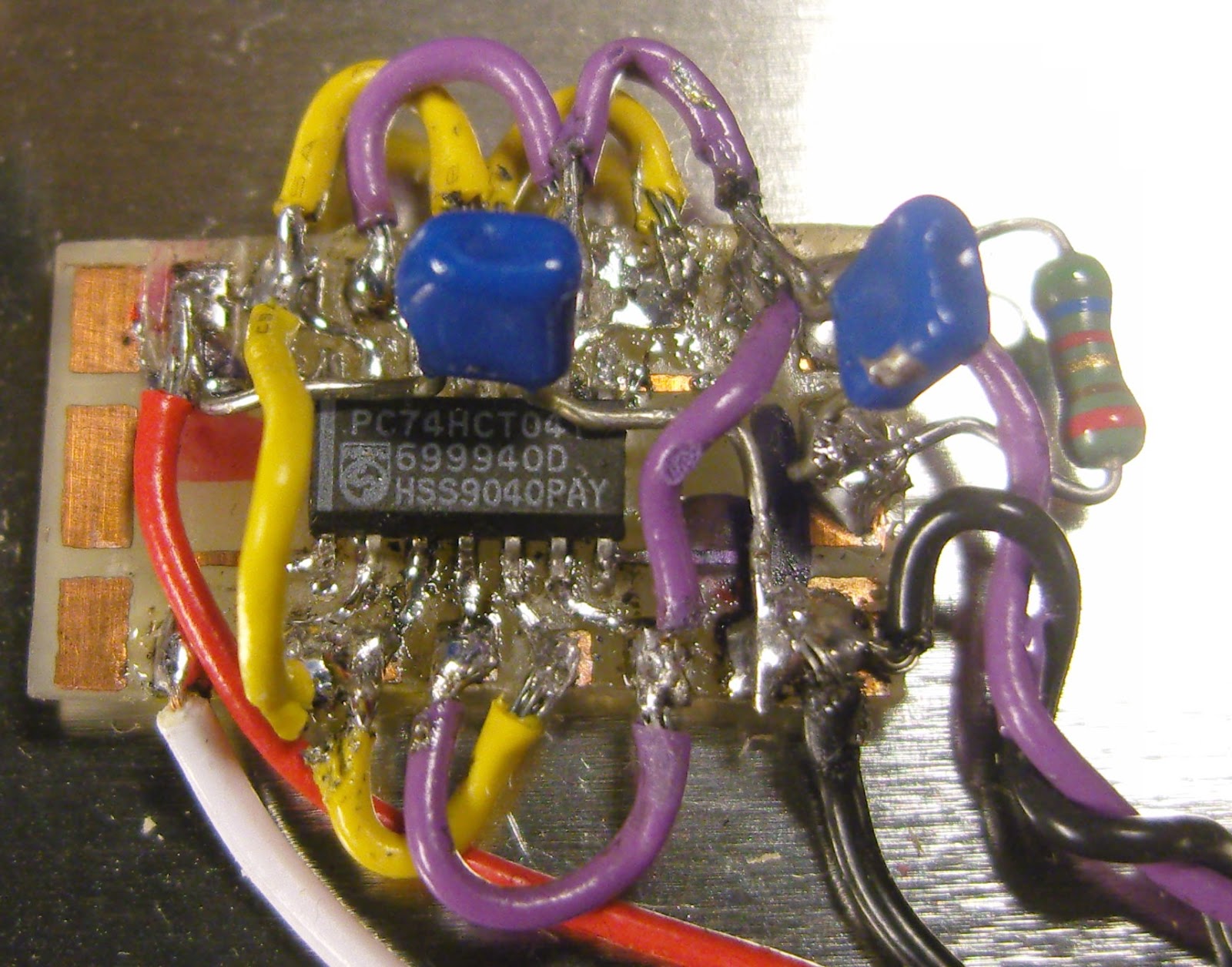 The timepulse is a 3.3 Vp-p output which cannot drive anything below 400-500 ohms impedance. Therefore I added a 74HCT04 driver that I have assembled on a little homemade SMD to DIL adapter PCB (easy to find on Ebay). It serves as a driver to feed the 10 MHz to the 50 ohm input of the K3EXREF.
The HCT04 IC has 6 inverters. One of them takes the input signal from the Timepulse output of the GPS IC and buffers it to drive the 5 other inverters in parallel. This is shown in the schematics at the end of this blog post.
The 5Vp-p output from the buffers is fed via 56 ohms to a connector that goes to the K3EXREF input. This is in accordance with the K3EXREF manual which says: “The 10 MHz source should have a signal level between +4 dBm and +16 dBm, nominal. For square wave sources, 2VDC to 3.3VDC peak is optimum. If the source is a 5V logic level, use a 50-ohm resistor in series with the input.“
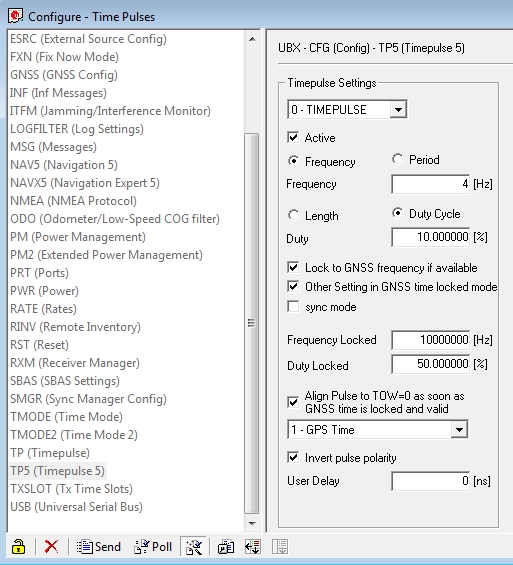 In order to set up the GPS I have used the u-center program (Menu: View, Configuration View, TP5 (Timepulse 5)) from Ublox and set it up with the parameters shown to the right. It blinks at 4 Hz before the signal is acquired and then switches to 10 MHz. This can be observed on the green LED connected to the Timepulse output also as it switches from blinking to a half-lit status.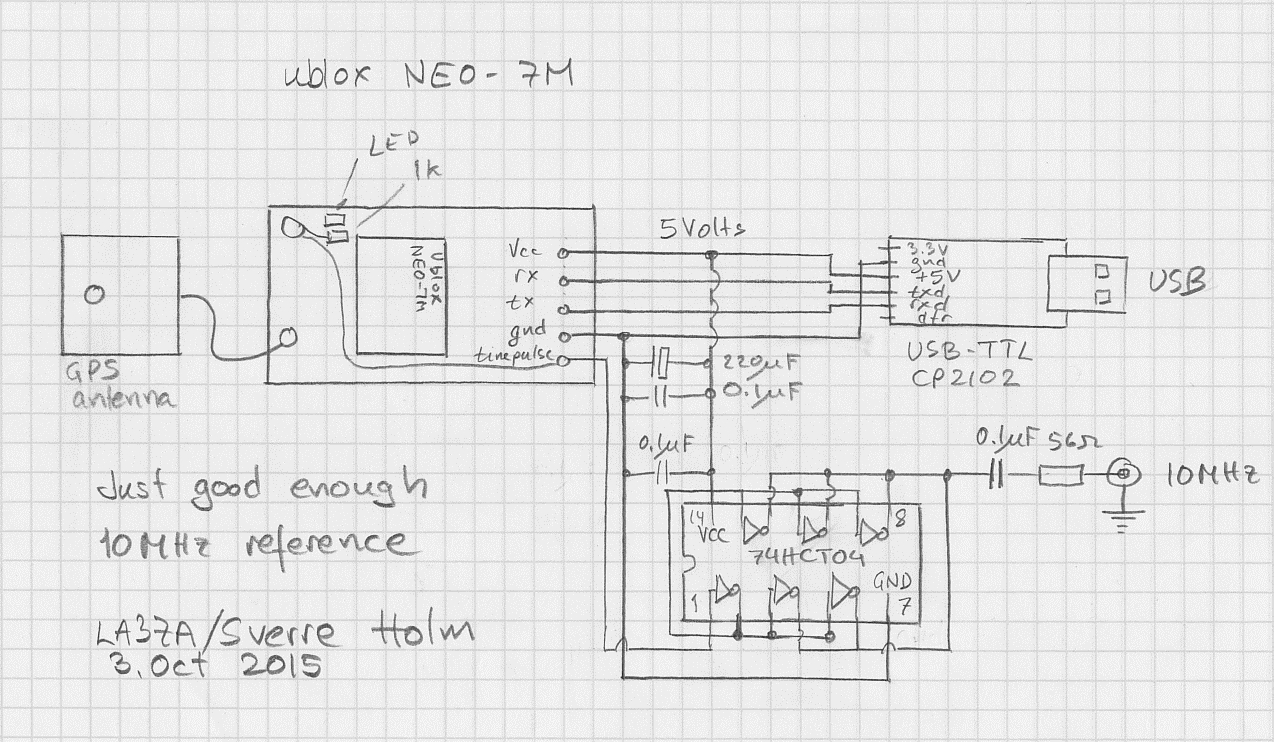
See also
Sverre Holm, LA3ZA, is a regular contributor to AmateurRadio.com and writes from Norway. Contact him at [email protected].
Just good enough 10 MHz reference
Some time ago I noticed that the Ublox Neo-7M GPS has a 10 MHz output which was locked to the GPS system’s accuracy. Most people kept saying how much jitter it had and how useless it was unless it was cleaned up with a phase locked loop of some sort.
At the same time I got the 10 MHz reference input for my Elecraft K3 (K3EXREF). What struck me was how its function was described:
- The frequency of the internal oscillator of about 49.38 MHz oscillator would be continuously measured and averaged, obtaining a value to the nearest 1 Hz.
- The K3EXREF does not phase lock the K3’s reference oscillator and the external 10 MHz source has no impact on the K3’s phase noise performance.
This got me wondering if the Neo-7M would be just good enough as a reference and that all the averaging internally to the K3 would take care of its jitter.I ordered one from Ebay for USD 12-13 together with an USB interface (USD 1.5) and hooked it up. The result is shown above as assembled in a clear top tin. In my shack I can receive GPS indoors, so I have no need for an external antenna
The K3 accepts the input and I see the star in REF*CAL blinking. Just after turn-on of the K3 my reference frequency ends in … 682 and after 10-15 minutes it has fallen and stabilized to …648, i.e. 34 Hz down in frequency. This is just 8 Hz off the reference value I determined manually was the right one when my K3 was new in 2009 (49,379,640).
All this taken together indicates to me that the K3 finds this 10 MHz acceptable for locking.
In order to get this to work I had to do some modifications to the GPS unit. First I had to get access to the timepulse on the chip’s pin 3. My connection is inspired by that of G4ZFQ and consists of a small wire to the upper left hole. From there another grey wire goes below the chip and to the 5-pin header which is soldered to the Vcc, Rx, Tx, Gnd pins. The 5th pin is cut off and is just attached to the other pins through the plastic hardware.
The second modification was required in order to get it to run from the somewhat noisy USB 5 Volt supply. That took some decoupling between the Vcc and Gnd pins (220 uF and 0.1 uF in parallel), visible to the right in the image above, using good engineering practice to keep the wires as short as possible.
The timepulse is a 3.3 Vp-p output which cannot drive anything below 4-500 ohms impedance. Therefore I added a 74HCT04 driver that I have assembled on a little homemade SMD to DIL adapter PCB. It serves as a driver to feed the 10 MHz to the 50 ohm input of the K3EXREF.
The HCT04 IC has 6 inverters. One of them takes the input signal from the timepulse output of the GPS IC and buffers it to drive the 5 other inverters in parallel. This is shown in the schematics at the end of this blog post.
The 5Vp-p output from the buffers is fed via 56 ohms to a connector that goes to the K3EXREF input. This is in accordance with the K3EXREF manual which says: “The 10 MHz source should have a signal level between +4 dBm and +16 dBm, nominal. For square wave sources, 2VDC to 3.3VDC peak is optimum. If the source is a 5V logic level, use a 50-ohm resistor in series with the input.“
In order to set up the GPS I have used the u-center program (Menu: View, Configuration View, TP5 (Timepulse 5)) from Ublox and set it up with the parameters shown to the right. It blinks at 4 Hz before the signal is acquired and then switches to 10 MHz. This can be observed on the green LED connected to the Timepulse output also as it switches from blinking to a half-lit status. Sverre Holm, LA3ZA, is a regular contributor to AmateurRadio.com and writes from Norway. Contact him at [email protected].
Surface mount soldering
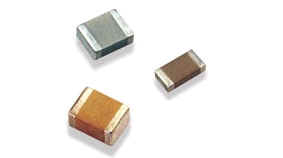
If, like me, you have had an irrational fear of surface mount devices for some time, you will be glad to know its not as bad as you may think. I recently started working with SMD and while I suffer from shaky hands and have poor eyesight, its actually quite a methodical process and not as fiddly as you would think.
I created a 2 part video on SMD soldering using a hot air (reflow) station and using solder paste. In this video I created a QRP dummy load which is a great introduction into Surface Mount Components and at a great price of £5.95 available from Kanga Products
Dan Trudgian, MØTGN, is a regular contributor to AmateurRadio.com and writes from Wiltshire, England. He's a radio nut, IT guru, general good guy and an all round good egg. Contact him him here.
Surface mount soldering
If, like me, you have had an irrational fear of surface mount devices for some time, you will be glad to know its not as bad as you may think. I recently started working with SMD and while I suffer from shaky hands and have poor eyesight, its actually quite a methodical process and not as fiddly as you would think.
I created a 2 part video on SMD soldering using a hot air (reflow) station and using solder paste. In this video I created a QRP dummy load which is a great introduction into Surface Mount Components and at a great price of £5.95 available from Kanga Products
Dan Trudgian, MØTGN, is a regular contributor to AmateurRadio.com and writes from Wiltshire, England. He's a radio nut, IT guru, general good guy and an all round good egg. Contact him him here.
What’s Wrong With the ARRL?
Every so often a blog posting takes on the topic of “the ARRL needs to change.” A recent one came from Dan KB6NU, referencing some worthwhile ideas he has encountered via Rotary International. (I like Dan’s blog and read it fairly consistently.) Whenever I see this kind of article, my brain immediately thinks:
The ARRL is the worst US national amateur radio organization, except when compared to all others.
Yeah, its easy to criticize the ARRL, but it is the only game in town in terms of a national organization. And they do a lot of good for amateur radio and probably don’t get sufficient credit for that. (I should point out that Dan is very clear that he just wants to see the ARRL improve, especially in attracting new hams. I believe him and I share that motivation.)
It is hard being the ARRL.
Amateur radio is not really one hobby, it is a collection of hobbies and activities. We’ve got CW-enthusiasts, QRP folks, Emcomm volunteers, HF contesters, VHF contesters, tinkerers, 75m AM operators, repeater operators and on and on and on. Because the ARRL is a member-driven organization, it tries to balance these competing interests. Just listen to the random-vector criticism that spews forth: the ARRL is too focused on QRP, doesn’t do enough for QRP, only cares about HF, doesn’t do enough for HF, is against new digital modes, is always promoting new digital modes, thinks CW is the only way to go, gave us the No Code license, hung on to the Morse Code requirement too long. This list goes on and on. It really is impossible to keep everyone happy.
Like every large organization that I belong to, the ARRL is not perfect. But the good it does clearly outweighs the stuff I don’t like, so I enthusiastically support it. Said another way, I get enough benefit out of the membership to justify the dues. The key benefits for me are: QST magazine, Logbook of the World, contests, awards and representation with the FCC. QST is clearly the biggest benefit of membership and many people just view the membership fee as a magazine subscription.
A huge threat to an organization with such a print franchise is the shift from print to new media (video, web, blogs, podcasts, social). The ARRL web site has a lot of good information and most of the bugs have been worked out of the major redesign of a few years ago. They have a basic presence on twitter and podcasts. The ARRL has a youtube channel but the content is weak. At the same time, other people are putting out some good video content. Look at what HamNation, HamRadioNow, HamRadioSchool.com are doing.
The ARRL is a long-lived institution and like most long-lived institutions they tend to be grounded in the past and are a bit old school in nature. Attracting newly licensed radio amateurs, especially Techs, is the big challenge for the ARRL. I don’t know what market research the ARRL does but I suggest they establish on on-going program that gets inside the heads of newer licensees and potential hams to understand how they view the ARRL. This requires an ongoing investment that is coupled to strategy. I’ve seen marketing pros do focus groups, interviews, surveys, etc. that bring customer needs to the surface so an organization can respond to changes that attract new customers members.
If you are an ARRL member, what can you do to change things? Your avenue to make your views known is via your Division Director, so I suggest you reach out to him or her. (Contact information is listed in the front of every QST.) Don’t be surprised if your voice is mixed in with a whole bunch of other people’s views…kind of like Congress 
If you are not a member and spend a substantial amount of time having fun messing around with radios, I encourage you to join the ARRL. You might like it.
That’s my view, what’s yours?
73, Bob K0NR
The post What’s Wrong With the ARRL? appeared first on The KØNR Radio Site.
Bob Witte, KØNR, is a regular contributor to AmateurRadio.com and writes from Colorado, USA. Contact him at [email protected].
Alaskan NDBs Awaken

Good geomagnetically-quiet conditions continued into Tuesday morning, with the 'K' index hitting '0' just before dawn here on the west coast. A two-minute Perseus recording of the NDB band revealed good propagation towards Alaska, the first of the season.
The first good opening of the new DX season always provides an opportunity to see which NDB's have survived the summer and have not been closed down by the FAA bean counters. Every year, a few more of the Alaskan NDBs go quiet, with no new ones being added to the list.
The situation is certainly not confined to Alaska. The growing reliance on GPS and RNAV procedures is gradually making the reliance on NDBs a thing of the past. Frankly I'm astounded, yet grateful, that there are many hundreds of NDBs still in use and I'll really miss chasing the low-powered DX targets when they are all eventually decommissioned.
The following Alaskans were heard on Tuesday morning at 1300Z, about one hour before my local sunrise:
9/30/15 1300 529 SQM Level Island AK CO36
9/30/15 1300 396 CMJ Ketchikan AK CO45
9/30/15 1300 391 EEF Sisters Island AK CO28
9/30/15 1300 372 FPN Fredericks Point AK CO36
9/30/15 1300 266 ICK Annette Island AK CO45
9/30/15 1300 414 IME Mt. Edgecumbe AK CO27
9/30/15 1300 394 RWO Kodiak AK BO37
9/30/15 1300 209 CYT Yakataga AK BP80
9/30/15 1300 390 HBT Sand Point AK AO95
9/30/15 1300 358 SIT Sitka AK CO26
9/30/15 1300 350 VTR McGrath AK BP22
9/30/15 1300 338 CMQ Campbell Lake AK BP41
9/30/15 1300 429 BTS Dillingham AK BO08
9/30/15 1300 233 ALJ Johnstone Point AK BP60
9/30/15 1300 212 CGL Coghlan Island AK CO28
9/30/15 1300 223 AFE Kake AK CO36
9/30/15 1300 229 AKW Klawock AK CO35
9/30/15 1300 283 DUT Dutch Harbor AK AO63
9/30/15 1300 245 HNS Haines AK CO29
9/30/15 1300 347 DJN Delta Junction AK BP74
9/30/15 1300 411 ILI Iliama AK BO29
9/30/15 1300 277 ACE Homer AK BO49
9/30/15 1300 355 AUB King Salmon AK BO18
9/30/15 1300 524 MNL Valdez AK BP61
9/30/15 1300 382 JNR Unalakleet AK AP93
9/30/15 1300 281 CRN Cairn Mountain AK BP21
9/30/15 1300 385 EHM Cape Newenham AK AO88
9/30/15 1300 385 OCC Yakutat AK CO09
9/30/15 1300 263 OAY Norton Bay AK AP84
9/30/15 1300 390 AES Northway AK BP29
9/30/15 1300 404 GCR Cordova AK BP70
9/30/15 1300 525 ICW Nenana AK BP54
9/30/15 1300 251 OSE Bethel AK AP90
9/30/15 1300 341 ELF Cold Bay AK AO85
9/30/15 1300 248 GLA Gulkana AK BP72
9/30/15 1300 376 PVQ Deadhorse AK BQ50
9/30/15 1300 379 IWW Kenai AK BP40
9/30/15 1300 399 SRI St. George AK AO56
9/30/15 1300 359 ANI Aniak AK BP01
9/30/15 1300 272 UTO Utopia Creek AK BP35
9/30/15 1300 275 CZF Cape Romanzof AK AP61
9/30/15 1300 529 FDV Nome AK AP74
9/30/15 1300 391 EAV Bettles AK BP46
9/30/15 1300 346 OLT Soldotna AK BP40
9/30/15 1300 347 TNC Tin City AK AP65
There were several missing from the list ... but I classify them as 'third-tier' beacons since propagation needs to be even better than it was on Tuesday to hear them. These are beacons that are either suffering from terrible locations, small inefficient antenna / ground systems or in need of maintenance. I also have a list of Alaskans that have never been heard at all outside of Alaska but are known to be on the air according to recent FAA online information. It is these last two groups that keep me watching and waiting ... for those magic mornings that happen only once or twice per year.
From what I can surmise by scouring the FAA information, there are presently 77 active NDBs in Alaska, including the ones not heard down here. If you live in Alaska, and can take a listen on the NDB band, I'll send you the ones I'm not sure about. If anyone else wants a list of all of the beacons up there, with detailed frequency information, drop me an e-mail and I will send you a three-page pdf.
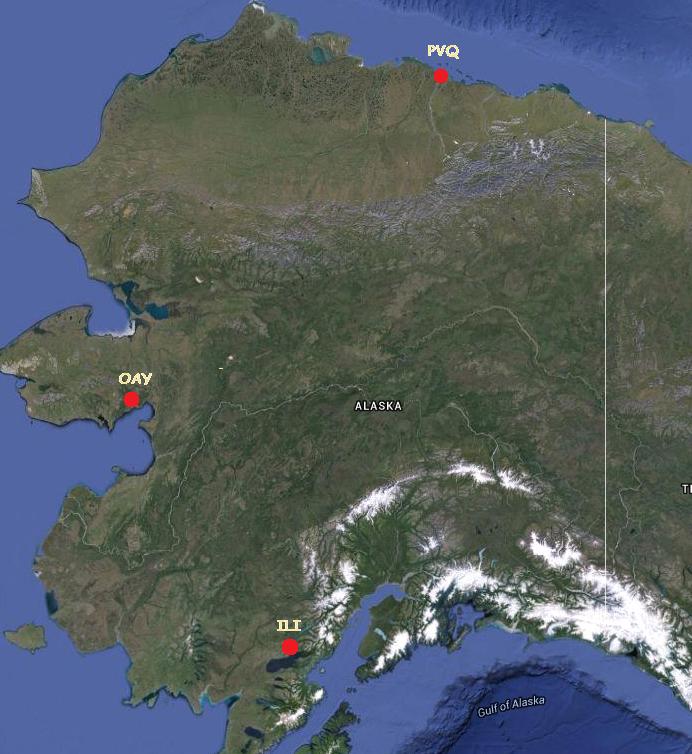
Here are some signal samples, recorded on Tuesday morning, of some of the 'second-tier' (not heard every morning) signals from Alaska.
 |
| courtesy: https://www.google.ca/maps |

PVQ - 376 kHz Put River (Deadhorse), Alaska

OAY - 263 kHz Norton Bay (Moses Point), Alaska
ILI - 411 kHz Iliamna, Alaska
With the sun getting quieter and quieter, conditions on the NDB band should continue to get better and better over the next several years ... let's just hope that the NDBs are still around long enough to enjoy the solar-quiet benefits.
Steve McDonald, VE7SL, is a regular contributor to AmateurRadio.com and writes from British Columbia, Canada. Contact him at [email protected].
Made my first satellite QSO
Last month Abdel Mesbah M0NPT chairman of the Hucknall Rolls-Royce ARC came to South Kesteven ARS to give an informative talk on operating amateur radio satellites. Abdel was the first UK operator to receive the AMSAT-UK 73 on 73 award for making 73 confirmed contacts via the FUNCube satellite AO-73. http://amsat-uk.org/2015/01/28/abdel-m0npt-73-on-73-award/
Abdel explained all the current active satellites, how to work through them and gave hints and described techniques for achieving success on this more challenging mode of operation.
Spurred on I opted to target the SO-50 satellite which until very recently this was the only satellite carrying a FM transponder. The satellite receives on 145.850 MHz and retransmits them on 436.800 MHz (+/- 10 kHz Doppler shift). Operation requires the use of CTCSS (PL) tones of 74.4 Hz which starts a 10 minute timer and then a 67 Hz tone used for the contact. More details of how to operate and a video are on the AMSAT-UK website
I initially tried using just a suitably programmed Baofeng UV-5R with a NA771 whip and could clearly hear the downlink on higher passes, I called a few times with no luck.
I hadn't monitored SO-50 much before and sadly it seems to suffer from very poor operating, with stations calling over contacts in progress, or stations continually calling CQ CQ seemingly oblivious to any reply and those that just keep calling "hola hola hola" for whatever bizarre reason! I would be lucky to get through the QRM with just the whip so I needed a better antenna.
Despite being extremely busy at the National Hamfest last weekend I did manage to get hold of a dual band Yagi that was reasonably lightweight for hand held use and capable of being easily dismantled for transporting. (The Moonraker YG27-35 Dual Band) it has a single feed point and two adjustable gamma match sliders and was easy to adjust using my analyser.
It has a single feed and I tried it with the Baofeng and reception of the downlink was excellent, again on a couple of passes I tried answering calls with no success.
Last night I decided to try again but with the FT-857D set at 10W output. I put it on a small workbench in the garden and powered it from my portable SLA battery. I ran split operation with the 2m Tx VFO set at 145.850MHz with 67Hz CTCSS, the 70cm Rx VFO set at 436.800Mhz I was able to adjusted it down in 5kHz steps during the pass. I got the wife to take a picture while I was operating.

As I started to hear the downlink I heard Abdel M0NPT calling and answered him, I was shocked when he came back and we exchanging details - that was it I had made my first QSO via an amateur radio satellite! Then amazingly other stations started calling me and I was able to also work DO2SYD.
I did manage to record it on a small dictaphone (did have a bit of a brain fade with my callsign at one point!)
I could get hooked on this... There is also the new LilacSat-2 (CAS-3H) satellite with a FM transponder to try to work!So much to do, so little time...
Andrew Garratt, MØNRD, is a regular contributor to AmateurRadio.com and writes from East Midlands, England. Contact him at [email protected].
 Ham Radio Deluxe |
 W5SWL Electronics |
 Ham Radio Prep |
 KB3IFH QSL Cards  Hip Ham Shirts  HamRadioAuctions HamRadioAuctions Reliance Antennas Reliance Antennas Enigma Shop Enigma Shop |  morseDX  Ni4L Antennas  R&L Electronics R&L Electronics antennas.us antennas.us QRV QRV |
- Matt W1MST, Managing Editor
