 |
 Weekly Propagation Summary – 2015 Nov 16 16:10 UTC
 16 November 2015 | by
Here is this week’s space weather and geophysical report, issued 2015 Nov 16 0630 UTC.
Highlights of Solar and Geomagnetic Activity 09 – 15 November 2015
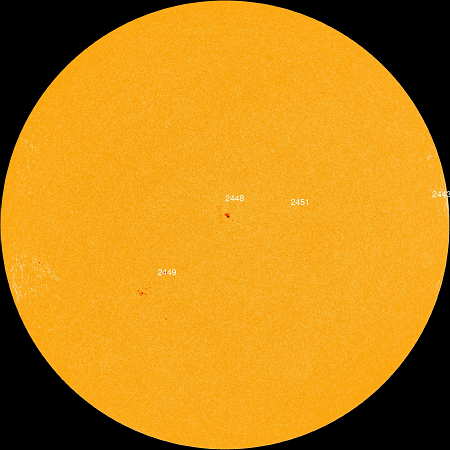
Solar activity was at very low to moderate levels over the period. The period began at moderate levels with an M3/2b flare at 09/1312 UTC from Region 2449 (S12, L=207, class/area Dao/150 on 08 Nov). Associated with the flare were Type II (957 km/s) and Type IV radio sweeps, a 670 sfu Tenflare, and a partial halo coronal mass ejection (CME). Originally, the CME was thought to have a partial Earth-directed component; however, there was no arrival apparent in ACE/SWEPAM data. Low levels were observed on 10 and 13 November due to low level C-flare activity from Regions 2443 (N07, L=316, class/area Fkc/650 on 01 Nov) and 2452 (S08, L=169, class/area Axx/010 on 11 Nov). Late on 15 November, two filament eruptions occurred in the SW quadrant. The first was an approximate 21 degree filament eruption centered near S11W17 that was observed lifting off around 15/2114 UTC in SDO/AIA 304 imagery. The second was an approximate 19 degree filament eruption centered near S26W24 observed lifting off around 16/0114 UTC. Analysis was ongoing for these two events, however given their location and initial trajectory, an Earth-directed component is probable.
An enhancement (below S1-Minor threshold) of the greater than 10 MeV proton flux occurred at 09/2130 UTC associated with the M3 flare. Particle flux measurements reached a maximum of 3.7 pfu 10/0020 UTC before declining to background levels by early on 11 November.
The greater than 2 MeV electron flux at geosynchronous orbit was at high to very high levels over the period. Very high levels occurred on 11 and 13 November with maximum flux levels of 59,508 pfu at 11/1915 UTC and 88,813 pfu at 13/1355 UTC, respectively.
Geomagnetic field activity ranged from quiet to major storm levels. The period began under the influence of a prolonged negative Bz component followed by a solar sector boundary crossing mid-day on 09 November. Shortly after, a co-rotating interaction region preceding a positive polarity coronal hole high speed stream (CH HSS) became geoeffective starting in the latter half of 09 November. Total field rose briefly to 12 nT with solar wind speeds increasing to the 650-750 km/s range. Solar wind continued to be enhanced through 12 November as CH HSS effects declined. The geomagnetic field responded with unsettled to (G1-minor) minor storm levels on 09 November, active to (G2-moderate) major storm levels on 10 November, and quiet to minor storm levels on 11 November. Quiet levels were observed on 12 November. By 13 November, another positive polarity CH HSS became geoeffective causing total field to initially rise to 10 nT with solar wind speeds in the upper 400 km/s range. Total field remained slightly agitated from 14-15 November with total field ranging from 5-9 nT. As a result, quiet to active levels were observed on 13 November, with quiet to unsettled levels on 14-15 November.
Forecast of Solar and Geomagnetic Activity 16 November – 12 December 2015
Solar activity is expected to be at very low to low levels with a chance for M-class (R1-R2, minor-moderate) flares from 22 November through 05 December with the return of old Region 2443 (N07, L=316).
No proton events are expected at geosynchronous orbit.
The greater than 2 MeV electron flux at geosynchronous orbit is expected to be at high levels from 16-18 November and again from 01-12 December due to recurrent CH HSS influence. Normal to moderate levels are expected from 19-30 November.
Geomagnetic field activity is expected to be at unsettled to active levels from 16-19 November due to prolonged southward Bz as well as a negative polarity CH HSS on 18-19 November. Multiple recurrent positive polarity CH HSSs are expected to influence the geomagnetic field from 30 November-02 December, 05-08 December, and 10-12 December causing unsettled to active levels with (G1-minor) storm periods likely on 30 November-01 December, and 06-08 December.
The eruptive filaments on 15-16 November are not in the present forecast as we are waiting on further imagery to model these events.
Don’t forget to visit our live space weather and radio propagation web site, at: http://SunSpotWatch.com/
Live Aurora mapping is at http://aurora.sunspotwatch.com/
If you are on Twitter, please follow these two users: + https://Twitter.com/NW7US + https://Twitter.com/hfradiospacewx
Get the space weather and radio propagation self-study course, today. visit http://SunSpotWatch.com/swc for the latest sale and for more information!
Check out the stunning view of our Sun in action, as seen during the last five years with the Solar Dynamics Observatory (SDO): https://www.youtube.com/watch?v=zXN-MdoGM9g
We’re on Facebook: http://NW7US.us/swhfr
Visit, subscribe: NW7US Radio Communications and Propagation YouTube Channel
Get crackalackin’
As Fall is here, it is time to put together a To Do list of everything I have been putting off all Summer and the beginning of the school year.
TM-D710A

I have four of these rigs and they need some TLC. I need to make sure they have the updated firmware on the main unit, TNC, and operating panel.
The latest versions:
TNC: 1.02 – May 2011
Operating Panel: 2.12 – Janurary 2015
Main unit: 2.10 – May 2011
For the benifit of emergency operations, I have been performing the modificiation to the TM-D710As to open the frequency range.
Standard frequency plan. I developed a spreadsheet of the repeaters in the greater Kansas City area, frequecies for FRS/GMRS, the Kansas City Airport (MCI), Sherman Army Airfield, and various national park frequency plans. This is the first step in standardizing the configuration across all four of the TM-D710As. I can additionally take the spreadsheet and use it for programming my HTs. This should allow for a memory channel standardization that will make my life easier.
Weather Station

The current Davis Vantage Pro2 I have installed on the roof needs maintenance. Wouldn’t it be nice to get the top of the line version?
For some time I have been talking about finding a weather station setup that will work with a linux-based computer. That quest continues. I have read about a piece of software called Meteo that is suppose to work with Xastir.
And if I can’t get Xastir to work with the Vantage Pro2… is there another comparable weather station that WILL work with Xastir? Life would be a lot easier without Windows.
HF Antenna for home
I need to string up the Carolina Windom I have had sitting on the shelf for the last few years. The G5RV that is up now is showing its age (not to mention one of the legs is drooping badly). Now that the leaves have fallen, I should be able to get the Windom up there without too many problems (… famous last words).
HF setup in the mobile
Time to get going. I have all the materials I need. What I don’t have is an installation plan… mainly for the Tarheel antenna. I can’t do a hitch mount because I need the hitch for pulling my travel trailer. Two possible options: (a) get a swinging gate for the back bumper where you could mount a spare tire and a water can or (b) find some way to afix a mount coming out behind the left rear tire.
Scott Hedberg, NØZB, is a regular contributor to AmateurRadio.com and writes from Kansas, USA. Contact him at [email protected].
Series Eight Episode Twenty-Four – Planning a Ham Radio Christmas (15 November 2015)
In this episode, Martin M1MRB / W9ICQ is joined by Leslie Butterfield (G0CIB), and Edmund Spicer M0MNG to discuss the latest Amateur / Ham Radio news. Colin M6BOY rounds up the news in brief, and this episodes feature is Planning a Ham Radio Christmas.
- Youngsters Build Antennas at Goonhilly
- Blue Heritage Plaque for Radar Pioneer
- New Amateur Radio Licence Guidance
- Tackling Pirate Radio
- Online Survey for UK Amateur Radio Hams
- New Symbol Graphics for APRS
- North Korea Operation
- BBC R&D White Papers
- Netherlands 5 MHz Allocation
Colin Butler, M6BOY, is the host of the ICQ Podcast, a weekly radio show about Amateur Radio. Contact him at [email protected].
Series Eight Episode Twenty-Four – Planning a Ham Radio Christmas (15 November 2015)
In this episode, Martin M1MRB / W9ICQ is joined by Leslie Butterfield (G0CIB), and Edmund Spicer M0MNG to discuss the latest Amateur / Ham Radio news. Colin M6BOY rounds up the news in brief, and this episodes feature is Planning a Ham Radio Christmas.
- Youngsters Build Antennas at Goonhilly
- Blue Heritage Plaque for Radar Pioneer
- New Amateur Radio Licence Guidance
- Tackling Pirate Radio
- Online Survey for UK Amateur Radio Hams
- New Symbol Graphics for APRS
- North Korea Operation
- BBC R&D White Papers
- Netherlands 5 MHz Allocation
Colin Butler, M6BOY, is the host of the ICQ Podcast, a weekly radio show about Amateur Radio. Contact him at [email protected].
Amateur Radio Weekly – Issue 85

Multimode Raspberry Pi transmitter software
PiTX permits transmission of HF signals directly through a pin of Raspberry Pi GPIO.
Southgate
Hams talk digital
Towards the end when the two stations switch to regular SSB, the difference is dramatic.
Hack A Day
What happened to WWBS?
Down in Macon, Georgia, USA there was once a private shortwave radio station with the callsign WWBS.
Mount Evelyn DX Report
Morse Code is only mostly dead
When I completed my 100th CW QSO as a new operator I decided to gather some statistics on age of Morse Code operators with whom I had QSOs.
N4PBQ
Diagrams for every wire antenna ever
Wire antennas for Ham Radio.
N4LCD
10 things you never knew about military radio technology
In honor of Veterans’ Day, we look back at military radio technology.
goTenna
How to
The “Cylinder” center connector for dipole antenna
This is another alternative home-brew center connector for a dipole.
K4ICY
Raspberry Pi ISS iGate Project
This project is an APRS iGate for ARISS program’s digipeater aboard the International Space Station.
N5DUX
Video
Windows Pi
George demonstrates Windows 10 on the Raspberry Pi.
Amateur Logic TV
Building an 80m horizontal loop
It looks easy but this video is made in a 4 hour timespan.
PE4BAS
The very particular world of amateur radio
In the last three years, the number of amateur radio licences has risen by over 8,000 – with 80,000 currently issued in the UK.
BBC News
Amateur Radio Weekly is curated by Cale Mooth K4HCK. Sign up free to receive ham radio's most relevant news, projects, technology and events by e-mail each week at http://www.hamweekly.com.
630m Crossband – Last Minute Addition
 Another VE7 has been added to the group of Canadians who will be active tonight and tomorrow night during the CW crossband activity.
VE7CA will be operational during the evening on 475.5kHz. He will be listening for calls on both 3555kHz and 7064kHz. His hours of operation will be from 0300Z - 0500Z. This will be Markus's first operation on 630m and he would be delighted to work anybody that is able to hear him. He will be running ~ 25W output to a large top-loaded vertical, high on the hills of North Vancouver.
Please give a listen for him and make all of his hard work worthwhile!
Steve McDonald, VE7SL, is a regular contributor to AmateurRadio.com and writes from British Columbia, Canada. Contact him at [email protected].
630m Crossband Reminder
Just a reminder of the '630 activity event' ... including the crossband CW activity, tonight and tomorrow. The complete operating schedule, showing times and frequencies, can be viewed here.
The sun has been acting-up once again and band conditions have been up and down all week. Another CME is scheduled to arrive at anytime ... the jury is still out on how good or how poor the band might be.
More of a concern is the weather forecast. Very high winds are forecast for the west coast VE7 operators. I'm not worried about losing antennas but more likely, losing the hydro power, as often times the first big windstorm of the fall brings down a lot of branches and trees ... and that means power outages. So if you don't hear me, or some of the other stations, that may be the reason.
As well, please be patient if signals appear too weak, as the long slow fade-rate on 630m will often result in a huge change just a few minutes later.
If you can possibly give a listen for any of the crossband stations and respond to their CQ's it would be really great ... we hope to see as many of you as possible tonight or tomorrow, weather permitting!
Steve McDonald, VE7SL, is a regular contributor to AmateurRadio.com and writes from British Columbia, Canada. Contact him at [email protected].
 Ham Radio Deluxe |
 W5SWL Electronics |
 Ham Radio Prep |
 KB3IFH QSL Cards  Hip Ham Shirts  HamRadioAuctions HamRadioAuctions Reliance Antennas Reliance Antennas Enigma Shop Enigma Shop |  morseDX  Ni4L Antennas  R&L Electronics R&L Electronics antennas.us antennas.us QRV QRV |
- Matt W1MST, Managing Editor
