 |
 472kHz preamp – a good idea?
 11 November 2015 | by
 The FT817 is a bit low in sensitivity on 472kHz so I was expecting a decent improvement with a preamp. To my surprise I am copying no more stations. In fact I am hearing just as many without as with! The result has surprised me. The rig sensitivity is definitely better with the preamp and stations are stronger but it is far from clear cut whether it is worth using it in reality. At the moment my 472kHz transverter does not have the preamp.
Maybe the FT817 sensitivity is good enough. In marginal cases (and these seem few) it probably helps, but most of the time it seems fine without.

Roger Lapthorn, G3XBM, is a regular contributor to AmateurRadio.com and writes from Cambridge, England.
Contentment with radios
After considering buying a new transceiver, I have decided to stick with the rigs I have. At present, my poor voice makes all speech QSOs an effort. I enjoy WSPR as this is really a true QRP mode and it tells me a lot about propagation, without shouting!
I’ll still “window shop” and might consider a new radio transceiver next year. I get by far the most fun from my $49 10m WSPR rig and my home-brew 472kHz transverter, proving that you do not need to break the bank to have fun. I am not against those who think differently – each to his/her own.

Roger Lapthorn, G3XBM, is a regular contributor to AmateurRadio.com and writes from Cambridge, England.
Weekly Propagation Summary – 2015 Nov 09 16:10 UTC
Here is this week’s space weather and geophysical report, issued 2015 Nov 09 0211 UTC.
Highlights of Solar and Geomagnetic Activity 02 – 08 November 2015
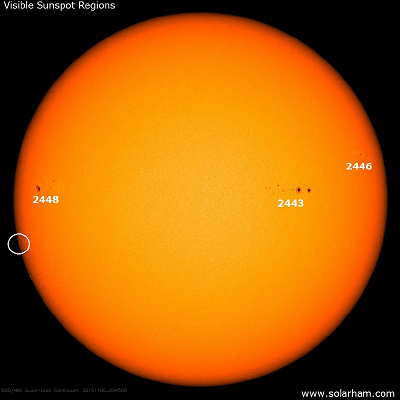
Solar activity was at very low to moderate levels. The summary period began with numerous weak to mid-level C-class flares from Regions 2443 (N07, L=316, class/area Fkc/650 on 01 Nov) and 2445 (N15, L=026, class/area Dac/240 on 02 Nov) observed on 02-03 November. Activity increased to moderate levels (R1-Minor) on 04 November. At 04/0326 UTC, Region 2445 produced an M1/1n flare with an associated Type II radio sweep (790 km/s estimated shock velocity). In addition, discrete frequency bursts of 56,000 sfu and 41,000 sfu were observed on 245 MHz and 410 MHz, respectively. Region 2445 also prodcued an M2/1n flare at 04/1203 UTC with an associated Type II sweep (1033 km/s estimated shock velocity). Shortly afterward, Region 2443 produced an M3/2b flare with associated Type II (955 km/s estimated shock velocity) and Type IV sweeps. This event also prodcued an associated partial-halo coronal mass ejection (CME), first observed in LASCO C2 imagery at 04/1436 UTC.
By 05 November, activity levels declined to very low levels. Levels increased to low on 06-07 November with weak to mid-level C-class activity observed from Regions 2446 (N15, L-349, class/area Cro/020 on 01 Nov), 2448 (N06, L=234, class/area Dao/140 on 06 Nov), 2449 (S12, L=209, class/area Dao/150 on 07 Nov) and 2450 (S23, L=200, class/area Bxo/010 on 07 Nov).
No proton events were observed at geosynchronous orbit.
The greater than 2 MeV electron flux at geosynchronous orbit was at normal levels on 02-03 November and high levels on 04-07 November due to enhanced solar wind speeds.
Geomagnetic field activity was at quiet to major storm levels. The summary period began with quiet to unsettled levels on 02 November. Solar wind speeds, measured at the ACE spacecraft, were weak at about 300 km/s. Field activity picked up to unsettled to minor storm levels (G1-Minor) on 03-04 November due to effects from an equatorial, positive polarity coronal hole high speed stream (CH HSS). Wind parameters observed a rapid increase in winds speeds to an average of about 675 km/s with a peak of near 770 km/s early on 04 November. Total field (Bt) increased to peak at 34 nT about 03/0700 UTC while the Bz component reached a maximum southward extent of -24 nT at 03/0620 UTC. Activity levels decreased to quiet to active on 05 November through early on 06 November as effects from the CH HSS waned. Quiet levels were observed from 06/0300-1800 UTC. During this time frame, wind speeds decreased to near 475 km/s while Bt and Bz relaxed to nominal levels.
On 06/1800-2400 UTC, field activity increased to active levels and further increased to minor to major storm levels (G1-G2 / Minor-Moderate) for the first half of 07 November. This increase in activity was attributed to the arrival of the 04 November CME. Wind speeds increased to 719 km/s at 07/0257 UTC, Bt increased to 20 nT late on 06 November and the Bz component varied between +18 nT to -16 nT. The last half of 07 November through the first half of 08 November saw field conditions relax to quiet levels. Wind speeds declined to about 425 km/s while Bt and Bz relaxed to nominal levels. By midday on the 8th, wind parameters indicated the likely onset of a co-rotating interaction region in advance of a recurrent positive polarity CH HSS. Wind speeds peaked to near 550 km/s late on the 8th while Bt reached 10 nT and Bz was mostly southward to -6 nT.
Forecast of Solar and Geomagnetic Activity 09 November – 05 December 2015
Solar activity is expected to be at predominately low levels with a chance for moderate levels (R1-R2 / Minor-Moderate) through the outlook period. Regions 2443 and 2449 , coupled with the return of old Region 2437 (S18, L=098) on 12 November, are the regions most likely to produce M-class activity.
No proton events are expected at geosynchronous orbit in the absence of any significant flare activity.
The greater than 2 MeV electron flux at geosynchronous orbit is expected to be at moderate to high levels on 09-16 November and again on 01-05 December due to an enhanced solar wind enviroment as recurrent CH HSSs become geoeffective. Normal to moderate levels are expected on 10-30 November.
Geomagnetic field activity is expected to be at unsettled to active levels on 09-11 November. Minor storm levels (G1-Minor) are expected on 09 November as a recurrent, positive polarity CH HSS impacts Earth. Unsettled to active levels are expected on 16-17 November due to extended periods of southward Bz. Unsettled to active levels are expected on 30 November – 02 December and again on 05 December, with minor storm levels likely on 30 November and 01 December. This activity is due to recurrent positive polarity CH HSSs. Quiet to unsettled levels are expected for 12-15 and 18-29 November.
Don’t forget to visit our live space weather and radio propagation web site, at: http://SunSpotWatch.com/
Live Aurora mapping is at http://aurora.sunspotwatch.com/
If you are on Twitter, please follow these two users: + https://Twitter.com/NW7US + https://Twitter.com/hfradiospacewx
Get the space weather and radio propagation self-study course, today. visit http://SunSpotWatch.com/swc for the latest sale and for more information!
Check out the stunning view of our Sun in action, as seen during the last five years with the Solar Dynamics Observatory (SDO): https://www.youtube.com/watch?v=zXN-MdoGM9g
We’re on Facebook: http://NW7US.us/swhfr
Visit, subscribe: NW7US Radio Communications and Propagation YouTube Channel
LHS Episode #156: Beer and Balloons
 Hello, podcast listeners! In this episode of Linux in the Ham Shack, your intrepid hosts discuss APRS software, Bluetooth TNC hardware, FCC regulations on WiFi hardware, UK ham radio licensing issues, the crazy idea that Microsoft might buy Canonical and much more. Thank you for tuning in, donating and subscribing and just being a friend of the show. Thank you also for sticking it out while we work hard to get back to putting our show out on time despite all of life's obstacles.
73 de The LHS Guys
Russ Woodman, K5TUX, co-hosts the Linux in the Ham Shack podcast which is available for download in both MP3 and OGG audio format. Contact him at [email protected].
Upcoming 630m Crossband Weekend
 This coming weekend will see the annual '630m activity event' on Friday and Saturday night.
There will be a lot of activity from both the U.S. experimental stations and from a group of five Canadian amateurs who will be seeking two-way CW 'crossband' contacts.
The five Canadians will be transmitting on 630m CW but listening for answering stations on various HF (QSX) frequencies. Last year's one-night event was a great success ... hopefuly the two-night event this year will lead to even more participation by interested amateurs in both Canada and the U.S.
Unlike Canadian hams, American amateurs does not yet have access to 630m as a ham band but ... there will be a large number of U.S. 'experimental' stations (most of them operated by hams with an experimental licence) beaconing and working each other and seeking your 'heard' reports. The Canadian operation will give interested hams the actual opportunity to make a two-way MF to HF CW contact, via the crossband mode as well as provide the Canadians an opportunity to test their 630m systems.
Here are the details of the five Canadian crossbanders:
Station: VO1NA (Joe) GN37 Torbay, Newfoundland
Time: 2130Z - 0130Z both Friday night (Nov 13-14Z) / Saturday night (Nov
14-15Z)
TX Frequency: 477.7 kHz
RX (QSX) Frequency: 3562 kHz
Station: VE7SL (Steve) CN88 Mayne Island, B.C.
Time: 0200Z - 0700Z both Friday night (Nov 14Z) / Saturday night (Nov 15Z)
TX Frequency: 473.0 kHz
RX (QSX) Frequency: 3566 / 7066 kHz
Station: VE7BDQ (John) CN89 Delta, B.C.
Time: 0430Z - 0700Z both Friday night (Nov 14Z) / Saturday night (Nov 15Z)
TX Frequency: 474.0 kHz
RX (QSX) Frequency: 3536 kHz
Station: VA7MM (Mark) CN89 Coquitlam, B.C.
Time: 0500Z - 0700Z Friday (Nov 14Z)
0400Z - 0800Z Saturday (Nov 15Z)
TX Frequency: 475.0 kHz
RX (QSX) Frequency: 3570 kHz
Station: VE7CNF (Toby) CN89 Burnaby, B.C.
Time: 0300Z - 0700Z both Friday night (Nov 14Z) / Saturday night (Nov 15Z)
TX Frequency: 476.0 kHz
RX (QSX) Frequency: 3558 kHz / 7062 kHz
All stations will either call CQ or run "VVV" marker beacons while listening on their respective QSX frequencies. QSX frequencies will be included
in the CQ or marker beacons.
Last year's event saw many nice contacts, some of them from coast-to-coast! I really hope that as many amateurs as possible will have a listen and be able to answer our 'CQ's on the various QSX frequencies. Your participation on one (or both) of the two night's activity would be just great.
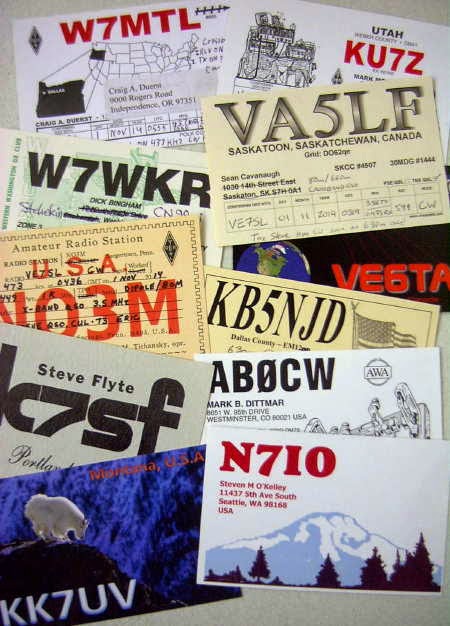
I will post a reminder of the event again at the end of the week ... in the meantime, try to see what you can hear on 630m (472-479kHz) and arrange your setup so that you can call us on HF as well.
For a more detailed description of the upcoming event, see the ARRL's announcement here.
Steve McDonald, VE7SL, is a regular contributor to AmateurRadio.com and writes from British Columbia, Canada. Contact him at [email protected].
Amateur Radio Weekly – Issue 84

How a group of neighbors created their own Internet service
Powered by radios in trees, homegrown network serves 50 houses on Orcas Island.
Ars Technica
Feds have plan in case we are hit with catastrophic solar flares
The White House bases contingency plan on the Carrington Event.
Digital Journal
DSTAR Parachute Mobile QSOs prove popular in Japan
Mark Meltzer, age 66, had an optimistic longshot QSO sked with hams in Japan hoping to work them on 28.425 KHz with a 5 watt SSB signal.
Southgate
QSO with W0RW from Knox Mountain
Every day is a surprise.
amateurradio.com
FCC, Justice Department investigate covert Chinese radio network
The Federal Communications Commission and the Justice Department are investigating a California firm whose U.S. radio broadcasts are backed by a subsidiary of the Chinese government.
Reuters
Secret radio stations by the numbers
There are actually several types of number stations, but the prototypical one is simply someone on the air reading lists of numbers.
Hack a Day
How good is the FT817’s MH-31 stock standard microphone?
Others reported improved results by substituting an electret insert. It seemed too simple not to try.
VK3YE
How to
SDR reception of Digital Amateur TV from the ISS
How to receive DVB-S digital video transmissions from the International Space Station with a bit of hardware and a lot of software.
pabr.org
Video
W1AW/6 Pacificon Special Event Station – All on one antenna
This video explains how they ran multiple stations using a single antenna. Watch and see how Rick engineered the radio system.
K7AGE
Why You Need Circulators in Repeaters
A discussion of circulators and a teardown of a 915 MHz circulator.
The Life of Kenneth
Amateur Radio Weekly is curated by Cale Mooth K4HCK. Sign up free to receive ham radio's most relevant news, projects, technology and events by e-mail each week at http://www.hamweekly.com.
630m Heating Up
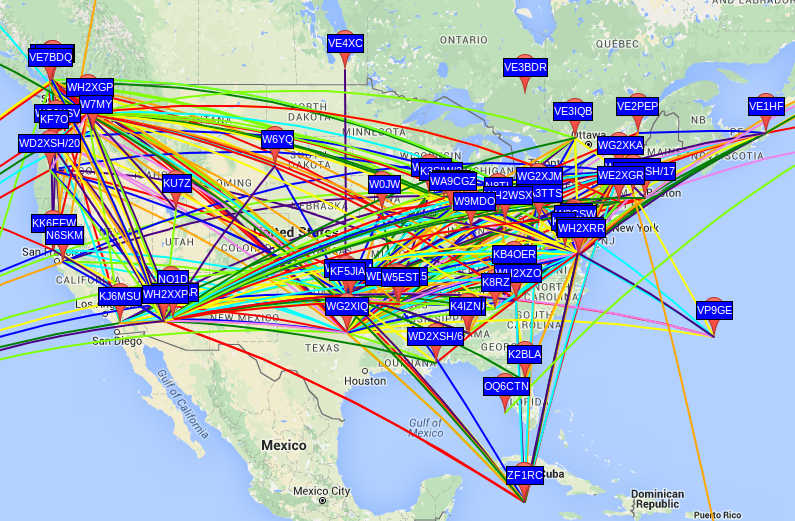
In spite of the sun's nasty and continual huffing and puffing, conditions on 630m continue to surprise many of the nightly diehards. It seems clear, that for the time being, the digital WSPR mode is the one chosen by the majority of operators. I suspect that this will change to a more proportionate mix of both CW and digital, as more Canadians get on the band but more particularly, when U.S. amateurs get permanent access to 630m as a ham band. At present, it's mostly listeners reporting beacons, demonstrating the propagational capabilities to be found at the bottom of the broadcast band.
Last night saw over 80 stations worldwide, either listening or transmitting on 630m, with the majority of them in the 'listening mode' only.
 |
| courtesy: http://njdtechnologies.net/ |
It was particularly nice to see locals, VE7BDQ and VE7CNF being heard in the Cayman Islands and Hawaii, respectively ... both suburban backyard operations. The previous morning saw the experimental station run by Larry, W7IUV in Washington state, being heard in Japan by JA1NQI ... a first from the lower 48 into Japan.
Things over in Europe have also been heating-up and the nightly reports read more like a roster of 20m action. FR5ZX on Reunion Island in the Indian Ocean has been reporting many of the Europeans, making things more interesting for the dedicated in that part of the world. All of the reports were on the WSPR mode.
John (KB5NJD / WG2XIQ) in Texas, continues to post his amazingly-detailed nightly updates of 630m action. If you want to know what's been happening both here and in the rest of the world, his daily updates will keep you in the loop ... but be warned, as you will likely find yourself heading for 630m yourself to get in on the nightly activity. In addition, his blog contains a goldmine of information for those wanting to get started with building a 630m MF station. To really keep tabs of real-time happenings, the ON4KST MF chat page is the place to be.
Next weekend, the 630m CW crossband activity will take place, with 5 different Canadian CW stations CQing on 630m CW and listening for callers on various HF frequencies on 80 and 40m. I will have the details up here again shortly, but please give a listen for us on 630m as well as a call on HF, next Friday or Saturday (or both!) nights ... the more the merrier, and tell your friends too!
Steve McDonald, VE7SL, is a regular contributor to AmateurRadio.com and writes from British Columbia, Canada. Contact him at [email protected].
 Ham Radio Deluxe |
 W5SWL Electronics |
 Ham Radio Prep |
 KB3IFH QSL Cards  Hip Ham Shirts  HamRadioAuctions HamRadioAuctions Reliance Antennas Reliance Antennas Enigma Shop Enigma Shop |  morseDX  Ni4L Antennas  R&L Electronics R&L Electronics antennas.us antennas.us QRV QRV |
- Matt W1MST, Managing Editor
