 |
 The 1929 ‘BK’ QSO Party
 18 November 2015 | by
 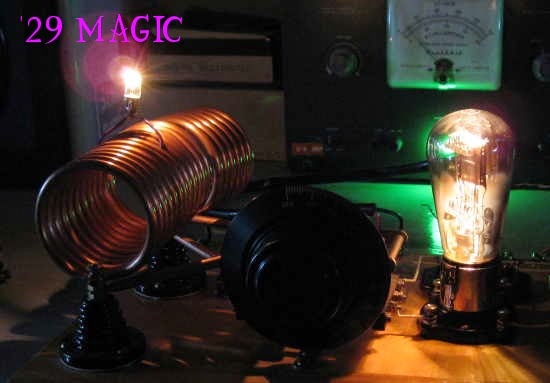 The month of December will soon be upon us and that means it's 'BK' time once again! The Bruce Kelley 1929 QSO Party is the annual two-weekend event celebrating the sound of amateur radio as it was in 1929.
At no other time of the year can you tune across the bands and hear the melodic sound of radio as it once was ... before the days of crystal-control, when most hams were using self-excited one or two-tube transmitters.
With antennas blowing in the wind, these directly-coupled oscillators often make the band sound like a musical symphony gone wrong ... the wonderful whooping, chirping, buzzing, clicking, drifting, swishing, swaying, warbling, and other interesting sounds of '29, when amateur radio was in its infancy.
If you've ever considered joining-in on the fun, then you still have a few weeks to slap something together for the party ... it need not be 'pretty', but it must be 'compliant'. That is, the tube (or tubes) that you use, must have been available in 1929 or earlier. For receiving, use anything you like ... modern or vintage, as there are no restrictions.
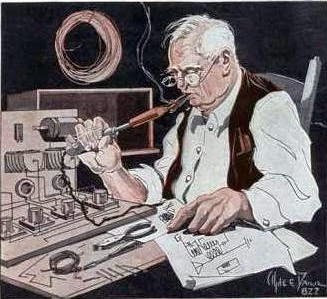
I've penned several blogs on popular circuits and tubes that are commonly used among the BK regulars and they can be viewed here:
Building '29 Style
Building '29 - What To Build? - PT.1
Building '29 - What To Build? - PT.2
More BK Building
With the usual propagation of early December, it is not surprising that many transcontinental QSO's are made every year, even with the little two or three watters. Considering the 10 watt power input rule, it is surprising how strong some signals from across the country can become on the lower bands, especially on 40m.
Please consider rolling-up your sleeves, heating up your soldering iron and putting something together for the BK fun, especially if you are on the left coast ... and don't be the least concerned about how it looks!
For a gallery of inspiration from individuals that were too weak to resist the temptation, have a look at some previously built '29 time machines.
For the first time, I'll be using my newly constructed MOPA, a two-tuber that will hopefully reduce my annual BK windstorm angst. It seems that every BK weekend, I have gale-force winds here on the island, making my signal a little bit 'too musical', although some '29 diehards still claim to love the sound ... for them, there is no hope.
Steve McDonald, VE7SL, is a regular contributor to AmateurRadio.com and writes from British Columbia, Canada. Contact him at [email protected].
A semi-annual rant about learning CW

Please take my word for it! As I've told so many times before, I know the frustration of not being able to learn CW. I put off getting my license for at least five years (maybe more), because I could not wrap my brain around the code. And one of the major reasons for that lack of brain wrapping was because someone thought that they were doing me a good turn by handing me a chart similar to the one above.
From personal experience, I can tell you that making the jump from audio input to visual input to brain is the perfect recipe for frustration and resignation. I made the mistake of hearing, trying to visualize and then decode. What you need to do is skip that visual step. Morse Code is a heard language, and unless you're in the Navy operating signal lamps, it's primarily an aural language. To this day, I have extreme difficulty (in fact, I don't even bother) when people "type" out cutsie messages using periods and hyphens to make dits and dahs in print. I have to hear it to de-code. No ifs, ands or buts ..... I have to hear it.
Think about it for a second. When you were a baby, how did you learn to talk - by reading, or by listening to your parents and siblings?
So thanks be to God for the Hams who taught my Novice class. They handed me a set of ARRL Morse Code cassettes with only one word of instruction - LISTEN! And in the end, that's what did it, but the damage had already been done. I had to "unlearn" my past efforts and had to re-learn the direct step of "hear, then de-code". For me, that damage lasted well past 5 WPM. I was stuck at the 10 WPM barrier for a long time, and it was only by the Grace of God that I was able to get up to 13 WPM within 6 months in order to earn my General ticket.
So my advice for those wishing to learn Morse?
1) Ditch any visual aids, as if they were a rattlesnake or the plague.
2) Listen to letters being generated at a speed of anywhere from 13-18 WPM. Let the spacing between the letters determine the code speed. If you listen to Morse being generated slowly and drawn out, you're more than likely going to suffer the 10 WPM plateau like I did.
3) Limit your dedicated practice sessions to no more than 15-20 minutes a pop - two sessions a day, max. At other times, I find it helpful to have Morse playing quietly, almost subliminally in the background while driving, doing chores, etc. IMHO, it gets your brain used to hearing it, and before you know it, you're going to be picking out characters without even realizing it. Lastly, I never liked the concept of listening to random characters once I learned the alphabet. From then on, I found it most useful to listen to actual words and not letter groups. Let's face it, unless you're a spy, you're going to be on the air making conversation - not sending clandestine messages.
4) Once you've learned all the characters and numbers and basic punctuation, and feel somewhat confident in being able to de-code, then get on the air and make QSOs. Real live QSOs are without a doubt, the best vehicle towards increasing your code speed. You can find a lot of beginners hanging out in the 7.120 MHz neighborhood of 40 Meters.
5) Relax, and don't get down on yourself. We all learn things at different speeds. Some people are quick studies and then there are people like me. But if you stick with it, you will get it - I promise.
6) Make full use of W1AW code practice and all the free CW learning software that's out there. Personally, I keep "Morse Trainer" by Wolphi on my phone. It's not a free app, you have to pay for it, but it will generate Morse at speeds up to 60 WPM. I keep it set at 40 WPM. Can I de-code Morse that fast? No way in heck! But I can tell you that after listening (JUST listening - not even trying to decipher) code at that speed for 15 minutes .... code sent at 25 or 28 WPM sounds a lot slower than it used to.
I suffered the double whammy. I had to "unlearn" the aural to visual to brain process; and then once I actually learned the code, I had to unlearn the "code letters sent at 5 WPM" error. Look at me now - CW is my most preferred mode and I am comfortable anywhere around the 25 WPM mark! On a good day, if I don't tense up, I can go for short bursts of 30 -35 WPM. The bottom line is, that learning and becoming proficient with Morse Code is not impossible, in most cases.

Take it from someone who thought it was.
72 de Larry W2LJ
QRP - When you care to send the very least!
Larry Makoski, W2LJ, is a regular contributor to AmateurRadio.com and writes from New Jersey, USA. Contact him at [email protected].
Nikola Tesla: What happened to his papers after his death?

They say that in order to know where you are going, you must first know from where you came. I really believe that and have applied it in my genealogy hobby. I think maybe the time has come to apply it to my ham radio hobby, as well.
While I haven’t been a ham for very many years, I worked as an electronics tech for about 18 years –much of it in the Air Force, on radar and radar guided missiles on a fighter jet, but later working Civil Service for the Army, then Air Force as well. Many times I started to get my FCC license, but I had nobody to elmer me, and some of what I was studying was for a license for career use.
While working in electronics repair in 1983, a copy of “Radio Electronics” came (as it normally did) in my mailbox as part of a monthly subscription. An article in that issue on Nikola Tesla touched me like no other before, or any other even to this day!
Who was this Nikola Tesla? After reading the article I had to question, with years of electronic education, an A.S. degree in electronics, and specialty schools galore, why had I never learned more about this guy that had almost EVERYTHING to do with my interests at the time! I was stunned that I could have gone so long without being educated on this man! Sure, I had heard of the coils named after him, but little on the man himself. Maybe in my youthfulness I didn’t pay attention to past history so much? But it shook my foundations and made me curious to know more about Mr. Tesla.
Recently, my wife and I moved back into a house we were in before I got into HF. As such, it had no HF antennas or tower. So I put in a request for help in my local club, DARA; the famous hosts of the Dayton Hamvention. The club is huge, so I hoped I might get some help. I did receive two offers of assistance.
One offer to help was a fellow vet that raised a son by himself due to a tragic loss of his wife and the son’s mother. The man and his son soon were over and helped me undo the mess I made, and started on a new plan to move forward. Another great guy also helped greatly, and before we knew it, we started over on my meager beginnings on a tower, and improved and added on.
We had several long days and late nights as well. The XYL is a GREAT cook and I suspected that the man and his son had few home cooked meals the caliber of which the wife could put together. So we had some nice late dinners and stuffed ourselves while talking all sorts of ham-related subjects.
The son of this man has a name similar to mine, and he did most of the climbing and hard work. As such he really impressed me. His father raised him well and taught him respect and service to others. It turns out he has a desire to one day purchase a radio similar to my ICOM IC 7000, which I use for a primary station radio. He had studied the manuals some and downloaded one to his cell phone and helped me use the features built in to the radio that I hadn’t yet figured out how to use!
After thinking about this tower and antenna outlasting me, I realized that one day I will take my turn to go silent key, and this young guy is one of the few that will be working to carry on this great hobby and service to our community. I have grandsons, but they are too young yet to know if they will show any interest later on in life.
When Tesla came back up to me recently, I remembered the old magazine article, and the book I later purchased by Margaret Cheney on Mr. Tesla’s biography. Did you ever have something happen to you that just said you were at the right place at the right time, and it was supposed to happen just the way it did? After a base closure in Sacramento, I found myself working at Wright-Patterson AFB just outside of Dayton, Ohio (and yeah, it’s that place that has long had a reputation of supposed aliens being brought there! In fact, the bowling alley on base makes fun of it and has special “Alien Bowl” events and signs posted at the back above the pins showing aliens in cartoon form).
The place I was assigned was the Air Force Institute of Technology. I was working in computer support as a LAN Admin, and establishing and maintaining accounts, adding new equipment, maintenance on servers and more. I had changed my career, but not lost interest in electronics. I read something somewhere that indicated that the biography on Tesla written by Margaret Cheney was a pretty good read and fairly accurate! I ordered the book and to this day is one of the few books I have actually finished. It was that interesting!
At the end of the book she claims that the Department of Defense went into Tesla’s home and lab after his death, and confiscated many of his papers and research notes. She claimed they were taken to Wright-Patterson Air Force Base. If this is true, the most likely places for these records to go would be the Air Force Research Labs, and the Air Force Institute of Technology. They shared a common library. I was careful to not jeopardize my career, so my curiosity remained mostly in check. But still, not a day went by when I wasn’t thinking about Tesla and his work being studied and possibly carried on where I was working.
So becoming friends with this young man who helped me greatly, I feel a sense of responsibility to help him succeed. To make sure he knows about some of the roots of this hobby so that he is better “grounded” in basic facts, to help him move forward. As I write this, I am not yet sure if he is already familiar with Tesla or not. But maybe, just maybe, I can pass on some of the history, to help a young man continue on in this great hobby and service of ours.
Maybe one day I can do the same with my grandsons, but for now, I feel an obligation to “pass it forward” and make sure a new generation was aware of a man I knew little about, but had a great contribution to my career and daily life.
Steve Martin, KD8QZT, is a special contributor to AmateurRadio.com and writes from Ohio, USA. Contact him at [email protected].
630 Crossband Excitement
In spite of the mediocre band conditions, this past weekend's 630 crossband activity was a great success. Firstly, it was gratifying to see so much activity from the VE7 region. Last year, it was just John, VE7BDQ, and myself, holding the fort, but this year saw new activity from VE7CNF, VA7MM and VE7CA. If this rate keeps up, the band will soon be getting crowded and wouldn't that be great!
It was only a few short months ago that VE7CNF and VA7MM began tinkering on 630m, their signals barely out of the noise here on Mayne Island. How quickly their stations have evolved into systems now capable of working several thousands of miles on the new band. To make the weekend even more special, Markus, VE7CA, had his first-ever 630m contacts on Saturday, working all of the locals and later in the evening, pushing his 14 watts down into Tahuya, WA, working K7CW on crossband. I'll wager that Markus will treasure that first 'DX' QSO for some time.
Conditions from VE7 on Friday were poor, and although somewhat disappointing, not entirely unexpected after watching the sun play tricks on our geomagnetic field all week long. The only path that seemed somewhat normal was the north-south one, yielding contacts with the Californians. As the K-index briefly dropped to '1', Saturday's conditions were much improved, showing short-lived glimpses of normality both to the west and to the east.
On both evenings, the HF bands (and probably 630m to a lesser extent) seemed to be very 'long', with few continental signals being heard. The long skip made it very hard, in some cases, to hear close-in callers on both 40 and 80m ... callers who would normally be 599. Particularly absent where callers from the closer WØ states and the easier W7 regions such as Nevada, Utah and Arizona ... areas that have been easily worked on previous crossband nights. It was also disappointing to not have anyone from the other VE regions call in. I hope it was just conditions and not from lack of trying, as it has been a struggle to generate much interest in the western provinces so far.
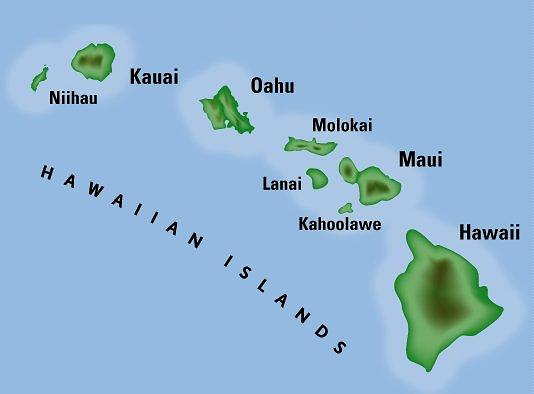
The biggest surprise and the highlight of the weekend was most assuredly the crossband contacts between the VE7 stations and Hawaii, with VA7MM, VE7CNF, VE7BDQ and VE7SL, all working Merv, K9FD/KH6 in Maunaloa on Moloka'i Island. Merv noted that all four VE7's were worked within a 25 minute window and all peaked at different times. A few minutes later, the 'tranpacific' path turned 'transcontinental' as NO3M in Pennsylvania, called VE7SL and exchanged 559/549 signal reports ... who would have thought that 630m could generate such magic! This band has so much exciting potential for amateurs, even for those confined to normal suburban backyard locations. Activity will surely skyrocket when U.S. amateurs get access to the band ... hopefully soon.
Several SWL reports were received from the U.S., with one of the most interesting coming on Saturday night, from the maritime operators at KSM, near San Francisco. As well, the Red Oak Victory shipboard station anchored near San Francisco, KYVM, sent a detailed report of several VE7 stations that they had heard.
Crossband Summaries
VE7BDQ :
VA7TA CN79 Courtenay, BC
K6LG DM13 Riverside, CA
VA7MM CN89 Port Coquitlam, BC
VE7KW CN89 Port Coquitlam, BC
K7HV CN87 Seattle, WA
VE7CA CN89 North Vancouver, BC
VE7CNF CN89 Burnaby, BC
VE7SL CN88 Mayne Island, BC
K7CW CN87 Tahuya, WA
VA7JX CN79 Campbell River, BC
VA7DXX CN89 Ladysmith, BC
K9FD/KH6 BL11 Maunaloa, HI
K7SS CN87 Seattle, WA
K6AIG DM04 Mandalay Bay, CA
VE7CNF :
KK7UV DN36 Missoula, MT
VA7MM CN87 Port Coquitlam, BC
K6GZ DM14 Esperia, CA
VA7TA CN79 Courtenay, BC
K6LG DM13 Riverside, CA
K7CW CN87 Tahuya, WA
VE7KW CN89 Port Coquitlam, BC
VE7BDQ CN89 Delta, BC
VA7DXX CN89 Ladysmith, BC
WØYSE CN85 Vancouver, WA
K9FD/KH6 BL11 Maunaloa, HI
VA7MM :
VE7KW CN89 Port Coquitlam, BC
VA7TA CN79 Courtenay, BC
K7CW CN87 Tahuya, WA
K9FD/KH6 BP11 Maunaloa, HI
WØYSE CN85 Vancouver, WA
K7SS CN87 Seattle, WA
VA7DXX CN88 Ladysmith, BC
VE7CA :
VE7SL CN88 Mayne Island, BC
VE7CNF CN89 Burnaby, BC
VE7BDQ CN89 Delta, BC
K7CW CN87 Tahuya, WA
VA7MM CN87 Port Coquitlam, BC
VO1NA :
VE1VDM FN85 Onslow, NS
VO1BQ GN37 St. John's, NL
VE7SL :
VE7KW CN89 Port Coquitlam, BC
KK7UV DN36 Missoula, MT
VA7MM CN87 Port Coquitlam, BC
K6GZ DM14 Esperia, CA
VA7TA CN79 Courtenay, BC
K7CW CN87 Tahuya, WA
K6LG DM13 Riverside, CA
VE7BDQ CN89 Delta, BC
VA7DXX CN88 Ladysmith, BC
VA7JX CN79 Campbell River, BC
K9FD/KH6 BP11 Maunaloa, HI
NO3M EN91 Saegertown, PA
K7SF CN85 Portland, OR
K7SS CN87 Seattle, WA
KGØD/7 CN88 Sequim, WA
W2VJN CN83 Roseburg, OR
It is readily apparent that acres of antenna space are not needed to enjoy 630m ... all of these stations operate out of normal-sized residential lots, with antennas planned and built well enough to exploit the propagation characteristics of 630m.
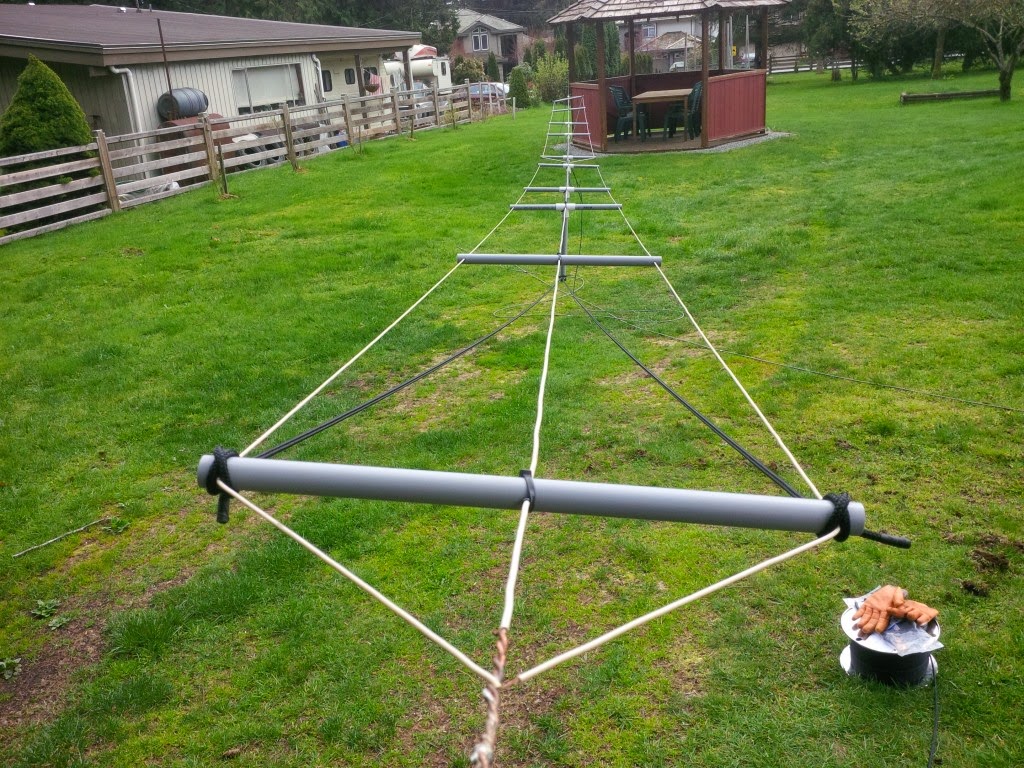 | ||
| VA7MM antenna system. More info here. |
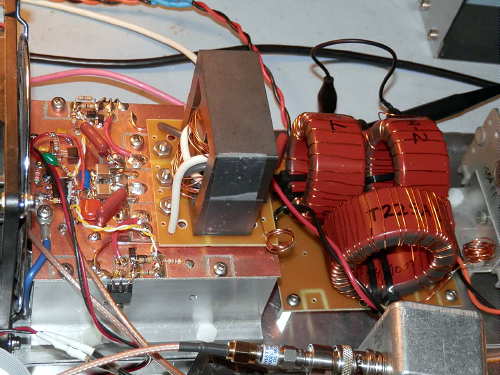 | ||
| VE7CNF's homebrew PA. Website here. |
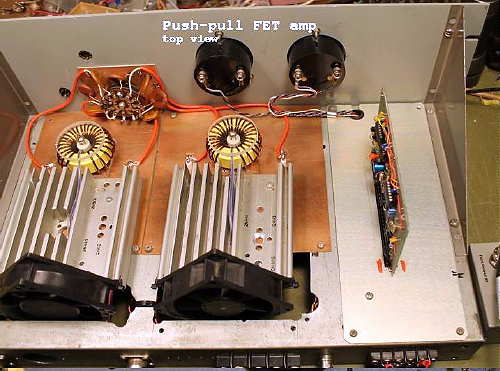 |
| VE7BDQ's homebrew 2200m/630m duo-band tx. |
Steve McDonald, VE7SL, is a regular contributor to AmateurRadio.com and writes from British Columbia, Canada. Contact him at [email protected].
Weekly Propagation Summary – 2015 Nov 16 16:10 UTC
Here is this week’s space weather and geophysical report, issued 2015 Nov 16 0630 UTC.
Highlights of Solar and Geomagnetic Activity 09 – 15 November 2015
Solar activity was at very low to moderate levels over the period. The period began at moderate levels with an M3/2b flare at 09/1312 UTC from Region 2449 (S12, L=207, class/area Dao/150 on 08 Nov). Associated with the flare were Type II (957 km/s) and Type IV radio sweeps, a 670 sfu Tenflare, and a partial halo coronal mass ejection (CME). Originally, the CME was thought to have a partial Earth-directed component; however, there was no arrival apparent in ACE/SWEPAM data. Low levels were observed on 10 and 13 November due to low level C-flare activity from Regions 2443 (N07, L=316, class/area Fkc/650 on 01 Nov) and 2452 (S08, L=169, class/area Axx/010 on 11 Nov). Late on 15 November, two filament eruptions occurred in the SW quadrant. The first was an approximate 21 degree filament eruption centered near S11W17 that was observed lifting off around 15/2114 UTC in SDO/AIA 304 imagery. The second was an approximate 19 degree filament eruption centered near S26W24 observed lifting off around 16/0114 UTC. Analysis was ongoing for these two events, however given their location and initial trajectory, an Earth-directed component is probable.
An enhancement (below S1-Minor threshold) of the greater than 10 MeV proton flux occurred at 09/2130 UTC associated with the M3 flare. Particle flux measurements reached a maximum of 3.7 pfu 10/0020 UTC before declining to background levels by early on 11 November.
The greater than 2 MeV electron flux at geosynchronous orbit was at high to very high levels over the period. Very high levels occurred on 11 and 13 November with maximum flux levels of 59,508 pfu at 11/1915 UTC and 88,813 pfu at 13/1355 UTC, respectively.
Geomagnetic field activity ranged from quiet to major storm levels. The period began under the influence of a prolonged negative Bz component followed by a solar sector boundary crossing mid-day on 09 November. Shortly after, a co-rotating interaction region preceding a positive polarity coronal hole high speed stream (CH HSS) became geoeffective starting in the latter half of 09 November. Total field rose briefly to 12 nT with solar wind speeds increasing to the 650-750 km/s range. Solar wind continued to be enhanced through 12 November as CH HSS effects declined. The geomagnetic field responded with unsettled to (G1-minor) minor storm levels on 09 November, active to (G2-moderate) major storm levels on 10 November, and quiet to minor storm levels on 11 November. Quiet levels were observed on 12 November. By 13 November, another positive polarity CH HSS became geoeffective causing total field to initially rise to 10 nT with solar wind speeds in the upper 400 km/s range. Total field remained slightly agitated from 14-15 November with total field ranging from 5-9 nT. As a result, quiet to active levels were observed on 13 November, with quiet to unsettled levels on 14-15 November.
Forecast of Solar and Geomagnetic Activity 16 November – 12 December 2015
Solar activity is expected to be at very low to low levels with a chance for M-class (R1-R2, minor-moderate) flares from 22 November through 05 December with the return of old Region 2443 (N07, L=316).
No proton events are expected at geosynchronous orbit.
The greater than 2 MeV electron flux at geosynchronous orbit is expected to be at high levels from 16-18 November and again from 01-12 December due to recurrent CH HSS influence. Normal to moderate levels are expected from 19-30 November.
Geomagnetic field activity is expected to be at unsettled to active levels from 16-19 November due to prolonged southward Bz as well as a negative polarity CH HSS on 18-19 November. Multiple recurrent positive polarity CH HSSs are expected to influence the geomagnetic field from 30 November-02 December, 05-08 December, and 10-12 December causing unsettled to active levels with (G1-minor) storm periods likely on 30 November-01 December, and 06-08 December.
The eruptive filaments on 15-16 November are not in the present forecast as we are waiting on further imagery to model these events.
Don’t forget to visit our live space weather and radio propagation web site, at: http://SunSpotWatch.com/
Live Aurora mapping is at http://aurora.sunspotwatch.com/
If you are on Twitter, please follow these two users: + https://Twitter.com/NW7US + https://Twitter.com/hfradiospacewx
Get the space weather and radio propagation self-study course, today. visit http://SunSpotWatch.com/swc for the latest sale and for more information!
Check out the stunning view of our Sun in action, as seen during the last five years with the Solar Dynamics Observatory (SDO): https://www.youtube.com/watch?v=zXN-MdoGM9g
We’re on Facebook: http://NW7US.us/swhfr
Visit, subscribe: NW7US Radio Communications and Propagation YouTube Channel
Get crackalackin’
As Fall is here, it is time to put together a To Do list of everything I have been putting off all Summer and the beginning of the school year.
TM-D710A

I have four of these rigs and they need some TLC. I need to make sure they have the updated firmware on the main unit, TNC, and operating panel.
The latest versions:
TNC: 1.02 – May 2011
Operating Panel: 2.12 – Janurary 2015
Main unit: 2.10 – May 2011
For the benifit of emergency operations, I have been performing the modificiation to the TM-D710As to open the frequency range.
Standard frequency plan. I developed a spreadsheet of the repeaters in the greater Kansas City area, frequecies for FRS/GMRS, the Kansas City Airport (MCI), Sherman Army Airfield, and various national park frequency plans. This is the first step in standardizing the configuration across all four of the TM-D710As. I can additionally take the spreadsheet and use it for programming my HTs. This should allow for a memory channel standardization that will make my life easier.
Weather Station

The current Davis Vantage Pro2 I have installed on the roof needs maintenance. Wouldn’t it be nice to get the top of the line version?
For some time I have been talking about finding a weather station setup that will work with a linux-based computer. That quest continues. I have read about a piece of software called Meteo that is suppose to work with Xastir.
And if I can’t get Xastir to work with the Vantage Pro2… is there another comparable weather station that WILL work with Xastir? Life would be a lot easier without Windows.
HF Antenna for home
I need to string up the Carolina Windom I have had sitting on the shelf for the last few years. The G5RV that is up now is showing its age (not to mention one of the legs is drooping badly). Now that the leaves have fallen, I should be able to get the Windom up there without too many problems (… famous last words).
HF setup in the mobile
Time to get going. I have all the materials I need. What I don’t have is an installation plan… mainly for the Tarheel antenna. I can’t do a hitch mount because I need the hitch for pulling my travel trailer. Two possible options: (a) get a swinging gate for the back bumper where you could mount a spare tire and a water can or (b) find some way to afix a mount coming out behind the left rear tire.
Scott Hedberg, NØZB, is a regular contributor to AmateurRadio.com and writes from Kansas, USA. Contact him at [email protected].
Series Eight Episode Twenty-Four – Planning a Ham Radio Christmas (15 November 2015)
In this episode, Martin M1MRB / W9ICQ is joined by Leslie Butterfield (G0CIB), and Edmund Spicer M0MNG to discuss the latest Amateur / Ham Radio news. Colin M6BOY rounds up the news in brief, and this episodes feature is Planning a Ham Radio Christmas.
- Youngsters Build Antennas at Goonhilly
- Blue Heritage Plaque for Radar Pioneer
- New Amateur Radio Licence Guidance
- Tackling Pirate Radio
- Online Survey for UK Amateur Radio Hams
- New Symbol Graphics for APRS
- North Korea Operation
- BBC R&D White Papers
- Netherlands 5 MHz Allocation
Colin Butler, M6BOY, is the host of the ICQ Podcast, a weekly radio show about Amateur Radio. Contact him at [email protected].
 Ham Radio Deluxe |
 W5SWL Electronics |
 Ham Radio Prep |
 KB3IFH QSL Cards  Hip Ham Shirts  HamRadioAuctions HamRadioAuctions Reliance Antennas Reliance Antennas Enigma Shop Enigma Shop |  morseDX  Ni4L Antennas  R&L Electronics R&L Electronics antennas.us antennas.us QRV QRV |
- Matt W1MST, Managing Editor
