 |
 Can anybody hear me
 3 December 2015 | by
 Calling QRP CQ - Inconceivable
Amazingly my 80m Windom / OCF Dipole has 4.5:1 SWR native around 1.8 mHz and it matches easily with a tuner across the entire 160m band. That was a surprise.
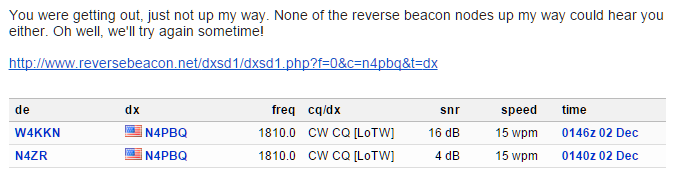
I tossed my mighty 5 watts call out at 1810 kHz not expecting much...
So how do you know if and where your signal is getting out ?
The Reverse Beacon Network
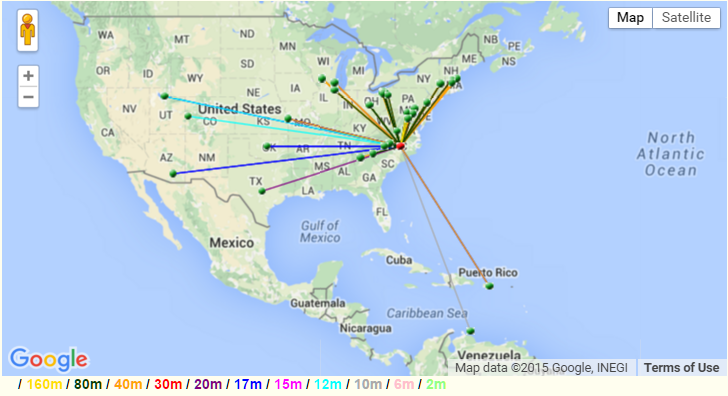 |
| Map of the last 100 reports from Reverse Beacon stations of my call sign Color coded by band |
It even includes a speedometer
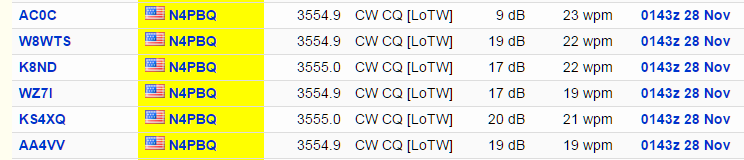 |
| My brief speed key session with N4HAY |
Summary
Richard Carpenter, AA4OO, is a regular contributor to AmateurRadio.com and writes from North Carolina, USA. Contact him at [email protected].
More Low Noise Vertical (LNV) Construction
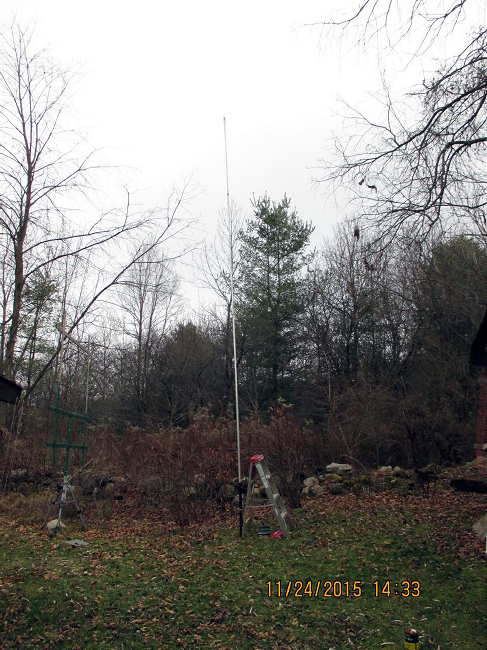 |
| New LNV At WG2XKA |
The low-noise vertical discussed here previously, has recently been implemented by at least three of the 630m experimental stations. John, WG2XKA / WA3ETD, along with Ken, WG2XXM / K5DNL and John, WG2XIQ / KB5NJD, have all constructed versions of this receiving antenna after reading about the details here.
John's antenna, pictured above, is described in more detail here, along with some nice pictures of his matching transformer.
All stations report good results with the antenna so it may be something you might want to consider if your present receiving antenna is a noise-collector.
For those interested in getting started on 630m, John (WG2XIQ), has a ton of inspiring information available on his website here as does John (WG2XKA) on his site here.
Steve McDonald, VE7SL, is a regular contributor to AmateurRadio.com and writes from British Columbia, Canada. Contact him at [email protected].
CQ-DATV mags free
See http://cq-datv.mobi/ebooks.php .
CQ-DATV is available for free download. I have not tried amateur TV but some remarkable results are being achieved by DATV in the 146-147MHz band. Like all things in our hobby, you can only do so much. I think the use of digital techniques has given amateur TV a new lease of life.

Roger Lapthorn, G3XBM, is a regular contributor to AmateurRadio.com and writes from Cambridge, England.
Weekly Propagation Summary – 2015 Nov 30 16:10 UTC
Here is this week’s space weather and geophysical report, issued 2015 Nov 30 0318 UTC.
Highlights of Solar and Geomagnetic Activity 23 – 29 November 2015
Solar activity was at very low levels with the exception of 23 and 25 November. Region 2454 (N14, L=121, class/area Dai/150 on 23 Nov) produced a few C-class events, the largest a C8/1f at 23/0228 UTC. Between 24/1130-1530 UTC, SDO/AIA 193 and 304 imagery observed a 20 degree long eruption, centered near S10W00, along a NW to SE oriented filament channel. No Earth-directed coronal mass ejections were observed during the period.
No proton events were observed at geosynchronous orbit.
The greater than 2 MeV electron flux at geosynchronous orbit reached moderate levels on 23-27 November but decreased to normal levels on 28-29 November.
Geomagnetic field activity was at quiet levels from 23-26 November. Mostly quiet levels were observed with a few isolated unsettled periods on 27-29 November and a single active period observed during the 29/2100-2400 UTC synoptic period due to prolonged negative Bz and slightly elevated solar wind speed.
Forecast of Solar and Geomagnetic Activity 30 November – 26 December 2015
Solar activity is expected to be at very low to low levels throughout the forecast period.
No proton events are expected at geosynchronous orbit.
The greater than 2 MeV electron flux at geosynchronous orbit is expected to be normal to moderate levels for the majority of the period with the exception of 03-05 December, 08-09 December and 11-15 December following several recurrent coronal hole high speed streams (CH HSS).
Geomagnetic field activity is expected to be unsettled to active on 30 November-02 December with minor storm periods expected on 01 December due to a recurrent positive polarity CH HSS. Quiet to unsettled levels are expected from 03-05 December. Isolated active periods are likely again on 06-07 December and 10 December as two subsequent positive polarity CH HSSs become geoeffective respectively. Quiet to unsettled conditions are expected to dominate the remainder of the forecast period.
Don’t forget to visit our live space weather and radio propagation web site, at: http://SunSpotWatch.com/
Live Aurora mapping is at http://aurora.sunspotwatch.com/
If you are on Twitter, please follow these two users: + https://Twitter.com/NW7US + https://Twitter.com/hfradiospacewx
Get the space weather and radio propagation self-study course, today. Visit http://nw7us.us/swc for the latest sale and for more information!
Check out the stunning view of our Sun in action, as seen during the last five years with the Solar Dynamics Observatory (SDO): https://www.youtube.com/watch?v=zXN-MdoGM9g
We’re on Facebook: http://NW7US.us/swhfr
Visit, subscribe: NW7US Radio Communications and Propagation YouTube Channel
Next Stage
- I've been working 40 years and that's enough
- I've been married 40 years and that's, well, that's good
- Both of my sons have lost their hair
- My oldest grandson is 6' 2" tall
Mike Crownover, AD5A, is a regular contributor to AmateurRadio.com and writes from Texas, USA. Contact him at [email protected].
Next Stage
- I've been working 40 years and that's enough
- I've been married 40 years and that's, well, that's good
- Both of my sons have lost their hair
- My oldest grandson is 6' 2" tall
Mike Crownover, AD5A, is a regular contributor to AmateurRadio.com and writes from Texas, USA. Contact him at [email protected].
My CQ WW CW contest overview.
 |
| The QRP setup |

Since I am operating QRP and using small MFJ loop antenna on the balcony my operating style was as follows
- I Use my VFO B to save a strong DX station that at the time has a huge pileup going. This stops me from wasting time trying to break the pile. Better to come back when the crazy pileup is gone. This worked great when I came across a Senegal station.
- Even when a station is at an S2 level but is just calling and listening my 5 watts can and did many times make it through for a contact.
- I don't use a spotting network as I found most of these stations have a huge pileup but I do have an Elecraft P3. Using some hardware and software my P3 is seen on a 19 inch monitor and I am able to point and click on signals. My K3 then moves to that signal this allows me to see the activity on the band and Search and pounce these stations.
- When possible stay with a band such as 15m were my MFJ loop does not need to be retuned at all across the whole CW portion.
- Stick with my 250hz Inrad 8 pole CW filter so I can get between tight signals and only hear the op I want to contact.
In my post I am going to go into detail about my software I am now using and finding to be great for contesting and general QSO's It's now time to grab some eats and relax.
Mike Weir, VE9KK, is a regular contributor to AmateurRadio.com and writes from New Brunswick, Canada. Contact him at [email protected].
 Ham Radio Deluxe |
 W5SWL Electronics |
 Ham Radio Prep |
 KB3IFH QSL Cards  Hip Ham Shirts  HamRadioAuctions HamRadioAuctions Reliance Antennas Reliance Antennas Enigma Shop Enigma Shop |  morseDX  Ni4L Antennas  R&L Electronics R&L Electronics antennas.us antennas.us QRV QRV |
- Matt W1MST, Managing Editor
