 |
 LHS Episode #158: Tipping the SCaLE
 21 December 2015 | by
  Today we have a special episode of Linux in the Ham Shack in which your hosts interview two of the volunteer coordinators for the Southern California Linux Expo, Hriday "Bala" Balachandran and Stewart Sheldon. Both of them are amateur radio operators and play key roles in making SCaLE one of the largest and most successful Open Source conferences in the world. We talk with them about their new amateur radio focus for 2016, the conference program, technology and many other topics. It's a lot of fun and highly educational, so don't miss this one.
73 de The LHS Crew
Russ Woodman, K5TUX, co-hosts the Linux in the Ham Shack podcast which is available for download in both MP3 and OGG audio format. Contact him at [email protected].
Time to get in Line
 Excitement in the shack! We’ve had a new addition. I have had my Elecraft K3 for quite a while. Nothing but positive words about it. It has never let me down.
We’ve all heard about the K-Line. I am assuming that the term K-Line is an omage to the Collins S-Line.

Through my research of MARS, I know that the Collins S-Line was the choice of MARS stations. Collins even had a repair shop located at the major air base outside of Saigon.

Although I have never operated any Collins gear, from what I’ve read it was built like a tank but clearly was designed to have aesthetic appeal. Elecraft is aiming to achieve the same.

I’ve started my attempt at building my K-line with the addition of the Elecraft amp and tuner. Both easily interface with each other and the K3. This allows for seamless band switching and tuning.
While only a 500 watt amplifier, I have already noticed an notable increase in my ability to make contacts and get to the top of the pileup. Band conditions helped, I’m sure – but it was still enjoyable making contacts with South Africa, Findland, the Canary Islands, and Aruba. Stateside contacts have also seemed to be easier to make with a little extra punch.
Scott Hedberg, NØZB, is a regular contributor to AmateurRadio.com and writes from Kansas, USA. Contact him at [email protected].
Tri-Tet Fun
 |
| courtesy: VK5TR http://www.users.on.net/~endsodds/ |
I spent a few hours yesterday, operating in the 'RAC Winter Contest'.
Originally, this contest began back in 1932, when QST excitedly announced a 'Canada-U.S.A. Contact Contest' to run in mid-January of that year.

The contest turned out to be extremely popular and has been run, in one form or another, ever since ... gradually becoming known as the 'VE-W Contest', sponsored by the Montreal Amateur Radio Club, and eventually by its modern name, with one version in July and a second in December.
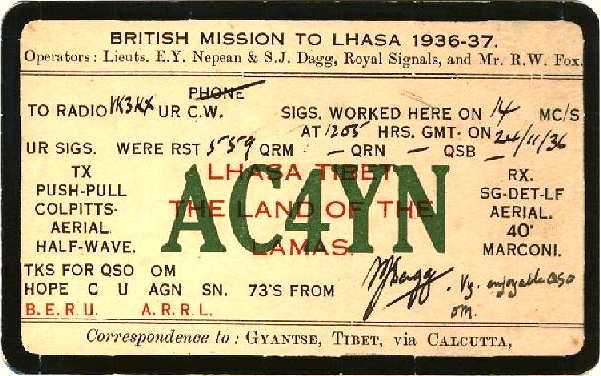
As a teen-aged ham, the 'VE-W Contest' was always the highlight of the year as the contest format, much as it is today, made anyone with a 'VE' call as sought-after as AC4YN ... not the one in North Carolina!
Old-timers and DXers will remember the call, as it represented the rarest of all possible contacts at the time and only a very lucky few made contact with the low-powered station, high in the Himalayan mountains at the British mission encampment in Lhasa, Tibet, in the late 30's. Having an 'AC4' QSL on the wall anointed you bragging rights for life.
Another great aspect about the contest back then, as in most, was that stations exchanged real RST's and not the meaningless '599' of today's contest operation. It was always interesting to learn how my little station, nestled in the upstairs attic, was really sounding at the other end.
I decided to set up my homebrew 'Tri-Tet-Ten', 6L6 crystal oscillator, and give the contest a short try. Being unable to conveniently move around the band meant that I would be reliant on stations answering my CQs ... not something that normally happens with the little transmitter in typical contest QRM ... but the magical 'VE' factor would change all of that, I hoped.
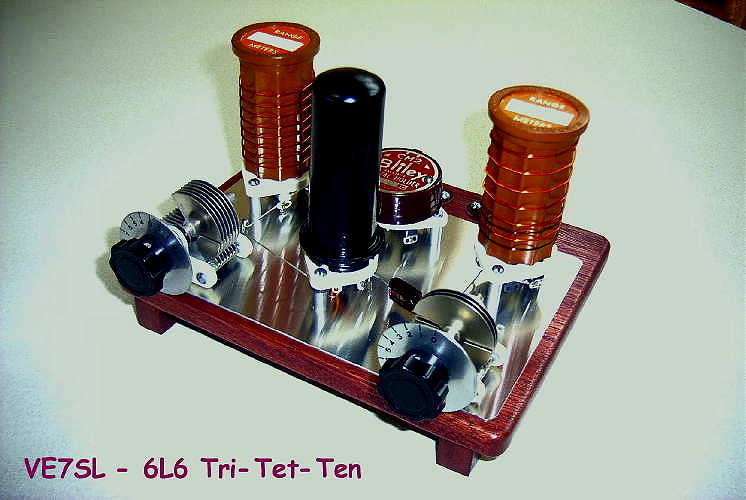
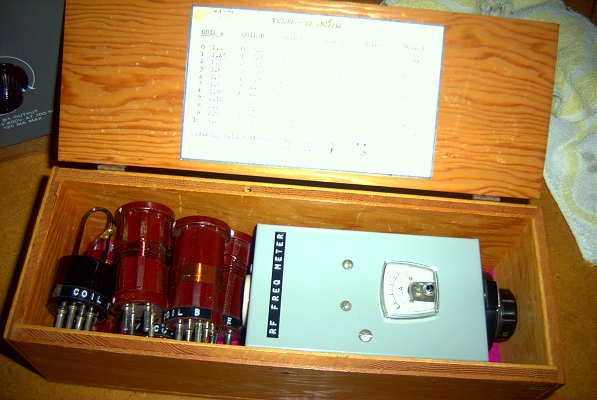
I plugged-in the 15/20m plate coil and got out my old homebrew RF-sniffer / wavemeter. It was the first piece of gear that I built, as a new 15 year-old ham, and the poor man's spectrum analyzer has been in constant use ever since. Using the 40m crystal's third harmonic, I have found the wavemeter is the easiest way to avoid mistuning and quickly found myself with just over 5 watts of RF ready to go. A tune-up for 20m later, found the second harmonic producing about 10 watts of pile-up generating madness.
Nowadays, the rules have changed a bit, and 'VE-to-VE' contacts are worth more than 'VE-to-W' QSO's but for 'W's, the goal is still to work as many 'VE's as possible ... and call they did.
Over the period of a few hours, the Tri-tet did not disappoint, generating 206 callers, including PY, PJ and HP ... frequently generating pileups 4 and 5 deep. I didn't try 10m as by the time I got started, it was falling off and the 6L6's 4 1/2 watts of fourth harmonic output on 10m requires really good conditions to be heard very well.
Due to conflicts with other activities, this was the first RAC VE-W Party that I have operated in many years ... it's nice to see that apparently not much has changed since 1932!
Steve McDonald, VE7SL, is a regular contributor to AmateurRadio.com and writes from British Columbia, Canada. Contact him at [email protected].
Christmas project
What’s the use of holidays if you just do nowt? It’s never going to happen in our house. So I decided to do something with one of he old netbooks I have. Remember them? Mine is an Advent 4211 that my lad decided to pull the keys off and eat them whilst our backs were turned and he was a less mobile menace 
Anyway. A media server is something we’ve been missing since our NAS decided to go on a ‘go slow’. After 20 mins Googling I ended up with OpenMediaVault. Impressed eh?

An all in one server is almost on us. I did the usual and downloaded the iso, burnt it to a USB stick with Rufus and installed it on the machine. As expected the installation was simple and I used this tutorial to help. Needless to say the 20 mins Googling the right software was the quick bit.
The MiniDLNA bit was what I was after and after a few ‘Uh’s’ and a quick trip round the internet and back and it looks like its going to serve me nicely. Did you see what I did there? serve? server? Oh well never mind. Here’s to you internet and your ability to give me ideas for stuff to do in the holidays whilst I’m waiting for stuff to arrive from China……Now what’s next on eBay?
Alex Hill, G7KSE, is a regular contributor to AmateurRadio.com and writes from Cumbria, UK. Contact him at [email protected].
Which antenna is better?
Real world antenna comparisons
The RBN
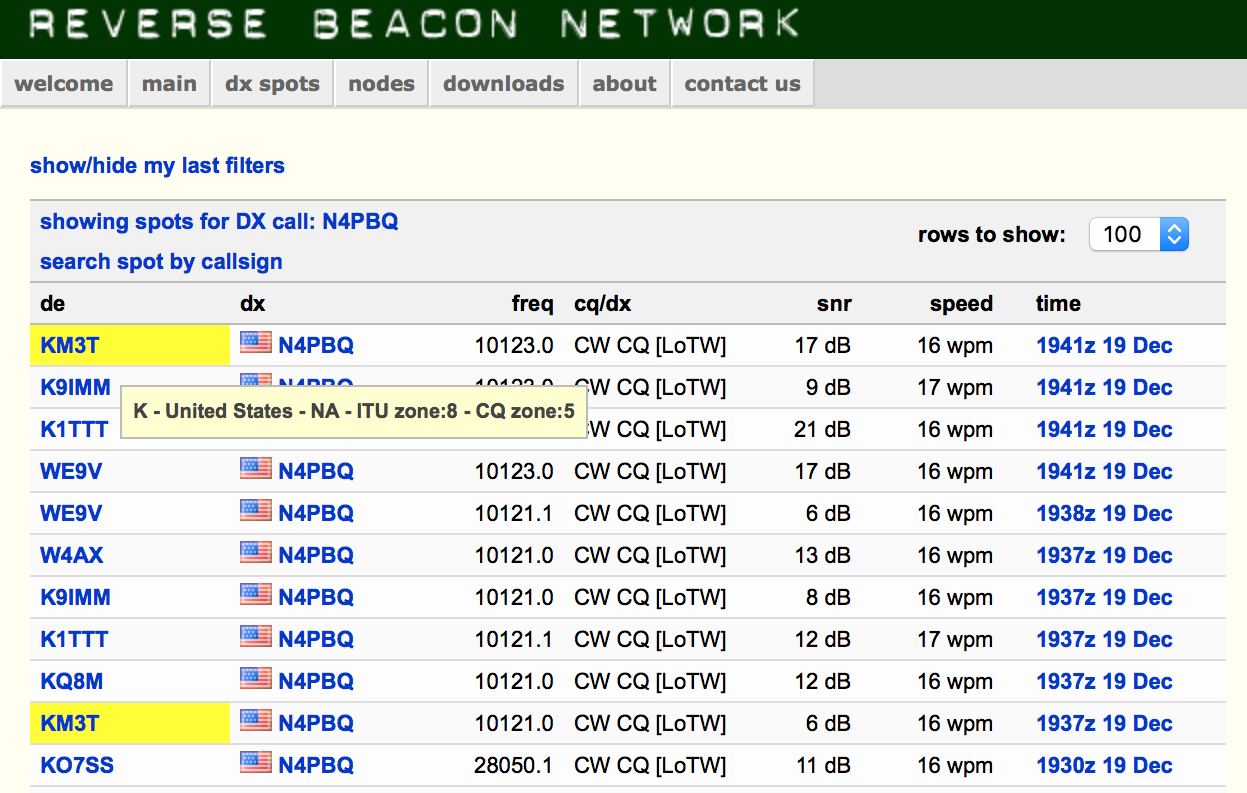 |
| Two highlighted records show the difference when I switched antennas and moved the transmit frequency slightly to cause a new report to be sent |
Process
Richard Carpenter, AA4OO, is a regular contributor to AmateurRadio.com and writes from North Carolina, USA. Contact him at [email protected].
Amateur Radio Weekly – Issue 90

Fessenden Christmas Eve commemorative transmissions set
WA1ZMS, will again put his 600 meter Experimental Station WG2XFQ on the air for a Christmas Eve commemorative transmission.
ARRL
Christmas Poems
‘Twas the night before Christmas and all through the shack
The rig was turned off and the mic cord lay slack.
eHam.net
ISS SSTV activity planned for late December
The first session is being targeted for Dec 26-27 to celebrate 15 years of ARISS school contacts with the ISS crew.
AMSAT UK
AO-85 slow scan TV image likely a prank, not a test
“I can tell you that in South America, they are having some fun, and that our analog-to-digital to analog IHU processing of the audio seems to work very well at SSTV frequencies!”
ARRL
Spacing – the most important thing
“Written” Morse is almost impossible for me to decode.
W2LJ
Sorry, I’ve been on 2m FM again
It is just too easy and too convenient.
K0NR
Yaesu FT1DR Review
Very nice, but as with ANY radio it has a few bugs including with the accessories. We tested it side by side with it’s elder FT1D model.
N9EWO
Agnes Scott College first Amateur Radio station on a women’s college
The station was established with the enthusiastic support of Agnes Scott faculty in the Department of Physics & Astronomy.
Agnes Scott College
Historic Ocean Gate antenna field may be removed
The iconic poles emerging from the tidal marshes in Bayville’s Good Luck Point may soon disappear if a federal plan clears a historic preservation hurdle.
The SWLing Post
Impact of WWI on US Ham Radio
When the United States declared war on Germany in 1917, most radio stations came under government control, reserved for war efforts.
Southgate
Video
Skelton HF transmitting station
Skelton Short-Wave Transmitting Station: Its Role in WWII and the Cold War.
YouTube
Amateur Radio Weekly is curated by Cale Mooth K4HCK. Sign up free to receive ham radio's most relevant news, projects, technology and events by e-mail each week at http://www.hamweekly.com.
Bargains – really?
Many of the larger dealers are offering special deals in the lead up to Christmas. But, are you really getting a bargain? For example, MLS have the FT1200 at less than £1000 after cash back. Maybe this radio is over-stocked as people prefer the IC7300 or the FT991?
Call me a cynic, but I think we are being offered discounts on radios that have not sold. As they say, “beware of Greeks bearing gifts”. If something looks too good there is probably a catch. Of course, if you really want one of the discounted rigs then now is as good a time to buy as any.
See www.phrases.org.uk/meanings/beware-of-greeks-bearing-gifts.html .

Roger Lapthorn, G3XBM, is a regular contributor to AmateurRadio.com and writes from Cambridge, England.
 Ham Radio Deluxe |
 W5SWL Electronics |
 Ham Radio Prep |
 KB3IFH QSL Cards  Hip Ham Shirts  HamRadioAuctions HamRadioAuctions Reliance Antennas Reliance Antennas Enigma Shop Enigma Shop |  morseDX  Ni4L Antennas  R&L Electronics R&L Electronics antennas.us antennas.us QRV QRV |
- Matt W1MST, Managing Editor
