 |
 LED Lights In The Shack
 6 January 2016 | by
  |
| Utilitech Pro Soft White LED Bulb |
A recent posting by Phil, KO6BB, to Yahoo Group's ndblist, described his recent search for some LED lamps to replace the CFL's in his shack / radio workbench area. If you have been wondering how much RFI that LED lamps might be producing, you may find Phil's findings of some value.
"Recap
I had a 60W equivalent CFL in the floor lamp directly over my operating position. I'd tried a 100W equiv one but it was extremely noisy! Also a couple CFLs in the ceiling lamp.
This is a floor lamp with a crookneck at the top and a triangular metal
shade reminiscent of the old style desk lamps, bulb is horiz to the
floor. I've used it for years and like it because it places the light
directly over the operating position work area (keyboard, radios etc).
The actual bulb was about 4.5 inches from the front of the Softrock SDR
receiver (in a plastic case), with the base of the lamp (where the
electronics are) about 7.5 inches (somebody asked about the distances).
This coupled a LOT of RFI directly into the SDR, visible on the
waterfall. For best results when recording and having the light on I'd
slip a 60W incandescent lamp in place of the CFL. The lamp is also
about 16 inches above the operating table, and when listening to ANY
portable radio on the table, if it was in the AM or Longwave band and
using the built in loopstick antenna, got a LOT of RFI from the lamp
(unless the lamp was off ;-)
So today I went down to Lowes (we have a Costco, but I don't have a
card) and looked at their LED lamp offerings. As I expected they had a
large variety of them, from a low cost 3 pack for ~$9.00 for 60W units
to about $18.00 or so each (Sylvania). From what I read here I wanted
to avoid the REALLY cheap ones as some reported them to be 'noisy'.
Also, I wanted to put a 75W equivalent unit in the one over the
operating position, and a pair of 100W equivalent units in the ceiling
lamp. All three had CFLs, and if I walked around the radio room with a
portable radio and the ceiling lamp on I could hear it's 'hash' anywhere
in the room. . .
The ones I settled on were a brand I'd never heard of, "UtiliTech Pro"
soft white, 75W for the bench and 2 100W ones for the ceiling. They
were what I'd call "mid-priced", $8.98 for the 75W and $9.98 for the
100W ones.
Specs:
75 W one draws 12W and gives 1100 Lumens.
100W one draws 16.5W and gives 1600 Lumens (the pair in the ceiling
should then be 3200 Lumens if I calculated right).
How low is the RFI to my Radios?
75W one over the bench:
NO trace from the lamp electronics visible in the SDR waterfall at
all. With a portable radio on the bench-top, NO audible RFI. Put a
portable radio up to the "bulb" part (light area) and with no station
tuned in can't hear ANY RFI. Move the portable to the base area of the
lamps there is SOME RFI, but I won't be putting the radio that close to
the lamp, move it a couple inches away and the noise disappears.
100W ones in the ceiling lamp, NO audible RFI in the portable when
walking around the room, RFI just barely perceptible right next to the
light wall switch that turns the lamp on, again, audible IF I put the
radio right up to the base of the lamps, not a likely real-world scenario!
Upshot?
Based on the sample of three that I bought and the almost
non-existent RFI from them I'd consider the UtiliTech Pro lamps to be a
good product and suitable for use in the radio room. I consider them
good value for the ~$30.00 I spent for three."
I don't see these being sold here in Canada but I may be mistaken. If you have tested anything similar (other brands / models), please let me know and I will add it to Phil's helpful information.
KO6BB's website can be found here, along with some of his homebrew equipment.
Steve McDonald, VE7SL, is a regular contributor to AmateurRadio.com and writes from British Columbia, Canada. Contact him at [email protected].
Ten Tec: 2016 and Beyond

Although there had been much speculation that Dishtronix was the mystery buyer of Ten Tec, we got confirmation in the last couple of days.
I wrote to Mike Dishop of Dishtronix, Ten Tec’s new owner, to ask him for more information about what we can expect from Ten Tec going forward. Here is his response:
Although Ten Tec has changed hands several times in the last couple of years, I would like to state that Ten Tec has changed hands for the last time in the foreseeable future. Dishtronix has been continuously operating for 17 years, is financially stable and will continue managing in a manner that promotes and maintains financial stability. My vision is strictly long term. I have no plans to leave this business and will continue to operate Ten Tec as long as I am physically able to do so. I believe the Ten Tec transceivers to be some of the best transceivers available at any price and personally have been operating an Orion II until the first change of ownership. Everyone who uses a piece of equipment long enough, develops a personal wish list of things they would change or improve. I feel extremely fortunate to now be in the position where I can use my skills and expertise from more than forty years of ham radio and SWLing to implement changes which I hope will make fantastic products even better.
Unfortunately I have had to make some tough decisions which were made for the long term health and viability of the company. The Ten Tec team is the nicest bunch of people you could hope to work with and have overall reacted positively to the changes. Some team members have chosen to pursue retirement or other opportunities but the core competency remains. We are extremely fortunate to have retained former engineering manager John Henry on a consulting basis and I must give him the greatest credit. I certainly would not take on this project without him and the other team members like Boyd Lichlyter and Patty Gann. Ten Tec is like a big family, and I do not view this as me acquiring Ten Tec but more like me joining an extended family of talented and skilled people. I hope anyone reading this who is in the market for a new radio will help me support this great group by at least trying one of their radios. Of the present production the Eagle is my favorite for having the best sound out of the box, and that is what my personal preference is always based on – good sound. My all-time favorite is of course the Orion II so an Orion III is on my personal wish list for the future. There are numerous Ten Tec user nets on the air and it is my intention so support them by posting the time and frequency schedules on the website. If I can accomplish one thing at Ten Tec it will be to be more customer-centric. I want to build the radios that you the customer wants! I am looking for ways to reliably engage with our customers so we can do that, and I think factory support of the nets is one way to start.
The Ten Tec team is working on production improvements to our facility and business. We are fully occupied with our commercial business at this time. When I have capacity the next step is to run the first batch of Omni 7+ which is the Omni 7 with some minor cosmetic changes and improvements such as a flat metal front for improved shielding. Following this we are releasing the Super Eagle which brings into the Eagle most of the DSP features found on the Orion II and is the first step on the path to the Orion III. This is different hardware from existing product so it is not a firmware upgrade. There are no firm dates or guarantees for when these things will occur.
The blow out sale prices are over and any outstanding orders at those prices are terminated The prices will be the regular list price. Those prices were previous owners intent to liquidate all inventory and will never be repeated.
I am pleased to state that we have completed some firmware updates which will be posted on the new Ten Tec website once it is up and running to entice people to visit the site.
Dishtronix has other new products under development as well. The DX2400MKII replaces the DX2400L1 legal limit + solid state amplifier and should be unveiled at Hamvention, to mention just one. We are close to beginning production of our Emtron DX2/3-SPd tetrode amplifiers which will also be shown at Hamvention. Further, there are some other exciting things happening which we may announce in the near future.
There has been some speculation if Ten Tec will move to Ohio. I do not plan to move anything at this time from the Sevierville – Knoxville area, but we may move within that area.
If I could ask the ham community to do one thing, it would be to please be patient with us. Things like this take time.
Matt Thomas, W1MST, is the managing editor of AmateurRadio.com. Contact him at [email protected].
More on the IC7300
There is a little more on this new ICOM radio on the MLS website. Deliveries are expected “in early 2016” with a UK (initial?) price of “under £1000”. I shall wait.

Roger Lapthorn, G3XBM, is a regular contributor to AmateurRadio.com and writes from Cambridge, England.
The Most Radio-Active Mountain in Colorado
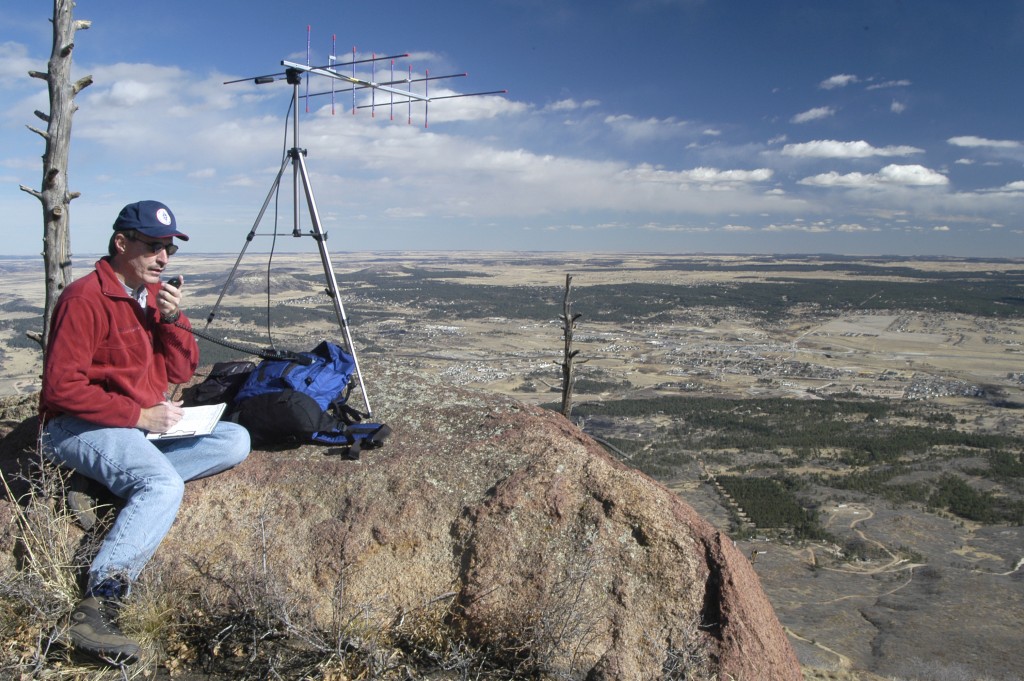
K0NR Operating VHF on Mt Herman (Photo: Ken Wyatt WA6TTY)
I’ve often said that Mount Herman (W0C/FR-063) is the most (ham) radio active mountain in Colorado. Many of us have operated from that summit for VHF contests, QRP events and Summits On The Air (SOTA). Of course, I didn’t have any data to back that claim…until now. A review of the cumulative SOTA activations in Colorado through Jan 1, 2016 shows these four summits as the most-activated SOTA peaks.
| Summit | SOTA Designator | Number of Activations |
| Mount Herman | W0C/FR-063 | 95 |
| Pikes Peak | W0C/FR-004 | 53 |
| Mount Evans | W0C/FR-003 | 33 |
| Squaw Mountain | W0C/PR-082 | 31 |
All of these summits are relatively close to the large population centers in the state. Also, they not that difficult to get to and some of them have roads that go to the top. Pikes and Evans are both 14ers but can be accessed via 2WD vehicles.
But what makes Mount Herman so special? It does not have a road to the summit — you definitely have to hike it, a little bit more than a mile one way with elevation gain of ~1000 feet. What makes the difference for Herman is that it is in the backyard of the well-known radio ham, goat hiker and SOTA enthusiast, Steve WGØAT. Steve has personally activated the summit more than 30 times AND he drags along mentors encourages other radio hams to join him. Frank KØJQZ did 22 activations, some with Steve and many on his own. (Frank just achieved SOTA Mountain Goat status, activating enough summits to earn 1000 SOTA points.) Fortunately for me, Mt Herman is about 4 miles as the GPS flies from my house, so I have worked that summit 31 times (usually Steve or Frank and always on 2 meters). I’ve also activated Mt Herman for SOTA three times, as described here: A Soggy Mount Herman SOTA Activation, Mt Herman: SOTA plus VHF Contest and Winter Assault on Mt Herman.
Here’s one of Steve’s fun videos that captures the first SOTA activation of Mt Herman, with his goat crew Peanut and Rooster (SK).
Frank and Steve, thanks for all of the Q’s from Mt Herman over the past years! See you on the air and on the trail.
73, Bob KØNR
The post The Most Radio-Active Mountain in Colorado appeared first on The KØNR Radio Site.
Bob Witte, KØNR, is a regular contributor to AmateurRadio.com and writes from Colorado, USA. Contact him at [email protected].
Weekly Propagation Summary – 2016 Jan 04 16:10 UTC
Here is this week’s space weather and geophysical report, issued 2016 Jan 04 0534 UTC.
Highlights of Solar and Geomagnetic Activity 28 December – 03 January 2016
Solar activity ranged from very low to moderate levels. Very low activity was observed on 03 Jan, low level activity on 29 Dec – 01 Jan, and moderate level activity on 28 Dec and 02 Jan. Region 2473 (S22, L=331, class/area=Fkc/590 on 26 Dec), which exhibited a complex beta-gamma-delta configuration, produced all of the significant flare activity (2 M-class, 14 C-class).
On 28 Dec, Region 2473 produced an M1 flare at 28/1245 UTC. Associated with this event was a Type IV radio emission and a partial-halo CME observed off the southern portion of the disk, first visible in LASCO coronagraph imagery at 12/1212 UTC. Analysis of this CME determined that an Earth-directed component was present.
On 02 Jan, Region 2473 produced a long duration M2 flare at 02/0011 UTC. Associated with this event were Type II (1095 km/s) and IV radio emissions and an assymetric partial-halo CME observed off the southwest limb, first visible in LASCO coronagraph imagery at 01/2324 UTC. Analysis of this CME determined that a weak Earth-directed component was present and would arrive around midday on 03 Jan, though eventually proved to be a miss.
There was greater than 10 MeV proton event on 02 Januaury 2016. The event began at 02/0430 UTC shortly after a long duration M2 flare that accured at 02/0011 UTC. Proton flux reached a maximum flux value of 21 pfu (S1-Minor) at 02/0450 UTC and ended at 02/0750 UTC.
The greater than 2 MeV electron flux at geosynchronous orbit was at high levels throughout the period with the exception of 31 December when moderate flux levels were observed. A maximum flux of 6,782 pfu was observed at 03/1600 UTC.
Geomagnetic field activity ranged from quiet to moderate (G2) storm conditions. At 31/0003 a small shock was observed at the ACE spacecraft. Total field (Bt) increased from 5 nT to 13 nT with a corresponding solar wind speed increase from 350 km/s to 500 km/s. The shock was associated with the arrival of the 28 Dec CME observed in LASCO C2 imagery at 28/1212 UTC. Isolated G1-Minor to G2-Moderate storm conditions were observed midday through late on 31 Dec as well as early on 01 Jan. Mostly quiet conditions were observed on 28 – 30 Dec, 02-03 Jan.
Forecast of Solar and Geomagnetic Activity 04 January – 30 January 2016
Solar activity is expected to be at low levels with a chance for M-class (R1-R2, Minor-Moderate) flare activity from 15 Jan – 28 Jan due to the return of Region 2473 (S22, L=331). Very low solar activity is expected for the remainder of the period.
No proton events are expected at geosynchronous orbit.
The greater than 2 MeV electron flux at geosynchronous orbit is expected to be high from 04 – 13 Jan, 25 – 30 Jan due to recurrent coronal hole high speed streams (CH HSS).
Geomagnetic field activity is expected to be at active levels on 04, 07, and 22 Jan with G1-Minor storm conditions on 06 Jan due to recurrent CH HSS activity. Mostly quiet to unsettled levels are expected for the rest of the period.
Don’t forget to visit our live space weather and radio propagation web site, at: http://SunSpotWatch.com/
Live Aurora mapping is at http://aurora.sunspotwatch.com/
If you are on Twitter, please follow these two users: + https://Twitter.com/NW7US + https://Twitter.com/hfradiospacewx
Get the space weather and radio propagation self-study course, today. Visit http://nw7us.us/swc for the latest sale and for more information!
Check out the stunning view of our Sun in action, as seen during the last five years with the Solar Dynamics Observatory (SDO): https://www.youtube.com/watch?v=zXN-MdoGM9g
We’re on Facebook: http://NW7US.us/swhfr
Visit, subscribe: NW7US Radio Communications and Propagation YouTube Channel
Winter update from KG9DW
Welcome to 2016! Lots of big projects are going on here at the radio ranch. My youngest is working on an arduino powered weather station that will be located at the FFA field plot along US51 north of Heyworth. We’re going to get the data from the site using the AREDN ham radio mesh software. It’s a real cool project, and my daughter is doing a great job with the programming.
I finally got all of my coax run into the shack in a decent fashion, and I’ve got coax switches in place to be able to toggle between the two hf rigs and the two hf antennas. My next antenna will either be an hf beam, or I’m putting up a sky loop. Or maybe another windom positioned north to south. Who knows!
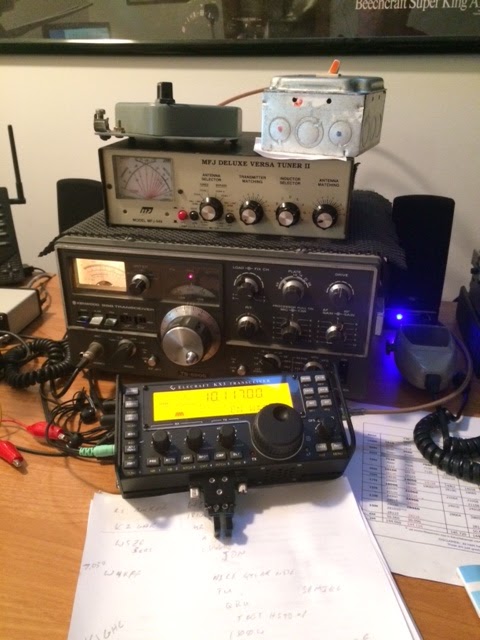
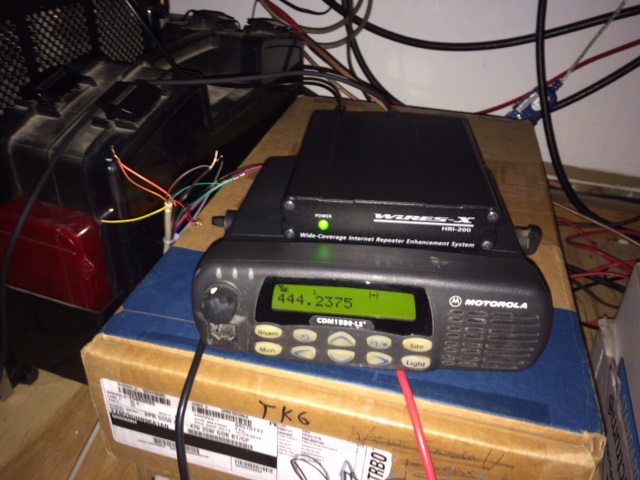
I played with the Yaesu Wires-X software and an HRI-200 box this past week. I hooked it to a Motorola CDM-1550 mobile radio. I really like these Motorola radios – great receive, easy to interface, and just all around bullet-proof. These are the same radios I’ve used for two D-STAR repeaters…hard to beat. Anyway, I’ve got the Wires-X setup on a UHF simplex channel linked into the Central Illinois room. Wires achieves the same as a D-STAR reflector, just done a different way. I’m running Wires in analog mode, and so my analog audio is digitized at my computer and sent on to the server running the room. From there it goes to whoever else is joined into the room. If someone is running Wires in digital mode, the audio comes out digital. If you’re running analog, it comes out analog. I’m not sure if I’m going to hook this into our Heyworth analog machine, or if I’m just going to keep it as a simple simplex node (a hotspot in D-STAR speak).
We’ve got a DR-1X repeater coming to Heyworth to replace the Kenwood TKR-820 the club has up on the elevator. The big benefit for us will be to replace the old Kenwood that sometimes has problems in warm weather, along with getting rid of a crazy long squelch crash. The new repeater arrives on Tuesday, and I’ll let it burn in for a few weeks (or months depending on the weather) before it goes up on top of the elevator.
That’s it for now…have a great year everyone!
Michael Brown, KG9DW, is a regular contributor to AmateurRadio.com and writes from Illinois, USA. Contact him at [email protected].
Winter update from KG9DW
Welcome to 2016! Lots of big projects are going on here at the radio ranch. My youngest is working on an arduino powered weather station that will be located at the FFA field plot along US51 north of Heyworth. We’re going to get the data from the site using the AREDN ham radio mesh software. It’s a real cool project, and my daughter is doing a great job with the programming.
I finally got all of my coax run into the shack in a decent fashion, and I’ve got coax switches in place to be able to toggle between the two hf rigs and the two hf antennas. My next antenna will either be an hf beam, or I’m putting up a sky loop. Or maybe another windom positioned north to south. Who knows!
I played with the Yaesu Wires-X software and an HRI-200 box this past week. I hooked it to a Motorola CDM-1550 mobile radio. I really like these Motorola radios – great receive, easy to interface, and just all around bullet-proof. These are the same radios I’ve used for two D-STAR repeaters…hard to beat. Anyway, I’ve got the Wires-X setup on a UHF simplex channel linked into the Central Illinois room. Wires achieves the same as a D-STAR reflector, just done a different way. I’m running Wires in analog mode, and so my analog audio is digitized at my computer and sent on to the server running the room. From there it goes to whoever else is joined into the room. If someone is running Wires in digital mode, the audio comes out digital. If you’re running analog, it comes out analog. I’m not sure if I’m going to hook this into our Heyworth analog machine, or if I’m just going to keep it as a simple simplex node (a hotspot in D-STAR speak).
We’ve got a DR-1X repeater coming to Heyworth to replace the Kenwood TKR-820 the club has up on the elevator. The big benefit for us will be to replace the old Kenwood that sometimes has problems in warm weather, along with getting rid of a crazy long squelch crash. The new repeater arrives on Tuesday, and I’ll let it burn in for a few weeks (or months depending on the weather) before it goes up on top of the elevator.
That’s it for now…have a great year everyone!
Michael Brown, KG9DW, is a regular contributor to AmateurRadio.com and writes from Illinois, USA. Contact him at [email protected].
 Ham Radio Deluxe |
 W5SWL Electronics |
 Ham Radio Prep |
 KB3IFH QSL Cards  Hip Ham Shirts  HamRadioAuctions HamRadioAuctions Reliance Antennas Reliance Antennas Enigma Shop Enigma Shop |  morseDX  Ni4L Antennas  R&L Electronics R&L Electronics antennas.us antennas.us QRV QRV |
- Matt W1MST, Managing Editor
