 |
 January VHF Contest Plus SOTA
 31 January 2016 | by
A view of Pikes Peak from Mt Herman.
It’s been a while since I’ve done a January VHF contest from a mountaintop so I decided to give it a try from Mount Herman this year. The ARRL recently changed the contest rules to allow the use of the national 2m fm calling frequency for contests. See Coming Soon: 146.52 MHz in ARRL VHF Contests. I wanted to see how this change would play out in practice when doing a combination VHF Contest plus SOTA activation. In previous attempts, I had to vector the SOTA activity to another 2m fm frequency for it to be a legal contact for the contest. The SOTA + Contest operation is attractive because it has all the elements of a fun SOTA hike coupled with the increased activity of a VHF contest. The contest brings out the weak-signal folks with very capable stations, increasing the probability of making some good DX contacts.
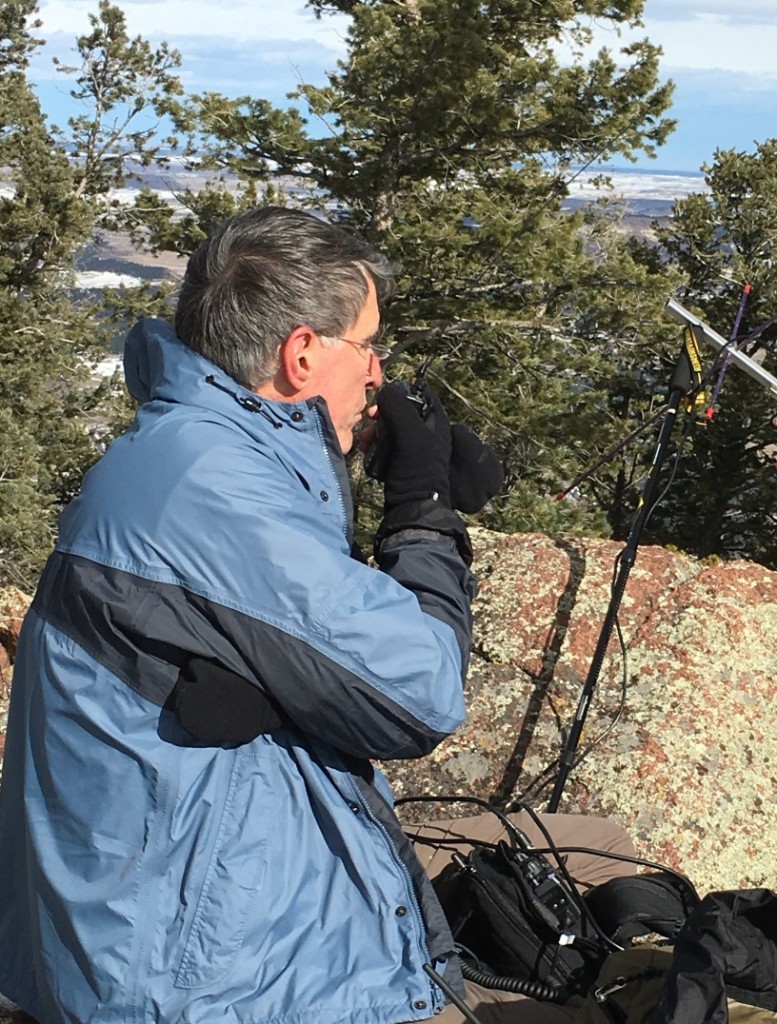
Bob K0NR using an HT to make contacts on 446.0 MHz FM.
Joyce KØJJW and I hit the trail at 10:30 AM local with the goal of being at the summit around noon (1900 UTC) for the start of the ARRL contest. The trail was icy, but manageable with the gripping devices on our boots. The weather was chilly but not bad for January. At the summit, I configured my FT-60 handheld radio for 146.52 MHz using a 2m half-wave vertical. My first call netted a QSO with Tim, KAØMWA in Castle Rock. I worked a few other stations on 2m fm and then set up the 2m ssb station (FT-817 plus Arrow II antenna). On 144.200 MHz SSB, I contacted two Wyoming stations in grid DN71, about 140 miles away. I also gave a call on 446.0 MHz fm and worked W3DHJ and KE0HBW mobile.
Freq    Mode    UTC     Call     Grid
146.52    FM    1900    KA0MWA   DM79
146.52    FM    1902    N0AXK    DM79
146.52    FM    1905    N0LP     DM79
146.52    FM    1905    K0GPA    DM79
146.52    FM    1905    WG0AT    DM79
146.52    FM    1920    N0ISB    DM78
146.52    FM    1923    N0LEA    DN70
144.2    SSB    1932    WY7KY    DN71
144.2    SSB    1935    K0ALE    DM79
144.2    SSB    1938    AB0YM/R  DM79
144.2    SSB    1939    KG0RP    DN70
144.2    SSB    1940    WA7KYM   DN71
144.2    SSB    1942    KC4YLV   DM79
446.0    FM     1948    W3DHJ    DM78
144.2    SSB    1949    WE7L     DM79
144.2    SSB    1951    N0SP     DM79
446.0    FM     2000    KE0HBW   DM79
The wind was strong at the summit and kept blowing everything around, making it difficult to operate the radio and manage the antennas. After an hour of operating, I decided to QRT and head on down. I know I missed a bunch of potential contacts, especially having not gotten on 70 cm and 6m ssb.
Except for the short operating time, the operation played out as expected. I was able to work the SOTA folks and 2m fm enthusiasts on 146.52 MHz. I made it a point to not hog the calling frequency, as there are quite a few folks that monitor there. Switching over to 2m ssb, I worked the contest crowd, typically with more capable vhf stations. My score is a whopping 114 points, in the single-op portable category.
Thanks to everyone that got on the air to play radio that day!
73, Bob KØNR
The post January VHF Contest Plus SOTA appeared first on The KØNR Radio Site.
Bob Witte, KØNR, is a regular contributor to AmateurRadio.com and writes from Colorado, USA. Contact him at [email protected].
Amateur Radio Weekly – Issue 96

ARRL January VHF Contest this weekend
Assuming Mother Nature cooperates, the January VHF Contest offers a welcome reprieve from what might be the long winter doldrums.
ARRL
Teletext time travel
Recovering teletext from VHS recordings.
TRANSDIFFUSION
Net map tool
See location points on a map based on callsign.
K5EHX
VK5ARG FreeDV transmissions
The Amateur Radio Experimenters Group, under its club call sign VK5ARG, are conducting experimental retransmissions in FreeDV.
Southgate
Capital City Hamfest to be webcast
w5kub.com will be live at the Capital City Hamfest this weekend.
W5KUB
Militia radio frequencies
The militia-patriot movement in America has embraced radio communications in a big way.
RadioMaster Reports
Amateur Radio Satellites live position on a map
FG8OJ
AggieSat4 deployed with Amateur telemetry and CW payload
AggieSat4 was launched aboard the Orbital ATK Cygnus OA-4 cargo resupply mission.
AMSAT UK
Open letter to the ‘Ham’ in Thursday night’s pile-up
Is this really the way we all should be behaving in the pile-ups? Does it ever work? It must, because you kept doing it.
N4KC
Will CircuitCity be this generation’s RadioShack?
Watch out, Best Buy. Circuit City is coming back this year, but it may look a little different.
Engadget
Two portable oscilloscopes: shootout
To get an idea of what the signals ought to look like, I measured them both with my current favorite bench scope, a Rigol DS1104Z.
Hack A Day
Video
How to operate FO-29 using a single Yaesu FT-817
How-to video describing and demonstrating the basic concept of working amateur radio satellite FO-29 semi-duplex using a single Yaesu FT-817 2m and 70cm.
YouTube
Vacuum fluorescent tube clock
Manhattan style construction IV-18 Tube Clock based on the MSP430G2553 microcontroller.
YouTube
Amateur Radio Weekly is curated by Cale Mooth K4HCK. Sign up free to receive ham radio's most relevant news, projects, technology and events by e-mail each week at http://www.hamweekly.com.
Carrying On The Practical Way – Follow up
What it does prove though is what I have said before and made well known to PW several years ago, that G3RJV's series is very popular, and well liked in our circles, and will always be the anchor for the Novice to find a good reference point and solid footing into our hobby. Another way of putting George's work, is like a fine Wine that matures with age, or a Matt Monro recording that never fades, that is of course if you appreciate Matt Monro?
I have now printed some of my missing early parts out and bound them up into a folder, allowing me to read it when I have a boring moment:
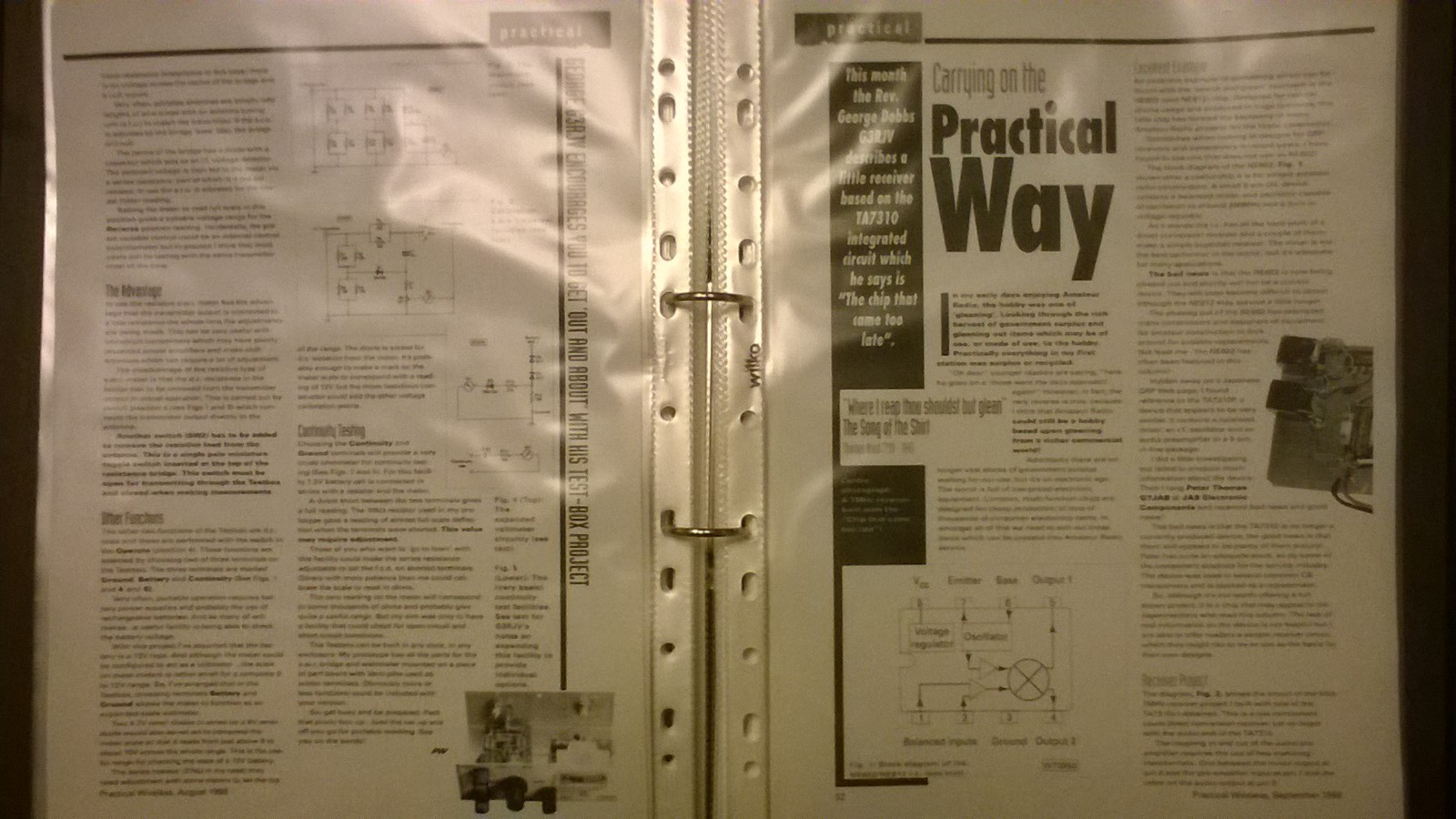
One or Two contacted me to ask if this will be available as a book? I just don't know, but judging by the intense interest of traffic, over to you Practical Wireless!
Steve, G1KQH, is a regular contributor to AmateurRadio.com and writes from England. Contact him at [email protected].
Carrying On The Practical Way- Follow up
What it does prove though is what I have said before and made well known to PW several years ago, that the G3RJV's series is very popular, and well liked in our circles, and will always be the anchor for the Novice to find a good reference point and solid footing into our hobby. Another way of putting George's work, is like a fine Wine that matures with age, or a Matt Monro recording that never fades, that is of course if you appreciate Matt Monro?
I have now printed some of my missing early parts out and bound them up into a folder, allowing me to read it when I have a boring moment:
One or Two contacted me to ask if this will be available as a book? I just don't know, but judging by the intense interest of traffic, over to you Practical Wireless!
Steve, G1KQH, is a regular contributor to AmateurRadio.com and writes from England. Contact him at [email protected].
The Spectrum Monitor — February, 2016
 Stories you’ll find in our February, 2016 issue:
Discovering Vintage Transistor Radios
By Michael Jack
Although today’s chips may house billions of transistors, the average consumer is not familiar with the term ‘transistor’ any longer. And, while all of our devices depend on transistors to this day, the pocket transistor radio was the first ubiquitous device to introduce the world to solid-state technology. Michael Jack takes us on a visual tour of the history of the transistor radio through beautiful examples of the art of transistor radio production. He also tells us how to spot potential finds and restore these solid-state gems.
Monitoring Joint Warrior 15/2 and Russian Air and Sea Activity
By Tony Roper
In October 2015 there was the second of the large-scale exercises that take place every year off the north and west coasts of Scotland under the exercise “Joint Warrior” name, as well as exercises involving ballistic missile defense ships that took part in Joint Warrior and which took place in the danger areas at sea, off the west coast of Scotland. Tony shows how to monitor these twice-yearly exercises as well as how to keep track of Russian air and sea activity involved in their activities in Syria, much of which is found on HF frequencies in SSB and CW.
RTL-SDR Dongle: Your Eye to the Wireless World
By Mario Filippi N2HUN
The RTL-SDR dongle has garnered much popularity over the last several years as an inexpensive and effective broadband receiver for the radio enthusiast. Now Mario shows us how the RTL-SDR can be pressed into serving in other ways: as a rudimentary piece of test equipment to explore those countless wireless devices that power our world and make life convenient. You can use it when restoring vintage radios, doing frequency analysis, antenna analysis and a host of troubleshooting activities you may never have thought of.
ATSC Off-Air Local TV: Doing it Right
By Mike Kohl
Part of his continuing series on cord-cutting, Mike shows us how to use online tools to find out what’s available in your area for Over-the-Air (OTA) TV reception; what antennas work best; when to use and not use antenna amplifiers and how to configure your OTA-TV system without needing to use an antenna rotator. What are the TV reception limits in the area in which you live? You can learn how to get the most out of OTA signals wherever you live without having to spend a fortune on equipment or for cable and satellite-TV subscriptions.
VHF and Above: Aurora Propagation
By Joe Lynch N6CL
If you have spent any time on HF you are somewhat familiar with the effects of aurora, particularly on 10 meters. Those watery sounding signals you may have heard are signals affected by aurora. However, those funny-sounding signals are only one small aspect of auroral propagation. This month Joe shows us how to anticipate aurora propagation by monitoring WWV broadcasts. He also takes a look at the interesting world of High Altitude Ballooning. Joe says, “There is nothing more exhilarating than watching a helium-filled balloon take off and then chasing it using the signals being transmitted from its payload!”
Scanning America
By Dan Veenaman
Fulton County, Georgia, and Riverside, California
Federal Wavelengths
By Chris Parris
The Challenges of Federal Monitoring
Utility Planet
By Hugh Stegman NV6H
New Life for Operation SECURE?
Digital HF: Intercept and Analyze
By Mike Chace-Ortiz AB1TZ/G6DHU
The Russian Navy T600 “Bee” Modem
HF Utility Logs
By Mike Chace-Ortiz and Hugh Stegman
Digitally Speaking
By Cory Sickles WA3UVV
Avoiding Mixed-Mode Mix-Ups
Amateur Radio Insights
By Kirk Kleinschmidt NT0Z
Forgotten Antenna Fundamentals and Other Curious Tidbits—Part 2
Radio 101
By Ken Reitz KS4ZR
The Case for Satellite Radio
Radio Propagation
By Tomas Hood NW7US
The Ionosonde
The World of Shortwave Listening
By Andrew Yoder
HF Pirates Roam 41 and 90-meter Bands
The Shortwave Listener
By Fred Waterer
RCI’s Broadcast Legacy and You Too can be a Shortwave Radio Broadcaster!
Amateur Radio Astronomy
By Stan Nelson KB5VL
WWVB and other Fun Stuff
The Longwave Zone
By Kevin O’Hern Carey WB2QMY
Up and Running with SDR!
Adventures in Radio Restoration
By Rich Post KB8TAD
The Saga of the Philips BX490A: Beauty and the Geek
Antenna Connections
By Dan Farber AC0LW
Single File, Please: Understanding SWR
Radio Horizons
The Worldwide Listening Guide 7th Edition by John Figliozzi
The Spectrum Monitor is available in PDF format which can be read on any desktop, laptop, iPad®, Kindle® Fire, or other device capable of opening a PDF file. Annual subscription is $24. Individual monthly issues are available for $3 each.
Ken Reitz, KS4ZR, is publisher and managing editor of The Spectrum Monitor. Contact him at [email protected].
LHS Episode #161: Someone Spelt the Soup
 This is a very exciting episode of Linux in the Ham Shack for us. It's so special, that it's a double episode! That's right, it's like getting two episodes in one. Your hosts (one of them new to the program) discuss winter field day, WxBot, the origin of Debian Linux, SSTV using Linux, OpenSSH security concerns, solving the Rubik's Cube with Linux and a whole lot more. Hope you enjoy, and please welcome our new host!
73 de The LHS Crew
Russ Woodman, K5TUX, co-hosts the Linux in the Ham Shack podcast which is available for download in both MP3 and OGG audio format. Contact him at [email protected].
Web Based Repeater Power Controller
This week we installed a new Yaesu Fusion DR-1X repeater at a very nice site in Central Illinois. One of the things I’m a big fan of is controlling supply power via the web. This ability to remotely control the repeater is great – even if the controller goes belly up, you can turn the entire system off or just remotely power cycle it. I’ve used the Digital Loggers data center type power strips before, but they are a bit expensive – over $100. So for this site, I used the Iot Relay – Enclosed High-power Power Relay for Arduino, Raspberry Pi, PIC or Wifi, Relay Shield
Since I had an extra Raspberry Pi on the shelf, this quick hack made for a fun project. I’m also going to add a temperature and humidity sensor so that we can monitor the environmental conditions in the repeater building. Here’s a short 3 minute video I made explaining the code and the connections. Have fun! Put the Amateur back in Amateur Radio!
Michael Brown, KG9DW, is a regular contributor to AmateurRadio.com and writes from Illinois, USA. Contact him at [email protected].
 Ham Radio Deluxe |
 W5SWL Electronics |
 Ham Radio Prep |
 KB3IFH QSL Cards  Hip Ham Shirts  HamRadioAuctions HamRadioAuctions Reliance Antennas Reliance Antennas Enigma Shop Enigma Shop |  morseDX  Ni4L Antennas  R&L Electronics R&L Electronics antennas.us antennas.us QRV QRV |
- Matt W1MST, Managing Editor
