 |
 The FCC says you have a new callsign. Now what?
 28 February 2016 | by
 Once I knew that I had a new callsign, I sat down a wrote down a list of what I needed to do…
(1) QRZ.com website. When my callsign changed a few years back from AD7MI to NI0L, I jumped on the air to “test it out”. On 20m, I was having a PSK31 QSO when the distant party thought I was a pirate station because on QRZ.com my new callsign did not reflect the name and QTH I was using. A pirate! I explained that it was a new callsign but I could tell that the other guy was not buying it.
I thought I would need to go on to QRZ.com and register as a new user. I made a posting in the QRZ.com forum category dedicated to callsign problems. The end result: just wait… the change will take place automatically in a few days.
And that is the case. If you are a US ham and change your callsign, just wait. Within two or three days the callsign change will be reflected on QRZ.com. If you get on the air before QRZ.com is updated, be prepared for people to think you are a pirate.

(2) Log of The World. Easy to do. Just submit for a new certificate under the new callsign. ARRL usually responds within one working day.
(3) EchoIRLP node. This ended up being much easier than I thought it would be.
a. To change your callsign in the IRLP database, go to this webpage using a computer connected to the same router as the IRLP node.
b. Go into your node and edit irlp/custom/environment file to change the old callsign to the new callsign. Restart the node and verify the changes have taken effect.
c. For the EchoLink side:
– Validate your new callsign.
– Check for validation of the new EchoLink call sign / node number on EchoLink using the EchoLink PC client software. Remember, EchoIRLP only allows link (-L) or repeater (-R) nodes.
– Note: you can only register the new callsign once the EchoLink folks of pulled the latest and greatest database update from the FCC. This may take a day or two. Once that is done, you can validate your new callsign. Your new callsign will be assigned a new EchoLink node number. If you want to use your previous node number, EchoLink allows you to swap node numbers between your old callsign and your new callsign.
– Once you are validated and have swapped node numbers edit the files and settings listed below:
/home/EchoIRLP/ custom/tbd. conf
ConferenceCall =
ConferencePass =
/home/EchoIRLP/ custom/echo_ environment
export ECHO_MYCALL=
/home/EchoIRLP/ custom/userdata. txt
Restart IRLP from root login with script /home/irlp/custom/ rc.irlp, or reboot the node.
IRLP node 4433 and EchoLink node 536398 are up and operational.
(4) APRS – change the callsign in my vehicle, HTs, and UI-View32. Pretty straight forward. The home weather station info can now be found here.
(5) Change the blog website. I have been keeping an amateur radio blog for about 10 years now. Web hosting companies make it pretty easy to get a domain for your website and then setup web hosting. I like using WordPress to setup and maintain the actual blog. Fairly straight forward but flexible to do just about anything you would want for a amateur radio blog. The new website is up and running.
(6) Callsign license plate. Kansas makes the pretty simple. I went down to my county office on Friday after work. The application process was smooth and the wait should be about 4-6 weeks.
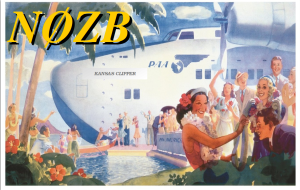
(7) New QSL card. I am thinking of going with this:
Scott Hedberg, NØZB, is a regular contributor to AmateurRadio.com and writes from Kansas, USA. Contact him at [email protected].
NI0L…. Happy Trails!
I have a new, bright, and shiny callsign!
When I made the decision back in 2013 to stay in Kansas after retiring from the military, I decided I would try to get a callsign for zero-land (or ten-land, if you like). It was time to leave my 7-land callsign and fully embrace being a citizen of the sunflower state. NI0L was available and I applied for it without much thought. After having the callsign for a while, I noticed many hams were confused with the 2×1 call. The most common mistake was flip flopping the zero and the “i”. Another common mistake was interpreting the “i” as one and then the zero would become an “o” (N1OL). All very confusing.
The hunt for a new callsign was on. I determined that a new callsign would still be from zero-land, thus greatly reducing the pool of available calls. In an effort to avoid callsign confusion, I further resolved that the call would be a 1×2 call. The good news was that the vanity callsign fee was no more. The bad news was that everybody and their brother was applying for vanity calls. For the last few months I kept at it – watching which calls became available and then submitting applications. Waiting. The odds where never in my favor. Often there would be 10 or twelve applying, all in competition.
Perseverance finally paid off. Last week the FCC said that I was now the proud holder of N0ZB. It is a 1×2 call, that should alleviate some confusion. The “zero” and the “zulu” may prove to be a bit of a tongue twister, but I think it will be far less of an issue and having the “zero” and an “i” next to one another.
Scott Hedberg, NØZB, is a regular contributor to AmateurRadio.com and writes from Kansas, USA. Contact him at [email protected].
The Grand Illusion
Five by Nine... QRP... How can it be?
 |
| The real gain doesn't come from transmitter watts |
I gave him reports as he switched back and forth from running barefoot ~75w to his amp ~500w. With his amp on he was an S9, running barefoot he was S8. So the amp gave him one additional S unit. In terms of hearing him I would have been hard pressed to tell much difference simply by volume. He was perfectly copyable without noise with the amp off.
We also did some tests with my station at reduced power (as if...) At 10w-12w output I received a S9 to S9+10. Reducing output to 5 watts netted me a S8 report and when I reduced to 1 watt (one watt) he was still able to comfortably copy me and I received an S5. So with my station at 1 watt and his running 500 watts we could still converse via SSB. Ladies and Gentlemen you don't need as much output wattage as you think you do.
He was running through a newly constructed homebrewed vertical while I was using my 80m OCF Dipole. We didn't discuss what sort of radial system he had installed, but the difference in antennas was likely the deciding difference in our stations. We were about 500 miles apart and his vertical probably had more low-takeoff gain than my dipole, or possibly more ground loss so I probably had better high angle gain on him for the short 500 mile skip. I think the take-away from this exercise is that the antenna is generally the key rather than transmitter power. If I can get 6 dB of gain from my antenna I have in essence quadrupled my effective radiated power. Quadrupled? Yes, Quadrupled effective output power.
Power and S-Units
- A Power Ratio: dB = 10 Log P2/P1
- A Voltage Ratio: dB = 20 Log V2/V1
You increase 3dB each time you DOUBLE your power
You increase 3dB each time you DOUBLE your power. So to gain one S-Unit you must quadruple your power.
Antennas offer the cheapest increase in dB
Note the statement above "using the same antenna system". That's the key then isn't it? It's easier to get 6 dB of gain from an antenna than from wattage. A 40m doublet can offer significant directional gain especially when operated on higher bands. Now unless it's rotatable you will be at the mercy of the directionality of its lobes but if you have trees or tall structures you can very cheaply string up a few dipoles oriented in different directions and for far less money that a 500 watt amp (6 dB). If you can only have one wire antenna you may miss out on some DX in the antenna's nulls but you will have some stellar gain in the direction of the lobes. Of course rotatable yagis and beams are the best but now we are talking about real money again. I'm talking bang for the penny. You don't have to buy a wire antenna. Some Dacron rope or weed-eater line and some surplus insulated wire is all you need. You can even make your own feedline cheaply from electric fence wire and insulators.We have a great hobby, but there are so many aspects of it that sound like common sense when they really are not... like increase your power.
Increasing power gains you very little compared to a better antenna systems. Put that in your 811A amplifier tube and smoke it !
That's all for now.
So lower your power and raise your expectations (or your antennas)
72/73 (Note: 72 is a common substitute for 73 among QRPers... as in "not enough power for 73")
Richard, N4PBQ
Richard Carpenter, AA4OO, is a regular contributor to AmateurRadio.com and writes from North Carolina, USA. Contact him at [email protected].
NI0L…. Happy Trails!
I have a new, bright, and shiny callsign!
When I made the decision back in 2013 to stay in Kansas after retiring from the military, I decided I would try to get a callsign for zero-land (or ten-land, if you like). It was time to leave my 7-land callsign and fully embrace being a citizen of the sunflower state. NI0L was available and I applied for it without much thought. After having the callsign for a while, I noticed many hams were confused with the 2×1 call. The most common mistake was flip flopping the zero and the “i”. Another common mistake was interpreting the “i” as one and then the zero would become an “o” (N1OL). All very confusing.
The hunt for a new callsign was on. I determined that a new callsign would still be from zero-land, thus greatly reducing the pool of available calls. In an effort to avoid callsign confusion, I further resolved that the call would be a 1×2 call. The good news was that the vanity callsign fee was no more. The bad news was that everybody and their brother was applying for vanity calls. For the last few months I kept at it – watching which calls became available and then submitting applications. Waiting. The odds where never in my favor. Often there would be 10 or twelve applying, all in competition.
Perseverance finally paid off. Last week the FCC said that I was now the proud holder of N0ZB. It is a 1×2 call, that should alleviate some confusion. The “zero” and the “zulu” may prove to be a bit of a tongue twister, but I think it will be far less of an issue and having the “zero” and an “i” next to one another.
Scott Hedberg, NØZB, is a regular contributor to AmateurRadio.com and writes from Kansas, USA. Contact him at [email protected].
MFJ 1788 vs Weather
7. I then put the plastic cover back on and again check the SWR on all bands, I wanted to make sure nothing changed……. nothing did change and all was still good.
Below is one section of the fins that have been adjusted and are back to normal position.
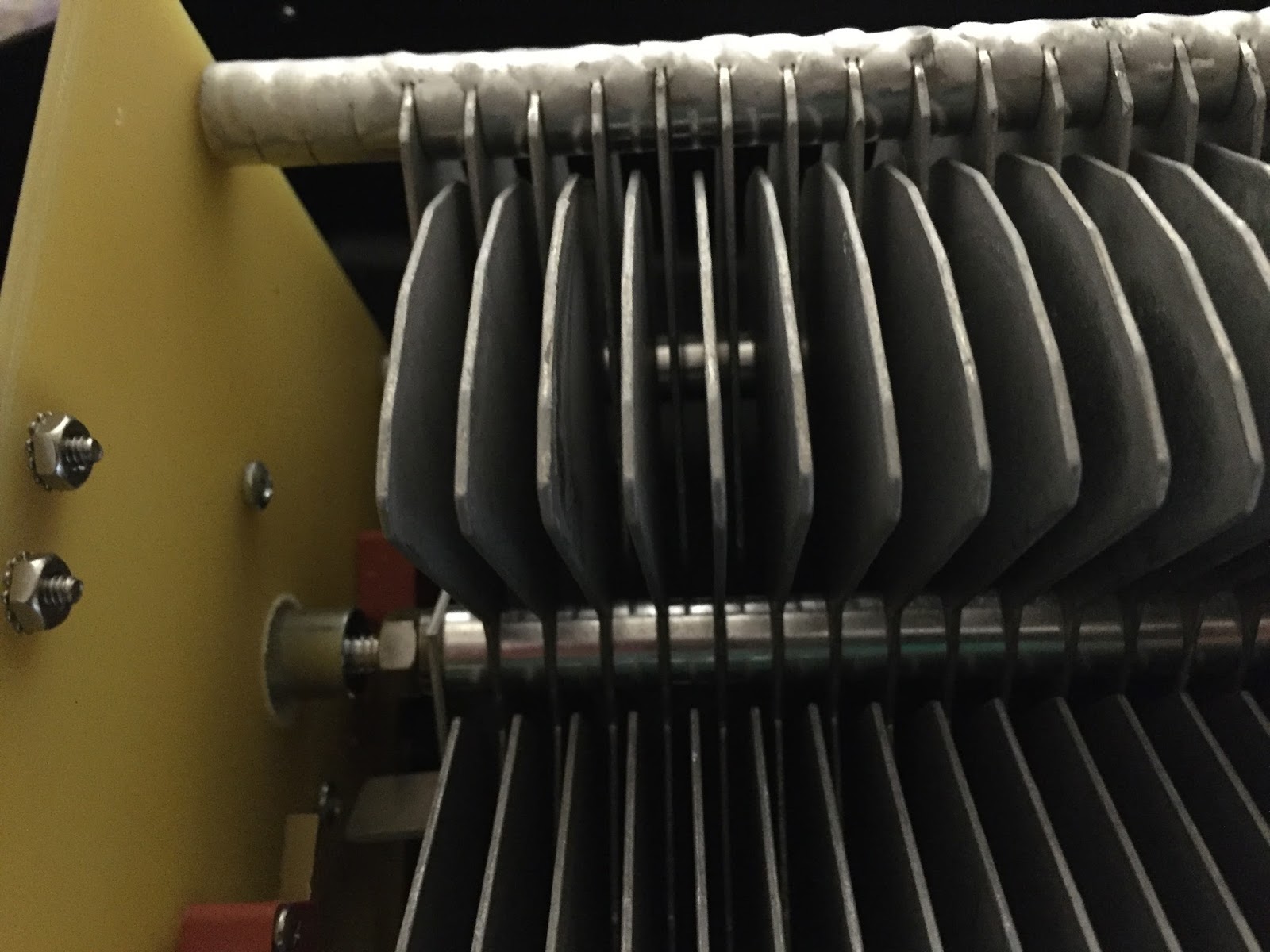
Mike Weir, VE9KK, is a regular contributor to AmateurRadio.com and writes from New Brunswick, Canada. Contact him at [email protected].
RSGB grants permission to use images of book covers.

At the time of writing I didn't have permission from the RSGB to include images from their books.. However I have recently been in touch with the RSGB and have been granted permission to include them on my blog, subject to asking at the time I require.
Thank you
RSGB Commercial & Membership Manager
That particular blog has now been updated with the cover image, see link above.
Steve, G1KQH, is a regular contributor to AmateurRadio.com and writes from England. Contact him at [email protected].
RSGB grants permission to use images of book covers.
At the time of writing I didn't have permission from the RSGB to include images from their books.. However I have recently been in touch with the RSGB and have been granted permission to include them on my blog, subject to asking at the time I require.
Thank you
RSGB Commercial & Membership Manager
That particular blog has now been updated with the cover image, see link above.
Steve, G1KQH, is a regular contributor to AmateurRadio.com and writes from England. Contact him at [email protected].
 Ham Radio Deluxe |
 W5SWL Electronics |
 Ham Radio Prep |
 KB3IFH QSL Cards  Hip Ham Shirts  HamRadioAuctions HamRadioAuctions Reliance Antennas Reliance Antennas Enigma Shop Enigma Shop |  morseDX  Ni4L Antennas  R&L Electronics R&L Electronics antennas.us antennas.us QRV QRV |
- Matt W1MST, Managing Editor
