 |
 Carrington Probabilities
 16 March 2016 | by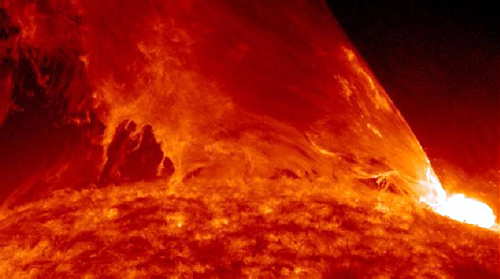
K7RA's 'Solar Update' in this week's ARRL News, mentions Jeff Foust's recent article in 'The Space Review', reminding us again of the dangers posed by a modern-day 'Carrington Event', also known as the 'Solar Storm of 1859'. A large solar flare in late August, hurled a monster-sized CME towards earth, making the 93 million mile journey in just 17.6 hours compared with the more normal rate of several days.
Huge auroras soon lit up the sky as far as central Mexico, Hawaii and the Caribbean. The aurora was so bright, it was reported that Rocky Mountain goldminers awoke in the middle of the night, and thinking morning had arrived, started to prepare breakfast. Telegraph lines and equipment burst into flame while some circuits continued to be usable with power supplies completely disconnected. The 1859 event still remains the most geoeffective solar storm since records have been kept.
Such an event today, of course, would wreak much more havoc ... probably having devastating consequences for decades and causing trillions of dollars of damage.
From Foust's article:
Was that, though, just a fluke event? .... Pete Riley, senior research scientist at Predictive Science Inc., offered a probabilistic forecast for the likelihood of another Carrington-like event, based on that storm’s estimated strength and measurements of the actual strength of solar storms over the last few decades. “If you the (sic) time between events, you can calculate the probability of the next event occurring within some unit of time,” he explained.
His estimate of the probability of another Carrington event is surprisingly high: about a 10 percent chance of such an event occurring over the next decade. “Ten percent is very, very high,” said William Murtaugh, assistant director for space weather at the White House’s Office of Science and Technology Policy (OSTP) ... “A one-percent probability over the course of the next one hundred years of a storm with an impact of that magnitude is considered very, very high and will motivate action.”
Interestingly, for this prediction, the actual strength of the solar storm of 1859 can only be estimated. If it was actually twice as strong as thought, then the probabilities drop from a (decade) 10% probability to just a 1% chance.
The U.S. government has recently set up a NASA multi-million budget funding proposal to study the likely effects of future large scale impacts and possible “response and resiliency capabilities” but it's not known if these will carry over to any new administration.
“Fortunately in space weather there’s no real politics,” Murtaugh said. “Both sides of House, both sides of the Senate, Republicans and Democrats, are both keen to work together to do something about this issue.”
The article has brought some interesting 'food for thought' comments, among them:
It's a little funny about how much energy is being spent advocating human spaceflight for colonization and settlement as a means to save the species, but so little is being devoted to specific threats to the species, and to individuals in particular. I could get killed in an asteroidal impact or a severe geomagnetic storm, but sending a shipload of people to Mars sure isn't going to protect me.
I am a member of Infragard, which is dedicated to supporting efforts to protect us from risks to our electrical grid and other critical infrastructure. A novel "One Second After" by William R. Forstchen accurately illustrates the effects of a similar intentional attack on our grid and how it creates a cascading collapse of our society. Gas stations cannot pump gas, food rots in the stores, more food cannot be delivered to all the needed locations, and the people who know how to fix things cannot reach where they are needed and also starve to death. The result of a severe Carrington event with no effective preparation or protection for the giant transformers could thus cause most of our population to starve in a few months. This risk is about 1% to 0.5 % per year and is like having everyone playing Russian roulette once a year with 200 pistols where just one is loaded.
A modern day 'Carrington repeat' does indeed give pause for thought but perhaps the generally predicted upcoming 'grand solar minimum' will buy scientists some extra time to come up with solutions for what will eventually occur ... and, one more thing's for certain ... it'll be a heck of an aurora!
Steve McDonald, VE7SL, is a regular contributor to AmateurRadio.com and writes from British Columbia, Canada. Contact him at [email protected].
Weather forecast is looking good
The plan is to leave the house somewhere around 11:00 AM (1500 UTC) and be up there and on the air by around 12:00 Noon (1600 UTC). I plan on working 40, 20 and 17 Meters - CW around the QRP watering holes. I'll be packing some water and snacks and hope to stay for three or four hours. I am going to see if I can get the PAR END FEDZ 40/20/10 up in a tree in the parking lot. If not, I'll just rely on the Buddistick for 20 and 17 Meters and a Hamstick for 40 Meters.
Last Saturday, I went to the Cherryville hamfest out in Flemington, NJ which is run by the W2CRA, Cherryville Repeater Association. This was the very first hamfest that I ever went to as a newbie Ham back in 1979, and it's always held a special place for me. Unfortunately, over the years (and especially since the dawn of eBay) the Cherryville hamfest seemed to be on the down slope. Like a lot of hamfests, it suffered from poor attendance, lack of vendors, etc was plaguing it - and seemed to be spiraling towards its death knell.
Happily, between last year and this year, that trend seems to be reversed. Attendance is still nowhere near where it used to be, but it's growing. The number of vendors is still down (but again, growing), and for the most part the really bad junk is gone - and by junk I mean non-ham related garbage. I mean really, who wants to buy a roto-tiller at a hamfest? Sure there's still lots of non-Ham stuff to be seen, but it also seems there are more and more treasures to be found.
I purchased some new SO-239 chassis connectors as well as two old butterfly type variable capacitors that I got for five bucks. The capacitors have long stems on them, so they should be useful in my magnetic loop antenna project. I need to clean them up with some contact cleaner, but some initial testing seems to indicate that they are in the 200 pF range. KJI Electronics was there, and I purchased a Diamond antenna for my VHF/UHF handheld. What a difference when you buy the real brand and not a cheap knock-off!
Before I forget ........ I have a friend who has a "hardly used, very good condition" SGC-2020 QRP radio that he wants to sell. I am not privy to the price. But if you're interested, send an e-mail to [email protected] and I will forward it on to him. He's not looking for eBay type money, but he's not interested in getting taken, either.
72 de Larry W2LJ
QRP - When you care to send the very least!
Larry Makoski, W2LJ, is a regular contributor to AmateurRadio.com and writes from New Jersey, USA. Contact him at [email protected].
Weather forecast is looking good
The plan is to leave the house somewhere around 11:00 AM (1500 UTC) and be up there and on the air by around 12:00 Noon (1600 UTC). I plan on working 40, 20 and 17 Meters - CW around the QRP watering holes. I'll be packing some water and snacks and hope to stay for three or four hours. I am going to see if I can get the PAR END FEDZ 40/20/10 up in a tree in the parking lot. If not, I'll just rely on the Buddistick for 20 and 17 Meters and a Hamstick for 40 Meters.
Last Saturday, I went to the Cherryville hamfest out in Flemington, NJ which is run by the W2CRA, Cherryville Repeater Association. This was the very first hamfest that I ever went to as a newbie Ham back in 1979, and it's always held a special place for me. Unfortunately, over the years (and especially since the dawn of eBay) the Cherryville hamfest seemed to be on the down slope. Like a lot of hamfests, it suffered from poor attendance, lack of vendors, etc was plaguing it - and seemed to be spiraling towards its death knell.
Happily, between last year and this year, that trend seems to be reversed. Attendance is still nowhere near where it used to be, but it's growing. The number of vendors is still down (but again, growing), and for the most part the really bad junk is gone - and by junk I mean non-ham related garbage. I mean really, who wants to buy a roto-tiller at a hamfest? Sure there's still lots of non-Ham stuff to be seen, but it also seems there are more and more treasures to be found.
I purchased some new SO-239 chassis connectors as well as two old butterfly type variable capacitors that I got for five bucks. The capacitors have long stems on them, so they should be useful in my magnetic loop antenna project. I need to clean them up with some contact cleaner, but some initial testing seems to indicate that they are in the 200 pF range. KJI Electronics was there, and I purchased a Diamond antenna for my VHF/UHF handheld. What a difference when you buy the real brand and not a cheap knock-off!
Before I forget ........ I have a friend who has a "hardly used, very good condition" SGC-2020 QRP radio that he wants to sell. I am not privy to the price. But if you're interested, send an e-mail to [email protected] and I will forward it on to him. He's not looking for eBay type money, but he's not interested in getting taken, either.
72 de Larry W2LJ
QRP - When you care to send the very least!
Larry Makoski, W2LJ, is a regular contributor to AmateurRadio.com and writes from New Jersey, USA. Contact him at [email protected].
Portable Ops 4/45: A SKCC Kind of Day!

I have been a member of SKCC for some time now, but never really done anything with it except hand out my number if asked- I’m 8033 if you’re interested.
Burke Jones, NØHYD, is a regular contributor to AmateurRadio.com and writes from Kansas, USA. Contact him at [email protected].
Portable Ops 4/45: A SKCC Kind of Day!
I have been a member of SKCC for some time now, but never really done anything with it except hand out my number if asked- I’m 8033 if you’re interested.
Burke Jones, NØHYD, is a regular contributor to AmateurRadio.com and writes from Kansas, USA. Contact him at [email protected].
50 Years Ago, These Were the Ads in 73
 They say the days are long, but the decades are short. It’s hard to appreciate how far we’ve come in fifty years — both in terms of technology and prices!
Here are a few of the ads from the March, 1966 issue of 73 Magazine. Enjoy the walk down memory lane!

Matt Thomas, W1MST, is the managing editor of AmateurRadio.com. Contact him at [email protected].
Weekly Propagation Summary – 2016 Mar 14 16:10 UTC
Here is this week’s space weather and geophysical report, issued 2016 Mar 14 0430 UTC.
Highlights of Solar and Geomagnetic Activity 07 – 13 March 2016
Solar activity reached low levels on 08-09 and 12 March. The largest event of the period was a C3 flare from Region 2519 (N05, L=007, class/area=Cso/80 on 13 Mar) at 09/1250 UTC. Very low levels of solar activity were observed throughout the remainder of the period. No coronal mass ejections (CMEs) observed in coronagraph imagery were determined to be Earth-directed.
No proton events were observed at geosynchronous orbit.
The greater than 2 MeV electron flux at geosynchronous orbit was at high levels on 07-11 Mar and decreased to moderate levels on 12-13 Mar.
Geomagnetic field activity reached G1 (Minor) geomagnetic storm levels early on 07 Mar due to the influence of a positive polarity coronal hole high speed stream (CH HSS). Activity levels subsided to quiet to unsettled levels on 08 Mar and quiet levels by 09 Mar. Quiet to unsettled conditions were observed on 10 Mar and continued into early on 11 Mar when the co-rotating interaction region (CIR) ahead of a positive polarity CH HSS caused G2 (Moderate) geomagnetic storm conditions. As the CH HSS progressed, conditions tapered down to active levels early on 12 Mar and into quiet to unsettled for the remainder of the day. Activity continued to subside with only quiet conditions observed on 13 Mar.
Forecast of Solar and Geomagnetic Activity 14 March – 09 April 2016
Solar activity is expected to be at very low levels with a chance for C-class flares throughout the forecast period.
No proton events are expected at geosynchronous orbit.
The greater than 2 MeV electron flux at geosynchronous orbit is expected to be at high levels on 16-21 Mar and 04-06 Apr. Moderate levels are expected on 22 Mar-03 Apr and 07-09 Apr. Normal levels are expected on 14-15 Mar.
Geomagnetic field activity is expected to reach G1 (Minor) storm levels on 15-16 Mar and 02-03 Apr due to the influence of a negative polarity CH HSS. Active conditions are expected on 17 Mar and 08 Apr. Unsettled conditions are expected 18 Mar and 01, 04, 07, 08 Apr. Quiet conditions are expected throughout the remainder of the outlook period under a nominal solar wind regime.
Don’t forget to visit our live space weather and radio propagation web site, at: http://SunSpotWatch.com/
Live Aurora mapping is at http://aurora.sunspotwatch.com/
If you are on Twitter, please follow these two users: + https://Twitter.com/NW7US + https://Twitter.com/hfradiospacewx
Get the space weather and radio propagation self-study course, today. Visit http://nw7us.us/swc for the latest sale and for more information!
Check out the stunning view of our Sun in action, as seen during the last five years with the Solar Dynamics Observatory (SDO): https://www.youtube.com/watch?v=zXN-MdoGM9g
We’re on Facebook: http://NW7US.us/swhfr
Visit, subscribe: NW7US Radio Communications and Propagation YouTube Channel
 Ham Radio Deluxe |
 W5SWL Electronics |
 Ham Radio Prep |
 KB3IFH QSL Cards  Hip Ham Shirts  HamRadioAuctions HamRadioAuctions Reliance Antennas Reliance Antennas Enigma Shop Enigma Shop |  morseDX  Ni4L Antennas  R&L Electronics R&L Electronics antennas.us antennas.us QRV QRV |
- Matt W1MST, Managing Editor
