 |
 Blue is a nice color but not on my monitor!
 12 April 2016 | by
 |
| Crammed cards |
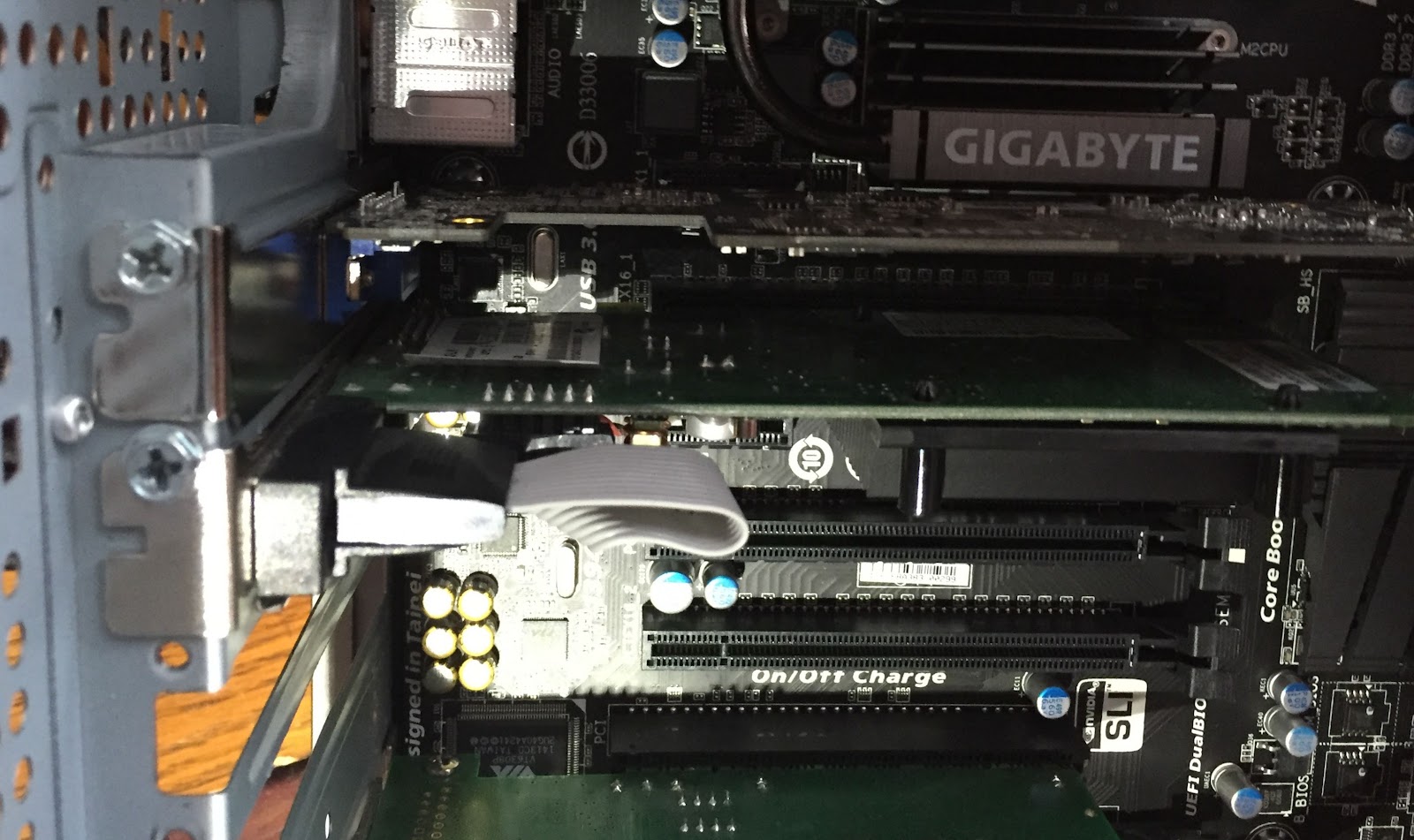 |
| Video card moved to bottom |
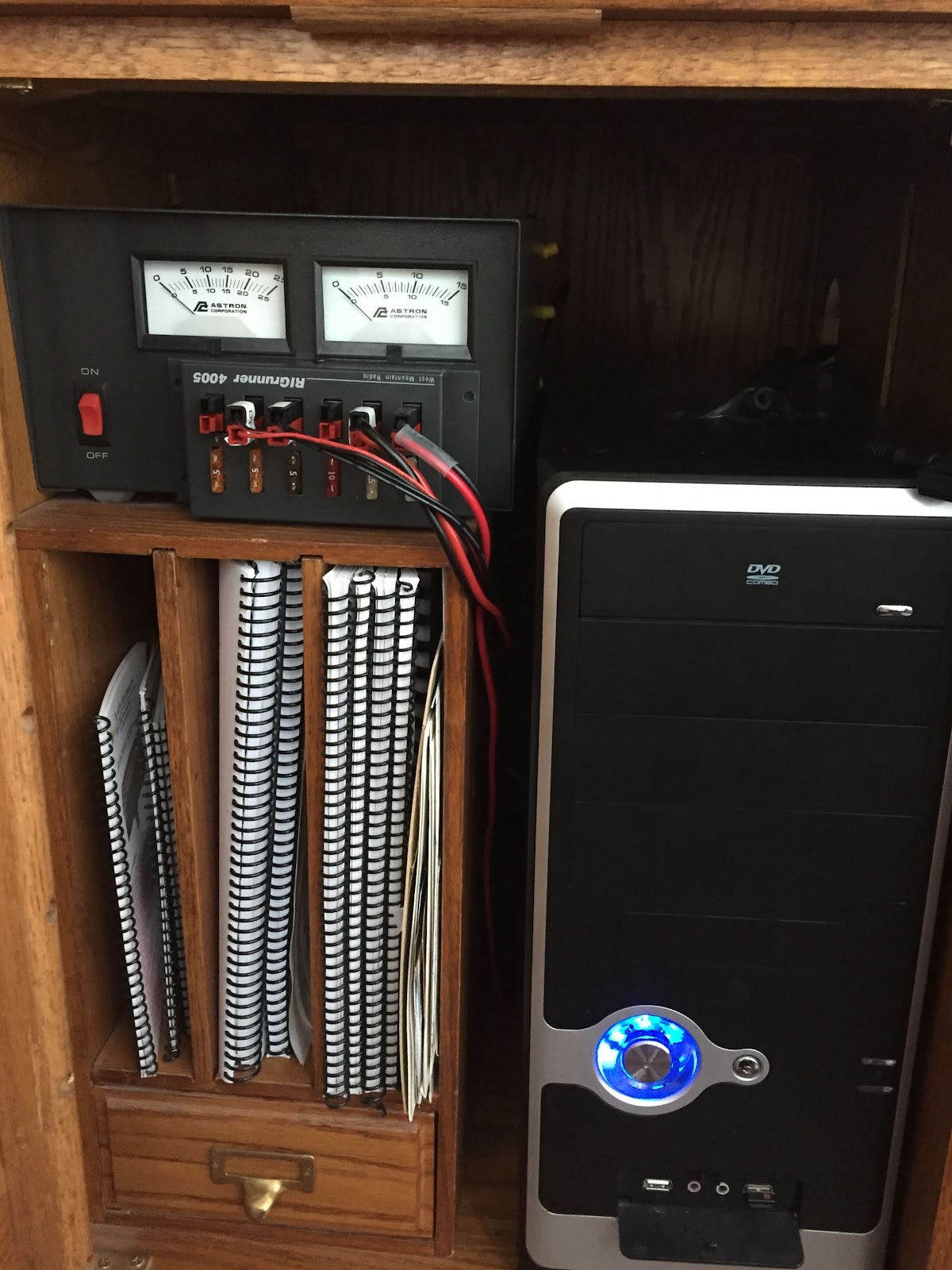 |
| The cramped quarters |
Mike Weir, VE9KK, is a regular contributor to AmateurRadio.com and writes from New Brunswick, Canada. Contact him at [email protected].
Seven To Go

Confirmed DXCC entity #332 arrived in the mail last week. With a total of 339 active DXCC entities, this leaves just seven to go.
Although I had worked Tunisia a couple of years ago on 15m, I was never able to get the contact confirmed. In spite of sending an SAE and green stamps for postage, 3V8HQ's several promises of his card 'soon to be mailed', proved to be hollow.
The contact with 3V8HQ was my first and only one with Tunisia, since being licenced in 1963. The low level of ham radio activity from 3V8 combined with the challenges of VE7 to Meditteranean Africa propagation, made it a difficult one to work.
 |
| courtesy: https://www.google.ca/maps |
My present confirmed list sitting at 332, combined with my 10 confirmed 'deleted' entities, brings the overall confirmed total to 342. The seven remaining entities will be very difficult, if not impossible, unless I live to be 150. They are:
FT/G, TO - Glorioso
HK0 - Malpelo Island
KP5 - Desecheo Island
P5 - N. Korea
SV/A - Mt. Athos
Z8 - S. Sudan
ZL9 - Auckland / Campbell Islands
A couple of these have been active in past recent years ... for some, I was asleep at the switch and for others, I was away travelling at the time. With solar conditions heading downhill quickly, and possibly staying there for many many years, the prospects of working these last seven is looking pretty bleak.
On the other hand, my favorite winter band (160m) should continue to improve. Last week also brought a new DXCC QSL for me on that band, A35T in Tonga, bringing my confirmed total on that band to 157.
Getting new entities from here on out will be increasingly challenging ... I guess I need to remember, that if it was easy, it just wouldn't be any fun!

Steve McDonald, VE7SL, is a regular contributor to AmateurRadio.com and writes from British Columbia, Canada. Contact him at [email protected].
Weekly Propagation Summary – 2016 Apr 11 16:10 UTC
Here is this week’s space weather and geophysical report, issued 2016 Apr 11 0439 UTC.
Highlights of Solar and Geomagnetic Activity 04 – 10 April 2016
Solar activity was at very low levels on 04-05 April with low levels observed from 06-10 April as Region 2529 (N09, L=341, class/area, Eki/820 on 10 April) began its transit across the solar disk. The region emerged as a large bipolar group that produced 15 low level C-class flares during the period. The largest flare was a long-duration C2 at 09/1342 UTC, however it also produced another long-duration C1 flare at 10/0934 UTC. Other activity included a 10 degree filament eruption, centered near N18E29, that erupted beginning at approximately 10/1000 UTC. An associated CME was observed off the NE limb at 10/1100 UTC. The CME is currently being analyzed, however it is likely that little to no impacts will occur given its location and direction.
No proton events were observed at geosynchronous orbit.
The greater than 2 MeV electron flux at geosynchronous orbit was at high levels from 04-07 April with normal levels observed from 08-10 April. The highest flux value observed for the period was 3,924 pfu at 05/1605 UTC.
Geomagnetic field activity ranged from quiet to (G1) minor storm levels. Solar wind parameters were at mostly nominal levels through the period until a solar sector boundary crossing (SSBC) occurred around 07/1737 UTC. During this time, total field increased to a maximum of 13 nT while the Bz component deflected southward for approximately 8 hours reaching a maximum of -13 nT. The geomagnetic field responded with G1-minor storm levels late on 07 April through early on 08 April.
Forecast of Solar and Geomagnetic Activity 11 April – 07 May 2016
Solar activity is expected to be at low levels with a slight chance for M-class (R1-R2, Minor-Moderate) flares until Region 2529 rotates off the NW limb on 21 April. Very low levels are expected from 22 April through 03 May. Low levels are expected once again from 04-07 May with the return of Region 2529.
No proton events are expected at geosynchronous orbit.
The greater than 2 MeV electron flux at geosynchronous orbit is expected to be at high levels on 15-18, 24-28, and 30 April – 02 May due to coronal hole high speed stream (CH HSS) influence. Normal to moderate levels are expected for the remainder of the outlook period.
Geomagnetic field activity is expected to be at unsettled to active levels on 12-15, 23-26, and 29-30 April with G1-minor storm levels likely on 13-14 and 29 April due to recurrent CH HSS activity. Unsettled to active levels are also likely on 04 May due to activity associated with an SSBC.
Don’t forget to visit our live space weather and radio propagation web site, at: http://SunSpotWatch.com/
Live Aurora mapping is at http://aurora.sunspotwatch.com/
If you are on Twitter, please follow these two users: + https://Twitter.com/NW7US + https://Twitter.com/hfradiospacewx
Get the space weather and radio propagation self-study course, today. Visit http://nw7us.us/swc for the latest sale and for more information!
Check out the stunning view of our Sun in action, as seen during the last five years with the Solar Dynamics Observatory (SDO): https://www.youtube.com/watch?v=zXN-MdoGM9g
We’re on Facebook: http://NW7US.us/swhfr
Visit, subscribe: NW7US Radio Communications and Propagation YouTube Channel
April 2016 SKCC WES
This weekend was the monthly SKCC Weekend Sprintathon (WES), and I was really looking forward to working this. I had hear there was lots of activity, and a great way to pick up additional SKCC member QSO’s as I work towards my Centurion (100 contacts).
 |
| Map of contacts – most were on 40 meters (PR was on 15 meters, only 15 meter contact) – map by http://www.qsomap.org/ |
So I was up and at it at 7:00 AM local Saturday morning (12:00 UTC). Long story short, the bands really stunk here in Kansas the entire weekend. All total I probably was able to work about 8 hours of the contest.
I ended up making 24 contacts, 16 states/provinces (including Puerto Rico and France) for a total score of 774 points – all QRP at 5 watts with the KX3 and my 20/40 dipole that lays on my shingles on the roof.
I used the SKCC Logger program, and it made life really easy!
I dug out an old J-37 key that my father had, and it was a real pleasure to use!
 |
| J-37 Key – KX3 on 3D printed stand my son made for me! |
I added 16 new SKCC numbers, so right now I am sitting at 59 – just 41 more to go for my Centurion.
I will definitely be back next month! This was really fun, and if you’re worried about your CW skills, this is the perfect event for you. Nice and slow – not the break-neck speed of most CW contests!
Burke Jones, NØHYD, is a regular contributor to AmateurRadio.com and writes from Kansas, USA. Contact him at [email protected].
April 2016 SKCC WES
This weekend was the monthly SKCC Weekend Sprintathon (WES), and I was really looking forward to working this. I had hear there was lots of activity, and a great way to pick up additional SKCC member QSO’s as I work towards my Centurion (100 contacts).
|
| Map of contacts – most were on 40 meters (PR was on 15 meters, only 15 meter contact) – map by http://www.qsomap.org/ |
So I was up and at it at 7:00 AM local Saturday morning (12:00 UTC). Long story short, the bands really stunk here in Kansas the entire weekend. All total I probably was able to work about 8 hours of the contest.
I ended up making 24 contacts, 16 states/provinces (including Puerto Rico and France) for a total score of 774 points – all QRP at 5 watts with the KX3 and my 20/40 dipole that lays on my shingles on the roof.
I used the SKCC Logger program, and it made life really easy!
I dug out an old J-37 key that my father had, and it was a real pleasure to use!
|
| J-37 Key – KX3 on 3D printed stand my son made for me! |
I added 16 new SKCC numbers, so right now I am sitting at 59 – just 41 more to go for my Centurion.
I will definitely be back next month! This was really fun, and if you’re worried about your CW skills, this is the perfect event for you. Nice and slow – not the break-neck speed of most CW contests!
Burke Jones, NØHYD, is a regular contributor to AmateurRadio.com and writes from Kansas, USA. Contact him at [email protected].
Improved GPS reception with a ground plane

My poor-man’s 10 MHz reference based on the Ublox Neo-7M GPS module didn’t always receive GPS satellites. Since I rely on reception indoors, conditions were sometimes too marginal to lock the oscillator output to 10 MHz. Inspired by the QRPlabs GPS module of Hans Summers (G0UPL) with its large 6 x 6 cm PCB groundplane, I therefore decided to do something similar.
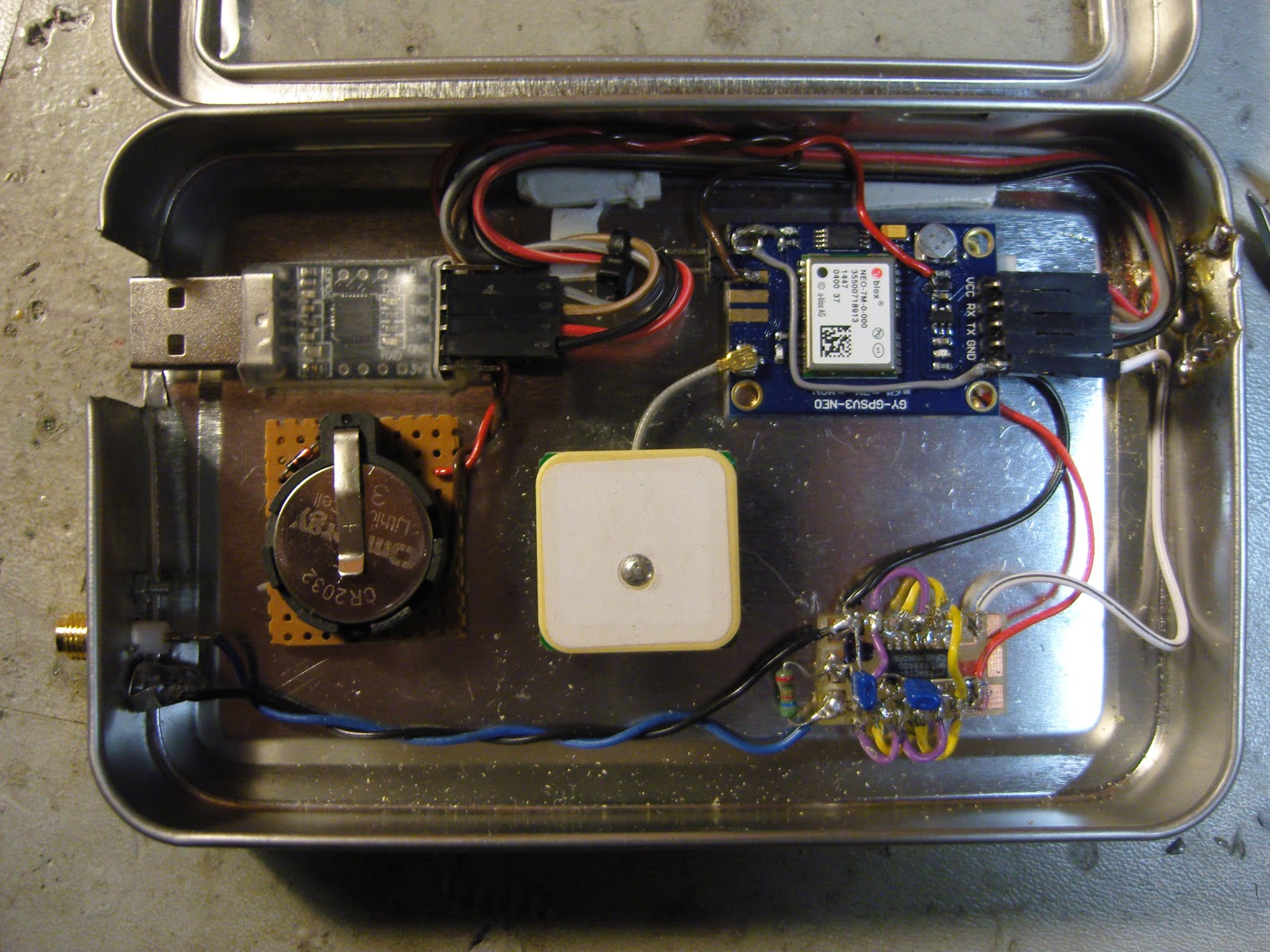
The first picture shows the unit with the 8.5 x 6.5 cm single-sided PCB ground plane attached with double-sided tape. It definitely helped make indoors reception in my shack much more reliable. In addition to the improved conditions for the patch antenna, it probably helps too that the antenna now is shielded from the digital circuitry of the GPS module, the 10 MHz pulse shaper, and the USB interface. I also added a small LED to the right so that I could see from the outside whether the GPS locks properly.
The second picture shows the interior prior to adding the ground plane.
This post is a continuation of these other posts about the 10 MHz reference:
- Just good enough 10 MHz reference (3 Oct 2015)
- Better with SMA (15 Oct 2015)
- Curing amnesia in the 10 MHz GPS reference (19 Nov 2015)
Sverre Holm, LA3ZA, is a regular contributor to AmateurRadio.com and writes from Norway. Contact him at [email protected].
Improved GPS reception with a ground plane
My poor-man’s 10 MHz reference based on the Ublox Neo-7M GPS module didn’t always receive GPS satellites reliably enough. Since I rely on reception indoors, conditions were sometimes too marginal to lock the oscillator output to 10 MHz. Inspired by the QRPlabs GPS module of Hans Summers (G0UPL) with its large 6 x 6 cm PCB groundplane, I therefore decided to do something similar.
It definitely helped make indoors reception in my shack much more reliable. The first picture shows the unit with the 8.5 x 6.5 cm single-sided PCB ground plane attached with double-sided tape. The picture below shows it prior to adding the ground plane. I also added a small LED to the right so that I could see from the outside whether the GPS locks properly.
This post is a continuation of these other posts about the 10 MHz reference:
- Just good enough 10 MHz reference (3 Oct 2015)
- Better with SMA (15 Oct 2015)
- Curing amnesia in the 10 MHz GPS reference (19 Nov 2015)
Sverre Holm, LA3ZA, is a regular contributor to AmateurRadio.com and writes from Norway. Contact him at [email protected].
 Ham Radio Deluxe |
 W5SWL Electronics |
 Ham Radio Prep |
 KB3IFH QSL Cards  Hip Ham Shirts  HamRadioAuctions HamRadioAuctions Reliance Antennas Reliance Antennas Enigma Shop Enigma Shop |  morseDX  Ni4L Antennas  R&L Electronics R&L Electronics antennas.us antennas.us QRV QRV |
- Matt W1MST, Managing Editor
