 |
 EFHW: progress on 20 meters
 25 May 2016 | by
 I’ve made some progress on the EFHW antenna since my last post here on AmateurRadio.com. I wound a new transformer, but now on a thinner plastic tube. Initially it had a 10:1 ratio, but after some initial tests at home I removed some turns and now it is 8:1.

Today, out on the parking lot, I managed to get a good match on 20 meters with 10 meter wire and a 1 meter counterpoise. A short video to prove this.
It was quiet on 20 meters in mid-afternoon. Only HS0ZJF came in with a reasonably strong signal and it was easy to work him. He gave me a 549 for my 5 Watt QRP signal and I was more than happy with that. And as fate would have it HS0ZJF is originally from Belgium, so we exchanged some Dutch greetings as well.
On 40 meters I wasn’t so successful. This time I tried various lengths of wire, ranging from 19 to 23 meters, but the lowest I could get my SWR was 2.4:1. Funny thing was that the KX3 wouldn’t put out the 3 Watts used when tuning at an SWR of 2.4:1, but it had no problem putting out more at a higher SWR of 3:1 or more. Now the SWR is measured behind 3 meters of coax at the KX3, which is not ideal, so the next step is to make a LED-based resistive SWR bridge to be put right behind the antenna and before the coax. 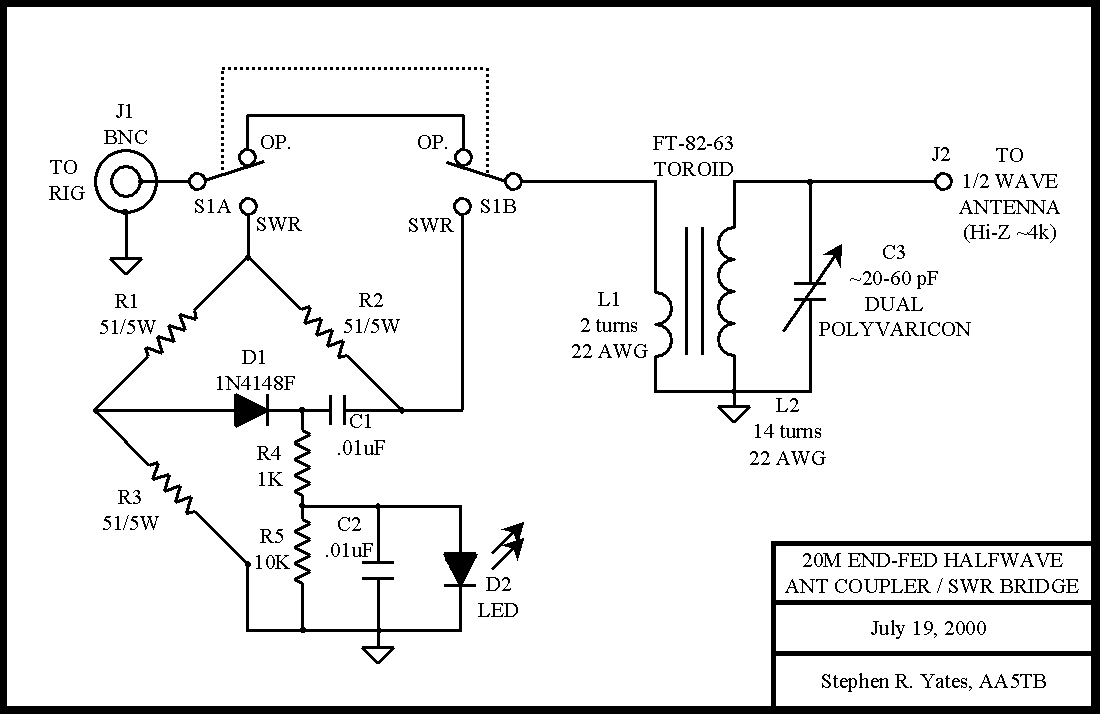
I could make it tonight, but unfortunately I only had two 51 ohm 5W resistors in my junk box. Back to the shops it is.
Hans "Fong" van den Boogert, BX2ABT, is a regular contributor to AmateurRadio.com and writes from Taiwan. Contact him at [email protected].
A great weekend for portable op’s
 |
| The setup by the Lake |
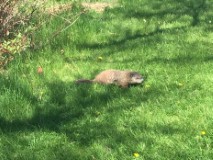
This past weekend the weather was great and the propagation seemed to be fair. So that meant it was time to take the Elecraft KX3 along with my bike and hit the trails again. I went out on Saturday and Monday (It was a long weekend up this way) to see if the Ham god's would smile on my QRP signal. On Saturday there was a CW contest in full swing which meant there was contesters with keen ears wanting to make contacts. On Saturday I setup at the same location I blogged about on Friday. The park located where we live was not too busy and I was able to scoop a nice picnic table. I was using the same setup the KX3 and mono band 20m whip mounted on my bike. I heard DL2SAX calling CQ test but I was not able to raise a contact from him. I did make contact with CO2RQ from Cuba who was in the contest. This contact told me my signal was getting out as up to this point I had not made any contacts with this setup. I then hung out at the QRP watering hole calling CQ there did not seem to be much action and I was beginning to wonder if Cuba would be the only contact. Then WL2LG came back to me, Len and I had a very nice QSO my report was 229 and I gave him 559. We had a nice QSO talking about antennas, rigs and weather. For Saturday that was it for my contacts.
 |
| A visitor |
Mike Weir, VE9KK, is a regular contributor to AmateurRadio.com and writes from New Brunswick, Canada. Contact him at [email protected].
Molokai, Hawaii 2016
Judy and I went to Hawaii for 10 days for our daughter’s wedding. The wedding was fantastic… and there was even a little ham radio. I brought the HB-1B and worked PA, Mexico, AR and AZ. Conditions were pretty awful… but the view was the best!

The HB-1B was powered by 8 AA cells. I used the little QRP Par End Fed trail model antenna. 40 meters was just noise every time I tried. 20 meters was only barely better. I set up a few times at our daughter’s house in the hills. I only made one QSO… with N3RS, Ron in Pennsylvania. He was booming in, but he could just copy my callsign and RST. He gave me a 349. I was discouraged.
For the wedding we moved down to a cottage on Kepuhi Beach on the west end of the island. I only operated once because of the busy schedule. I made more QSOs from the beach, but still didn’t get any good signal reports. I strung the End Fed to a near by sea grape tree (I think) and ran it as a sloper from the porch of the cottage. Myna birds called out from the branches and the waves and wind provided plenty of background noise.

From here I worked Mexico, Arkansas and Arizona. Here’s my log:
16 May-16 0234 14.005 XE2MVY CW 559 599 Mexico
16 May-16 0243 14.060 K5EDM CW 229 579 AR Greg
16 May-16 0303 14.024 K7HP CW 449 599 AZ Hank
After the QSO with Greg K5EDM, I sent him an email to let him know I was in Hawaii. He sent back that he’d never worked Hawaii before. “Your signal was right in my noise. I copied your call sign but only because you sent it several times. ” He was running 25 watts with a dipole at 35 feet.

Operating from Hawaii with QRP is really challenging. It’s thousands of miles to the nearest land mass, and the propagation is often fickle. The timing and conditions have to be just right. I had the best luck late in the afternoon Hawaii time.
While I was there I worked the EARCHI net (on Oahu) on VHF with a handie talkie. From the west end, I could see Oahu rising above the water in the distance. So it was fun to work them on 2 meters. I told them I use the 9:1 unun all the time from home and thanked them for that successful project.

Jim Cluett, W1PID, is a regular contributor to AmateurRadio.com and writes from New Hampshire, USA. Contact him at [email protected].
630m Transverter Project
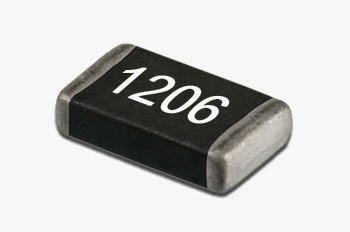 I've ordered parts from Digikey for the summer workbench project, a 630m transverter. With the nice 630m WSPR signals received here from Roger (VK4YB) this spring, I think it might be possible for us to work each other using JT9, if the path continues to improve over the next few seasons. On more than one night, Roger's signal was at JT9 QSO levels and had we been on a schedule, a QSO may have happened. Roger's signal was peaking late in his evening, which for me will require making schedules in the wee hours of the morning.
I've been wanting to build another SMD project for some time since making a little SMK-1 40m transceiver several years ago. This was a very inexpensive kit put out by the NorCal QRP Club as a way of introducing SMD construction techniques to beginners. I found working with the 1206 sized parts (basically the largest ones commonly available) to be fairly laborious and would only solder a few parts at a time before setting it aside for the next day. I think my frustration had a lot to do with my positioning and soldering methods and I'm anxious to try doing it with a more refined technique. As I recall, there were 72 SMD components on the board and it took me a couple of weeks to finish it all.
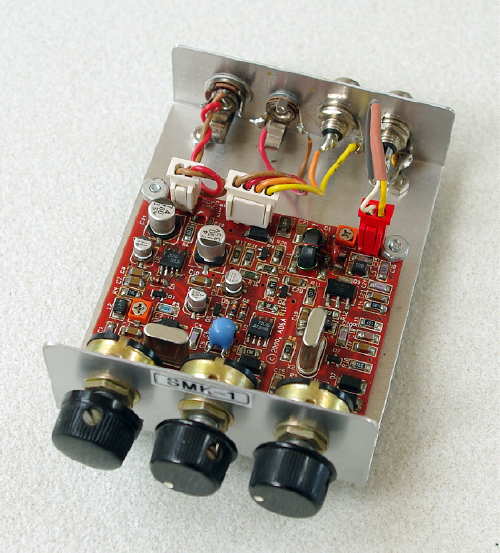 |
| My SMK-1 40m SMD transceiver |
The parts I have ordered are also 1206 sized but the older I get, the smaller these things seem to look. The transverter will be based partially on the popular G3XBM circuit but will eliminate the PA. Instead, I'll just use a few volts of the transverted squarewave signal and a doubler, so that I can feed the signal directly into my present homebrew amplifier which uses two switching FET modules into a power combiner. Hopefully this system will let me run several of the non-linear digital modes such as WSPR, JT9, JT65 etc.
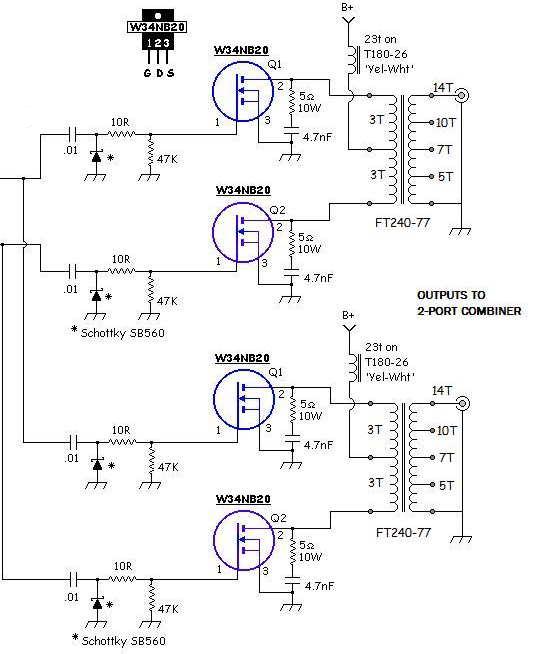 |
| My 630m PA |
As a way of getting back into the SMD-soldering groove, I have ordered and now received, an "SMD Practice Kit" from E-Bay ... a real bargain at $1.78!
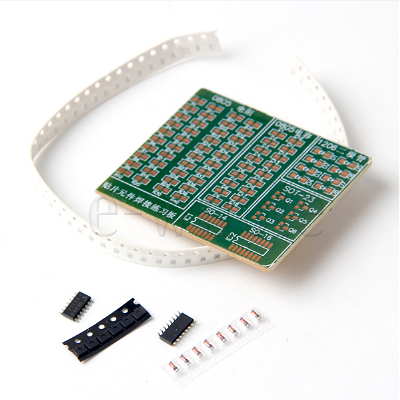 |
| courtesy: Tradeworld2105 |
Although there are many similar practice kits being offered on E-Bay, this was the only one I found that had two IC's to practice with ... all of the others had just one. Since the transverter's doubler circuit has an IC chip, a couple of practice opportunities will be helpful. My only hope is that I don't run out of SMD steam with the practice board before getting down to the actual transverter board.
As soon as the parts arrive from Digikey, I'll start designing the transverter's PCB ... but with all of the usual distractions of summer, as well as trying to maintain vigilance on the magic band once again, my summer project may not progress as quickly as I hope.
All of this assumes that my old eyeballs hold out as well.
Steve McDonald, VE7SL, is a regular contributor to AmateurRadio.com and writes from British Columbia, Canada. Contact him at [email protected].
Weekly Propagation Summary – 2016 May 23 16:10 UTC

Here is this week’s space weather and geophysical report, issued 2016 May 23 0405 UTC.
Highlights of Solar and Geomagnetic Activity 16 – 22 May 2016
Solar activity was low with only B-class and C-class flare activity observed. Regions 2544 (N20, L=295, class/area=Dai/160 on 16 May) and 2546 (S07, L=223, class/area=Cho/550 on 21 May) produced three low-level C-class flares between them, with the largest being a C1.8 at 16/1525 UTC from Region 2544. No Earth-directed coronal mass ejections (CME) were observed during the reporting period.
No proton events were observed at geosynchronous orbit. However, there was a slight enhancement on 16 May from a long duration C3 flare that occured previous to the reporting period. The greater than 10 MeV proton flux reached a maximum of 1 pfu at 16/0030 UTC.
The greater than 2 MeV electron flux at geosynchronous orbit reached high levels on 16, 17, and 19 May and moderate levels on 18, 20-22 May.
Geomagnetic field activity was mostly at quiet to unsettled levels from 16-20 May with an isolated period of active conditions on 17 May in response to a positive polarity coronal hole high speed stream (CH HSS). G1 (Minor) geomagnetic storm levels were observed during the 0600-0900 UTC synoptic period on 21 May due to influences from another positive polarity CH HSS.
Forecast of Solar and Geomagnetic Activity 23 May – 18 June 2016
Solar activity is expected to be very low (B-class flares) to low (C-class flares) levels throughout the outlook period.
No proton events are expected at geosynchronous orbit.
The greater than 2 MeV electron flux at geosynchronous orbit is expected to reach high levels on 28-29 May, 01 Jun, 03-09 Jun, 12-13 Jun, and 18 Jun. Moderate flux levels are expected for the remainder of the outlook period.
Geomagnetic field activity is expected to reach G2 (Moderate) geomagnetic storm levels on 04 Jun and G1 (Minor) geomagnetic storm levels on 05 Jun due to the influence of a negative polarity CH HSS. Active geomagnetic levels are expected on 26 May, 30-31 May, 02-03 Jun, 06 Jun, 11-13 Jun, and 17-18 Jun due to various recurrent CH HSSs.
Don’t forget to visit our live space weather and radio propagation web site, at: http://SunSpotWatch.com/
Live Aurora mapping is at http://aurora.sunspotwatch.com/
If you are on Twitter, please follow these two users: + https://Twitter.com/NW7US + https://Twitter.com/hfradiospacewx
Get the space weather and radio propagation self-study course, today. Visit http://nw7us.us/swc for the latest sale and for more information!
Check out the stunning view of our Sun in action, as seen during the last five years with the Solar Dynamics Observatory (SDO): https://www.youtube.com/watch?v=zXN-MdoGM9g
We’re on Facebook: http://NW7US.us/swhfr
Visit, subscribe: NW7US Radio Communications and Propagation YouTube Channel
Inverted L
I needed a cheap and relatively unobtrusive solution and I found one in Len Paget's (GM0ONX) design for an inverted L. The full details were printed in the Practical Wireless magazine several years ago and PDFs are available for download from Len's website. The designs make use of coaxial traps, one for the 80m version, two if you want to add a top-band (160m) option.
Opting for the smaller 80m version I set about building one. Using an old fibre-glass fishing pole about 5m high at the far end of the garden tucked behind the summer house which I could collapse down and then retract the wire elements when not in use so hiding it from view.
The fun and interesting part was building the trap. They are formed by coiling some coax, in this case RG58, round a former such as plastic waste pipe. I had a bit of scrap pipe but it was 32mm not the 40mm diameter type described in the article, thinking it couldn't make 'that much difference' I built one using the same number of turns but the resultant antenna wasn't anywhere near resonant according to the analyser.
I decided I needed to test the trap's frequency response. I found a YouTube video by Dave Tadlock (KG0ZZ) where he demonstrates using a MFJ 'Grid Dip Meter' adapter on an MFJ antenna analyser to test coaxial traps.
The adapter consists of nothing more than a coil of wire on a suitable former so I made my own to use with my AW07A analyser. It worked a treat and I discovered my trap was way off frequency. In the mean time I had located a useful PDF document by David Reynolds (G3ZPF) which informed me I actually needed 180cm of RG58 round a 32mm pipe to make a suitable 7MHz trap, so I made another.
I made a small video showing the traps and how I tested them.
The resulting antenna seems to perform well, but it does sag a little due to the weight of the trap and wire and the flimsiness of the pole. But I have made a number of contacts on it and used it during the RSGB 80m CC Datamode contest a few weeks back. It was my first go at this contest but once I got the hang of operating it was great fun.

Andrew Garratt, MØNRD, is a regular contributor to AmateurRadio.com and writes from East Midlands, England. Contact him at [email protected].
Inverted L
I needed a cheap and relatively unobtrusive solution and I found one in Len Paget's (GM0ONX) design for an inverted L. The full details were printed in the Practical Wireless magazine several years ago and PDFs are available for download from Len's website. The designs make use of coaxial traps, one for the 80m version, two if you want to add a top-band (160m) option.
Opting for the smaller 80m version I set about building one. Using an old fibre-glass fishing pole about 5m high at the far end of the garden tucked behind the summer house which I could collapse down and then retract the wire elements when not in use so hiding it from view.
The fun and interesting part was building the trap. They are formed by coiling some coax, in this case RG58, round a former such as plastic waste pipe. I had a bit of scrap pipe but it was 32mm not the 40mm diameter type described in the article, thinking it couldn't make 'that much difference' I built one using the same number of turns but the resultant antenna wasn't anywhere near resonant according to the analyser.
I decided I needed to test the trap's frequency response. I found a YouTube video by Dave Tadlock (KG0ZZ) where he demonstrates using a MFJ 'Grid Dip Meter' adapter on an MFJ antenna analyser to test coaxial traps.
The adapter consists of nothing more than a coil of wire on a suitable former so I made my own to use with my AW07A analyser. It worked a treat and I discovered my trap was way off frequency. In the mean time I had located a useful PDF document by David Reynolds (G3ZPF) which informed me I actually needed 180cm of RG58 round a 32mm pipe to make a suitable 7MHz trap, so I made another.
I made a small video showing the traps and how I tested them.
The resulting antenna seems to perform well, but it does sag a little due to the weight of the trap and wire and the flimsiness of the pole. But I have made a number of contacts on it and used it during the RSGB 80m CC Datamode contest a few weeks back. It was my first go at this contest but once I got the hang of operating it was great fun.
Andrew Garratt, MØNRD, is a regular contributor to AmateurRadio.com and writes from East Midlands, England. Contact him at [email protected].
 Ham Radio Deluxe |
 W5SWL Electronics |
 Ham Radio Prep |
 KB3IFH QSL Cards  Hip Ham Shirts  HamRadioAuctions HamRadioAuctions Reliance Antennas Reliance Antennas Enigma Shop Enigma Shop |  morseDX  Ni4L Antennas  R&L Electronics R&L Electronics antennas.us antennas.us QRV QRV |
- Matt W1MST, Managing Editor
