 |
 The Spectrum Monitor — July, 2016
 4 July 2016 | by
  Stories you’ll find in our July, 2016 issue:
Touring the WJZ Transmitter Site in Bound Brook, New Jersey—1925
By John F. Schneider W9FGH
This month, John takes us on a tour of WJZ, NBC’s Blue Network station in New York, which debuted on October 1, 1921. Founded by Westinghouse Electric, the station was originally located in a shack, accessible only by ladder, on the roof of a Westinghouse factory located at Orange and Plane Streets in Newark, New Jersey. This was Westinghouse’s radio station – preceded by KDKA in Pittsburgh and WBZ in Springfield, Massachusetts. The 500-watt WJZ transmitter was an exact duplicate of the one built for KDKA.
TSM Reviews: Yaesu FTM-3200DR Digital/Analog 2m Transceiver
By Cory GB Sickles WA3UVV
In mid-March, Yaesu surprised just about everyone with the announcement of a new transceiver, capable of analog FM and System Fusion operation. The FTM-320 (DR/DE) is a 2-meters only, 65-watt radio, with front-facing speaker and a simple black-on-amber, dimmable display. Its small dimensions mean it can fit just about anywhere. With a current street price of $180, he believes many hams are destined to be looking for just such a spot.
How to Become an EMI Detective
By Mark Haverstock W8MSH
In a world full of electronic technology, it’s inevitable that there will be an increase in electromagnetic interference (EMI), especially on HF bands. Computers and their peripherals are the biggest offenders, causing a host of problems for those of us in the radio hobbies. Not far behind are the infamous AC power supplies known wall-warts and power bricks. And don’t forget the plasma televisions! Mark shows how to diagnose your EMI problems and how to fix them.
Tube Tester Basics: Understanding and Restoring Emission Testers
By Rich Post KB8TAD
It’s useful to have at least one tube tester around for basic checking, especially for tubes for which you have no spares or as a relative measure of quality. But, all tube testers make compromises in testing. The most basic tester and the one most commonly seen is for emission which measures the cathode current relative to its target average. The typical emission tester also includes a test for shorts and leakage between the elements of a vacuum tube. Leakage and shorts are always tested first since an emissions circuit and meter can be damaged by a shorted tube.
Free-To-Air Satellite Update Mid-Year 2016
By Mike Kohl
Change is a constant in the field of Free-to-Air (FTA) satellite-TV. While some channels continue as they have for nearly two decades, others, particularly the last of the DigicipherII subscription channels may be on life-support. FTA satellite-TV expert, Mike Kohl, reviews all of the C and Ku-band satellites viewable to North American locations and explains what you might expect to find on those channels.
Scanning America
By Dan Veenaman
APCO P-25 Explained; Scanning Creek County, Oklahoma
Federal Wavelengths
By Chris Parris
DMR Scanning Finally Here!
Utility Planet
By Hugh Stegman NV6H
HF Fax: Radio with Pictures
Digital HF: Intercept and Analyze
By Mike Chace-Ortiz AB1TZ/G6DHU
Update on NATO STANAG4285 2400 baud HF Modem Activity
HF Utility Logs
By Mike Chace-Ortiz and Hugh Stegman
Digitally Speaking
By Cory Sickles WA3UVV
Digital Dayton
VHF and Above
By Joe Lynch N6CL
ARRL June VHF Contest
Amateur Radio Insights
By Kirk Kleinschmidt NT0Z
Old Trees, Old Towers, and Living to a Ripe Old Age
Radio 101
By Ken Reitz KS4ZR
FM Mayhem Part 2: A Little Help from a 16-Element Quad-Stacked Array
Radio Propagation
By Tomas Hood NW7US
The Solar Wind
The World of Shortwave Listening
By Keith Perron
Inside the Voice of Korea
The Shortwave Listener
By Fred Waterer
Greek, Country, Gospel Music and More
Maritime Monitoring
By Ron Walsh VE3GO
Change is Inevitable
The Longwave Zone
By Kevin O’Hern Carey WB2QMY
472-479 kHz (& Vicinity) Update
Adventures in Radio Restoration
By Rich Post KB8TAD
Finishing the Hammarlund HQ-129X Part 3: Those Modifications
Antenna Connections
By Dan Farber AC0LW
Antenna 101: Let’s Review the Basics
The Spectrum Monitor is available in PDF format which can be read on any desktop, laptop, iPad®, Kindle® Fire, or other device capable of opening a PDF file. Annual subscription is $24. Individual monthly issues are available for $3 each.
Ken Reitz, KS4ZR, is publisher and managing editor of The Spectrum Monitor. Contact him at [email protected].
Weekly Propagation Summary – 2016 Jul 04 16:10 UTC

Here is this week’s space weather and geophysical report, issued 2016 Jul 04 0322 UTC.
Highlights of Solar and Geomagnetic Activity 27 June – 03 July 2016
Solar activity was very low. The disk was spotless for the entire period with no measurable flare activity.
No proton events were observed at geosynchronous orbit.
The greater than 2 MeV electron flux at geosynchronous orbit was at high levels from 27-30 Jun and dropped to normal to moderate levels for the remainder of the period.
Geomagnetic field activity was quiet to unsettled on 27-28 Jun due to diminishing negative polarity CH HSS effects. Mostly quiet conditions were observed on 29 Jun. Quiet to unsettled conditions were observed for the remainder of the week with an isolated active period on 02/2100-2400 UTC due to effects from a series of coronal holes.
Forecast of Solar and Geomagnetic Activity 04 July – 30 July 2016
Solar activity is expected to be very low throughout the forecast period.
No proton events are expected at geosynchronous orbit.
The greater than 2 MeV electron flux at geosynchronous orbit is expected to reach high levels on 04-07, 16-19, and 22-26 Jul following recurrent CH HSS events.
Geomagnetic field activity is expected to be at quiet to unsettled levels early on 04 Jul followed by quiet conditions through 07 Jul. Quiet to unsettled conditions are expected to return from 08-15 Jul with active periods likely on 11-12 Jul due to effects from a series of recurrent coronal holes. Quiet conditions are expected to return from 16-18 Jul. Another recurrent CH HSS is expected to cause quiet to unsettled conditions from 19-23 Jul with isolated active periods likely on 19 Jul. Mostly quiet levels are expected for the remainder of the period with unsettled periods possible on 28 and 30 Jul due to recurrent coronal holes.
Don’t forget to visit our live space weather and radio propagation web site, at: http://SunSpotWatch.com/
Live Aurora mapping is at http://aurora.sunspotwatch.com/
If you are on Twitter, please follow these two users: + https://Twitter.com/NW7US + https://Twitter.com/hfradiospacewx
Get the space weather and radio propagation self-study course, today. Visit http://nw7us.us/swc for the latest sale and for more information!
Check out the stunning view of our Sun in action, as seen during the last five years with the Solar Dynamics Observatory (SDO): https://www.youtube.com/watch?v=zXN-MdoGM9g
We’re on Facebook: http://NW7US.us/swhfr
Visit, subscribe: NW7US Radio Communications and Propagation YouTube Channel
Ham College 18
All about Multi-mode transceivers and the benefits of certain modes. More related questions from the amateur radio technician exam pool.
1:07:51
George Thomas, W5JDX, is co-host of AmateurLogic.TV, an original amateur radio video program hosted by George Thomas (W5JDX), Tommy Martin (N5ZNO), Peter Berrett (VK3PB), and Emile Diodene (KE5QKR). Contact him at [email protected].
All VHF Shack Sloth
 On June 21st, I worked Steve K7PX on Mount Garfield (W0C/FR-040) using 2m fm to push me over 1000 points to quality for the SOTA Shack Sloth Award using only VHF. This is my first significant SOTA award, which I have been working towards for several years now. I decided to pursue Shack Sloth using only the VHF bands, which is much more difficult than using HF. Why? Something about mountains, Height Above Average Terrain (HAAT) and VHF radio has always intrigued me.
Here’s the line up of my top chased summits, with Mt Herman and Pikes Peak taking the clear lead. Mt Herman is The Most Radio-Active Mountain in Colorado and it is in my backyard. Most of those contacts were with Steve WGØAT and Frank KØJQZ. Thanks, guys! Pikes Peak is also a clear VHF shot from my house and many SOTA activators and tourists like to activate that summit. No surprise, the rest of the summits are various peaks in Colorado, worked from my house or from our cabin near Trout Creek Pass. Quite a few of these are Summit-to-Summit contacts made when activating peaks, often during the Colorado 14er Event.
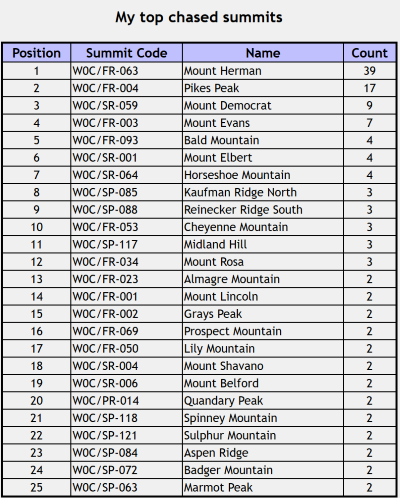 Most of my thousand points were contacts made using plain old 2m fm, The Utility Mode. A few contacts were made on 2m ssb along with some 70 cm fm and ssb contacts. I have been encouraging folks to try 2m ssb for huge improvements in weak-signal performance but the universal nature of 2m fm seems to be winning out.
My next goal is Mountain Goat with VHF only. I’ll need to activate a lot of summits to get that done, so it will take me a while. It’s always good to have something to work towards.
73, Bob KØNR
The post All VHF Shack Sloth appeared first on The KØNR Radio Site.
Bob Witte, KØNR, is a regular contributor to AmateurRadio.com and writes from Colorado, USA. Contact him at [email protected].
Amateur Radio Weekly – Issue 118

Sun has likely entered new evolutionary phase
The Sun is in the process of crossing into its magnetic middle age, where its 11-year Sunspot cycles are likely to slowly disappear entirely.
Forbes
13 Colonies Special Event
All HF bands will be in play, including the WARC bands, with the exception of 60 meters. Simplex on 2 meters and 6 meters is encouraged.
13 Colonies
Folded Skeleton Sleeve Antennas
The design is a unique way to build a dual-band resonant dipole or groundplane vertical.
High on Solder
Hams could be superheroes when the earthquake hits
When the big one hits, one of the best technologies to rely on for communication may not be cell phones or computers.
KUOW
Middle Tennessee Ham Quest
The Greater Nashville & Middle TN Ham Quest is a new project dedicated to combining traditional Hamfest elements with less traditional offerings that will help to unite the Ham community.
Ham Quest
K5EHX repeater search tool
Enter a city or zip code for near-by repeaters.
K5EHX
GQRX for digital signals
The idea was to show how GQRX can be combined with other software to use it’s nice GUI. With some plumbing, that’s easily possible.
Carriers Everywhere
How do you measure the success of Field Day?
I’m the president of our club, so if the experience isn’t great, then a large portion of the blame falls on me. After this year, I have a feeling some folks are ready to have me impeached.
KK4DSD
First Field Day as a CW operator
Field Day 2016 with the Knightlites QRP club.
Ham Radio QRP
Field Day 1929 style
The transmitter was a 27-24-24-865 job more or less straight out of July 1931 QST.
AmateurRadio.com
Direwolf: Software soundcard, modem/TNC and APRS encoder/decoder
It can be used stand-alone to observe APRS traffic, as a digipeater, APRStt gateway, or Internet Gateway (IGate).
WB2OSZ
Video
APRS timelapse
Video made of APRS screenshots from aprs.fi map.
DF2ET
Properties of different types of capacitor
Find out all about the different properties of the various capacitor types: electrolytic; ceramic; tantalum; plastic film.
YouTube
Amateur Radio Weekly is curated by Cale Mooth K4HCK. Sign up free to receive ham radio's most relevant news, projects, technology and events by e-mail each week at http://www.hamweekly.com.
Raspberry Pi APRS iGate
Further to my previous post(s) on APRS and Specifically Direwolf, here’s something with a bit more meat.
APRS has always been a bit of a thing for me. I like to go for a ride or a walk on the Lakeland fells and whilst I don’t get to go on as many SOTA trips as I’d like I do nearly always carry a hand held when I’m on the mountain bike. I know that there are a few local hams who like a bit of APRS and you never know when you’ll need a way of communicating when you’ve gone over the handbars and smashed your phone….
So what?
Well I also have an early Raspberry Pi model B and an RTL-SDR dongle. I live quite close to a digipeater and also have a terrible QTH for an iGate. So, I thought I’d combine the two with my liking f APRS. I’m glad to say the process was really easy and very robust. Want to have a go yourself? Ok…
So lets start
- Get you SD card and load it with the OS (I used the Raspian image from the Raspberry Pi site)
- Get a copy of the Direwolf software from WB2OSZ (and simply excellent documentation) from GitHub
- Have a look in the Direwolf docs folder. Follow the Raspberry-Pi-SDR-IGate instuctions and the Raspberry-Pi-APRS. I’m definitely not going to try and replicate of better these docs as they are perfect
- Get an APRS passcode from Magicbug
- Off you go, simple as that. Any issues then the Direwolf Yahoo Group should sort you out

That’s it really. There are a few little odds and sods like beaconing your iGate. This can be achieved by adding a line into the sdr.conf file so it looks a little like this:
# # Sample configuration for SDR read-only IGate.
#
# We might not have an audio output device so set to null.
# We will override the input half on the command line.

ADEVICE null null
CHANNEL 0
MYCALL MX0WRC

# First you need to specify the name of a Tier 2 server.
# The current preferred way is to use one of these
# regional rotate addresses:
# noam.aprs2.net - for North America
# soam.aprs2.net - for South America
# euro.aprs2.net - for Europe and Africa
# asia.aprs2.net - for Asia
# aunz.aprs2.net - for Oceania

IGSERVER euro.aprs2.net

You also need to specify your login name and passcode.
# Contact the author if you can't figure out how to generate # the passcode.

IGLOGIN MX0WRC 12345 (your passcode)
PBEACON sendto=IG delay=0:30 every=10:00 symbol="igate" overlay=R lat=54^38.5611N long=3^3$

# That's all you need for a receive only IGate which relays
# messages from the local radio channel to the global servers.
I’ve not managed to get it to start up automatically if it falls over with the dw_start.sh script but that is a work in progress. Here we are on APRS.fi

Ok, thats all very well but mine is remote. There are a few suggestions from the RPi people but I plumped for Weaved and tightVNC as a solution. Here are the instructions I followed for Weaved, and for TightVNC . If you don’t fancy a link then try this:
Install Weaved and run the installer
sudo apt-get install weavedconnectd
sudo weavedinstaller
Then TightVNC
sudo apt-get install tightvncserver
Run it once to do the password thing, then to run at boot
sudo su
sudo nano vncboot.sh
Enter this into nano
#! /bin/sh
# /etc/init.d/vncboot

### BEGIN INIT INFO
# Provides: vncboot
# Required-Start: $remote_fs $syslog
# Required-Stop: $remote_fs $syslog
# Default-Start: 2 3 4 5
# Default-Stop: 0 1 6
# Short-Description: Start VNC Server at boot time
# Description: Start VNC Server at boot time.
### END INIT INFO

USER=pi
HOME=/home/pi

export USER HOME

case "$1" in
 start)
  echo "Starting VNC Server"
  #Insert your favoured settings for a VNC session
  su - $USER -c "/usr/bin/vncserver :1 -geometry 1280x800 -depth 16 -pixelformat rgb565"
  ;;

 stop)
  echo "Stopping VNC Server"
  /usr/bin/vncserver -kill :1
  ;;

 *)
  echo "Usage: /etc/init.d/vncboot {start|stop}"
  exit 1
  ;;
esac

exit 0
Then chmod
chmod 755 vncboot
Lastly
update-rc.d -f lightdm remove
update-rc.d vncboot defaults
I can’t tell you how useful to follow the steps enough. I found that one RTL dongle isn’t quite the same as another so there can be issues. So much so that I wiped the SD card a few times so as to get right and simple. If you didn’t want to run Jessie, Jessie lite will do but you’ll need to find an alternative way to remotely access the RPi, with something like SSH as VNC doesn’t work (easily) without the X server.
As always, comments, suggestions and alternative approaches are always welcome, after all this is a hobby and none of this hard work belongs to me, I just follow the instructions 
Alex Hill, G7KSE, is a regular contributor to AmateurRadio.com and writes from Cumbria, UK. Contact him at [email protected].
In the park with 5 watts, KX3 and new Endfed antenna
 |
| My outdoor shack |
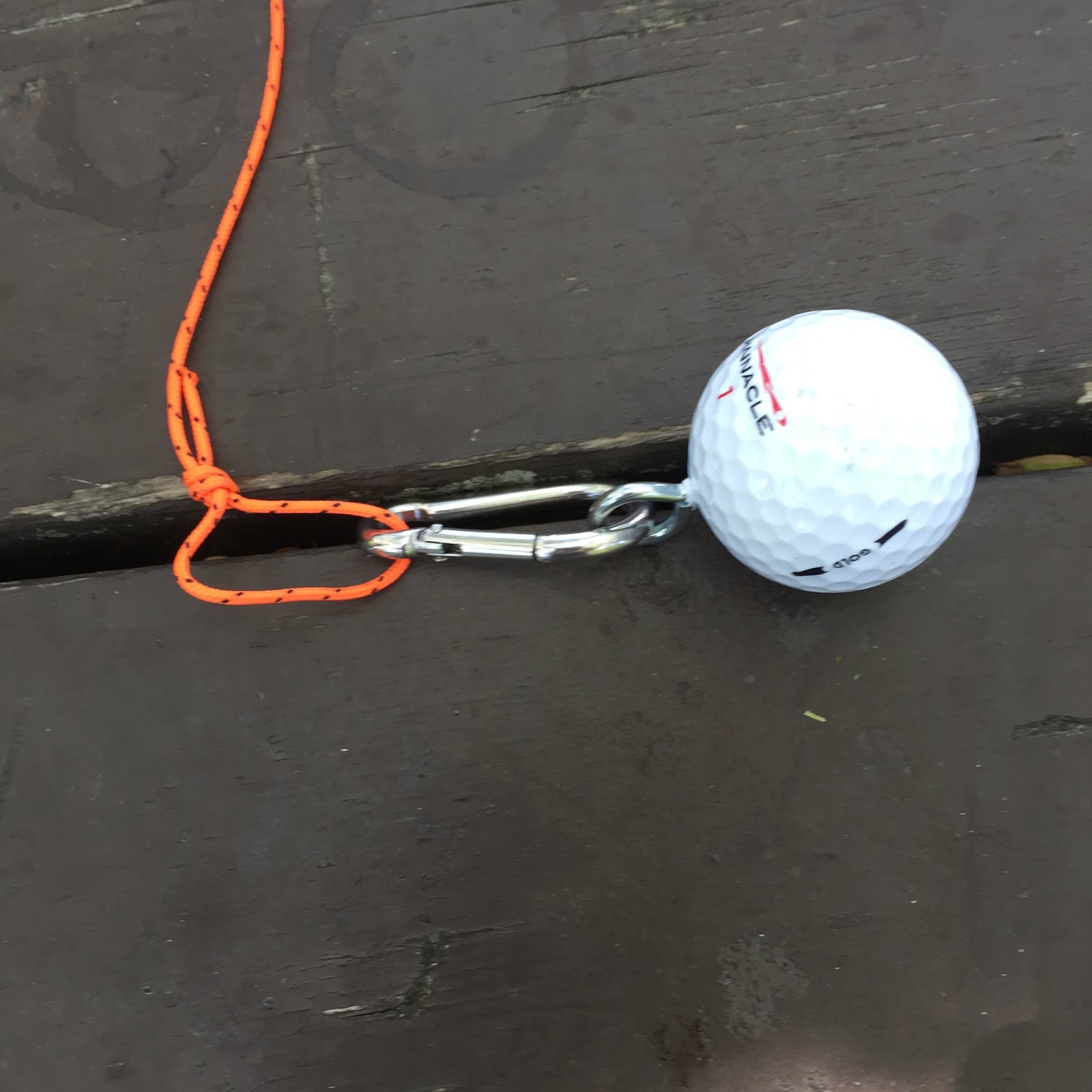 |
| Golfball setup |
10m Frequency SWR
28.020 3.8
28.060 3.8
15m
21.020 2.9
21.060 2.9
20m
14.020 3.8
14.060 3.8
40m
7.020 8.4
7.040 8.4
The antenna was mounted in a sloper configuration the high end at about 20 feet off the ground and the other end ground mounted. The tuner in the KX3 was able to bring all bands but 40m to a flat match, I was able to get 40m down to 1.5. The bands were very quite but I did spend some time
 |
| Anchor point |
Mike Weir, VE9KK, is a regular contributor to AmateurRadio.com and writes from New Brunswick, Canada. Contact him at [email protected].
 Ham Radio Deluxe |
 W5SWL Electronics |
 Ham Radio Prep |
 KB3IFH QSL Cards  Hip Ham Shirts  HamRadioAuctions HamRadioAuctions Reliance Antennas Reliance Antennas Enigma Shop Enigma Shop |  morseDX  Ni4L Antennas  R&L Electronics R&L Electronics antennas.us antennas.us QRV QRV |
- Matt W1MST, Managing Editor
