 |
 Weak Signal Volume Levels
 24 July 2016 | by
  A recent posting on Yahoo's Perseus SDR Group inquired about the use of external or PC-based DSP manipulation of signals partially masked by noise to improve readability. The most interesting part of this short discussion was the result of one response indicating:
"BTW one of the best and most simple noise reductions is to lower the volume."
to which the original inquirer responded:
"BTW, lower the volume to reduce noise ... ?? That was a joke, right ??"
Other comments soon followed, including my own, initially:
"Actually, for whatever reason, this works...at least when copying very very weak CW signals. I think it is more of an ear-brain thing where the noise
gets more focus than the signal when listening at moderate levels but
cranking everything down to a very low level has always improved copy for
me....not sure why this works as well as it does."
From Roelof Bakker, PAØRDT:
"The ear brain system works much better at low volume as it is easily
overloaded by strong signals. Similar like too much direct light in
your eyes will degrade contrast. I guess this is getting worse with
age, but I am not sure about that.
I have been watching many videos on YouTube which demonstrate ham
radio gear and most if not all use far to high volume settings,
which degrades readability. I believe it is a normal habit to raise
the volume for weak signals, but this is often contra productive.
When listening for weak signals at low volume settings, a quiet room
is mandatory. I have taken considerable effort in building a quiet
PC, that is aurally quiet.
What does wonders for copying weak signals with the PERSEUS is to
switch off the AGC."
"No it's not a joke and it's not the RF Gain. It's one of the capabilities of the human ear.
Of course qrm can be limited and reduced but noise is difficult. What you often see is that with all those noise reduction things is that the volume drops. Make an audio recording of a part with and without a (white) noise limiter switched on. Open it into an audio editor and you will see that the amplitude of the part where the noise reduction is on is lower. Now amplify that part to the same level as where the limiter is not active and play it back. You will be astonished how little the difference is.
It's probably also a thing that can differ from person to person but I've never seen tools that can make an unreadable signal readable. Most of the time they sound just different, not better."
Likely there is a ton of data showing how our ear / brain link deals with noise or tones buried in noise. With audio levels set to anything above bare minimum, I think it's very easy for your brain to react mainly to the noise and not to the tone. Reducing this level possibly puts the two back on even levels ... even though there really has been no change in signal-to-noise ratio.
When trying to copy very weak, difficult signals, I've always found that turning audio levels down to bare minimums helps me personally. As Roelof mentioned, the entire environment must be dead quiet as well so that there are no outside distractions. Even the sounds of the headphone cord, brushing against clothing or the table top, can make the difference between copy and no copy. Decades of copying very weak ndb CW idents buried in the noise as well as spending several years on 2m CW moonbounce, has taught me that my ear-brain connection works best when audio inputs are very, very low.
 |
| courtesy: http://justagwailo.com/ |
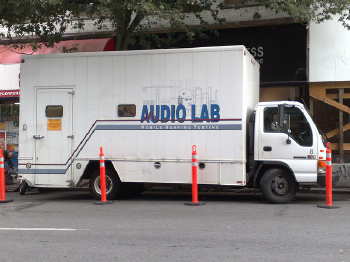
As an interesting aside, my years of copying weak CW tones, has shown itself in other ways as well. Before retirement as a high school tech ed teacher, staff were required to have their hearing checked annually, as part of the medical plan's requirement. Each year the mobile audio lab would roll-up for the tests. I would always make sure to sit perfectly still, with no headphone cord wires brushing against my clothing. The tones varied in frequency and intensity and were often extremely weak, not unlike the weak echoes I was used to copying from the lunar surface. The reaction from the examiner was always the same, every year ... complete astonishment when checking the results and usually a comment that I had the hearing of a teenager! Thankfully my hearing, which I've always been careful to protect, remains exceptionally good, for which I am truly grateful ... so often this is a genetic thing and there is little one can do about controlling hearing-loss as one ages.
I shudder anytime I see a young person with headphones or earbuds firmly in place and with the music volume cranked up to unbelievably high levels. Sadly, many of them will likely pay the price for this later in life as such hammering-away at the delicate auditory mechanism has a cumulative rather than a short-term effect.
So ... the next time you find yourself trying to copy that ultra-weak signal just riding along in the noise, try turning the audio way, way down. Take a deep breath and listen to the tone, not the noise. If you ask me, the best signal filter is still the one between our ears.
Steve McDonald, VE7SL, is a regular contributor to AmateurRadio.com and writes from British Columbia, Canada. Contact him at [email protected].
Saved by something or other
Today I almost bought a new rig. I say almost because it has been the closest time I have ever got to buying a new rig. I had a week with a KX3 and found it wasn’t to my taste, not because it didn’t perform well but for some reason or another it just didn’t do it for me. So I looked at the new Icom IC7300 and was really taken aback by it. It looks like a great rig and I’m sure it’ll do a lot for those that buy it, one day I might get one. Today I almost did. My finger was hovering over the buy now….I put one in the basket and got the credit card out. My XYL pointed out I could afford it (This made me very suspicious). Then I realised I was sure I didn’t actually want it. Am I losing the fun of radio?
I don’t think so.
I bought a LNR Precision Mountain Topper last April and have used it a handful of times and enjoyed the portability of it all. The simplicity and the lack of domestic real estate needed to make it work for me. I put together a neat little pack for taking away with me and I think I’ll refine that a little. Some things might look familiar, others look like they’re missing, notably a ‘flight deck’ or ‘thing to put your radio on whilst you’re operating out and about’. I’m going to laser cut a bespoke one that will fit into the case (which by the way is an old Dremel carry case). More on that later

So I decided to save my money and think about a shack in the box that I really miss, a Yaesu FT817ND. I sold my 817 a couple of years ago and regretted it from the minute I sold it. I think I will get myself a decent second hand one of those with a few of the bells and whistles I didn’t have the first time around. At least that’s what I think I’ll do today.
Tomorrow I’m sure I’ll change my mind again.
Alex Hill, G7KSE, is a regular contributor to AmateurRadio.com and writes from Cumbria, UK. Contact him at [email protected].
ICQ Podcast Episode 216 – DA0HQ Contest
In this episode, Martin M1MRB / W9ICQ is joined by Edmund Spicer M0MNG, Chris Howard M0TCH and Ed Durrant DD5LP to discuss the latest Amateur / Ham Radio news. Colin M6BOY rounds up the news in brief, and this episodes feature is an interview with the organisers of the DA0HQ Contest site.
- Malaysian Amateur Radio Licences Changes
- BBC Starts Roll-Out of International Radio App
- US Ham’s Save Kids from Surrounded Campfire
- Earthing and the Radio Amateur
- Ofcom Proposes Ham Band for Wi-Fi
- UK Amateurs Visit 10 Downing Street
- AES Ham Radio Store Closing Down
- New European Table of Frequency Allocations
- Australian Radio Operator Fined and Off Air
Colin Butler, M6BOY, is the host of the ICQ Podcast, a weekly radio show about Amateur Radio. Contact him at [email protected].
ICQ Podcast Episode 216 – DA0HQ Contest
In this episode, Martin M1MRB / W9ICQ is joined by Edmund Spicer M0MNG, Chris Howard M0TCH and Ed Durrant DD5LP to discuss the latest Amateur / Ham Radio news. Colin M6BOY rounds up the news in brief, and this episodes feature is an interview with the organisers of the DA0HQ Contest site.
- Malaysian Amateur Radio Licences Changes
- BBC Starts Roll-Out of International Radio App
- US Ham’s Save Kids from Surrounded Campfire
- Earthing and the Radio Amateur
- Ofcom Proposes Ham Band for Wi-Fi
- UK Amateurs Visit 10 Downing Street
- AES Ham Radio Store Closing Down
- New European Table of Frequency Allocations
- Australian Radio Operator Fined and Off Air
Colin Butler, M6BOY, is the host of the ICQ Podcast, a weekly radio show about Amateur Radio. Contact him at [email protected].
Amateur Radio Weekly – Issue 121

Radiosport vs. Pokémon GO
It should come as no surprise that ham radio operators are drawing comparisons between Pokémon GO and Amateur Radiosport.
ARRL
Growing 6m JT65 activity
On several occasions this week, I have heard or worked dozens of others on JT mode while the bottom end of the band appears void of signals.
AmateurRadio.com
North Korea activates numbers station
A female announcer at the radio station read numbers for two minutes on 24 June and 14 minutes on Friday.
The Guardian
What’s In your rubber duck?
I often refer to the rubber duck as The World’s Most Convenient Crappy Antenna.
K0NR
Life as a blind radio Ham
Anyone can join in the conversation and sometimes you find yourself talking to a dozen or so people across the ends of the Earth.
Largs & Millport
Smartphone vibration motor as microphone
Two researchers from the University of Illinois at Urbana-Champaign have devised a method for turning vibration motors, like the ones found in smartphones, into makeshift microphones, capable of recording the sound around them.
Southgate
How to: GPS spoofing (to hack Pokémon GO)
As satellite GPS signals are very weak while receiving on earth, transmitted signals with the HackRF will be very strong in comparison
Insinuator
A speaker mic NOT to buy
I’m guessing this one didn’t pass through quality control, if there is such a thing at the Baofeng factory.
Digital Mobile Radio
Receiving WSPR with RTL-SDR
Direct sampling mode allows you to receive HF signals on an RTL-SDR without the need for an upconverter
RTL-SDR.com
Amateur Radio Weekly is curated by Cale Mooth K4HCK. Sign up free to receive ham radio's most relevant news, projects, technology and events by e-mail each week at http://www.hamweekly.com.
2016 Summer Trip – Day 55
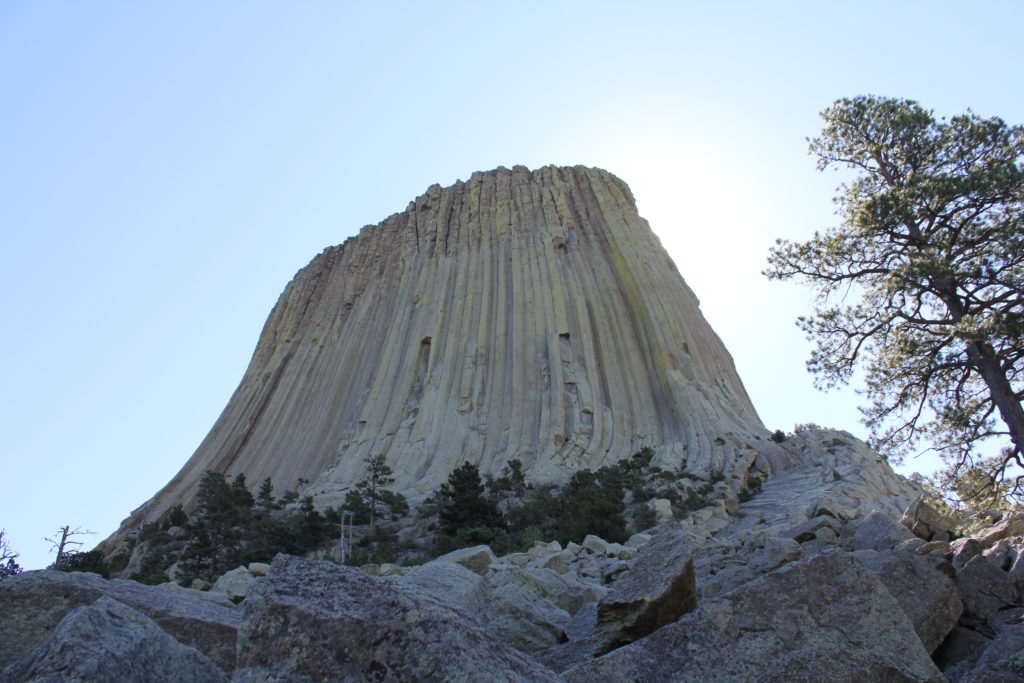
Wind Cave National Park, South Dakota. Devils Tower National Monument, Wyoming.

Friday, July 22nd – Toured Wind Cave. Once we entered the cave and started to descend, Emily was scared at first but then was ok. After the tour, the girls finished up their Junior Ranger books and received their badges for Wind Cave.
The day started getting hot. The expectation was temps into the upper 90s. I had gotten a prime parking spot in front of the Wind Cave Visitors Center which allowed me to connect to their wifi. I used the wifi connection to make reservations at the Devils Tower KOA. The heat made me want to camp at a location where we could make use of our air conditioner.
We left the Elk Mountain Campground around 1pm. Elk Mountain Campground is a good place to camp if the weather had been a bit more cooperative. I was disappointed in the lack of any substantial Ranger-led evening program.
It was a nice drive in a northeast direction through a national forest to I-90 where we were only on I-90 to go up one exit. Checked into Devils Tower KOA (located immediately outside the monument) and had some food across the street at the trading post. Ended up getting a pull-thru site next to another ham (KF5SA). He has an HF station mounted inside his trailer.
Quick trip up to the visitors center to get Junior Ranger books (from Ranger Erin Cahill). Attended evening program at the campground amphitheater which was blown out by bad weather into the picnic area.
Scott Hedberg, NØZB, is a regular contributor to AmateurRadio.com and writes from Kansas, USA. Contact him at [email protected].
Activating SOTA’s at Philmont Scout Ranch
Philmont rates their treks by the magnitude of difficulty from Challenging, Rugged, Strenuous and Super Strenuous. The trek I was on was in the Super Strenuous category, for those familiar with the system, our Trek was # 31. I have been training for this trek for over a year and would need all that accumulated fitness to make the trip. We had a crew of eight, two adults and six teenage boys. What you learn, or maybe remember, is that youth covers lots of physical ills, in other words, they recover quickly.
 |
| Baldy Mountain getting closer |
 |
| Operating from Baldy Mountain AD5A In The Middle and AB5EB On The Right |
 |
| Baldy Mountain From Scheaffers Peak Yes, We Hiked That Distance |
 |
| My Grandson, KF5GYD Operating From Scheaffer's Peak |
After the activation of Scheaffer's Peak, we had to put our packs back on and finish the last nine miles of the trek. Another long day, but at the end, what a sense of accomplishment. Hiking 84 miles in rugged back country and activating two new SOTA summits.
Mike Crownover, AD5A, is a regular contributor to AmateurRadio.com and writes from Texas, USA. Contact him at [email protected].
 Ham Radio Deluxe |
 W5SWL Electronics |
 Ham Radio Prep |
 KB3IFH QSL Cards  Hip Ham Shirts  HamRadioAuctions HamRadioAuctions Reliance Antennas Reliance Antennas Enigma Shop Enigma Shop |  morseDX  Ni4L Antennas  R&L Electronics R&L Electronics antennas.us antennas.us QRV QRV |
- Matt W1MST, Managing Editor
