 |
 AmateurLogic 93: There’s RF in Those Woods
 13 July 2016 | by
AmateurLogic.TV Episode 93 is now available for download.
ALTV’s 2016 Field Day excursion. The crew takes to the woods for this annual event. The fun ensues.
1:26:21
George Thomas, W5JDX, is co-host of AmateurLogic.TV, an original amateur radio video program hosted by George Thomas (W5JDX), Tommy Martin (N5ZNO), Peter Berrett (VK3PB), and Emile Diodene (KE5QKR). Contact him at [email protected].
Nightly 75kHz WSPR Activity From Arizona – WH2XND
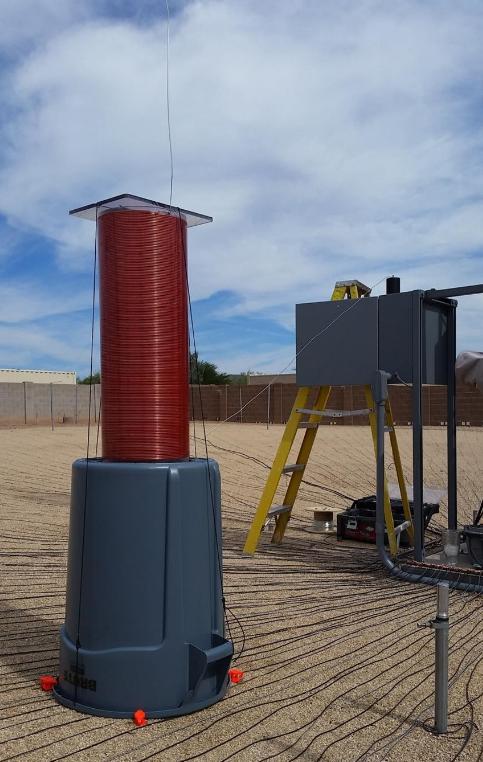 |
| 2.5mH 136kHz loading coil at WH2XND |
For the past few weeks, Ron, NI7J in Phoenix, has been activating his experimental station, WH2XND, in the LF band ... on 75.550kHz (WSPR), where he is licenced to operate.
Last night I decided to put my nightly 630m WSPR beacon on hold and have a listen for Ron's signal using my 10' x 20' loop.
Ron's main experimental operating has been on 630m and 2200m WSPR mode but his recent activity on 75kHz has sparked a lot of interest among dedicated summertime listeners. WH2XND is licenced for 10W ERP on 75kHz, not a number that's easy to muster considering the poor antenna efficiency produced by typical amateur installations ... however, judging from Ron's coils, his installation looks far from 'typical'!
Ron's signal is being well heard, even up in Alaska, in spite of the noisy summer conditions and it will be interesting to see how well it propagates once we move into the fall and quieter winter nights.
The big loop seemed to do well with Ron's signal last night, resulting in 55 decodes starting at around 2300 local time and continuing to sunrise.
Timestamp Call SNR Grid
2016-07-12 12:28 WH2XND -28 DM33xt
2016-07-12 12:20 WH2XND -27 DM33xt
2016-07-12 12:16 WH2XND -25 DM33xt
2016-07-12 12:12 WH2XND -28 DM33xt
2016-07-12 12:08 WH2XND -27 DM33xt
2016-07-12 12:04 WH2XND -28 DM33xt
2016-07-12 12:00 WH2XND -29 DM33xt
2016-07-12 11:40 WH2XND -25 DM33xt
2016-07-12 11:36 WH2XND -20 DM33xt
2016-07-12 11:32 WH2XND -18 DM33xt
2016-07-12 11:28 WH2XND -18 DM33xt
2016-07-12 11:24 WH2XND -19 DM33xt
2016-07-12 11:20 WH2XND -19 DM33xt
2016-07-12 11:16 WH2XND -20 DM33xt
2016-07-12 11:12 WH2XND -20 DM33xt
2016-07-12 11:08 WH2XND -19 DM33xt
2016-07-12 11:04 WH2XND -19 DM33xt
2016-07-12 11:00 WH2XND -20 DM33xt
2016-07-12 10:56 WH2XND -20 DM33xt
2016-07-12 10:52 WH2XND -21 DM33xt
2016-07-12 10:48 WH2XND -22 DM33xt
2016-07-12 10:44 WH2XND -23 DM33xt
2016-07-12 10:40 WH2XND -24 DM33xt
2016-07-12 10:36 WH2XND -25 DM33xt
2016-07-12 10:32 WH2XND -26 DM33xt
2016-07-12 10:28 WH2XND -24 DM33xt
2016-07-12 10:24 WH2XND -24 DM33xt
2016-07-12 10:20 WH2XND -25 DM33xt
2016-07-12 10:16 WH2XND -24 DM33xt
2016-07-12 10:12 WH2XND -23 DM33xt
2016-07-12 10:08 WH2XND -26 DM33xt
2016-07-12 10:04 WH2XND -25 DM33xt
2016-07-12 10:00 WH2XND -26 DM33xt
2016-07-12 09:56 WH2XND -26 DM33xt
2016-07-12 09:52 WH2XND -27 DM33xt
2016-07-12 09:40 WH2XND -26 DM33xt
2016-07-12 09:36 WH2XND -25 DM33xt
2016-07-12 09:32 WH2XND -24 DM33xt
2016-07-12 09:28 WH2XND -26 DM33xt
2016-07-12 09:24 WH2XND -26 DM33xt
2016-07-12 09:20 WH2XND -28 DM33xt
2016-07-12 09:16 WH2XND -27 DM33xt
2016-07-12 09:08 WH2XND -27 DM33xt
2016-07-12 09:00 WH2XND -27 DM33xt
2016-07-12 08:56 WH2XND -28 DM33xt
2016-07-12 08:52 WH2XND -29 DM33xt
2016-07-12 08:44 WH2XND -29 DM33xt
2016-07-12 08:40 WH2XND -27 DM33xt
2016-07-12 08:36 WH2XND -28 DM33xt
2016-07-12 06:44 WH2XND -32 DM33xt
2016-07-12 06:32 WH2XND -31 DM33xt
2016-07-12 06:28 WH2XND -31 DM33xt
2016-07-12 06:24 WH2XND -30 DM33xt
2016-07-12 06:20 WH2XND -30 DM33xt
2016-07-12 06:12 WH2XND -29 DM33xt
His signal peaked here (shown in blue above) about an hour before sunrise, with almost a dozen decodes in the -18 to -20 region ... not far from audible CW levels which will probably be seen in winter. It was interesting to note as well, that in several transmitting sequences, Ron's signal was stronger in Alaska than it was here and in Washington state ... just the opposite of what one might expect.
In the past, I have had good results on 75kHz with Dex (W4DEX), when listening for his QRSS CW signal, using my normal inverted -L with a 2.5mH RFC inserted in series with the antenna's normal loading coil.
 |
| 'XRS/5' on 75kHz from W4DEX in NC |
Steve McDonald, VE7SL, is a regular contributor to AmateurRadio.com and writes from British Columbia, Canada. Contact him at [email protected].
Weekly Propagation Summary – 2016 Jul 11 16:10 UTC
Here is this week’s space weather and geophysical report, issued 2016 Jul 11 0329 UTC.
Highlights of Solar and Geomagnetic Activity 04 – 10 July 2016
Solar activity was at very low levels from 04-06 Jul followed by low levels for the remainder of the period. Region 2561 (S16, L=344, class/area Cro/beta on 07 Jul) produced a C5/Sn flare at 07/0756 UTC. Region 2564 (N09, L=209, class/area Dai/120 on 10 Jul) produced all further C-class activity, the largest a C8/2f at 10/0059 UTC with an associated Type II radio sweep (1435 km/s). No Earth-directed CMEs were observed.
No proton events were observed at geosynchronous orbit.
The greater than 2 MeV electron flux at geosynchronous orbit was at normal to moderate levels from 04-08 Jul and reached high levels on 09-10 Jul following several days of enhanced solar wind speeds with a sequence of coronal holes.
Geomagnetic field activity was mostly quiet from 04-06 Jul with a few isolated unsettled periods under a nominal solar wind regime. Unsettled to minor storm conditions were observed on 07-08 Jul due to positive polarity CH HSS effects followed by unsettled to active conditions on 09 Jul as effects began to subside. Quiet to unsettled levels were observed on 10 Jul as CH HSS effects waned.
Forecast of Solar and Geomagnetic Activity 11 July – 06 August 2016
Solar activity is expected to be very low with a chance for C-class flares and a slight chance for M-class flares through 24 Jul due to flare potential from Region 2564. Activity is expected to be very low for the remainder of the forecast period.
No proton events are expected at geosynchronous orbit.
The greater than 2 MeV electron flux at geosynchronous orbit is expected to reach high levels on 16-19 Jul, 22-27 Jul and 05-06 Aug following recurrent CH HSS events. Normal to moderate levels are expected otherwise.
Geomagnetic field activity is likely to reach minor storm levels on 11 Jul due to positive polarity CH HSS effects. Unsettled to active conditions are expected on 12 Jul as effects continue followed by quiet to unsettled conditions on 13 Jul as effects subside. A second CH HSS is expected to bring quiet to unsettled conditions on 14-15 Jul with active periods likely on the 14th. Mostly quiet levels are expected on 16-18 Jul. Quiet to unsettled conditions are anticipated from 19-24 Jul due to effects from a series of recurrent CH HSSs. Mostly quiet conditions are expected from 25 Jul to 02 Aug with isolated unsettled periods possible from 28-30 Jul as a few small CH HSS events move past Earth. Minor storms are likely on 03-04 Aug due to recurrent, positive polarity CH HSS activity, decreasing to active conditions on 05 Aug and unsettled conditions on 06 Aug as effects subside.
Don’t forget to visit our live space weather and radio propagation web site, at: http://SunSpotWatch.com/
Live Aurora mapping is at http://aurora.sunspotwatch.com/
If you are on Twitter, please follow these two users: + https://Twitter.com/NW7US + https://Twitter.com/hfradiospacewx
Get the space weather and radio propagation self-study course, today. Visit http://nw7us.us/swc for the latest sale and for more information!
Check out the stunning view of our Sun in action, as seen during the last five years with the Solar Dynamics Observatory (SDO): https://www.youtube.com/watch?v=zXN-MdoGM9g
We’re on Facebook: http://NW7US.us/swhfr
Visit, subscribe: NW7US Radio Communications and Propagation YouTube Channel
What’s In Your Rubber Duck?
 Anyone with a VHF or UHF handheld transceiver (HT) probably uses the standard “rubber duck” antenna for casual use. I often refer to the rubber duck as The World’s Most Convenient Crappy Antenna. To be fair, all antennas are a compromise…the rubber duck optimizes small size and convenience at the expense of performance. The Wikipedia entry describes the rubber duck antenna as “an electrically short monopole antenna…[that] consists of a springy wire in the shape of a narrow helix, sealed in a rubber or plastic jacket to protect the antenna.“
Being curious about what really is hiding inside the typical rubber duck antenna, I decided to take a few of them apart. I did not try to assess the performance of the antennas but just examine their construction.
Baofeng UV-5R Stock Antenna
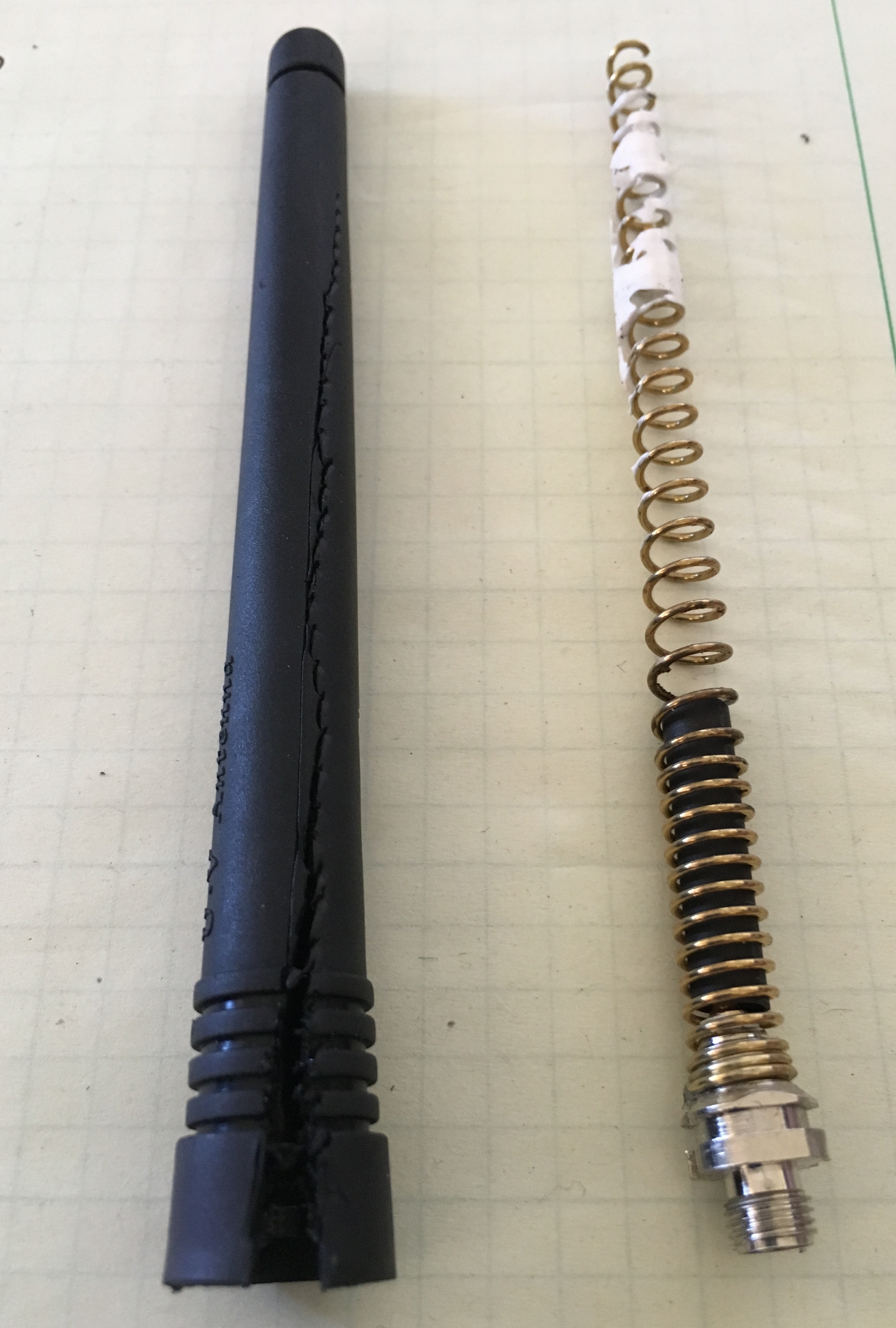
I started by dissecting a Baofeng UV-5R antenna, which took some aggressive action with a diagonal wire cutters to split the rubberized jacket near the bottom. After that, the jacket slid off to reveal the classic spiral antenna element inside. You can see some white adhesive near the top of the spiral element (upper right in the photo).
The Baofeng antenna had a female SMA connector.
Note: You can access high resolution versions of the photos in this article by clicking on them, allowing you to see lots of detail.
Yaesu FT-1DR Stock Antenna
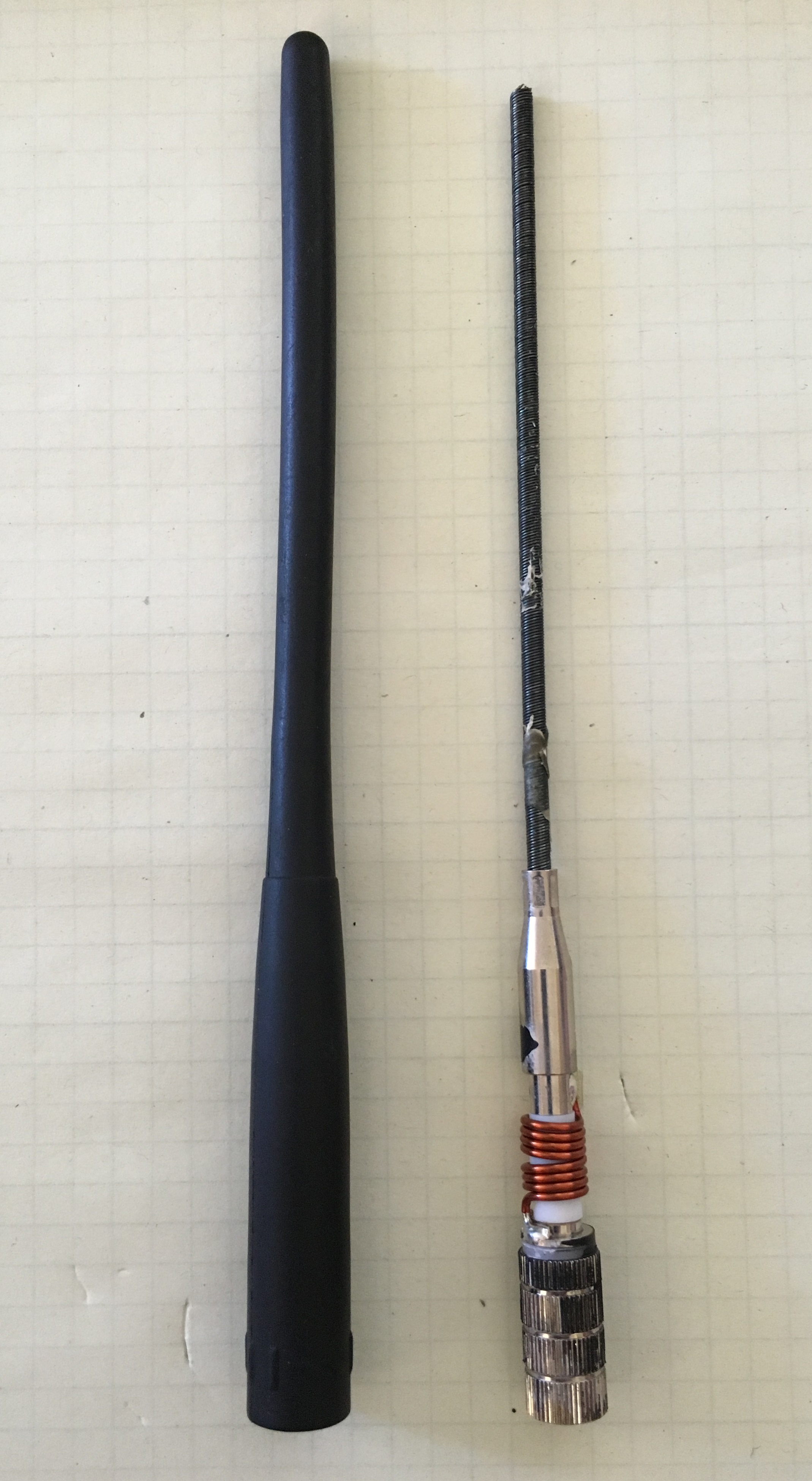
The Yaesu antenna was easy to disassemble. In fact, I chose this antenna because I noticed that the outside jacket had come loose and was starting to slide off the antenna. A steady pull on the cover exposed the antenna elements without any further antenna abuse. (I plan to reinstall the cover with a few dabs of glue and expect that it will continue to work fine.)
The construction of this antenna is quite different from the Baofeng. The main element is a very tightly-wound spring…so tight that I expect that it acts like a solid wire electrically. In other words, it doesn’t have the spiral configuration that makes the antenna act longer electrically. At the bottom of the antenna, there is a coil inserted in series with the radiating element (connects radiating element with the center pin of the SMA connector).
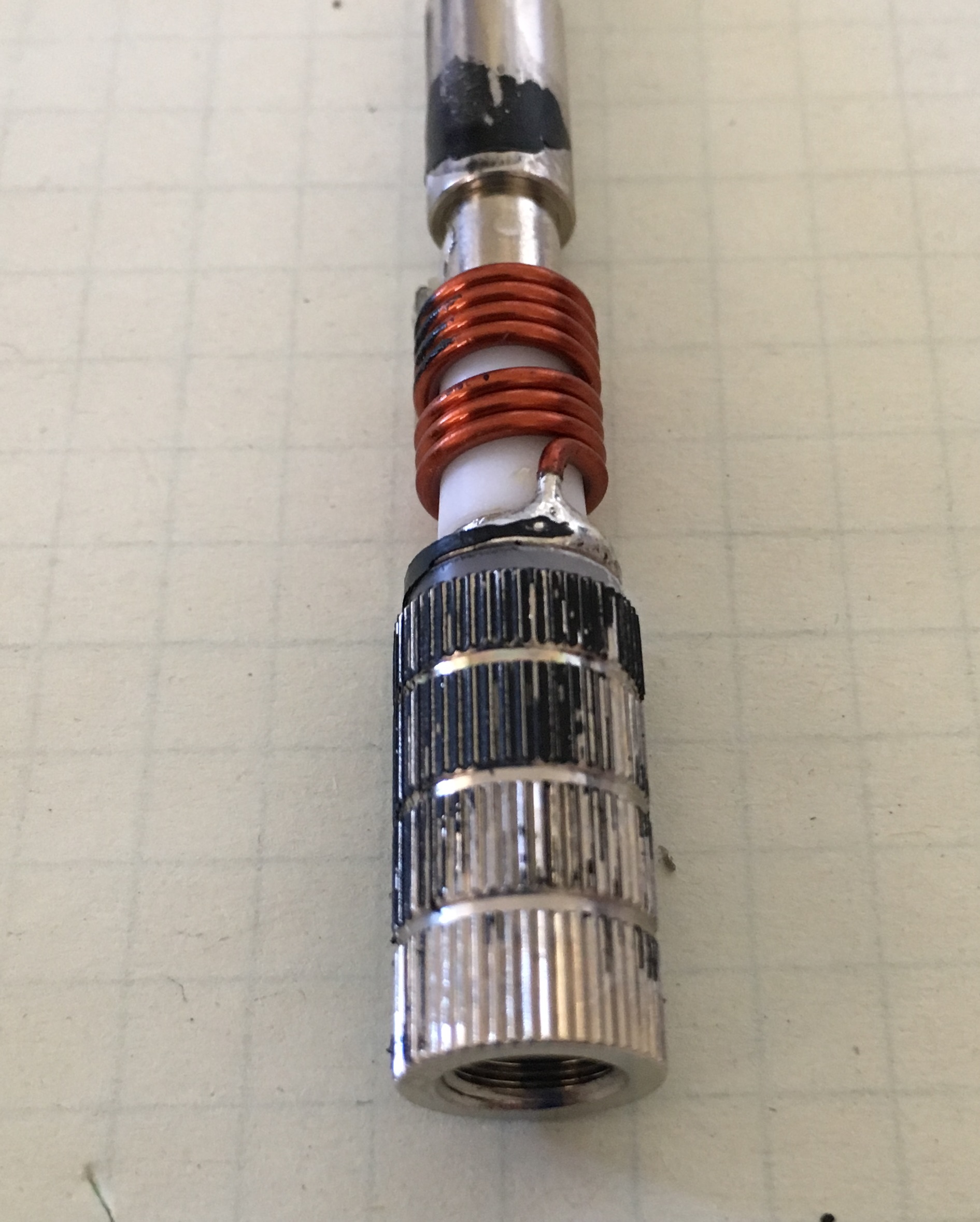
The photo to the right shows a closeup view of the male SMA connector and the coil.
Laird VHF Antenna
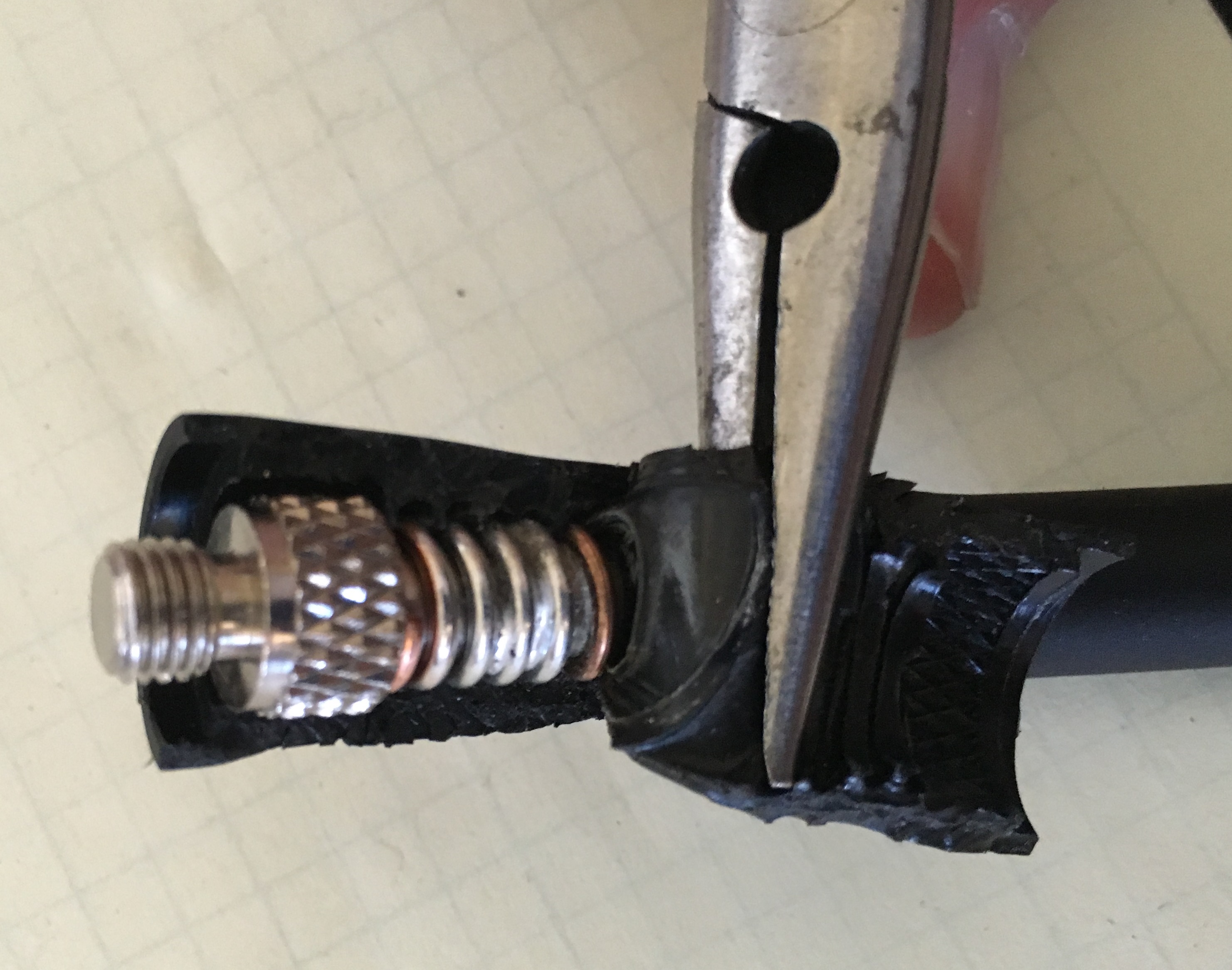
Next, I wondered if antennas for commercial radios had different design or construction techniques. Laird makes high-quality antennas for the mobile radio and other commercial markets, so I purchased one of their VHF rubber duck antennas to dissect. This model is intended for use with Motorola radios requiring a threaded antenna stud.
This antenna was a challenge to cut open. I used a sharp knife and diagonal pliers to cut the rubberized jacket and peeled it back using a needle-nose pliers. The rubberized coating was embedded into the spiral antenna element, so it did not come apart easily. It took over an hour fighting with the antenna and I gave up before getting the entire spiral element exposed.
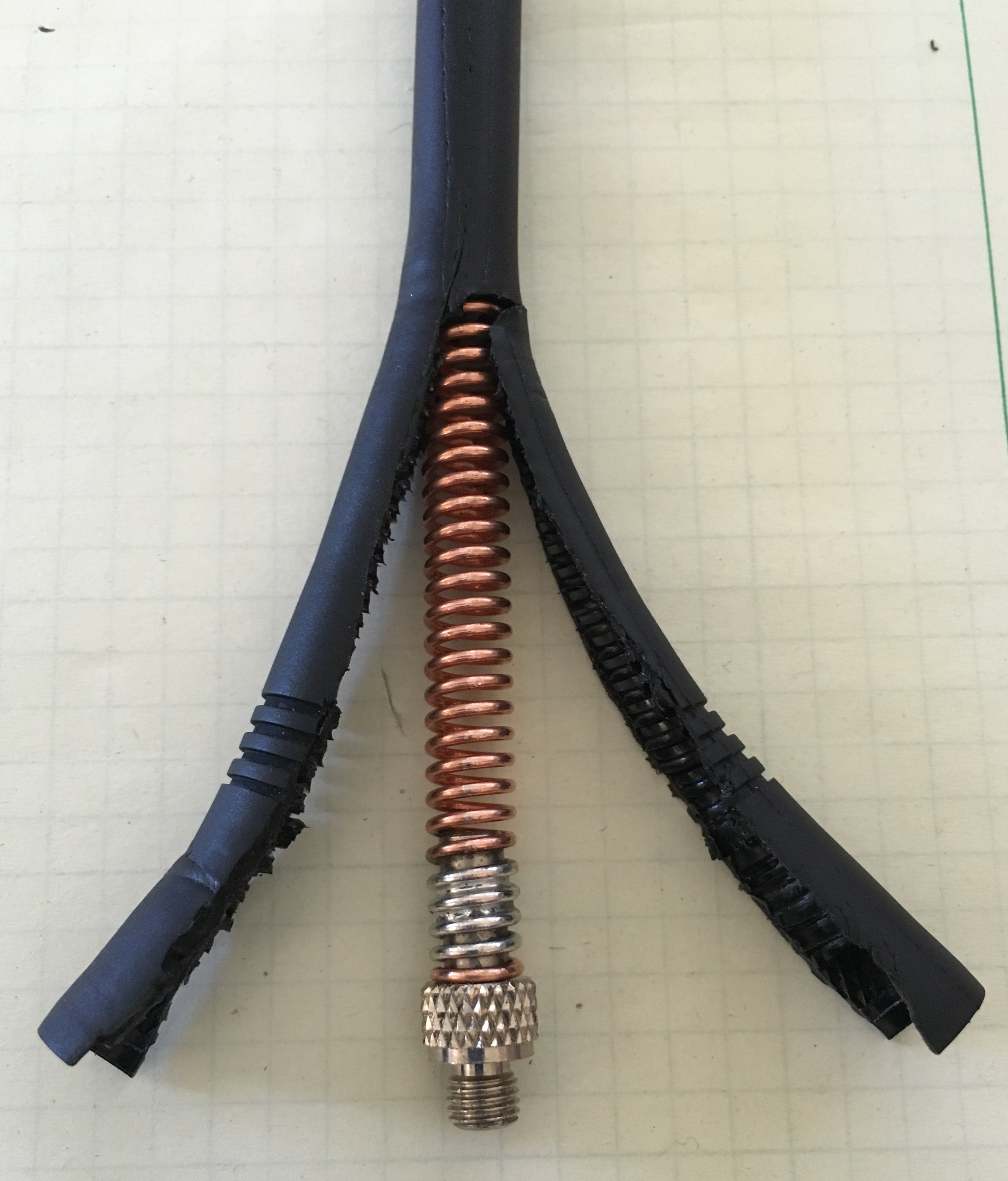
The Laird antenna is clearly the sturdiest of the three antennas. The spiral element is much thicker than the Baofeng and the rubberized coating is tougher and molded tightly into the spiral element.
The Baofeng and Laird antennas use the same design concept…just take a spiral antenna element and apply a protective cover. However, the Laird construction was far superior, but not a surprise given that Baofeng is a low-cost provider in the ham radio (consumer) market.
My disappointment is with the Yaesu antenna. The antenna came apart after one year of not very heavy use. I expect I can put it back together with some adhesive, improving on the design in the process.
Anyway, I found this interesting and wanted to share it with you. What’s in your rubber duck?
73, Bob KØNR
The post What’s In Your Rubber Duck? appeared first on The KØNR Radio Site.
Bob Witte, KØNR, is a regular contributor to AmateurRadio.com and writes from Colorado, USA. Contact him at [email protected].
IARU HF World Championship contest
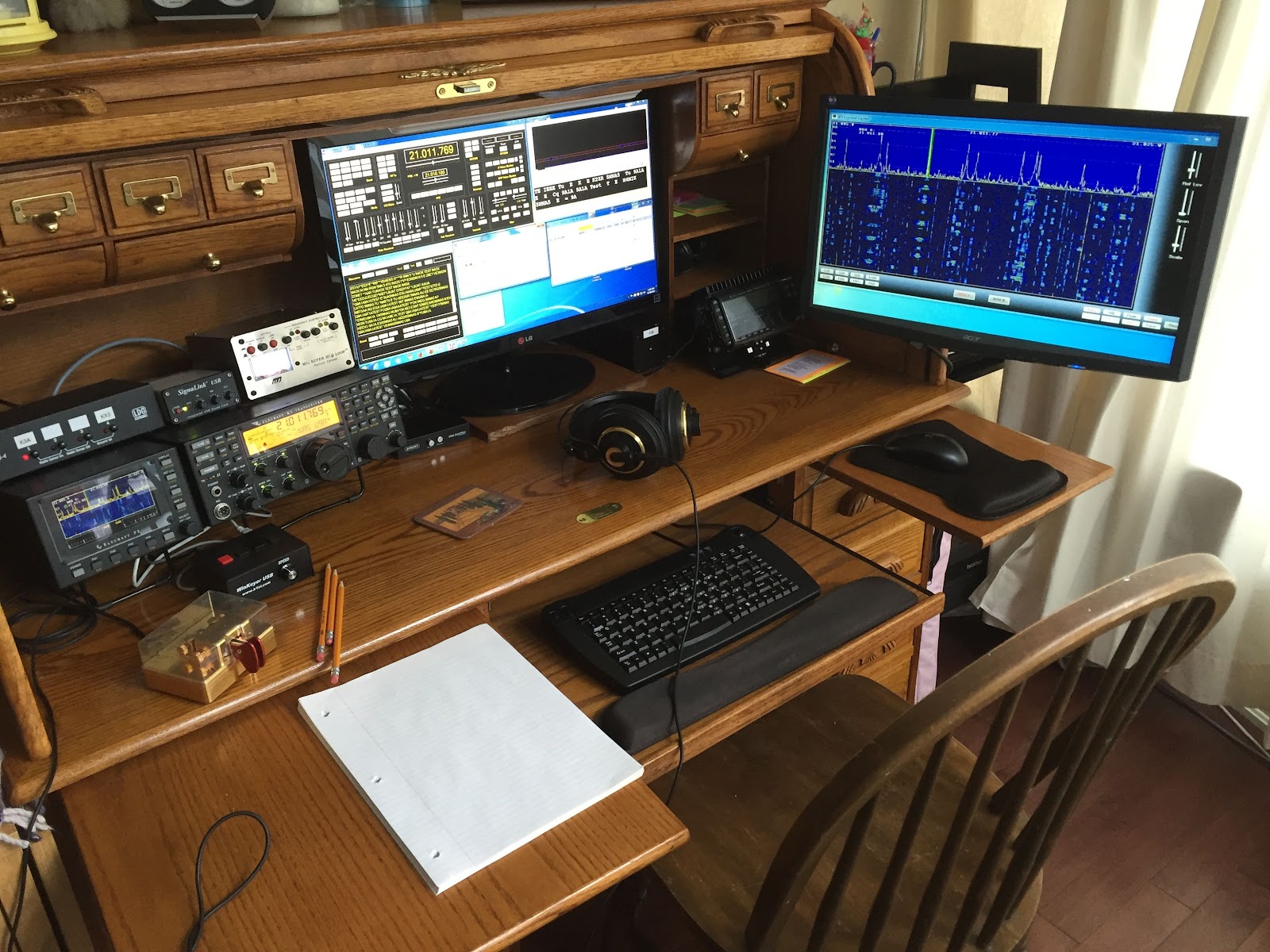
Mike Weir, VE9KK, is a regular contributor to AmateurRadio.com and writes from New Brunswick, Canada. Contact him at [email protected].
IARU HF World Championship contest
Mike Weir, VE9KK, is a regular contributor to AmateurRadio.com and writes from New Brunswick, Canada. Contact him at [email protected].
ICQ Podcast Episode 215 – Friedrichshafen 2016
In this episode, Martin M1MRB / W9ICQ is joined by Chris Howard M0TCH, Martin Rothwell M0SGL, Dan Romanchik KB6NU and Ed Durrant DD5LP to discuss the latest Amateur / Ham Radio news. Colin M6BOY rounds up the news in brief, and this episodes feature is Friedrichshafen 2016
- New Zealand Radio Hams Request 222-223 MHz
- 'No' to Lifetime Amateur Radio Licenses
- Rockford to Scramble All Police Radio Comms
- Andorra Returns to 60m, Gains 4m band, More Power on 6m
- Radio Caroline Special Event Station
- Clarification of RF LED Light Testing
- New RSGB Microwave Manager
- RF pollution from Solar Panels
- RSGB Training and Assessment Guide
Colin Butler, M6BOY, is the host of the ICQ Podcast, a weekly radio show about Amateur Radio. Contact him at [email protected].
 Ham Radio Deluxe |
 W5SWL Electronics |
 Ham Radio Prep |
 KB3IFH QSL Cards  Hip Ham Shirts  HamRadioAuctions HamRadioAuctions Reliance Antennas Reliance Antennas Enigma Shop Enigma Shop |  morseDX  Ni4L Antennas  R&L Electronics R&L Electronics antennas.us antennas.us QRV QRV |
- Matt W1MST, Managing Editor
