 |
 When 100mW’s QRPp can be QRO power!!
 26 August 2016 | by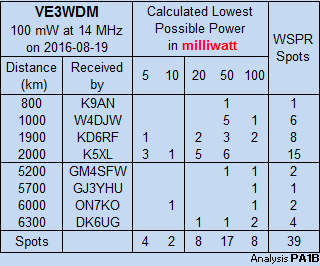
Mike Weir, VE9KK, is a regular contributor to AmateurRadio.com and writes from New Brunswick, Canada. Contact him at [email protected].
When 100mW’s QRPp can be QRO power!!
Mike Weir, VE9KK, is a regular contributor to AmateurRadio.com and writes from New Brunswick, Canada. Contact him at [email protected].
2016 Colorado QSO Party–Next Weekend
 As the long, dog-days of summer begin to come to an end it marks one of my favorite operating activities and that is the Colorado QSO Party. While I’m not a native to the Centennial State, I am always proud to represent Colorado and this year marks the 140th anniversary of statehood.
The 2016 Colorado QSO Party takes place on Saturday, 3 September beginning at 0400 UTC (7 AM to 10 PM MDT). I have a few mid morning commitments which I need to take care of, but KDØBIK should be on the air shortly after the lunch hour.
Perhaps it is naïve to anticipate better band conditions for next Saturday. After all…..

But I for one will be giving it a solid effort from the basement ham shack located in grid square DM79np. I hope to work you in the 2016 Colorado QSO Party.
Until then…
73 de KDØBIK
P.S. Episode 71 of the Practical Amateur Radio Podcast will release Saturday, 27 August. Thank you for listening!
Jerry Taylor, KD0BIK, is a regular contributor to AmateurRadio.com and writes from Colorado, USA. He is the host of the Practical Amateur Radio Podcast. Contact him at [email protected].
2016 Colorado QSO Party–Next Weekend
As the long, dog-days of summer begin to come to an end it marks one of my favorite operating activities and that is the Colorado QSO Party. While I’m not a native to the Centennial State, I am always proud to represent Colorado and this year marks the 140th anniversary of statehood.
The 2016 Colorado QSO Party takes place on Saturday, 3 September beginning at 0400 UTC (7 AM to 10 PM MDT). I have a few mid morning commitments which I need to take care of, but KDØBIK should be on the air shortly after the lunch hour.
Perhaps it is naïve to anticipate better band conditions for next Saturday. After all…..

But I for one will be giving it a solid effort from the basement ham shack located in grid square DM79np. I hope to work you in the 2016 Colorado QSO Party.
Until then…
73 de KDØBIK
P.S. Episode 71 of the Practical Amateur Radio Podcast will release Saturday, 27 August. Thank you for listening!
Jerry Taylor, KD0BIK, is a regular contributor to AmateurRadio.com and writes from Colorado, USA. He is the host of the Practical Amateur Radio Podcast. Contact him at [email protected].
Free ‘Ham Radio Podcasts’ App for Android
 Trevor Holyoak, KD7GHI, grew up in a house full of homemade gadgets that his dad made including clocks, a TV, and radios. He learned basic electronics from him, and practiced on a 150-in-one kit from Radio Shack.
“I watched him do CW and string wire antennas across the yard, and so I was aware of ham radio at a young age,” he said. “He built our first home computer, a Sinclair ZX81, from a kit and that got me started down a path that I’m still on today.”
Holyoak is a professional computer programmer and began creating Android apps on the side a few years ago.
“I got the idea to create the Ham Radio Podcasts app because I had already built a couple of other podcast apps for specific interests, and I discovered that there are a bunch of great amateur radio podcasts out there,” said Holyoak. “I put them all together in an app that makes it easy to listen to them. You can stream the episodes as you listen, or you can download them and listen to them later when you don’t have a data connection.”
A few of the twenty featured podcasts include 100 Watts and a Wire, ARRL’s The Doctor is In, Everything Ham Radio, Ham Nation, Ham Radio 2.0, Ham Radio 360, Ham Talk Live, and HamRadioNow.
Like many hams, Holyoak’s involvement in ham radio throughout his life has waxed and waned. “After a few years I became inactive, although I still kept a radio on hand in case of emergency,” he said.
It wasn’t until last year, when he was asked him to spearhead an emergency communications effort in his local area that he finally became active again. He is now very active and is currently studying for the General test. He purchased an all-band, all-mode base station and was recently elected as an officer for his local club.
“Since I’m currently a Technician, I mostly have been active on 2m and 70cm FM, although I’ve also been dabbling in SSB on 6m and trying to figure out how to reach someone on 10m with a end-fed long wire antenna,” he said. “I’m very interested in getting into digital modes on HF once I get my General license.”
Listening to the popular ham radio podcasts has been an easy way for him to get back up to speed quickly and learn about new aspects of the hobby.
“Personally, I most enjoy the podcasts that are in a particular technical subject that I’d like to learn more about,” he said. “Some of my favorites are ARRL’s The Doctor is In, Everything Ham Radio, and Ham Radio 360.”
The app is available free (ad-supported) on Google Play:
Ham Radio Podcasts
Matt Thomas, W1MST, is the managing editor of AmateurRadio.com. Contact him at [email protected].
Do You Have a Ham Radio ‘Elevator Pitch’?
 Everyone has an “Elevator Pitch” nowadays. The idea is to have something prepared to deliver in a minute or so (during an elevator ride) to a listener or reader.
Ham Radio can use elevator pitches, too, and you don’t even need an elevator!
One possibility is to use social networks or newsletters to do ham radio outreach. Your piece will be aimed at non-hams, and should catch their interest and tell them how to take action.
For example, I edit “Catalyst,” the monthly newsletter of our Oregon church. One of the perks of the job is a monthly column, “Cataclysm,” where I can write pretty much anything I like. In my experience, most community newsletters are perpetually hungry for material. If you can put together a few sentences with both subjects and verbs, you can deliver an effective elevator pitch for ham radio in a page or so. Pictures, even from a cell phone camera, are a plus in most publications.
The “Cataclysm” I wrote today is not meant to tell readers everything they need to know about ham radio or even about “Summits on the Air,” or SOTA. The aim is to give people a quick idea of what SOTA and ham radio are about, to suggest that they take action to find out more, and to tell them how to do that.
That’s not very much, but it’s a lot for one page. 
Andrew Ellis, NO6E, is a special contributor to AmateurRadio.com and writes from Oregon, USA. Contact him at [email protected].
DX from the Railroad Station
I rode my bike to the old Potter Place Railroad Station from Andover this afternoon. I worked Corsica, Oregon, Croatia and Spain. It was absolutely beautiful today.

It was a perfect, clear day around 75F. I rode about 2 miles from Andover along the old Northern Rail route. Part way into the ride I passed the old covered bridge at the Blackwater River.

The Potter Place station is a museum now. I set up under a huge pine tree on the south side of the track. I tossed a 30 foot wire over a branch and started with the KX3 on 20 meters. 9A2AJ, Tom from Croatia was calling CQ. I’ve worked him a dozen times before, and when I answered he asked if I was running 5 watts. He gave me a 579. He was 599 and I told him I was on a bike ride and was, indeed QRP.

Next I went to 17 meters where W1VDE, Roger in Oregon was just finishing up a QSO. At first he said I was only S1, but later he said I’d come up a lot and he gave me a 569. I tuned up a bit and was thrilled to work TK3LS on the island of Corsica. Laurent gave me a quick 599. He was very strong to me.

I was about to call it quits when I heard EA5KM in Spain calling CQ on 30 meters. He had a hard time copying my call, even though he was strong to me. We made a quick exchange and I packed up for the ride back. What a glorious day for a quick outing.
Jim Cluett, W1PID, is a regular contributor to AmateurRadio.com and writes from New Hampshire, USA. Contact him at [email protected].
 Ham Radio Deluxe |
 W5SWL Electronics |
 Ham Radio Prep |
 KB3IFH QSL Cards  Hip Ham Shirts  HamRadioAuctions HamRadioAuctions Reliance Antennas Reliance Antennas Enigma Shop Enigma Shop |  morseDX  Ni4L Antennas  R&L Electronics R&L Electronics antennas.us antennas.us QRV QRV |
- Matt W1MST, Managing Editor
