 |
 One stop daily Amatuer radio news update!
 15 October 2016 | by
Mike Weir, VE9KK, is a regular contributor to AmateurRadio.com and writes from New Brunswick, Canada. Contact him at [email protected].
Amateur Radio Weekly – Issue 129

Current rules holding Hams back from state-of-the-art technology
ARRL told the FCC in its comments that the current HF symbol rate “speed limit” reflects 1980s technology and has no place in an experimental radio service.
ARRL
Outernet broadcasting APRS packets globally
Outernet is a low data rate worldwide satellite downlink carried on three geostationary Inmarsat L-band sateliltes to provide web content (downlink files only) to remote areas anywhere in the world.
aprs.org
Building a Ham Radio power supply
After spending $820 for the radio, I wasn’t in the mood (or the financial state) to drop another $100 to $150 on an Alinco Power Supply.
Soliloquy Blog
Building your own GSM basestation
Having your own GSM basestation allows you to create your own private and free GSM network, or for more malicious illegal users it can allow you to create a system for intercepting peoples calls and data.
RTL-SDR.com
Open source, cross-band repeater board for high altitude ballooning
Project Echoloon is an Amateur Radio cross-band repeater device that can be lifted by a few helium or hydrogen-filled party balloons.
N0SSC
Top 10 Amateur Radio uses for the Raspberry Pi
The Raspberry Pi has proved to be a phenomenal hit with hobbyists around the world.
Adventures in Ham Radio
How the phonetic alphabet emerged
For a time the Able, Baker alphabet, derived from WWII when the US air force entered the war, hung around in aviation for years.
Southgate
Rehab for the KØNR Repeater
The SCOM 7K repeater controller has been in service for decades, handling multiple receivers and transmitters.
K0NR
What is Near Vertical Incident Skywave?
This series focuses on short-haul communication during a disaster in the Amateur Radio Service.
N4AE
Video
MMDVM home brew repeater demonstration
Here is a quick video clip showing the flexibility and ease of use when switching between the 3 digital modes DMR/DSTAR/FUSION.
N2LEM
Sean McQuillan: Engineer, farmer, pirate radio pioneer
Sean McQuillan single-handedly set up one of the first land-based pirate radio stations in the country. Sean recounts tales of many events in his life with humour, eloquence and humility.
Vimeo
Amateur Radio Weekly is curated by Cale Mooth K4HCK. Sign up free to receive ham radio's most relevant news, projects, technology and events by e-mail each week at http://www.hamweekly.com.
630m VK’s Light-Up North America
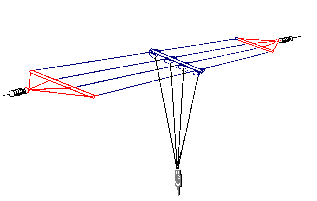
It seems that all of my blogspots of late have focused on 630m propagation ... but what has been happening down there recently has been both amazing and somewhat unexpected. With the growing number of active stations listening and transmitting, the band's propagation capabilities and mysteries are quickly revealing themselves.
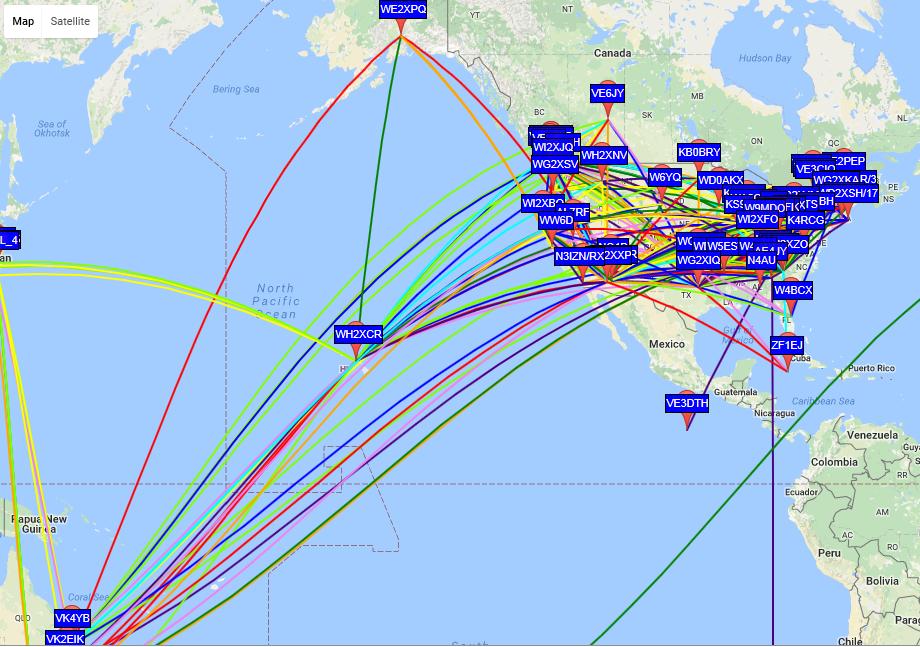
Last night was a great example but perhaps the WSPRnet prop map illustrates this best.
 |
| courtesy: http://wsprnet.org/drupal/wsprnet/map |
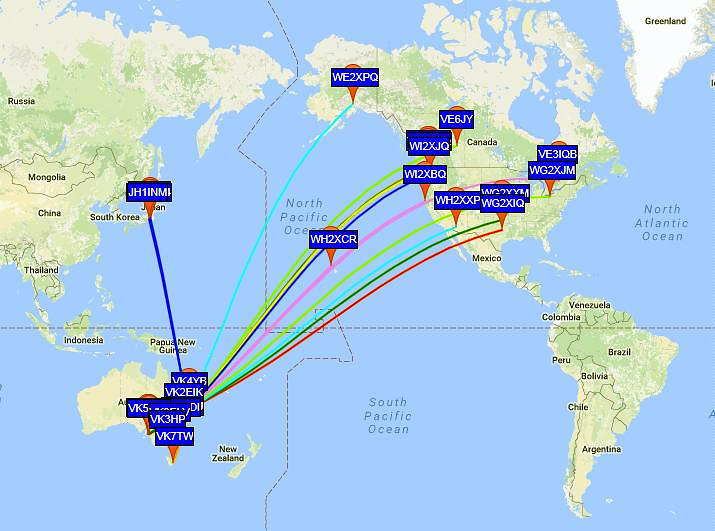
Particularly striking was the long haul propagation from VK to North America, with northernmost VK4YB leading the pack. His 90 watt signal made it all the way to VE3IQB, near Ottawa as well as to NO3M, in Pennsylvania! To provide further hope to those that have little room for big receiving antennas, VE3IQB uses a typical small active e-probe antenna, 20' above ground!
 |
| courtesy: http://wsprnet.org/drupal/wsprnet/map |
 |
| courtesy: http://www.swpc.noaa.gov/ |
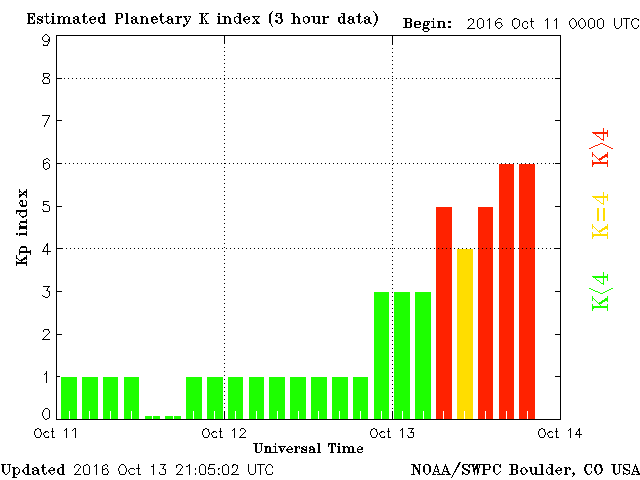
I'm theorizing that Roger's signal was arriving today at much lower angles than normal, evidenced by its far-reaching east coast reception and the fact that it couldn't get over my 600' local obstruction to the west. I've always believed that it takes higher angled signal arrival for me to hear Roger and today's events seem to support this.
Exactly what would cause this to be the case, I'll leave to the experts but I imagine that the sudden surge in geomagnetic activity played a significant role in today's very different propagation paths.
Roger was not the only VK lighting-up the map today. A much more detailed account of all the action can be found on the KB5NJD's daily 630m report here ... all very inspirational and hopefully enough to spur even more new activity on the MF band.
Why not give a listen and see what you can hear?
Steve McDonald, VE7SL, is a regular contributor to AmateurRadio.com and writes from British Columbia, Canada. Contact him at [email protected].
Bike Ride to the Potter Place RR Station
I made a quick bike trip from Andover to the old Potter Place railroad station this afternoon. The fall colors were beautiful and I worked Texas and Germany.

I rode along the old Northern Rail route. It’s a rails to trails bike path now. I heaved my wire over an oak tree across from the station and sat down in the grass with the KX3. I was using a 30 foot wire as a vertical with an EARCHI 9:1 unun. I started out on 17 meters and heard N5WNG calling CQ from Dallas. He was really strong… we must have had an excellent path because Mike gave me a 599 and judging by his signal, I think it was a real report.

I didn’t hear any other stations on 17 meters, so I switched to 20. Ralf, DK7AH in Munich was just finishing up a QSO and I called him. He was also very strong. He gave me a 579. He was running 500 watts with a 5 element yagi. “UR LOUD ES CLEAR,” he sent. We chatted for a few minutes and then I packed up for the return trip.

These beautiful fall days only last a short time. I’m trying to get out whenever I can.
Jim Cluett, W1PID, is a regular contributor to AmateurRadio.com and writes from New Hampshire, USA. Contact him at [email protected].
The Case for Mars
 Interest in Space has changed radically since Apollo ended in 1973 and the Shuttle Fleet has been retired. Advances in Science through NASA have continued since then, but mostly from Low Earth Orbit, leaving only interplanetary probes and landers to perform the state-of-the-art observations at the great distances to the planets.
Space communications are enjoyed by all Radio Operators’ with the rewards of exacting views of Mars, all the way to Pluto and well beyond.
Human space travel beyond the Van Allen Belt stopped in 1973. Excursions to Lunar Soil…no more. Since its conception, NASA has drafted scores and volumes of plans for every conceivable mission possible from this planet. But only one plan stands out as most feasible in view of the pioneering spirit of offworld adventure… Going to MARS!
Dr. Robert Zubrin, of Pioneer Astronautics, Lakewood Colorado has a vision that extends to colonizing the planet Mars. His radical approach surpasses NASA’s studies in “micro-gravity” since 1973 and in his words “..the purpose of spaceships is to actually travel across space and go to new worlds, not to hang out in space and observe the effects of doing so….” (circa 2003, US Senate Committee of Space Exploration) His Book, “Case for Mars” lays out the most suitable approach of a Mars Direct (or, Semi-Direct) Plan of going there.
The Mars Society has established a number of MARS simulation stations on Earth called “Analog Stations.” Two of these, MDRS & FMARS are affordable platforms offering a “near-to experience” for future Martian dwellers,
in the traditions Dr. Robert Zubrin’s Mars Direct Program.
Since the first “Crew 1” of 2001, the Crews have displayed techniques for:
- Growing sustainable crops to survive
- Health & Medical care
- Habitability & Water Reclamation
- Geodesics and Photogrammetry
- UAVs & Rovers
…all this, with devices brought with them for the duration of their stay.
What they lack is a realistic communications system to simulate the kinds of remote communications they would actually use on the planet. This article is a call to Hams to solicit help for the Mars Society in establishing some meaningful amateur radio between and around the camps. This help can either be radio work-groups or donations towards current state-of-the-art equipment & devices.
Amateur Radio Has a lot to offer the Mars Society activities. If they adopt ham radio, then the licensing requirements would be mandatory for Crew Members and Mission Control.
HF Frequencies could be used for making reports to Mission Control in Colorado, New Mexico or, in relaying reports between the other Analogues Stations.
Getting their licenses reminds these operators the importance of their radio studies. It is a medium to use at all times, no matter which world they are on.
The objective is to have BOTH Analogs & Mission Control “permanently equipped” with Communications, PCs, Sensors & hardware.
- Mission Control Radio Communication
( HF Med / High Power )
For “checking in” and reporting status of accomodations. - Point-to-Point Communication
( VHF – Low Power )
Mars has no ionosphere, therefore line-of-sight radio is handled by GMRS or 2 Meter Simplex Modes. Further Distance coverage is handled by a Remote, solar-powered, Repeater Station(s). - Telemetry
( VHF / UHF – Low Power using APRS ) for Weather, Seismic Sensor, Tracking, EVA Suit & Health, power charge monitoring. - Position Reporting
( VHF / UHF – Low Power using APRS)
RDF, APRS and EPLRS Methods can be used because by the time man and women arrive on MARS, there will be a network of GPS-MARS satellites to support exploration. In addition Radio Direction Finding can be useful for Search & Rescue. - Ground Penetrating Radar GPR
( UHF – 1 to 4 watts for depth data – VHF for data transfer )
Device mounted on Rover for high definition Tomography. - Satellite Communications
OSCAR SATS [any or all available] ( VHF – 20 to 35 Watts )
Remote Satellite Dish Controller and Program for Orbital Predictions. Exercising the practice of tracking and piloting a Supply Ship to and from the surface. - Power Management Monitoring
( VHF / UHF – Low Power )
Solar / Thermal / RTG Power Plants and Storage Arrays. - Enhanced UAV
( VHF / UHF – Low Power)
Ground Penetrating Radar.
Geodesics – LIDAR and Photogrammetry.
Seismic Sensor positioning. - Packet Digipeating
( VHF simulating MARS networks)
Wireless internet – Multi-node – Global coverage.
Telemetry,Telemetry, Telemetry….it’s about telemetry. The variety of existing APRS formats can be used to provide the neural life-blood of information that lives are depending on.
The objective is to use communications in a real-world environment to gain experience in day to day operations or emergencies 250 million miles away.
MARS simulated inhabitants would gain experience In the face of failures & power outages, and make immediate and command decisions as needed to conserve power in low power modes – alternate frequencies – troubleshoot – make on-the-fly Repairs.Similarly, MARS Ground Control would learn to activate alternate Tracking and communications Stations as needed to address every conceivable combination of situations no exceptions – as lives are on the line.
Communicating at such a remote and distant location, or in the protective cover of a Habitat or EVA Suit, is as important as the air they breathe.
The Mars Society’s Analog Stations of Hanksville, Utah, and Devon Island, Northern Canadian Reaches have been established over 15 years at locations almost identical to the Martian terrain, but with air. Well over 1,000 Crew Members have dedicated their studies of alternate foods, longevity, geology, mapping, power generation, tomography, astronomy, terraforming, fuel production…. …anything ….everything humanly devised, to be put to the task here and, out there.
Seen from their Crew Reports, there’s been limited use of telemetry, tracking and telecoms to date. University Teams who have introduced various hardware, have returned home with them and not left working systems behind to add to the stations. As such, the stations are relatively incomplete owing to the full spectrum of devices that are needed to make offworld procedures successful.
In the future, with Ham Radio participation and assistance in setting up communications, telemetry and networks, it is possible to see these Habitats fully equipped with more state-of-the art devices permanently on hand at all the Analogs and Mission Control Centers with real-time techniques and real-world equipment.
These Analogs and Simulatinos are not just practicing life on Mars for the sake of isolation. They are trying to replicate the full spectrum of conditions that would be involved in communicating with the distant world humans, and reporting their findings over these actual radio links. Using WiFi and the internet and our latest technology is not an accurate simulation. With Amateur Radio communications and links we would be practicing to be becoming proficient in the techniques involved in actually settling there.
This is a good opportunity for ham radio Elmers participate and consider what could be used on Mars and then help in setting it up (as well as get new experimenters, and scientists into the hobby).
Imagine how radio-quiet those first humans will find MARS to be. It will be like listening to the ether like Marconi first heard it on Earth a century ago, but without all the static and noise of lightning and thunderstorms. Maybe there are new noise sources on Mars or propagation possibilities as yet unexplored on Mars. Any ham radio made years ago still applies to the same Spectrum as devices do nowadays.
The radio communications needs are not just those on the surface of Mars but also every component that could very well be used: enroute to – orbiting above – onto, or under the Surface of Mars.
With the help of Hams, these Mars simulated stations on Earth can be much more than simple exercises in human isolation. The real-world experience with simple communications established from the ground up by the participants can be invaluable to learning about the experience of inhabiting a new world…
Think about this opportunity to involve Ham radio in not only the future of planetary exploration but also in involving these active and enthusiastic experimenters into a life long pursuit of the joy of radio communications.
Consider what you or your club can do to participate, or provide equipment donations that can be the instruments of success to this endeavor. The Mars Society is a nonprofit, and welcomes donations pertinent to their mission goals.
Dave Duca, KA9JSV, is a special contributor to AmateurRadio.com and writes from Wisconsin, USA.
DX and Blazing Fall Color

I hiked across Shute Hill this afternoon to David Swain’s Farm. The colors were stunning. I worked Bulgaria, the Cayman Islands, St. George Island, Aland Island, and Italy.
I started out at the old cemetery off the Rufus Colby Road and hiked south along a snowmobile trail. Along the way I took a snap shot of some of the trees.

It stayed in the 50s today, but was warm in the sun. I hiked about two and a half miles to the old range road and then into Swain’s field. I tossed my antenna wire into a gold maple and sat down in the grass with the KX3. Here’s a photo of the tree.

I operated on both 20 meters and 17 meters. Here’s my log:
11 Oct-16 1755 14.010 LZ3QE CW 559 589 Bulgaria
11 Oct-16 1758 18.072 ZF1DX CW 599 599 Cayman Islands
11 Oct-16 1800 18.074 K4G CW 599 599 St. George Island
11 Oct-16 1801 14.020 LZ1DS CW 449 599 Bulgaria
11 Oct-16 1806 14.027 IZ2QXG CW 559 579 Italy
11 Oct-16 1810 14.024 OH0Z CW 599 599 Aland Island
The color is a few days away from peak. But we may not get another brilliant
day like today. I’m glad I got out.
Jim Cluett, W1PID, is a regular contributor to AmateurRadio.com and writes from New Hampshire, USA. Contact him at [email protected].
VE3 – VE7 630m QSO
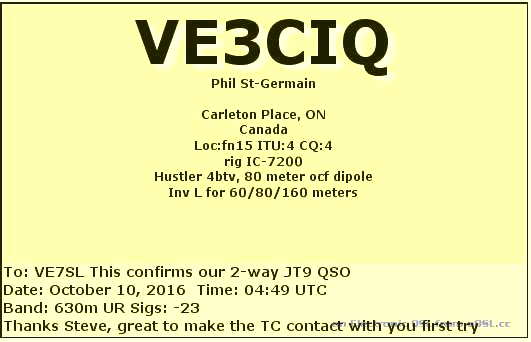
The 630m band continues to provide interesting challenges for Canadian amateurs ... be they antenna, equipment or propagation related.
Sunday night produced another flurry of excitement on the new band, further demonstrating its potential for small stations operating from the suburbs.
On Sunday evening, VE3CIQ in Carleton Place, Ontario (southwest of Ottawa), and I, completed a two-way JT9 contact, following a short exchange of the required information (and more) just after midnight, Ontario time.
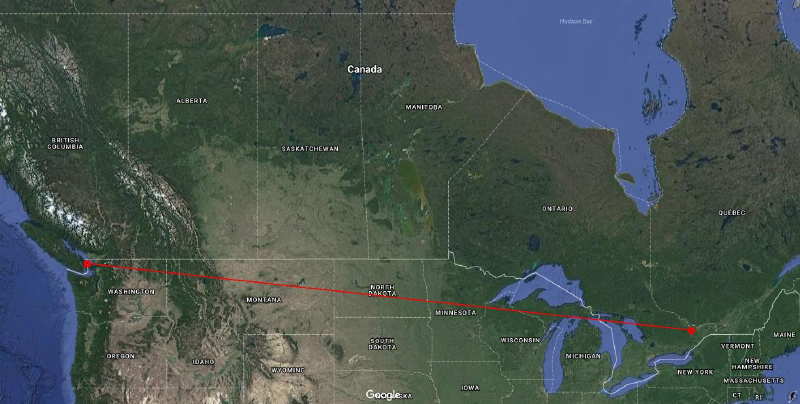 |
| courtesy: https://www.google.ca/maps/ |
Noting the increased east-west favorability over the past few nights, Phil and I decided to give it a shot and were delighted to cover the 2200 mile / 3500km path while Murphy was sleeping and not messing with propagation.
Rather than randomly beacon on JT9, we both set 'calling each other' messages. Although this continued for some time, the QSO only took 12 minutes to complete once I started to decode Phil's signal out west. He had been decoding me and sending signal reports for a long time before his signal eventually peaked up here for the evening. I suspect that we could have continued the contact for the remainder of the night as his signal was getting stronger and stronger as we worked.
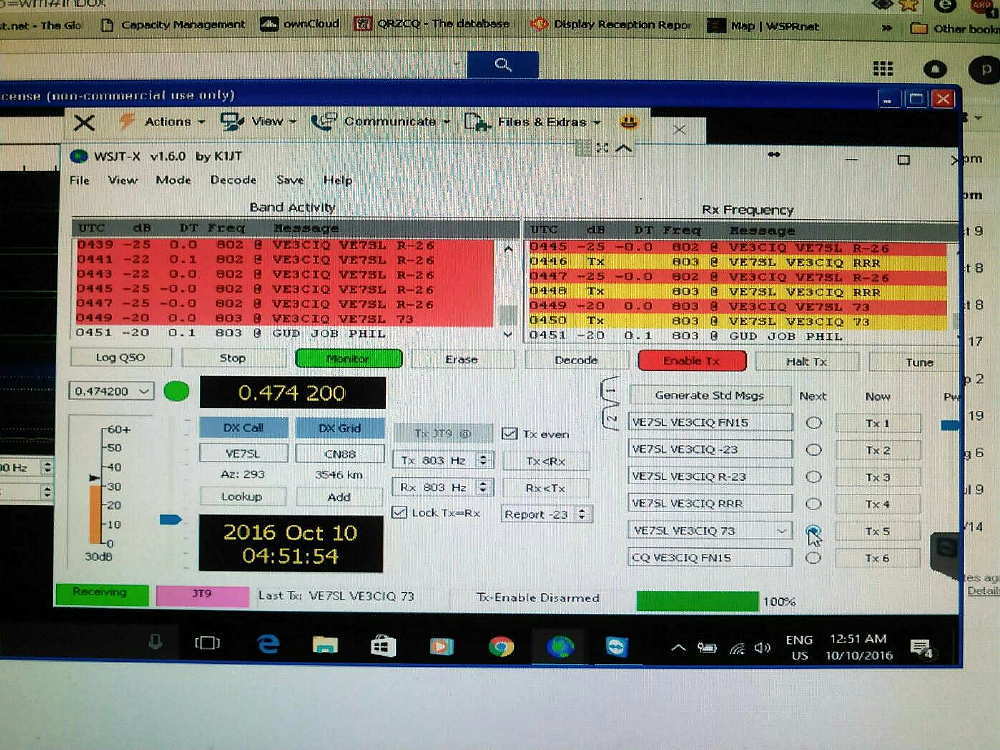 |
| Screen shot of QSO from VE3CIQ's end |
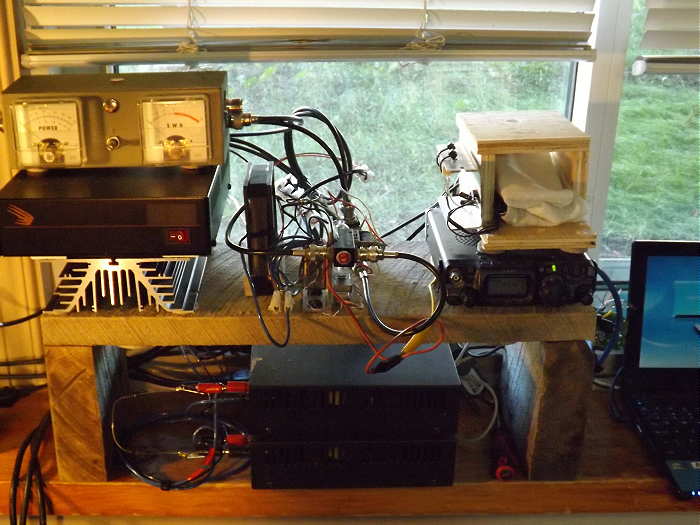 |
| VE3CIQ - 630m Station |
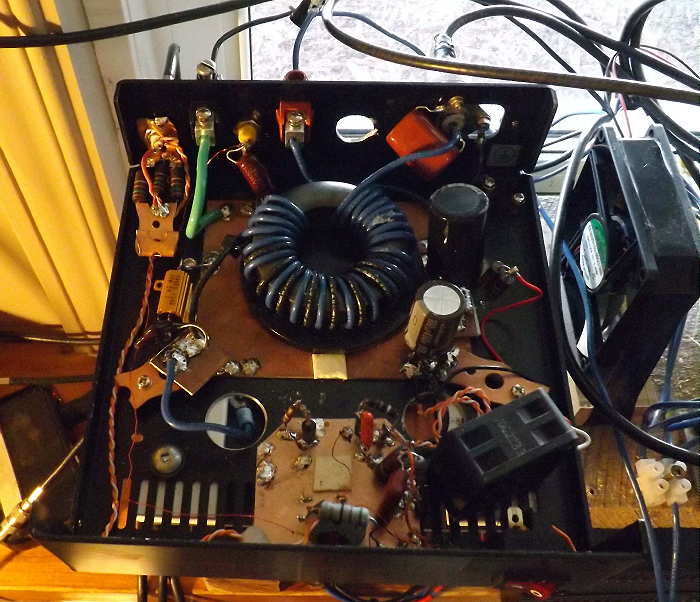 |
| VE3CIQ - Homebrew 630m Class-E Transmitter |
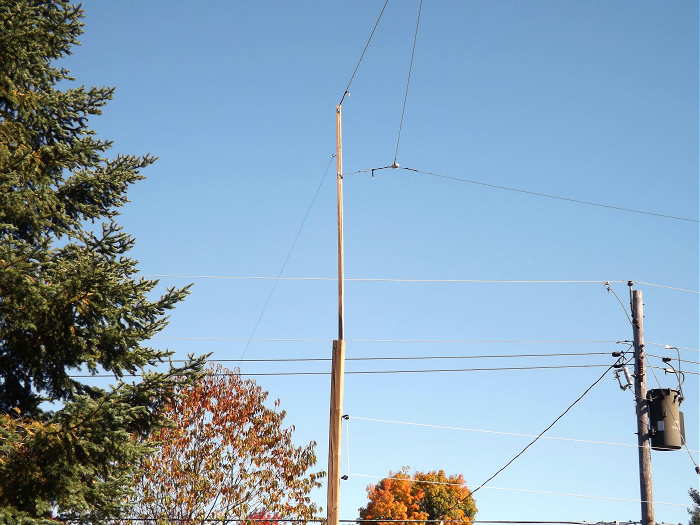 |
| VE3CIQ - 630m Linear-loaded Antenna |

Phil's station stands as yet another fine example of those living in the suburbs without a lot of room for antennas yet still able to successfully operate and explore our new 630m band. With a little ham-radio creativity, it's surprising how well a small station can perform, especially when the propagation co-operates.
Following our contact, I moved back to the WSPR section of the band and continued beaconing overnight.
Apparently Phil and I picked a good evening to run a sked as the overnight WSPR map shows it to have been the best night of the new DX season so far, with forty-four individual stations reporting my signal via the WSPRnet website.
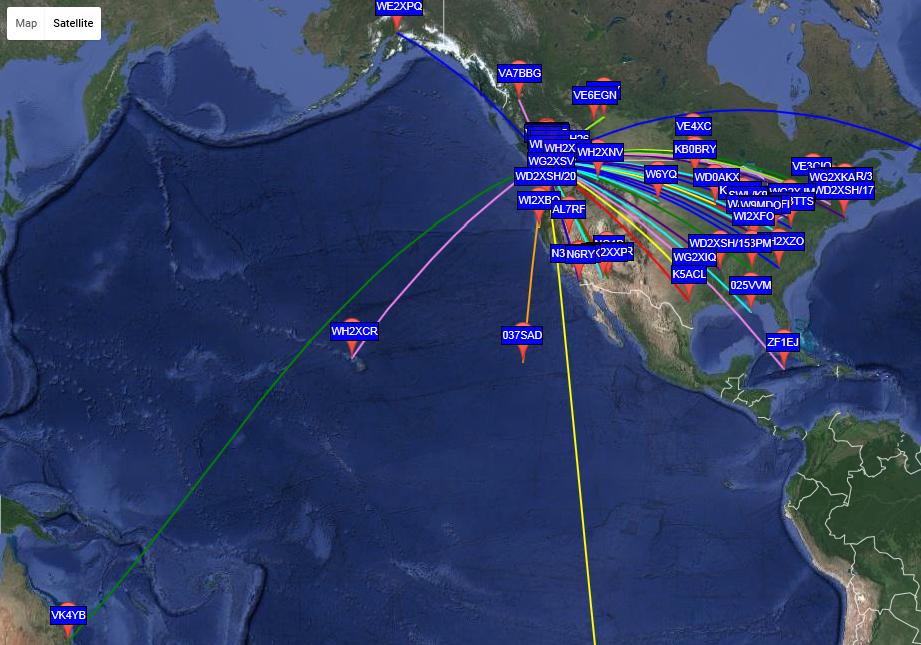 |
| courtesy: http://wsprnet.org/drupal/ |
Steve McDonald, VE7SL, is a regular contributor to AmateurRadio.com and writes from British Columbia, Canada. Contact him at [email protected].
 Ham Radio Deluxe |
 W5SWL Electronics |
 Ham Radio Prep |
 KB3IFH QSL Cards  Hip Ham Shirts  HamRadioAuctions HamRadioAuctions Reliance Antennas Reliance Antennas Enigma Shop Enigma Shop |  morseDX  Ni4L Antennas  R&L Electronics R&L Electronics antennas.us antennas.us QRV QRV |
- Matt W1MST, Managing Editor
