 |
 Weekly Propagation Summary – 2016 Oct 17 16:10 UTC
 17 October 2016 | by
Here is this week’s space weather and geophysical report, issued 2016 Oct 10 0105 UTC.
Highlights of Solar and Geomagnetic Activity 03 – 09 October 2016
Solar activity was at very low levels with a few background flares observed from Regions 2598 (N14, L=174, class/area Dai/140 on 07 Oct), 2599 (S14, L=144, class/area Cko/460 on 05 Oct) and 2600 (N13, L=105, class/area Cso/110 on 09 Oct). On 08 Oct, between 08/1500-1700 UTC, a 10 degree long filament erupted in the NE quadrant centered near N38E40. A slow-moving, asymmetric, partial-halo CME was observed in LASCO C2 imagery, first visible at 09/0048 UTC.
No proton events were observed at geosynchronous orbit.
The greater than 2 MeV electron flux at geosynchronous orbit was at high levels during the entire summary period. A maximum of 32,138 pfu was observed at 03/1640 UTC.
Geomagnetic field activity was highlighted by mostly unsettled to active levels on 03-05 Oct. An isolated minor storm (G1-Minor) period was observed early on 04 Oct. Mostly quiet levels were observed from 04-09 Oct with isolated unsettled and active periods were observed early on 07 and 08 Oct, respectively. The enhanced geomagnetic activity was due to high speed winds from a recurrent positive polarity coronal hole. Some further enhancement occurred early on 04 Oct due to CME effects from an eruptive filament observed early on 01 Oct.
The solar wind environment began the period at about 500 km/s, increased to near 600 km/s midday on 04 Oct and slowly decreased to end the period at about 370 km/s. Total field generally ranged from 2-6 nT with a peak of 10 nt observed midday on 04 Oct. The Bz component was mostly variable between +/- 6 nT. Phi angle was in a general positive orientation throughout the period.
Forecast of Solar and Geomagnetic Activity 10 October – 05 November 2016
Solar activity is expected to be at very low levels with a chance for C-class flare activity throughout the outlook period.
No proton events are expected at geosynchronous orbit.
The greater than 2 MeV electron flux at geosynchronous orbit is expected to be at high levels on 10-11, 16-18, 24-26, 30-31 Oct and 01-06 Nov increasing to very high levels on 27-29 Oct. This is due to the anticipated influence of multiple, recurrent CH HSSs. Normal to moderate levels are expected for the remainder of the outlook period.
Geomagnetic field activity is expected to be at unsettled to active levels on 11-18, 23-31 Oct and 01 Nov. G1 (Minor) field activity is possible on 13-15, 17 and 23-31 Oct with G2 (Moderate) levels possible on 24-26 Oct. This activity is due to the anticipated influence of multiple, recurrent CH HSSs. Additional enhancement to the field is expected on 13-14 Oct due to CME effects from the 08 Oct filament eruption. Generally quiet to unsettled conditions are expected for the remainder of the outlook period.
Don’t forget to visit our live space weather and radio propagation web site, at: http://SunSpotWatch.com/
Live Aurora mapping is at http://aurora.sunspotwatch.com/
If you are on Twitter, please follow these two users: + https://Twitter.com/NW7US + https://Twitter.com/hfradiospacewx
Get the space weather and radio propagation self-study course, today. Visit http://nw7us.us/swc for the latest sale and for more information!
Check out the stunning view of our Sun in action, as seen during the last five years with the Solar Dynamics Observatory (SDO): https://www.youtube.com/watch?v=zXN-MdoGM9g
We’re on Facebook: http://NW7US.us/swhfr
Visit, subscribe: NW7US Radio Communications and Propagation YouTube Channel
AmateurLogic 96: Our 11th Anniversary
AmateurLogic.TV Episode 96 is now available for download.
It’s our 11th Anniversary and we give away the Icom IC-7300 with accessories from MFJ to one lucky ham.
Peters got tips before you buy an Antique Radio. Emile continues his cheap network experiments. Tommy joins the DStar QSO Party. George builds the Arduino Pushbutton Radio.
1:25:35
George Thomas, W5JDX, is co-host of AmateurLogic.TV, an original amateur radio video program hosted by George Thomas (W5JDX), Tommy Martin (N5ZNO), Peter Berrett (VK3PB), and Emile Diodene (KE5QKR). Contact him at [email protected].
11th Anniversary Contest Winner Announced

And the winner is Joseph Ryan, Jr, N3NAI of Cape Coral, Fl. Joseph’s name was selected in the random drawing during the October 15th episode.
George Thomas, W5JDX, is co-host of AmateurLogic.TV, an original amateur radio video program hosted by George Thomas (W5JDX), Tommy Martin (N5ZNO), Peter Berrett (VK3PB), and Emile Diodene (KE5QKR). Contact him at [email protected].
SOTA Activation: Bald Mountain (W0C/SP-115)
On Saturday, I activated Bald Mountain (W0C/SP-115) for Summits On The Air. It was an awesome fall day here in the Rockies, so Joyce KØJJW and I were ready for some outdoor fun. When you say you are going to the summit of Bald Mountain, the usual response is “which Bald Mountain?” Fortunately, for SOTA purposes we can use the designator (W0C/SP-115) to drive out the ambiguity. Else, you have to deal with the fact there are 32 summits in Colorado known as Bald Mountain. And I am sure there are many more in other states.
SP-115 is a drive-up summit if you have a reasonable 4WD vehicle. For us, this meant taking the Jeep Wrangler to the top. (I am still recovering from a fractured ankle and just starting to hike a bit, so a drive-up opportunity sounded good to me.) Many maps do not show the road up Bald Mountain, so I included a portion of the latitude40smap.com map for the area (below). These recreational maps are excellent quality so I recommend you get one for exploring the area.
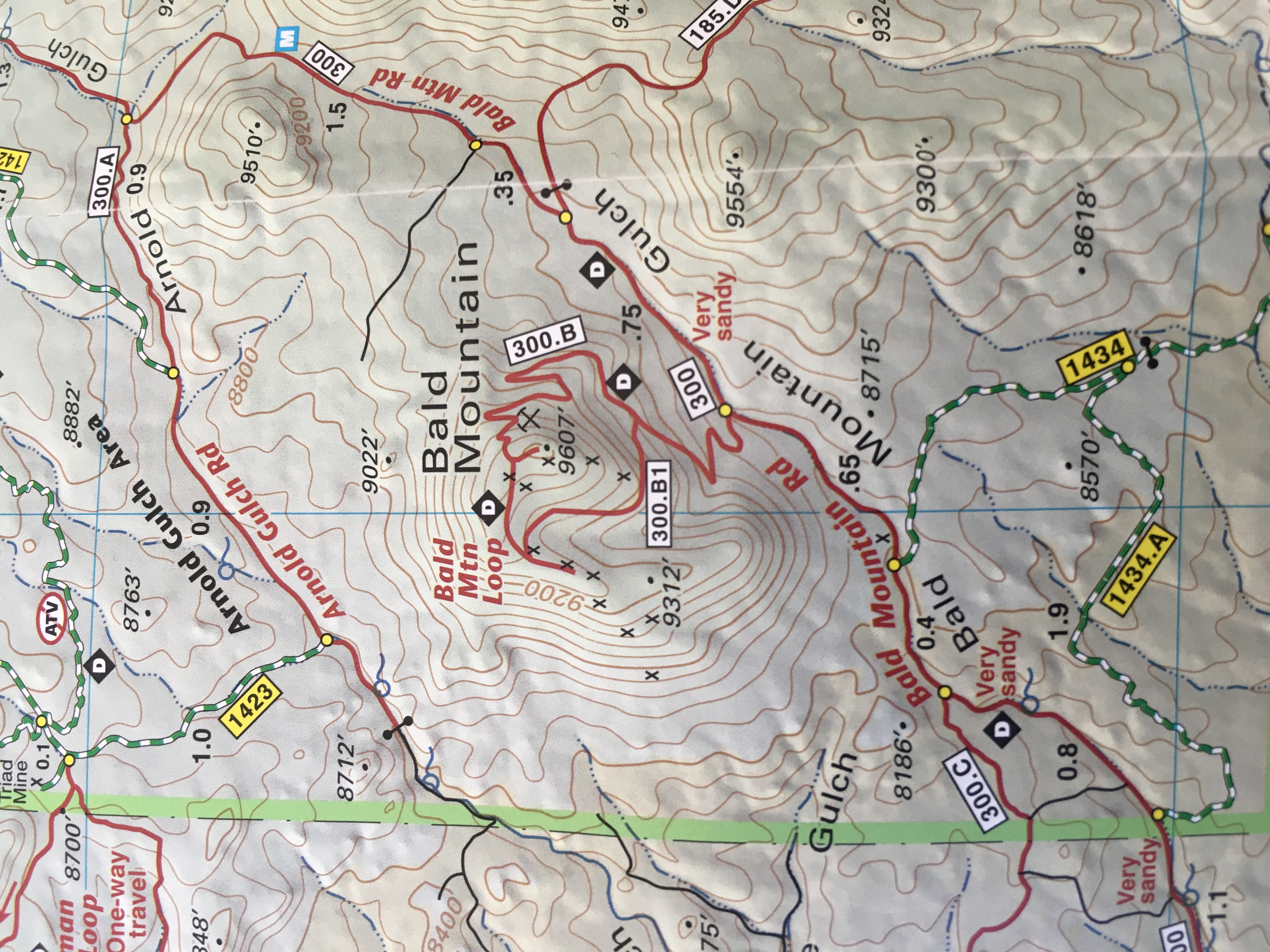
This summit is south of Buena Vista on Highway 285, which we exited at Fisherman’s Bridge, heading towards FS road 300. (Refer to the San Isabel National Forest or Latitude 40 map for details.) We followed FS 300 east which is easy 4WD. About 2 miles in, we took FS 300B (marked) to the north which winds its way up Bald Mountain.
At 0.6 miles from the intersection of 300 and 300B, an unmarked 4WD road leads off to the left and proceeds around the west side of the mountain. Taking this route provides a much easier path than the main route leading to the east side of the mountain. (We had taken the main route on our previous activation.) The preferred road does one big switchback out to the west and then returns east to the summit. This road is easy 4WD but is a bit narrow so a full size SUV or truck may have trouble. Of course, you can always hike to the summit…most likely just following the road.
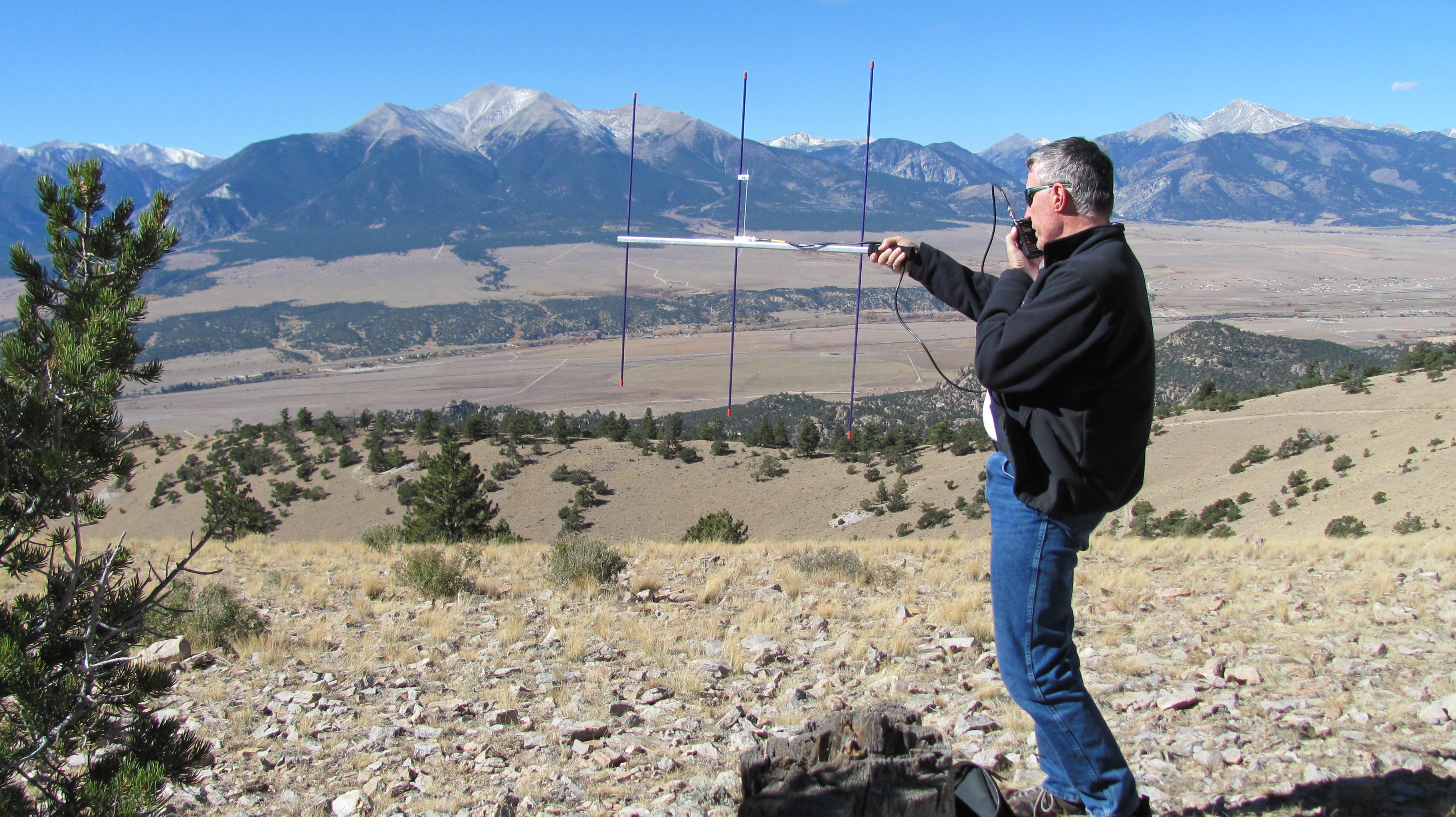 I got out my trusty Arrow 2m yagi antenna, connected it to the Yaesu FT-1D and started calling on 146.52 MHz. It took a while to get my four contacts but I kept at it. Actually, I worked five stations on 2m fm: KEØDMT, KDØMRC, K5UK, KAØABV and NØVXE. I was hoping to work WGØAT who was on the summit of Mount Herman, but I was unable to copy him. Thanks for the contacts! The summit has awesome views of the Collegiate Peaks to the west and it’s worth the trip just for the view.
73, Bob KØNR
The post SOTA Activation: Bald Mountain (W0C/SP-115) appeared first on The KØNR Radio Site.
Bob Witte, KØNR, is a regular contributor to AmateurRadio.com and writes from Colorado, USA. Contact him at [email protected].
ICQ Podcast Episode 222 – RFinder & Raynet Unification
In this episode, Martin M1MRB / W9ICQ is joined by Leslie Butterfield G0CIB Edmund Spicer M0MNG, Matthew Nassau M0NJX and Chris Howard M0TCH to discuss the latest Amateur / Ham Radio news. Colin Butler M6BOY rounds up the news in brief, and this episode’s feature is RFinder & Raynet Unification.
- Young UK Amateur Causing Emergency Services Havoc
- New Ofcom website
- Round-the-World Cyclist OZ1AA Returns
- 42 Years in Space for AO-7
- New Icom IC-7300 HF/50/70MHz Transceiver Firmware Update
- NZ 77-81 GHz Radiolocation and Vehicle Radar
- UNGO Ukrainian Amateur Radio League
Colin Butler, M6BOY, is the host of the ICQ Podcast, a weekly radio show about Amateur Radio. Contact him at [email protected].
ICQ Podcast Episode 222 – RFinder & Raynet Unification
In this episode, Martin M1MRB / W9ICQ is joined by Leslie Butterfield G0CIB Edmund Spicer M0MNG, Matthew Nassau M0NJX and Chris Howard M0TCH to discuss the latest Amateur / Ham Radio news. Colin Butler M6BOY rounds up the news in brief, and this episode’s feature is RFinder & Raynet Unification.
- Young UK Amateur Causing Emergency Services Havoc
- New Ofcom website
- Round-the-World Cyclist OZ1AA Returns
- 42 Years in Space for AO-7
- New Icom IC-7300 HF/50/70MHz Transceiver Firmware Update
- NZ 77-81 GHz Radiolocation and Vehicle Radar
- UNGO Ukrainian Amateur Radio League
Colin Butler, M6BOY, is the host of the ICQ Podcast, a weekly radio show about Amateur Radio. Contact him at [email protected].
A simple approach to VHF contesting
The UK Activity Contests (UKAC) are a series of VHF contests that happen every Tuesday night. There is a different band each week. The general set up is a signal report (genuine, not a 59 default), serial number and locator. The locator is used for multipliers. The calendar is as follows:
Every 1st Tuesday 2000-2230 (Local) 144MHz
Every 2nd Tuesday 2000-2230 (Local) 432MHz
Every 3rd Tuesday 2000-2230 (Local) 1.3GHz
Every 4th Tuesday 2000-2230 (Local) 50MHz & SHF
Every 5th Tuesday 2000-2230 (Local) 70MHz
So, its a pretty full calendar. I participate in the low power section, which is <10w but I actually run 5w from my FT817nd. Almost always portable and at most the 6m, 2m and 70cms sections. Antenna’s have been a mixture with some pretty substantial beam’s (for /p anyway) but my preference is for the now defunct Sotabeams SB270 for 2m and 70cm’s and a Nuxcom lightweight 6m yagi. I have moved away from heavy telescopic poles to a Harris 5m telescopic decorators pole.
The theme is to simplify some things but with a view to focus my spending on lightweight improvements. I find that this keeps my interest in building up as well as operating. Lets make this very clear, I’m not in it to win in, but to make use of the normally quiet VHF spectrum for some fun. DX is unusually no further than the south coast or the north of Scotland and the occasional trip a little bit further but conditions need to be exceptional.
So the latest addition is a more appropriate support for the pole. I was sick of using a drive on plate that was frankly destroying my £16 investment in a decorating pole. My car has a tow bar. I bought a ball attachment several years ago as it was right in front of me and very cheap. I now have a use for it.


The tow bar mount is made from a few off cuts of 47mm x 100mm (or 2″ by 4″ if you prefer) and a piece of rough sawn timber that was being used for shuttering for the summer house foundations. I used a 38mm hole saw so that the base is snug, but the upper support needs some kind of removable wedge.


It has been painted with Wilko’s timber paint left over from some other work (which is very good). I’ve yet to try it out but I’m impressed how quick it was to make. Let’s see how it performs, its certainly a lot simpler than buying an expensive drive on plate.
It remains to be seen if this is a worthwhile addition but it only has to deal with a little over a 1Kg in static mass so chances are even the most severe winds. In which case I won’t be out /p anyway. Next stop the antennas. To increase gain or not to increase gain, that is the question. I kind of know the answer really.
Alex Hill, G7KSE, is a regular contributor to AmateurRadio.com and writes from Cumbria, UK. Contact him at [email protected].
 Ham Radio Deluxe |
 W5SWL Electronics |
 Ham Radio Prep |
 KB3IFH QSL Cards  Hip Ham Shirts  HamRadioAuctions HamRadioAuctions Reliance Antennas Reliance Antennas Enigma Shop Enigma Shop |  morseDX  Ni4L Antennas  R&L Electronics R&L Electronics antennas.us antennas.us QRV QRV |
- Matt W1MST, Managing Editor
