 |
 An SWR anomaly….that suddenly popped up!!
 1 December 2016 | by
 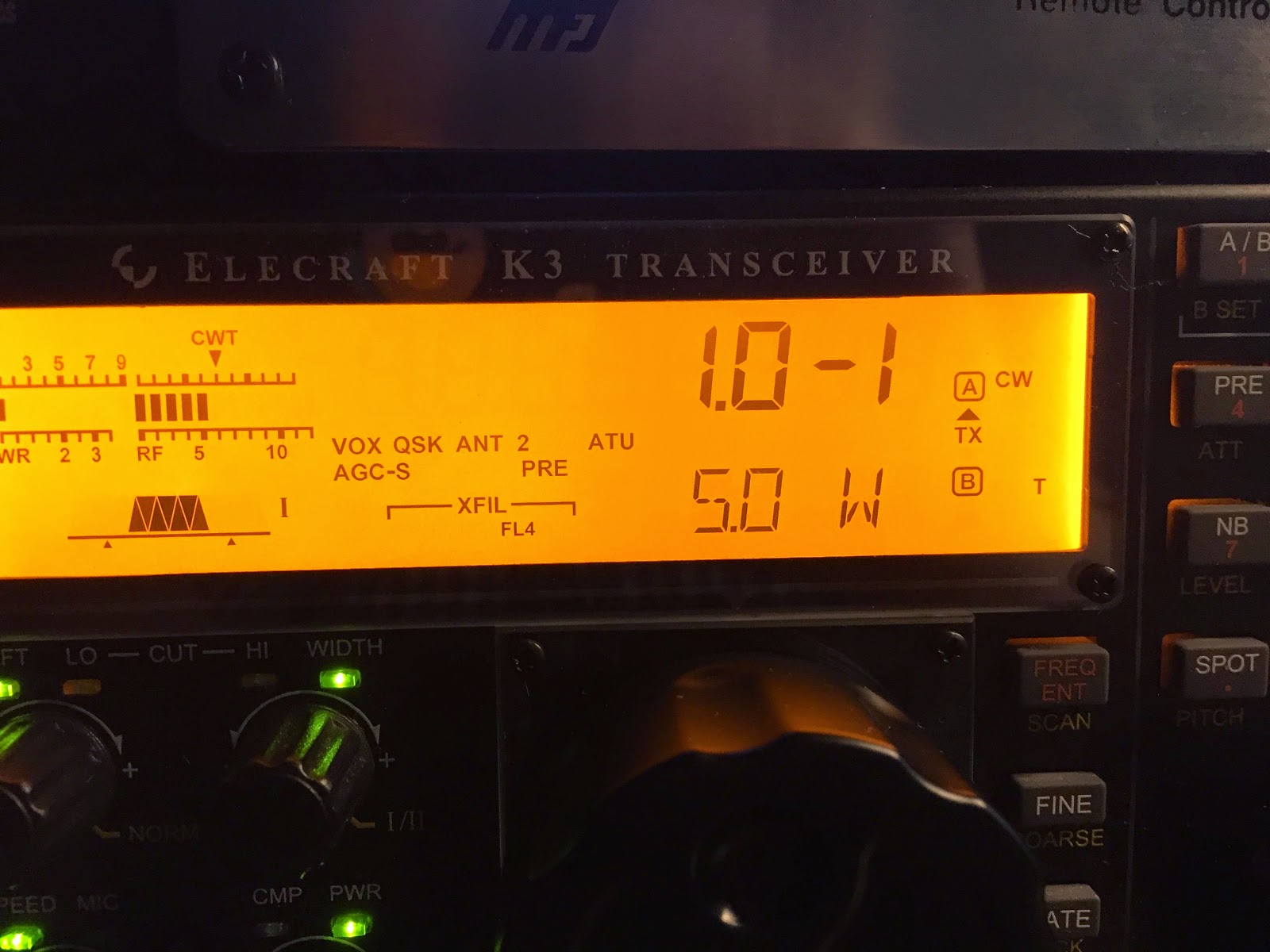 |
| SWR on 15m...and hoping to see it again on 20m |
Mike Weir, VE9KK, is a regular contributor to AmateurRadio.com and writes from New Brunswick, Canada. Contact him at [email protected].
CLE 213 Results
As usual, the wonderful LF and MF conditions experienced during the week went into the dumper as the CLE weekend arrived.
Looking back, most of this can be blamed on our monthly (~28 days) repetitive schedule which nicely matches the rotation of the Sun. It seems that the same large coronal hole stream that whacked us during CLE 212, is the same one that showed up for CLE 213 right on schedule. Perhaps we need to shift our schedule by a week in case it wants to hang around for yet another rotation.
Conditions were not as bleak as I make them sound but they were a far cry from those enjoyed earlier in the week. The skip seemed fairly long on all three nights, but most signals were on the runty side, with only a few making strong appearances here on the left coast.
As shown below, conditions were quite 'flat' for the entire weekend and propagation did not vary much in quality other than favoring slightly different regions each night. Interestingly, 'YLH - 247' in Landsdowne House, Ontario, whose antenna was pictured on my last blog, was not heard at all on both Friday or Saturday but had a booming signal on Sunday night.
Date 27 27 27 27 27 28 28 28 28 28 28 28 28 29
UTC 0900 1200 1500 1800 2100 0000 0300 0600
SFlx 81 81 81 81 83 83 83 83 83 83 83 83 85 85
A-in 12 12 12 12 10 10 10 10 10 10 10 10 7 8
K-in 3 3 2 1 2 2 2 2 2 1 2 3 2 3
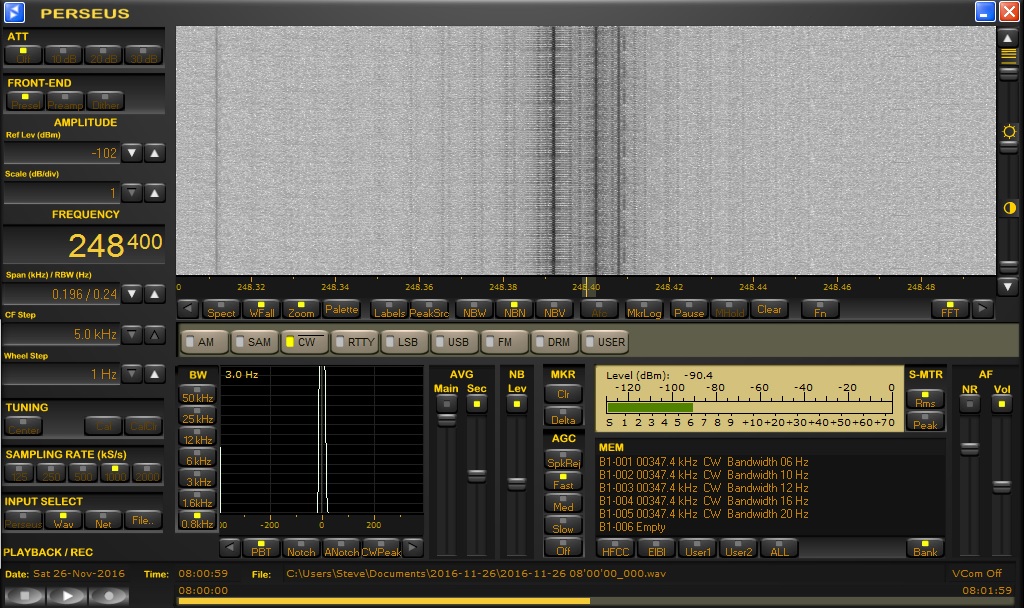
My usual procedure with the Perseus SDR is to record the CLE segments of the band for two minutes, every hour and every half-hour, from shortly after sunset to local sunrise. It then requires several hours of carefully going through the recordings to see what CLE signals were recorded ... sometimes spending up to an hour on one frequency only, sorting out what was coming through.
I have also found that the classic blue-screen waterfall does not yield the best contrast for finding weak signals ... the 'photo-negative' screen shown above is far superior, with signals in black appearing on a white background.
26 02:00 240.0 BVS Burlington, WA, USA
26 03:00 241.0 YGT Igloolik, NU, CAN
27 03:00 242.0 ZT Port Hardy, BC, CAN
26 03:00 242.0 XC Cranbrook, BC, CAN
27 08:00 242.0 MMI Athens, TN, USA
26 07:30 242.0 EL El Paso, TX, USA
27 06:30 244.0 TH Thompson, MB, CAN
27 06:30 245.0 YZE Gore Bay, ON, CAN
28 15:00 245.0 HNS Haines, ALS
27 06:30 245.0 CRR Circle, MT, USA
27 06:00 245.0 CB Cambridge Bay, NU, CAN
27 09:30 245.0 AVQ Marana, AZ, USA
27 04:00 246.0 ZXJ Fort St. John, BC, CAN
27 09:00 247.0 YLH Lansdowne House, ON, CAN
27 08:00 248.0 ZZP Queen Charlotte Is, BC, CAN
27 08:00 248.0 QL Lethbridge, AB, CAN
27 08:00 248.0 QH Watson Lake, YT, CAN
27 07:30 248.0 PQF Mesquite, TX, USA
27 06:30 248.0 GLA Gulkana, ALS
27 08:00 248.0 FRT Fairmont, SC, USA
27 08:00 250.0 FO Flin Flon Municipal, MB, CAN
27 08:00 250.0 2J Grand Forks, BC, CAN
27 08:00 251.0 YCD Nanaimo, BC, CAN
27 15:00 251.0 OSE Bethel Apt, ALS
28 08:00 251.0 JZY Macomb, IL, USA
27 06:30 251.0 BR Brainerd, MN, USA
27 08:00 251.0 AM Amarillo, TX, USA
27 10:00 253.0 GB Marshall, MN, USA
27 08:00 254.0 ZYC Calgary, AB, CAN
27 08:00 254.0 SM Fort Smith, AB, CAN
27 04:00 254.0 EV Inuvik, NT, CAN
27 04:00 256.0 LSO Kelso, WA, USA
27 14:00 256.0 EB Edmonton, AB, CAN
27 14:00 257.0 XE Saskatoon, SK, CAN
27 05:00 257.0 SQT Melbourne, FL, USA
27 07:00 257.0 SAZ Staples, MN, USA
27 08:30 257.0 PEA Pella, IA, USA
27 07:00 257.0 MB Saginaw, MI, USA
27 14:00 257.0 LW Kelowna, BC, CAN
27 12:00 257.0 HCY Cowley, WY, USA
27 08:00 258.0 ZSJ Sandy Lake, ON, CAN
27 06:30 420.0 V7BE2 XOC, XUU
27 08:00 420.0 PK Olathe, KS, USA
27 08:00 420.0 FQ East Chain, MN, USA
27 04:00 421.0 VLY McKenney, TX, USA
27 08:30 422.0 EA Kearney, NE, USA
27 06:30 424.0 RVJ Reidsville, GA, USA
27 06:00 425.0 PFL Fort Sill, OK, USA
27 06:00 426.0 FTP Fort Payne, AL, USA
27 08:00 426.0 EN Council Bluffs, NE, USA
27 07:30 428.0 POH Pocahontas, IA, USA
27 07:00 432.0 IZN Lincolnton, NC, USA
The logging at 0630Z of 'V7BE2' is a large drill ship, the "Deepwater Thalassa", located near the center of the Gulf of Mexico.
Steve McDonald, VE7SL, is a regular contributor to AmateurRadio.com and writes from British Columbia, Canada. Contact him at [email protected].
CLE 213 Results
As usual, the wonderful LF and MF conditions experienced during the week went into the dumper as the CLE weekend arrived.
Looking back, most of this can be blamed on our monthly (~28 days) repetitive schedule which nicely matches the rotation of the Sun. It seems that the same large coronal hole stream that whacked us during CLE 212, is the same one that showed up for CLE 213 right on schedule. Perhaps we need to shift our schedule by a week in case it wants to hang around for yet another rotation.
Conditions were not as bleak as I make them sound but they were a far cry from those enjoyed earlier in the week. The skip seemed fairly long on all three nights, but most signals were on the runty side, with only a few making strong appearances here on the left coast.
As shown below, conditions were quite 'flat' for the entire weekend and propagation did not vary much in quality other than favoring slightly different regions each night. Interestingly, 'YLH - 247' in Landsdowne House, Ontario, whose antenna was pictured on my last blog, was not heard at all on both Friday or Saturday but had a booming signal on Sunday night.
Date 27 27 27 27 27 28 28 28 28 28 28 28 28 29
UTC 0900 1200 1500 1800 2100 0000 0300 0600
SFlx 81 81 81 81 83 83 83 83 83 83 83 83 85 85
A-in 12 12 12 12 10 10 10 10 10 10 10 10 7 8
K-in 3 3 2 1 2 2 2 2 2 1 2 3 2 3
My usual procedure with the Perseus SDR is to record the CLE segments of the band for two minutes, every hour and every half-hour, from shortly after sunset to local sunrise. It then requires several hours of carefully going through the recordings to see what CLE signals were recorded ... sometimes spending up to an hour on one frequency only, sorting out what was coming through.
I have also found that the classic blue-screen waterfall does not yield the best contrast for finding weak signals ... the 'photo-negative' screen shown above is far superior, with signals in black appearing on a white background.
26 02:00 240.0 BVS Burlington, WA, USA
26 03:00 241.0 YGT Igloolik, NU, CAN
27 03:00 242.0 ZT Port Hardy, BC, CAN
26 03:00 242.0 XC Cranbrook, BC, CAN
27 08:00 242.0 MMI Athens, TN, USA
26 07:30 242.0 EL El Paso, TX, USA
27 06:30 244.0 TH Thompson, MB, CAN
27 06:30 245.0 YZE Gore Bay, ON, CAN
28 15:00 245.0 HNS Haines, ALS
27 06:30 245.0 CRR Circle, MT, USA
27 06:00 245.0 CB Cambridge Bay, NU, CAN
27 09:30 245.0 AVQ Marana, AZ, USA
27 04:00 246.0 ZXJ Fort St. John, BC, CAN
27 09:00 247.0 YLH Lansdowne House, ON, CAN
27 08:00 248.0 ZZP Queen Charlotte Is, BC, CAN
27 08:00 248.0 QL Lethbridge, AB, CAN
27 08:00 248.0 QH Watson Lake, YT, CAN
27 07:30 248.0 PQF Mesquite, TX, USA
27 06:30 248.0 GLA Gulkana, ALS
27 08:00 248.0 FRT Fairmont, SC, USA
27 08:00 250.0 FO Flin Flon Municipal, MB, CAN
27 08:00 250.0 2J Grand Forks, BC, CAN
27 08:00 251.0 YCD Nanaimo, BC, CAN
27 15:00 251.0 OSE Bethel Apt, ALS
28 08:00 251.0 JZY Macomb, IL, USA
27 06:30 251.0 BR Brainerd, MN, USA
27 08:00 251.0 AM Amarillo, TX, USA
27 10:00 253.0 GB Marshall, MN, USA
27 08:00 254.0 ZYC Calgary, AB, CAN
27 08:00 254.0 SM Fort Smith, AB, CAN
27 04:00 254.0 EV Inuvik, NT, CAN
27 04:00 256.0 LSO Kelso, WA, USA
27 14:00 256.0 EB Edmonton, AB, CAN
27 14:00 257.0 XE Saskatoon, SK, CAN
27 05:00 257.0 SQT Melbourne, FL, USA
27 07:00 257.0 SAZ Staples, MN, USA
27 08:30 257.0 PEA Pella, IA, USA
27 07:00 257.0 MB Saginaw, MI, USA
27 14:00 257.0 LW Kelowna, BC, CAN
27 12:00 257.0 HCY Cowley, WY, USA
27 08:00 258.0 ZSJ Sandy Lake, ON, CAN
27 06:30 420.0 V7BE2 XOC, XUU
27 08:00 420.0 PK Olathe, KS, USA
27 08:00 420.0 FQ East Chain, MN, USA
27 04:00 421.0 VLY McKenney, TX, USA
27 08:30 422.0 EA Kearney, NE, USA
27 06:30 424.0 RVJ Reidsville, GA, USA
27 06:00 425.0 PFL Fort Sill, OK, USA
27 06:00 426.0 FTP Fort Payne, AL, USA
27 08:00 426.0 EN Council Bluffs, NE, USA
27 07:30 428.0 POH Pocahontas, IA, USA
27 07:00 432.0 IZN Lincolnton, NC, USA
The logging at 0630Z of 'V7BE2' is a large drill ship, the "Deepwater Thalassa", located near the center of the Gulf of Mexico.
Steve McDonald, VE7SL, is a regular contributor to AmateurRadio.com and writes from British Columbia, Canada. Contact him at [email protected].
Ham College 23
Decibels, Metric Conversions and more questions from the Technician pool.
53:20
George Thomas, W5JDX, is co-host of AmateurLogic.TV, an original amateur radio video program hosted by George Thomas (W5JDX), Tommy Martin (N5ZNO), Peter Berrett (VK3PB), and Emile Diodene (KE5QKR). Contact him at [email protected].
Even better low-pass filters for transmitters
The last issues of QEX have featured two interesting articles by Gary Cobb, G3TMG. He outlines the advantage of using Zolotarev designs for the harmonic suppression filters of transmitters, giving even better suppression of the second harmonic than the more common Chebyshev or quasi-elliptic filters.
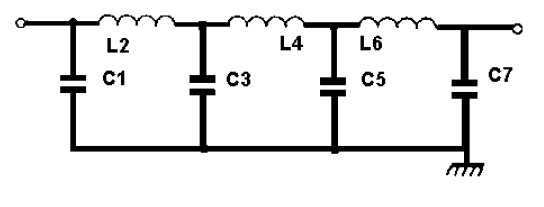 |
| Chebyshev low-pass filter from the GQRP data sheet (issue 1) |
My interest in this was triggered by the test of the Ultimate 3 QRSS/WSPR kit from QRP Labs in the Nov 2016 QST. The review was positive overall, but it was remarked that the harmonic suppression does not meet FCC requirements (-43 dBc or better). I am not sure whether this is due to PCB layout issues, or if better filters can alleviate it, but I note that the design uses the simplest filter of the ones I have listed here.
The evolution of filters for use for harmonic suppression follows at least these three steps:
- Chebyshev type I filters with equiripple in the passband and a monotonically falling, maximally flat stopband. A 7-pole version with three inductors and four capacitors in a pi-network has been around for a while, in e.g. the old recommendation from the GQRP club. It was based on the QST paper “Low-pass filters for amateur radio transmitters,” Ed Wetherhold, W3NQN, Dec. 1979. Two designs for a 20 m filter were given there:
1) Max. ripple in passband: 0.00731 dB, attenuation at 28 MHz: 40.7 dB
1) Max. ripple in passband: 0.00960 dB, attenuation at 28 MHz: 34.5 dB 
Second-harmonic optimized low-pass filter from the
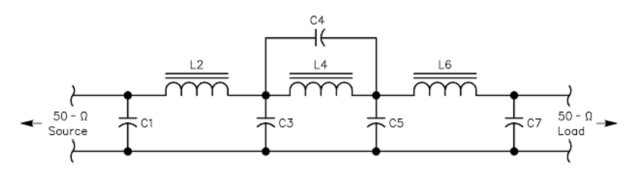
GQRP data sheet (issue 2)An improved stopband was the topic of W3NQN’s article “Second-harmonic optimized low-pass filters” in QST Feb. 1999. Here there is one additional capacitor as the central inductor is made into a parallel resonance which gives a zero in the stopband, based on an idea by Jim Tonne, WB6BLD. The design goal is that this zero should be at the second harmonic frequency. W3NQN proposed to call this a Chebyshev filter with a zero (CWAZ) filter, but it is more correct to call it a quasi- or pseudo-elliptic filter as remarked by G3TMG. It increases the attenuation at the second-harmonic in the 20 m design to better than 60 dB. This design is the basis for the current (Issue 2) G-QRP technical sheet. This would also be interesting to test in the QRP Labs Ultimate 3 transmitter kit.
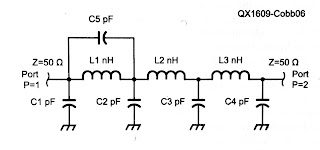
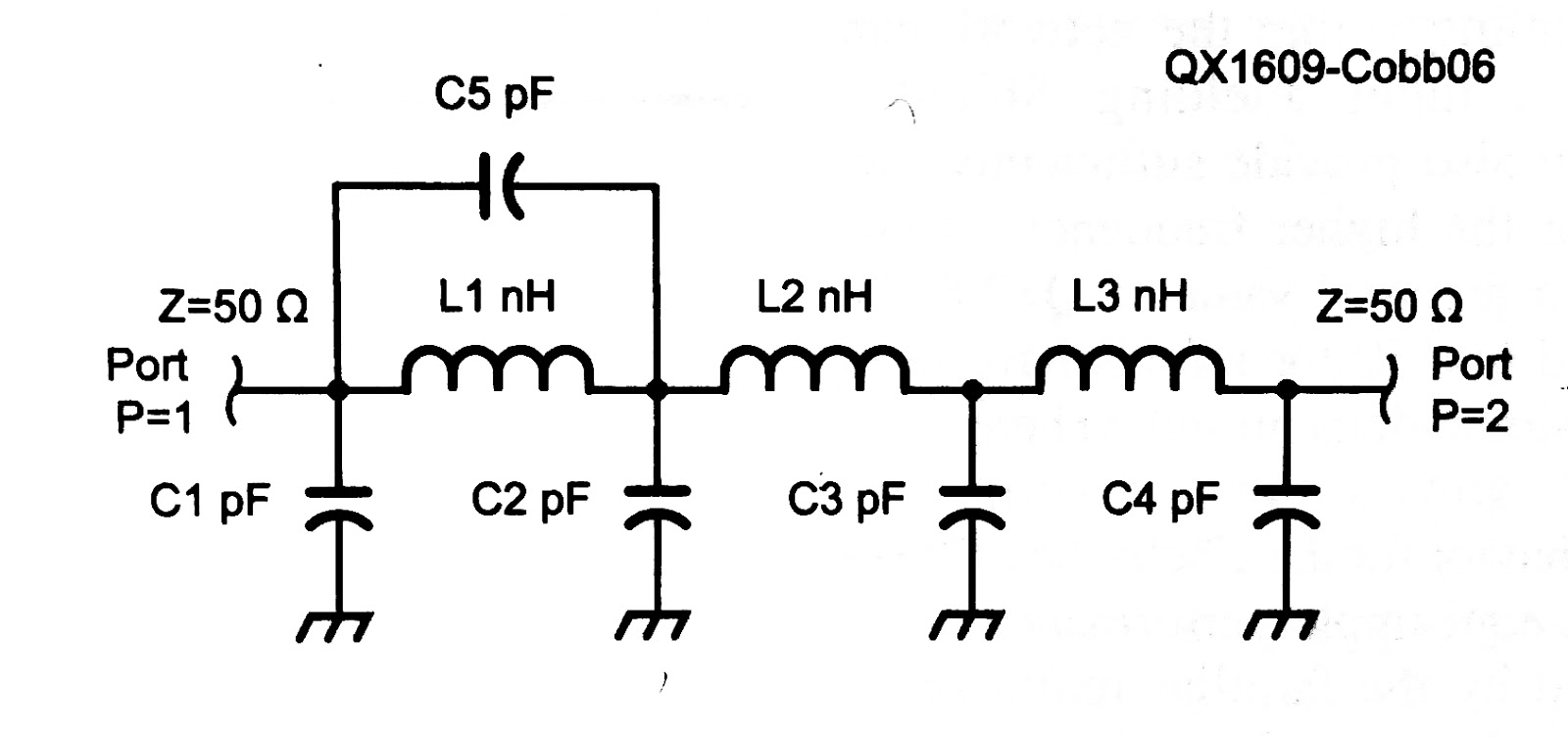
Zolotarev low-pass filter from the Nov/Dec 2016 QEX article G3TMG in the new QEX articles has noticed that the passband is over-specified in the above filters as the lower 60% or so of the passband is unused. The Zolotarev design allows for more passband ripple in this part where it does not matter. The advantage is even better stopband attenuation. A measured example for a 60 m filter has a passband ripple of 0.17 dB and a stopband attenuation at the second harmonic of 71 dB. This filter has the same component count as the previous one, but the filter is no longer symmetric like the two previous ones. The increase in second-harmonic suppression is not as great as the going from the first filters to the second, but should still be worth the effort.
- Gary Cobb, G3TMG, Zolotarev low-pass filter design, QEX, July/Aug 2016.
- Gary Cobb, G3TMG, A more efficient low-pass filter, QEX, Nov/Dec 2016.
Sverre Holm, LA3ZA, is a regular contributor to AmateurRadio.com and writes from Norway. Contact him at [email protected].
Even better low-pass filters for transmitters
The last issues of QEX have featured two interesting articles by Gary Cobb, G3TMG. He outlines the advantage of using Zolotarev designs for the harmonic suppression filters of transmitters, giving even better suppression of the second harmonic than the more common Chebyshev or quasi-elliptic filters.
|
| Chebyshev low-pass filter from the GQRP data sheet (issue 1) |
My interest in this was triggered by the test of the Ultimate 3 QRSS/WSPR kit from QRP Labs in the Nov 2016 QST. The review was positive overall, but it was remarked that the harmonic suppression does not meet FCC requirements (-43 dBc or better). I am not sure whether this is due to PCB layout issues, or if better filters can alleviate it, but I note that the design uses the simplest filter of the ones I have listed here.
The evolution of filters for use for harmonic suppression follows at least these three steps:
- Chebyshev type I filters with equiripple in the passband and a monotonically falling, maximally flat stopband. A 7-pole version with three inductors and four capacitors in a pi-network has been around for a while, in e.g. the old recommendation from the GQRP club. It was based on the QST paper “Low-pass filters for amateur radio transmitters,” Ed Wetherhold, W3NQN, Dec. 1979. Two designs for a 20 m filter were given there:
1) Max. ripple in passband: 0.00731 dB, attenuation at 28 MHz: 40.7 dB
1) Max. ripple in passband: 0.00960 dB, attenuation at 28 MHz: 34.5 dB Second-harmonic optimized low-pass filter from the
GQRP data sheet (issue 2)An improved stopband was the topic of W3NQN’s article “Second-harmonic optimized low-pass filters” in QST Feb. 1999. Here there is one additional capacitor as the central inductor is made into a parallel resonance which gives a zero in the stopband, based on an idea by Jum Tonne, WB6BLD. The design goal is that this zero should be at the second harmonic frequency. W3NQN proposed to call this a Chebyshev filter with a zero (CWAZ) filter, but it is more correct to call it a quasi- or pseudo-elliptic filter as remarked by G3TMG. It increases the attenuation at the second-harmonic in the 20 m design to better than 60 dB. This design is the basis for the current (Issue 2) G-QRP technical sheet. This would also be interesting to test in the QRP Labs Ultimate 3 transmitter kit.
Zolotarev low-pass filter from the Nov/Dec 2016 QEX article G3TMG in the new QEX articles has noticed that the passband is over-specified in the above filters as the lower 60% or so of the passband is unused. The Zolotarev design allows for more passband ripple in this part where it does not matter. The advantage is even better stopband attenuation. A measured example for a 60 m filter has a passband ripple of 0.17 dB and a stopband attenuation at the second harmonic of 71 dB. This filter has the same component count as the previous one, but the filter is no longer symmetric like the two previous ones. The increase in second-harmonic suppression is not as great as the going from the first filters to the second, but should still be worth the effort.
- Gary Cobb, G3TMG, Zolotarev low-pass filter design, QEX, July/Aug 2016.
- Gary Cobb, G3TMG, A more efficient low-pass filter, QEX, Nov/Dec 2016.
Sverre Holm, LA3ZA, is a regular contributor to AmateurRadio.com and writes from Norway. Contact him at [email protected].
ICQ Podcast Episode 225 – What is VSWR
In this episode, Martin M1MRB / W9ICQ is joined by Chris Howard M0TCH, Martin Rothwell M0SGL, Dan Romanchik KB6NU and Ed Durrant DD5LP to discuss the latest Amateur / Ham Radio news. Colin M6BOY rounds up the news in brief, and this episode’s features - What is VSWR
- Students FM transponder Satellite Launched
- WWII Veteran Still Taps out Morse code
- Enrol for UK Advanced Distance Learning Course
- Lowest Sunspot Cycle for 5 Years
- Suggestions Requested for Technician Pool
- New Greenlandic Beacon - OX4M
- HF Antenna Tester
Colin Butler, M6BOY, is the host of the ICQ Podcast, a weekly radio show about Amateur Radio. Contact him at [email protected].
 Ham Radio Deluxe |
 W5SWL Electronics |
 Ham Radio Prep |
 KB3IFH QSL Cards  Hip Ham Shirts  HamRadioAuctions HamRadioAuctions Reliance Antennas Reliance Antennas Enigma Shop Enigma Shop |  morseDX  Ni4L Antennas  R&L Electronics R&L Electronics antennas.us antennas.us QRV QRV |
- Matt W1MST, Managing Editor
