 |
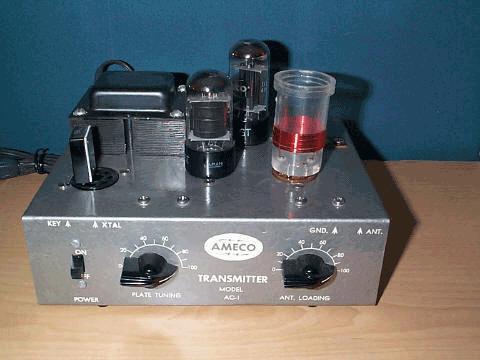
 The Everlasting Ameco AC-1
 25 March 2017 | by
  |
| courtesy: WB1GFH's AC-1 site |
I continue to be amazed at the high prices being paid on E-Bay for original Ameco AC-1 transmitters but perhaps I shouldn't ... they've been doing this for several years now.
Few radios that I can think of have elevated themselves to the cult status enjoyed by the AC-1, but the 3-tube Knight Ocean Hopper regen also comes to mind. Both radios typically reach $100- $200 on auction, with some going for much more. There were plenty of AC-1's sold and built over the years so it's not as if they're rare.
They seem to pop up frequently on E-Bay and the auctions are usually very spirited. I see a nice looking one at present, with 23 bids so far and now at $150! I guess the timing is just about right, with a large supply of now-retired ex-50's Novices who once owned an AC-1, looking to turn back the clock and recreate their early radio experience.
As transmitters go, they don't come much simpler, but the well-designed and smartly marketed radio made it extremely popular among the vast numbers of newly-licenced teenaged Novices who likely didn't have much spare change ... the first ones hit the market in the late 50's, right in time for the strongest solar cycle on record, selling for $14.95 in kit form. AC-1's continued to be sold into the early 70's with the price rising to around $25 ... a nice long run for most ham gear. I may be wrong but I don't think they were ever available in anything other than kit form.
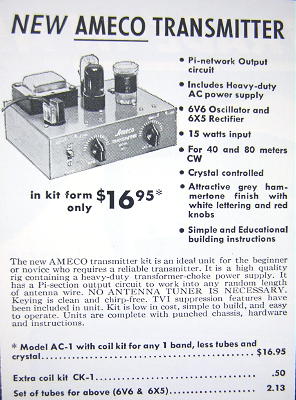
Here is what the kit looked like upon arrival ... this one still NIB in 2012!
 |
| courtesy: http://www.wa0itp.com/ac-1.html |
There is also a large builder's interest in making AC-1 'clones' along with a dedicated Yahoo Group for additional support. Several years go I decided to scratch-build my own clone and found that I had everything needed except for the gray hammertone spray paint. Although most AC-1's used black chicken head knobs, some early models used maroon knobs so I decided to go with a red slide switch and red chicken head knobs on my reproduction. The important decal was available at the time from the Yahoo group but I see them now being sold by Radio Daze, for those that may want to try their hand at building a clone themselves.

The AC-1 uses the inexpensive 6V6 elevated from AF to RF duty, in a crystal-friendly Colpitts crystal oscillator. The only departure from the norm is the output circuit. Most inexpensive one-tubers end up with a link-coupled output but the AC-1 uses the more versatile pi-network ... something that no doubt added to its production costs but produced a transmitter able to load a wider range of antenna impedances while providing superior harmonic attenuation, both important in a beginner's rig.
My clone puts out 8 watts on 80m and 7 watts on 40m. Although never intended, doubling to 20m sees a large drop in efficiency, with output power dropping to 2 watts. Swapping to a 6L6 yields an extra couple of watts. Not enough to be noticed at the other end except when doubling or tripling.
I haven't had my clone on the air for a few years and think it's time to spark it up once again for some summertime fun on 40m CW. It would be great to work another clone or even a real AC-1 if you have one, but any contacts will be exciting if you would like to try.
I'll be hanging around 7118 kHz or down near 7040 and ... I won't be loud!
Steve McDonald, VE7SL, is a regular contributor to AmateurRadio.com and writes from British Columbia, Canada. Contact him at [email protected].
Pipit – 15m QRP CW transceiver
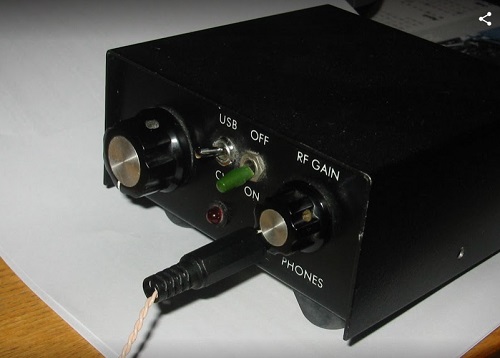
Many years ago I designed and built the Pipit, an 800mW CW transceiver with a direct conversion receiver. It really worked and for some time was my main rig. Used with a low dipole it worked some decent DX. The design was published in GQRP “SPRAT” many years ago.
Sadly, the rig was dismantled some years later. I regret this!
See https://sites.google.com/site/g3xbmqrp3/hf/15m_pipit

Roger Lapthorn, G3XBM, is a regular contributor to AmateurRadio.com and writes from Cambridge, England.
DMR Codeplug for Tytera MD-380
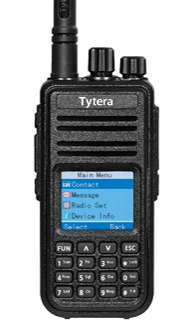 At our radio club meeting on Monday night, I talked about DMR radio, the fastest growing digital format on VHF/UHF. Wow, did I get a positive response! There is a lot of interest in this topic and many of our members are out buying DMR radios and getting on the air. My presentation is available here: DMR W0TLM Meeting Presentation.
Most folks are buying the UHF Tytera MD-380 due to its attractive price point. The price on Amazon seems to fluctuate but it is typically around $100: TYT MD-380 – UHF DMR Ham Radio. Main Trading Company usually has a good price on the radio, too.
A good source of codeplugs for Colorado is the Rocky Mountain Ham Radio web site. I adapted a recent MD-380 codeplug for use in the Monument area: K0NR Rev 1 RMHAM_MD380_2017-10-28.rdt
You’ll need to use the MD-380 software to load/edit this codeplug. See the VA3XPR web site if you need the software. Under General Setting, you must change these entries:
Radio Name – enter your callsign
Radio ID – enter your DMR-MARC radio ID number
Intro Screen – recommend putting your name and callsign there (or whatever you want)
In the codeplug, I created the W0TLM zone for use in the Monument area which should cover most of your needs. After you get used to the programming software, you can add/modify channels and zones. But be careful as there are many parameters that need to be entered correctly.
I will be updating this codeplug from time to time. Let me know how it works for you.
73, Bob K0NR
Update 18 Nov 2017: I updated the codeplug to incorporate the latest RM Ham Radio repeaters. This is based on the latest RM Ham codeplug dated 28 Oct 2017. I highly recommend you adopt the TyMD380toolz so you can just pull all of the worldwide DMR radio ID database into your radio.
The post DMR Codeplug for Tytera MD-380 appeared first on The KØNR Radio Site.
Bob Witte, KØNR, is a regular contributor to AmateurRadio.com and writes from Colorado, USA. Contact him at [email protected].
Amateur Radio Weekly – Issue 151

ARRL publishes 60 Second Century videos
CEO Tom Gallagher, NY2RF, supplements monthly QST editorial with video.
ARRL
80/40 Meter Loaded Dipole Antenna
The plan for this antenna was to build a lightweight 80/40 meter antenna for field use (as part of my Go Kit).
High on solder
Experimenting with my first remote antenna tuner
The transmitter doesn’t “see” an SWR at all — only an impedance resulting from the SWR.
K5ACL
The Doctor is In: Remote antenna tuners
Not every antenna tuner needs to be inside your station. Some do an even better job outdoors!
The Doctor is In
Would a membership survey help your club?
The goal is to make the club as relevant as it can be.
KB6NU
Monitoring NextGen ATC (on the cheap!)
A key component of next generation air traffic control is Automatic Dependent Surveillance – Broadcast (ADS-B).
K2DLS
First Meteor Scatter Contact
It’s not exactly ground-breaking in the Amateur Radio world, but I’m pleased to have made my first “meteor scatter” contact.
AA6E
Adventures in Science: Arduino Programming Syntax
This week, we look at what constitutes syntax in a programming language and how to employ it when writing code in Arduino.
SparkFun Electronics
Video
How To Build A Powerpole Polarity Tester
I show you how to build a simple red/green LED Powerpole polarity tester. Along with a bit of Ohm’s law.
K7AGE
Logging with AppleScript
We setup RUMLogNG, Fldigi and an AppleScript so Fldigi will log QSO’s into RUMLogNG.
K0PIR
Amateur Radio Weekly is curated by Cale Mooth K4HCK. Sign up free to receive ham radio's most relevant news, projects, technology and events by e-mail each week at http://www.hamweekly.com.
The Don Miller Enigma
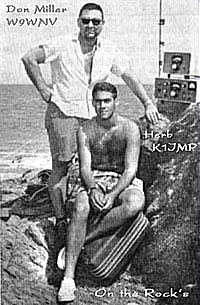
A mention in the KE9V weekly 'CALLING CQ' e-mail letter brought back more memories of my teen DX years. The article pointed to a YouTube interview of legendary DXer Dr. Don Miller, W9WNV, conducted by another DX legend, Martti Laine, OH2BH. The fascinating interview was conducted in December 2016 and is broken into five parts.
For those old enough to remember, Don spent a few years in the late 60's providing DXers with one rare country after another ... dozens of them. He was a superb operator and the originator of the now ubiquitous "5NN" shortened signal report, after trying unsuccessfully with "FNN". He was also one of the very first to operate 'split', requiring stations to call up or down instead of the then prevalent one frequency pileup! Don was really instrumental in shaping much of what we see today as 'standard ops' when it comes to DX'pedition operations. To hear Don handle a pileup was something else. Often when the pile became very large, he would listen to the calling crowd for a couple of minutes and then respond with a list of calls and signal reports ... nothing like the individual exchanges we see today.
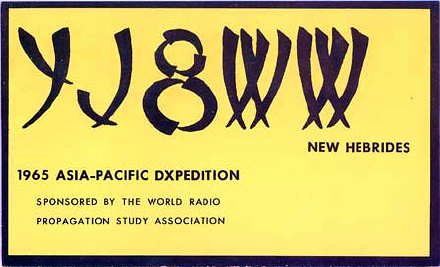
My little DX-20 and VF-1 were only able to work Don at one of his stops ... YJ8WW on 40m CW. He was all about giving the little guy, those running modest stations, an opportunity to work some rare countries.
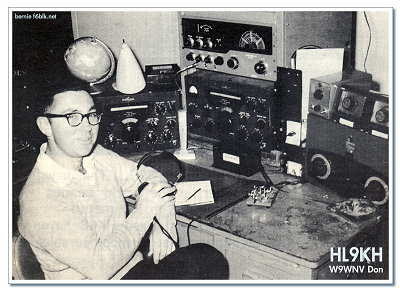 |
| courtesy: F6BLK |
As bad as things had become for Don, it got much worse, when in 1980, rightly or wrongly, he was convicted of conspiring to have his estranged wife killed and was sentenced to 25 years to life.
Don Miller is one of those 'larger than life' personalities whose presentations at DX clubs and conventions would bring the large crowds to their feet with his DX stories and expedition accomplishments.
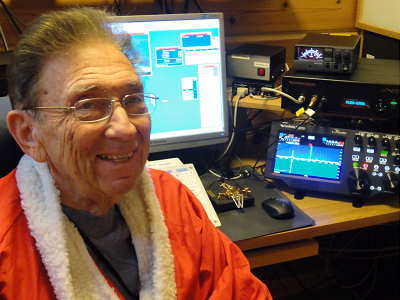
The YouTube interviews show a somewhat contrite, remorseful man, compared to the one we met in the 60's but there's still a hint of that young mischief-maker and a twinkle in his 80 year old eyes as he teases of putting another rare one on-the-air, one last time.
 |
| courtesy: OH2BH |
[See also: "The Don Miller Story As Told By Hugh Cassidy, WA6AUD]
Steve McDonald, VE7SL, is a regular contributor to AmateurRadio.com and writes from British Columbia, Canada. Contact him at [email protected].
The Don Miller Enigma
A mention in the KE9V weekly 'CALLING CQ' e-mail letter brought back more memories of my teen DX years. The article pointed to a YouTube interview of legendary DXer Dr. Don Miller, W9WNV, conducted by another DX legend, Martti Laine, OH2BH. The fascinating interview was conducted in December 2016 and is broken into five parts.
For those old enough to remember, Don spent a few years in the late 60's providing DXers with one rare country after another ... dozens of them. He was a superb operator and the originator of the now ubiquitous "5NN" shortened signal report, after trying unsuccessfully with "FNN". He was also one of the very first to operate 'split', requiring stations to call up or down instead of the then prevalent one frequency pileup! Don was really instrumental in shaping much of what we see today as 'standard ops' when it comes to DX'pedition operations. To hear Don handle a pileup was something else. Often when the pile became very large, he would listen to the calling crowd for a couple of minutes and then respond with a list of calls and signal reports ... nothing like the individual exchanges we see today.
My little DX-20 and VF-1 were only able to work Don at one of his stops ... YJ8WW on 40m CW. He was all about giving the little guy, those running modest stations, an opportunity to work some rare countries.
|
| courtesy: F6BLK |
As bad as things had become for Don, it got much worse, when in 1980, rightly or wrongly, he was convicted of conspiring to have his estranged wife killed and was sentenced to 25 years to life.
Don Miller is one of those 'larger than life' personalities whose presentations at DX clubs and conventions would bring the large crowds to their feet with his DX stories and expedition accomplishments.
The YouTube interviews show a somewhat contrite, remorseful man, compared to the one we met in the 60's but there's still a hint of that young mischief-maker and a twinkle in his 80 year old eyes as he teases of putting another rare one on-the-air, one last time.
|
| courtesy: OH2BH |
[See also: "The Don Miller Story As Told By Hugh Cassidy, WA6AUD]
Steve McDonald, VE7SL, is a regular contributor to AmateurRadio.com and writes from British Columbia, Canada. Contact him at [email protected].
Where are Those New Hams Coming From?
The Tri-Lakes Monument Radio Association just completed another successful Technician license class resulting in 21 new Technicians plus one person that passed both the Technician and General exams. We survey the class a week or two later to get their feedback and capture some demographic information. In recent years, our Technician class has consistently filled to capacity, causing us to ask the question “Where are those new hams coming from?”
The key relevant question on the survey is:
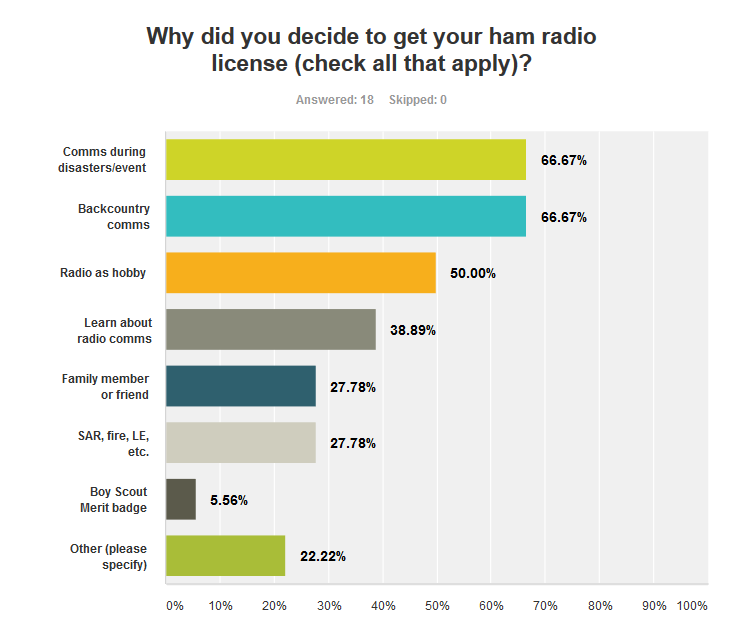 I’ve abbreviated the response choices so they read better on the graph. For example, “Comms during disasters/event” actually says “For communications during disasters or other major events” on the survey. These 18 responses represent over half of the students so they are representative of the class. However, it is a small sample size overall, representing just one class at one time at one location in the US. I will add that the surveys from our other classes are similar.
The two highest responses, both with 67%, are Comms During Disasters/Event and Backcountry Comms. It was no surprise that communications during a disaster would be a prime motivation for getting a ham radio license. Per FCC Part 97, this is one of the stated purposes of the Amateur Radio Service. Here in Colorado, many people have had the recent experience of wildfires disrupting communications causing them to look for alternatives. In general, the prepper movement is causing people to think in terms of disaster preparedness. Communications in the backcountry includes hikers, climbers, fishermen, dirt bike riders, four-wheel drive enthusiasts and anyone who spends time in the mountains. There are many locations in Colorado that don’t have cellphone coverage, so people are looking for alternative communications. This is likely a regional phenomenon…I don’t think you’d see “backcountry communications” on the short list of amateur radio interest is downtown Chicago.
Radio as a hobby gathers 50% of the responses, followed by 39% interested in learning about radio communications. This says that about half of the students are pursuing ham radio as a hobby. I wonder if this is different that the historical average from 20 years ago? I suspect it used to be higher but I don’t have any data to support that. This would likely be a leading indicator for how many of these new licensees get deeply involved in ham radio activities. I have seen students start out with a narrow focus on emergency preparedness but then discover there’s a lot more to ham radio that they choose to pursue.
What do you think about these results?
73, Bob K0NR
The post Where are Those New Hams Coming From? appeared first on The KØNR Radio Site.
Bob Witte, KØNR, is a regular contributor to AmateurRadio.com and writes from Colorado, USA. Contact him at [email protected].
 Ham Radio Deluxe |
 W5SWL Electronics |
 Ham Radio Prep |
 KB3IFH QSL Cards  Hip Ham Shirts  HamRadioAuctions HamRadioAuctions Reliance Antennas Reliance Antennas Enigma Shop Enigma Shop |  morseDX  Ni4L Antennas  R&L Electronics R&L Electronics antennas.us antennas.us QRV QRV |
- Matt W1MST, Managing Editor
