 |
 YADD
YADD
 8 August 2017 | by
 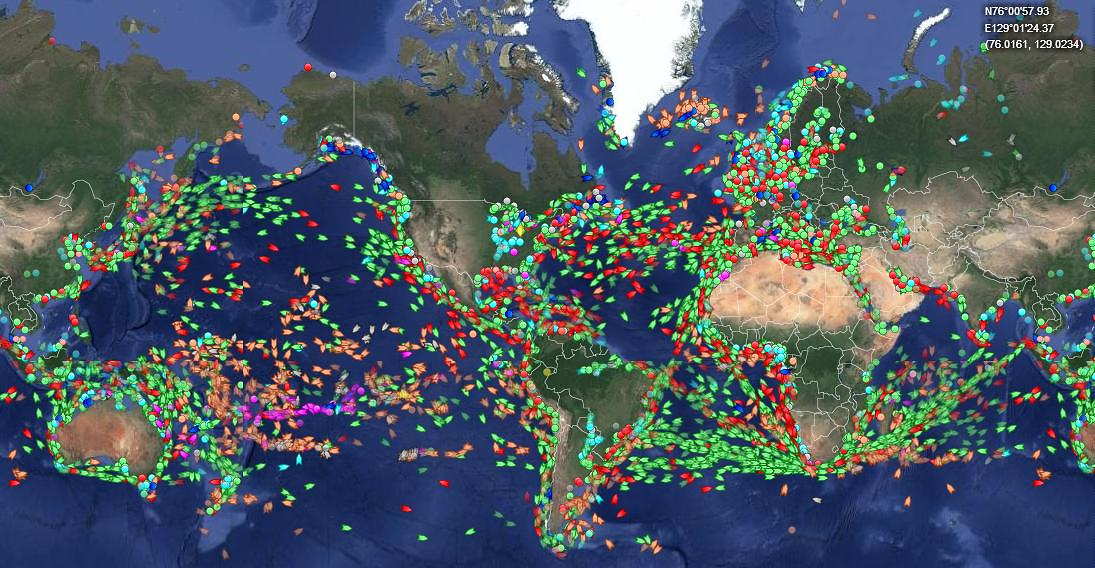 |
| Maritime Traffic - courtesy: www.marinetraffic.com/ |
Until very recently, I had believed that there were no longer any HF maritime operations left, other than various Coast Guard weather announcements and an emergency watch on certain USB frequencies.
Over the past week I have discovered that HF maritime activity is still alive and well, through the worldwide Digital Selective Calling (DSC) system, which has been around in one form or another since the early 90's as part of the Global Maritime Distress and Safety System (GMDSS) ... I guess I was just asleep at the switch, having not been aware of the HF DSC activity!
Although it's not CW, there's still ample opportunity to hear and follow global shipping traffic as vessels of all types contact coastal land stations or call each other. One requirement that keeps the DSC frequencies busy is the requirement for vessels to test their systems at least once per week, providing many opportunities to log various coastal stations or add a new ship to your logbook. Ships can be heard calling coastals for a routine signal test, setting up an SSB phone QSO on a specified frequency or just calling another ship for a test or a phone sked. As well, DSC can be used to send a distress message alert in times of emergency.
Messages are sent in an error-correcting FSK mode, similar to the Navtex system, using the same speed and shift of 100 baud /170Hz. There are a few programs that can be used to decode the DSC messages but one of the best and most popular is the freely available "YADD", by Dirk Claessens .
YADD stands for "Yet Another DSC Decoder" and is an offshoot of Dirk's equally popular and effective "YAND", a free Navtex decoder.
YADD and several other software decoders can be downloaded from the NDB List Info site ... the best source of hands-on information for topics involving NDBs, Navtex, DGPS, DSC DXing and more.
After downloading and installing YADD and setting audio levels correctly, YADD began decoding signals with ease.

The spectrum display at the top of YADD's screen shows the audio passband coming from the receiver. With the receiver in the CW mode, DSC signals will appear on the frequency that your receiver's BFO offset frequency is set for. I prefer an offset of 400Hz so the spectrum display shows the signal at 400Hz, with the tuning cursor centered on a signal. A narrow CW filter should also be selected but no narrower than 170Hz.
Each vessel using the system, as well as the coastal land stations, have a unique 9-digit MMSI number (Maritime Mobile Service Identity). Once the software detects the MMSI numbers being used, it can then display the vessel's name (or the coastal's location and distance) so you know who you are listening to ... it's all very slick!
After initially running my receiver for a few minutes on the 12MHz DSC channel, I decided to look up the location of the first two ships I had heard, using one of the Internet's marine traffic sites.
I was surprised to find that my first catch was a large tanker under way in Kola Bay, having just departed Murmansk, in the Russian Arctic. Vessel number two was also under way along the east coast of South Korea.
The YADD screen above is showing the large bulk carrier 'SALANDI' (3FEB9) calling Rio de Janeiro Radio (PWZ) today on 16804.5KHz.
 |
| Courtesy: Henk Guddee |
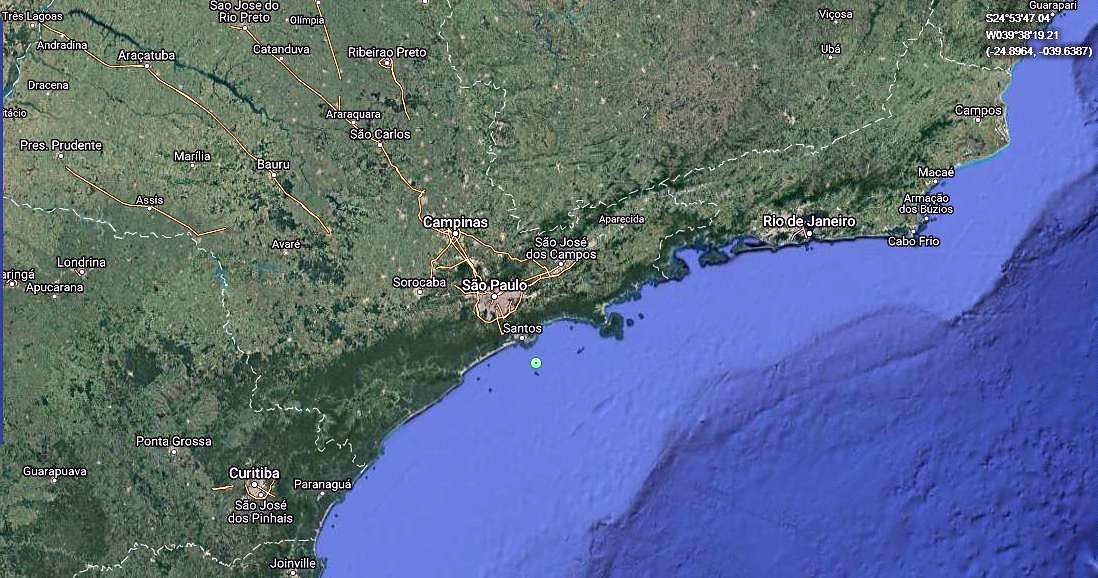
I soon discovered an active group of DSC DXers in Yahoo Group's DSC List, which I quickly joined and started asking a lot of questions. The 'Files' section also contains the latest list of ship MMSI numbers so that your YADD look-up text file can be kept up-to-date.
One of the group members, GM4SLV, has set up a wonderful website called YaDDNet devoted to collecting and posting listener's decoded loggings in realtime. One of YADD's features is the ability to automatically upload decoded signals, similar to PSK Reporter. It's an easy 30-second job to configure YADD to upload your spots to the net. His site also contains the latest MMSI look-up file used by YADD which is updated in real time from the latest log postings ... presently at 34,566 vessels!
Clicking on any of the uploaded ship names displayed in the real time YaDDNet log, automatically takes you to an online vessel-tracking site which usually has a picture of the ship along with all of its information, including its present position.
If you set up YADD to do some listening, I'd strongly urge you to also set it up so that your decoded spots are uploaded to the YaDDNet page in real time. Configuring this capability is very simple. Your latest logs will also keep the MMSI database up-to-date for all YADD users.
If, like me, you have missed the maritime CW activity on HF, you may find monitoring DSC traffic of interest ... both ships and coastals. I may even try QSLing some of the coastals again, many of which will still issue a traditional card QSL, upholding a long standing shortwave radio tradition ... but grab them while you can!
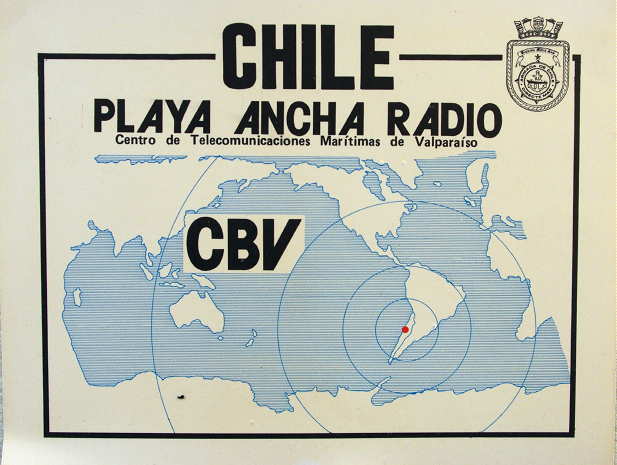 |
| From my collection. Heard 4349KHz CW Aug '96 |
Steve McDonald, VE7SL, is a regular contributor to AmateurRadio.com and writes from British Columbia, Canada. Contact him at [email protected].
YADD
|
| Maritime Traffic - courtesy: www.marinetraffic.com/ |
Until very recently, I had believed that there were no longer any HF maritime operations left, other than various Coast Guard weather announcements and an emergency watch on certain USB frequencies.
Over the past week I have discovered that HF maritime activity is still alive and well, through the worldwide Digital Selective Calling (DSC) system, which has been around in one form or another since the early 90's as part of the Global Maritime Distress and Safety System (GMDSS) ... I guess I was just asleep at the switch, having not been aware of the HF DSC activity!
Although it's not CW, there's still ample opportunity to hear and follow global shipping traffic as vessels of all types contact coastal land stations or call each other. One requirement that keeps the DSC frequencies busy is the requirement for vessels to test their systems at least once per week, providing many opportunities to log various coastal stations or add a new ship to your logbook. Ships can be heard calling coastals for a routine signal test, setting up an SSB phone QSO on a specified frequency or just calling another ship for a test or a phone sked. As well, DSC can be used to send a distress message alert in times of emergency.
Messages are sent in an error-correcting FSK mode, similar to the Navtex system, using the same speed and shift of 100 baud /170Hz. There are a few programs that can be used to decode the DSC messages but one of the best and most popular is the freely available "YADD", by Dirk Claessens .
YADD stands for "Yet Another DSC Decoder" and is an offshoot of Dirk's equally popular and effective "YAND", a free Navtex decoder.
YADD and several other software decoders can be downloaded from the NDB List Info site ... the best source of hands-on information for topics involving NDBs, Navtex, DGPS, DSC DXing and more.
After downloading and installing YADD and setting audio levels correctly, YADD began decoding signals with ease.
The spectrum display at the top of YADD's screen shows the audio passband coming from the receiver. With the receiver in the CW mode, DSC signals will appear on the frequency that your receiver's BFO offset frequency is set for. I prefer an offset of 400Hz so the spectrum display shows the signal at 400Hz, with the tuning cursor centered on a signal. A narrow CW filter should also be selected but no narrower than 170Hz.
Each vessel using the system, as well as the coastal land stations, have a unique 9-digit MMSI number (Maritime Mobile Service Identity). Once the software detects the MMSI numbers being used, it can then display the vessel's name (or the coastal's location and distance) so you know who you are listening to ... it's all very slick!
After initially running my receiver for a few minutes on the 12MHz DSC channel, I decided to look up the location of the first two ships I had heard, using one of the Internet's marine traffic sites.
I was surprised to find that my first catch was a large tanker under way in Kola Bay, having just departed Murmansk, in the Russian Arctic. Vessel number two was also under way along the east coast of South Korea.
The YADD screen above is showing the large bulk carrier 'SALANDI' (3FEB9) calling Rio de Janeiro Radio (PWZ) today on 16804.5KHz.
|
| Courtesy: Henk Guddee |
I soon discovered an active group of DSC DXers in Yahoo Group's DSC List, which I quickly joined and started asking a lot of questions. The 'Files' section also contains the latest list of ship MMSI numbers so that your YADD look-up text file can be kept up-to-date.
One of the group members, GM4SLV, has set up a wonderful website called YaDDNet devoted to collecting and posting listener's decoded loggings in realtime. One of YADD's features is the ability to automatically upload decoded signals, similar to PSK Reporter. It's an easy 30-second job to configure YADD to upload your spots to the net. His site also contains the latest MMSI look-up file used by YADD which is updated in real time from the latest log postings ... presently at 34,566 vessels!
Clicking on any of the uploaded ship names displayed in the real time YaDDNet log, automatically takes you to an online vessel-tracking site which usually has a picture of the ship along with all of its information, including its present position.
If you set up YADD to do some listening, I'd strongly urge you to also set it up so that your decoded spots are uploaded to the YaDDNet page in real time. Configuring this capability is very simple. Your latest logs will also keep the MMSI database up-to-date for all YADD users.
If, like me, you have missed the maritime CW activity on HF, you may find monitoring DSC traffic of interest ... both ships and coastals. I may even try QSLing some of the coastals again, many of which will still issue a traditional card QSL, upholding a long standing shortwave radio tradition ... but grab them while you can!
|
| From my collection. Heard 4349KHz CW Aug '96 |
Steve McDonald, VE7SL, is a regular contributor to AmateurRadio.com and writes from British Columbia, Canada. Contact him at [email protected].
NAQP CW contest.
Mike Weir, VE9KK, is a regular contributor to AmateurRadio.com and writes from New Brunswick, Canada. Contact him at [email protected].
NAQP CW contest.
Mike Weir, VE9KK, is a regular contributor to AmateurRadio.com and writes from New Brunswick, Canada. Contact him at [email protected].
ICQ Podcast Episode 244 – Friedrichshafen Ham Radio 2017 Round-Up
In this episode, Martin M1MRB/W9ICQ is joined by Chris Howard M0TCH, Dan Romanchik KB6NU and Ed Durrant DD5LP to discuss the latest Amateur / Ham Radio news. Colin M6BOY rounds up the news in brief, and this episode’s feature is Friedrichshafen Ham Radio 2017 Round-Up
We would like to thank Philip Heckingbottom (VK6ADF) and our monthly and annual donors for keeping the podcast advert free. To donate, please visit - http://www.icqpodcast.com/donate
- YOTA 2017 Summer Event
- Lauren Richardson - 12 Completes Wainwright Challenge
- Differences in Amateur Radio CEPT Class 1 Licence Exam
- Ofcom Permitting 5.8 GHz Wi-Fi
- Youngsters Unimpressed with Traditional Ham Radio
- NCDXC to Start HF Elmering Program
- Fox-1 Satellite Operating Guide updates for 2017
- US Radio Ham Receives Lifetime Recognition
- FT8 Amateur/Ham Radio Mode Software Support
- Pictures Received from ISS
- UK Amateur Radio Licence Guidance
- PyQSO Amateur Radio Logging Software
Colin Butler, M6BOY, is the host of the ICQ Podcast, a weekly radio show about Amateur Radio. Contact him at [email protected].
ICQ Podcast Episode 244 – Friedrichshafen Ham Radio 2017 Round-Up
In this episode, Martin M1MRB/W9ICQ is joined by Chris Howard M0TCH, Dan Romanchik KB6NU and Ed Durrant DD5LP to discuss the latest Amateur / Ham Radio news. Colin M6BOY rounds up the news in brief, and this episode’s feature is Friedrichshafen Ham Radio 2017 Round-Up
We would like to thank Philip Heckingbottom (VK6ADF) and our monthly and annual donors for keeping the podcast advert free. To donate, please visit - http://www.icqpodcast.com/donate
- YOTA 2017 Summer Event
- Lauren Richardson - 12 Completes Wainwright Challenge
- Differences in Amateur Radio CEPT Class 1 Licence Exam
- Ofcom Permitting 5.8 GHz Wi-Fi
- Youngsters Unimpressed with Traditional Ham Radio
- NCDXC to Start HF Elmering Program
- Fox-1 Satellite Operating Guide updates for 2017
- US Radio Ham Receives Lifetime Recognition
- FT8 Amateur/Ham Radio Mode Software Support
- Pictures Received from ISS
- UK Amateur Radio Licence Guidance
- PyQSO Amateur Radio Logging Software
Colin Butler, M6BOY, is the host of the ICQ Podcast, a weekly radio show about Amateur Radio. Contact him at [email protected].
Hallicrafters Shortwave Radio; Winning WWII With Technology (1944)
Great film about a great radio manufacturer and radio set.
In 1944, this short subject film was produced by the Jam Handy Organization and sponsored by the Hallicrafters Company. It shows the construction of the SCR-299 and dramatizes its use during World War II. This is a B&W documentary presenting a look at the manufacturing and use of the (now defunct) Hallicrafters Company’s SCR-299 “mobile communications unit.” This 1944 film, produced with help from the US Army Signal Corps, and by the Hallicrafters Company, explains how, using radio gear such as this Hallicrafters shortwave radio transmitter and receiver technology, the US Forces and Allies were better equipped to win World War II.
The SCR-299 “mobile communications unit” was developed to provide long-range communications during World War II. The US Military sought improvements of range, flexibility and durability over its existing SCR-197 and SCR-597 transmitters. In 1942, Hallicrafters Standard HT-4 was selected as the SCR-299’s transmitter, known subsequently by its military designation as the BC-610. The SCR-299 was first used on November 8, 1942, during Operation TORCH involving companies of the 829th Signal Service Battalion establishing a radio net that could exchange messages between beach-landed forces and bases in Gibraltar. Despite initial problems unloading the sets from convoy ships, the SCR-299s served until the installation of permanent Army Command and Administrative Network stations. According to US Army military historians, “General Dwight Eisenhower credited the SCR-299 in his successful reorganization of the American forces and final defeat of the Nazis at Kasserine Pass.”
The SCR-299 was a “self-contained” receiving and transmitting mobile high-frequency (HF; or, shortwave) station capable of operating from 2 MHz to 8 MHz. Using conversion kits, it could operate from 1 MHz to 18 MHz. The transmitter output reached 350 watts.
The entire unit came in a K-51 truck except for Power Unit PE-95 which was in a K-52 trailer. Power could either be supplied by the Power Unit and a 12-volt storage battery or 115-volt 60-cycle AC commercial power and two spare 6-volt storage batteries. The power requirement was 2000 watts, plus 1500 watts for heater and lights.
The system could be remotely controlled up to a distance of one mile (1.6 km) using two EE-8 field telephones and W-110-B Wire kit. Remote equipment was provided for remotely keying or voice modulating the transmitter, remotely listening to the receiver, and for communicating with the operator of the station.
Read more details here: http://en.wikipedia.org/wiki/SCR-299
Public domain film from the Library of Congress Prelinger Archive.
..
73 de NW7US
..
Visit, subscribe: NW7US Radio Communications and Propagation YouTube Channel
 Ham Radio Deluxe |
 W5SWL Electronics |
 Ham Radio Prep |
 KB3IFH QSL Cards  Hip Ham Shirts  HamRadioAuctions HamRadioAuctions Reliance Antennas Reliance Antennas Enigma Shop Enigma Shop |  morseDX  Ni4L Antennas  R&L Electronics R&L Electronics antennas.us antennas.us QRV QRV |
- Matt W1MST, Managing Editor
