 |
 FT817 and FT817ND
 21 August 2017 | by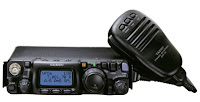
These little rigs from Yaesu have basically remained unchanged since 2000. They cover all bands from 160m-70cm (not 4m or 1.25m), all modes, 5W. With transverters, mine have been used from VLF upwards on all available bands. They work well, but I was surprised Yaesu did not do an upgrade in time for the last sunspot peak. Also, I was surprised they had no real competitors. These days there are a few SDR radios around, but the FT817 reigns supreme.
With mine I have worked the world including some great handheld DX. For base station use I recommend the Z817 auto-ATU.
I tried the Elecraft auto ATU but prefer the Z817. I am very happy with the FT817, although the early ones had PA failures with low voltage. This was fixed (I think) in the FT817ND.
See https://sites.google.com/site/g3xbmqrp3/hf/ft817
Roger Lapthorn, G3XBM, is a regular contributor to AmateurRadio.com and writes from Cambridge, England.
ICQ Podcast Episode 246 – FT8 and Essex Hams
In this episode, Martin M1MRB/W9ICQ is joined by Leslie Butterfield G0CIB, Matthew Nassau M0NJX and Chris Howard M0TCH to discuss the latest Amateur/Ham Radio news. Colin M6BOY rounds up the news in brief, and this episode’s feature is Essex Hams and FT8.
We would like to thank Ian Tickle (G4ZJH), Anonymous Donor and our monthly and annual subscription donors for keeping the podcast advert free. To donate, please visit - http://www.icqpodcast.com/donate
Colin Butler, M6BOY, is the host of the ICQ Podcast, a weekly radio show about Amateur Radio. Contact him at [email protected].
Amateur Radio Weekly – Issue 169

Solar Eclipse QSO Party
The SEQP will take place on August 21 from 1400 – 2200 UTC.
hamsci.org
VUARC Eclipse balloon project
AA4VU will fly three items in the balloon payload: Crossband repeater, APRS tracking unit, CW ID.
Vanderbilt University Amateur Radio Club
Pacific Hams to aid emergency response during eclipse
Alderman Steve Myers asked local hams to be on hand during the eclipse in case someone needs an ambulance or police during a cell tower overload.
Pacific Missourian
South Carolina Hams to aid emergency response during eclipse
There will be added voices over the air waves, aiding emergency response over the Total Solar Eclipse weekend.
WIS
Ham Radio Operators step up in good times and bad
Hams regularly volunteer their skills and expertise to coordinate responses in emergencies like the Boston Marathon bombing and when Hurricane Katrina devastated New Orleans.
Emergency Management
The 30m CW Interest Group
encourages CW activity on 30m to ensure that we do not lose this very special prime CW band to other modes, nor lose it to other primary services.
30cw.net
Using RUMlogNG for iOS with an Elecraft KX2 over Bluetooth
My goal is to build the project for under $35. I’m also planning to design my own PCB board and offer it as a kit.
VA2SS.com
A test of the saltwater effect using WSPR
The simultaneous reports showed a mean 10 dB SNR advantage for Vertical 1 at the shore.
N4KGL.info
ARRL finally realizes status quo isn’t going to cut it
Any “visioning” or strategic planning that doesn’t get the membership involved right from the start just isn’t going to work.
KB6NU.com
Parachute Mobile
In the Air, On the Air
Parachute Mobile
Thank a Ham radio operator today
Since the early 1900s, no other group has made a greater contribution to radio communications.
The Tribune
Video
RF Noise: Find the sources
Neighbors, street lighting, shopping malls plus much more. I have had a few QSOs on SSB when the propagation have been good and other stations have been strong so they have overthrown my QRM.
SA5LKC
HF signal propagation reporter
Where is your signal being heard? Is your antenna working? What is the status of the band? Check out this video to learn about the PSK reporter website and how it can benefit you.
HamRadioConcepts
Amateur Radio Weekly is curated by Cale Mooth K4HCK. Sign up free to receive ham radio's most relevant news, projects, technology and events by e-mail each week at http://www.hamweekly.com.
A 630m Maritime Adventure
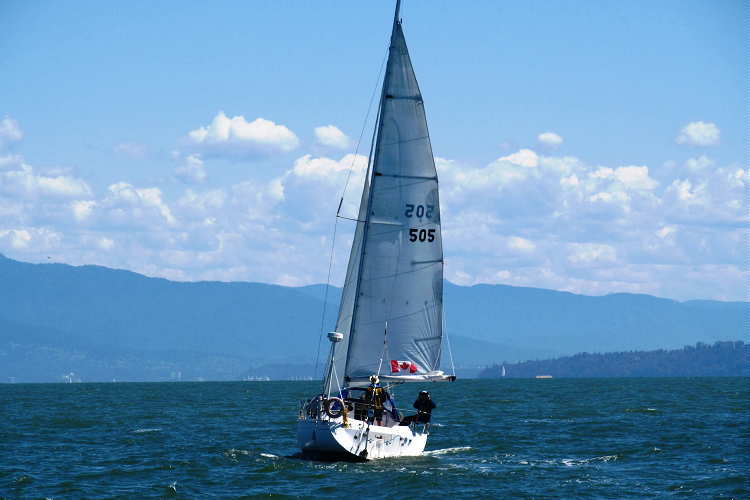 |
| HAKUNA MATATA |
Crewed by Mark (VA7MM) and YL May (VA7MAY), Toby (VE7CNF) and XYL Nancy, the 31' Benateu recently completed a 14-day circumnavigation of Georgia Strait's Gulf Islands. This is a yearly adventure that has been successfully completed for the past few summers and looks as though it may now be an annual tradition.
Normally, the crew kept up regular radio contact on HF as well as on VHF when possible but this year saw a major departure.
In previous summers, near the end of the voyage, the crew has always visited us here on Mayne Island for an afternoon of vittles and libation before heading for home. There is always a good amount of time spent recalling the past-year's radio activities, winter projects and reminiscence of the 'good old days'. Last year, just as the party was ending, I jokingly suggested that 'next year', it would be cool to work them from the boat on 630m.
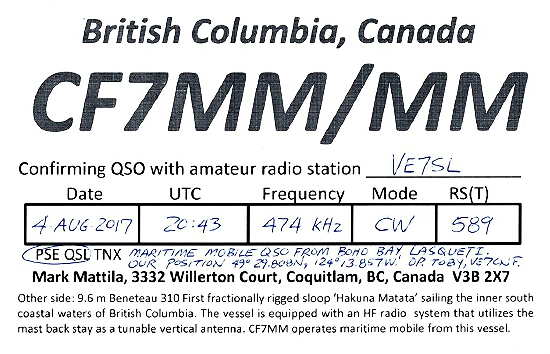
Although there was no immediate commitment, I knew that the seed had been planted, and with three of the four crew being engineers, I suspected it might be hard for them to resist, and ... just before departure, the local bunch of 630m ops were put on alert to be watching for CF7MM/mm on 475 kHz CW as they would be attempting to work us from three different overnight anchorages during their summer voyage!
Evidently Toby had been working quietly during the winter to make this become a reality. Here are some pictures of the system along with Toby's (the system's builder) comments.
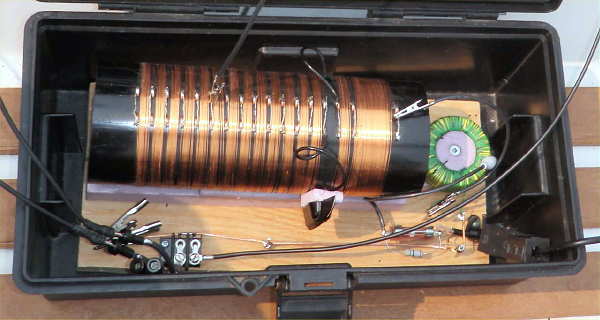 |
| Variometer and matching transformer |
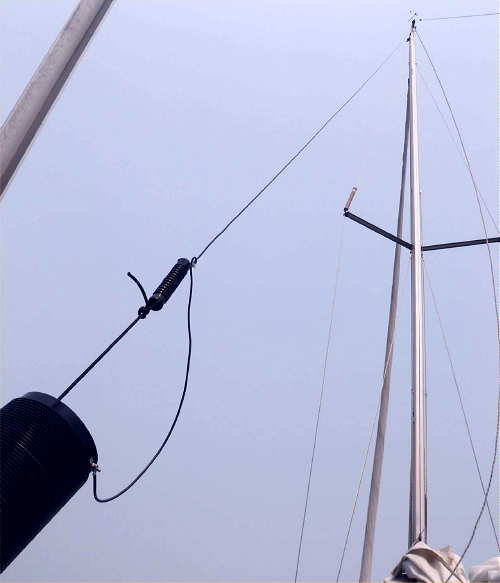 |
| Wire vertical and loading coil |
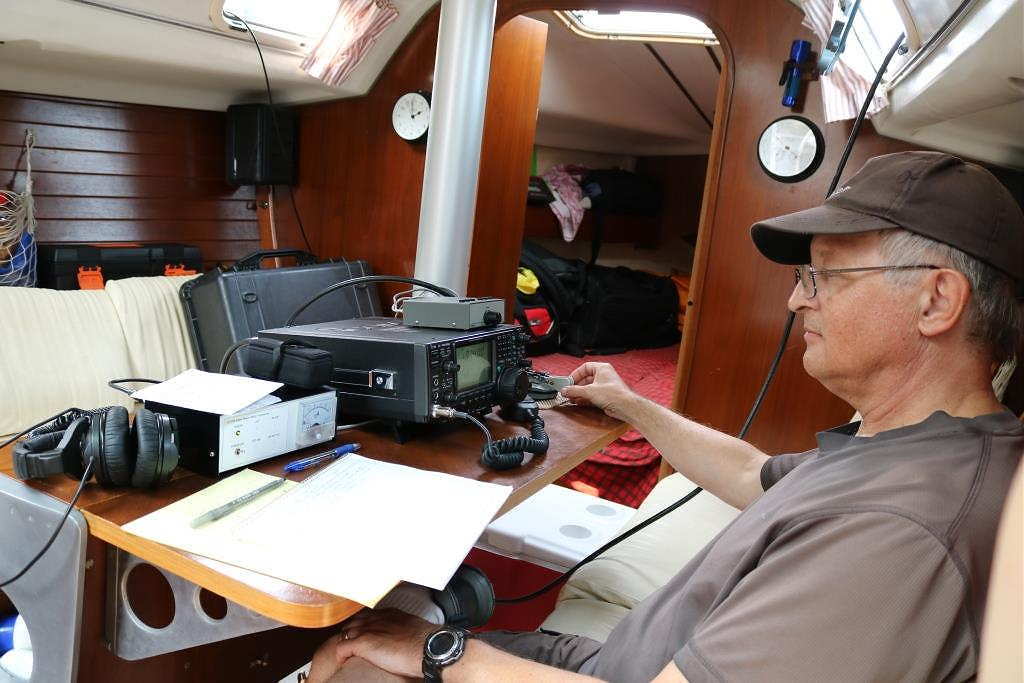 |
| Toby (VE7CNF) working the pileups! |
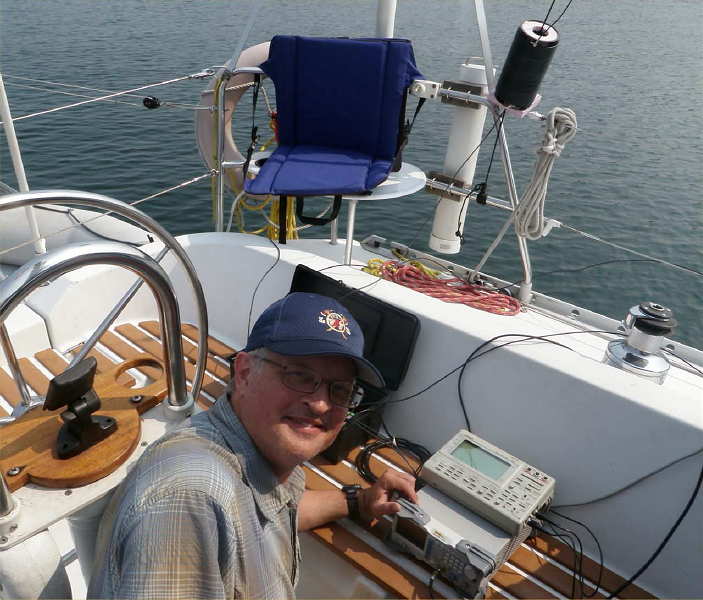 |
| Tuneup |
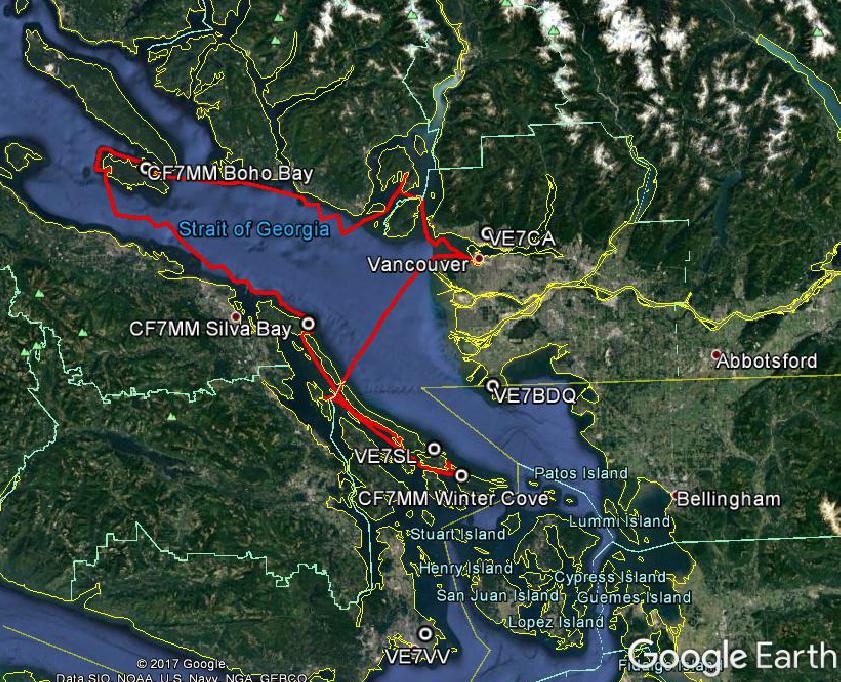 |
| The route, heading north from Vancouver |
Some of the contacts are shown below. Note the transceiver is not really on 160m ... it's just the i.f. for my 630m transverter!
I was impressed with the strength of ground wave signals given the low transmitter powers and EIRP's well below 5W. Received signals ranged from S1 to S9+10dB and copy was easy for all QSOs. QSO distances ranged from 10 to 142 km. We had low receive noise levels in all locations, with Silva Bay being a little noisier than the others due to many nearby boats and some shore power lines.
We tried disconnecting the gunnel ground wires and leaving only the keel, and found that the antenna capacitance and resistance did not change. When we disconnected the keel and left only the gunnel wires, the antenna capacitance dropped to about 87pF and antenna resistance dropped by a few ohms. It appears that the keel provided most of our ground coupling to sea water and it would have been a sufficient ground on its own.
More details of Toby's 630m transverter as well as a practical 630m antenna tune-up procedure can be found on his website here.
All-in-all, I think the 630m operation was a great success and very likely the first-ever 630m marine mobile operation on that band, as I don't recall this happening anywhere else over the years. It was also a great way to pay homage to the band's original maritime heritage where its quality groundwave and skywave capabilities were used to advantage for so many decades safeguarding mariners worldwide.
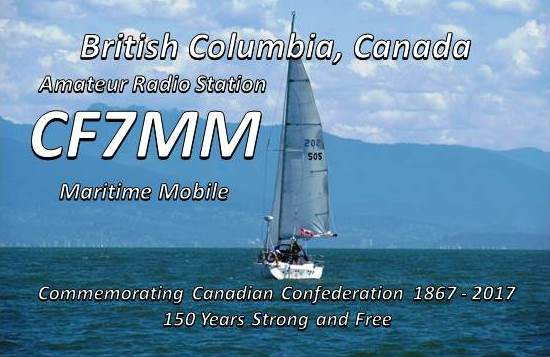
Maritime mobile operation on the amateur bands has some great history behind it, including the yacht YASME. In the mid-50's, Danny Weil was the first ever amateur to undertake DX'pedition style operations via sailboat, as he visited numerous rare islands in the Caribbean and South Pacific.
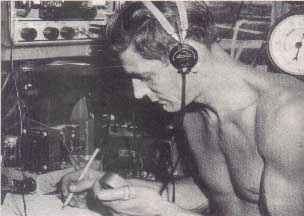 |
| Danny on the YASME - courtesy: www.gm3itn.co.uk |
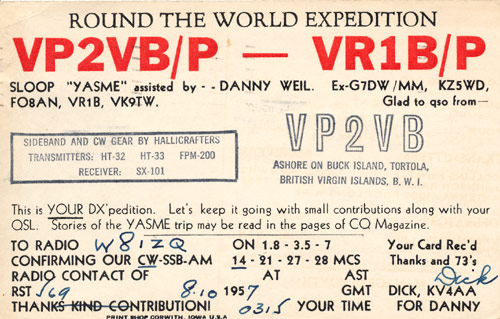 |
| Original YASME QSL - courtesy: http://hamgallery.com/ |
His exploits were regularly published in CQ magazine at the time and always made for exciting reading as Danny would eventually wreck three YASMES over the years! His adventures laid the groundwork for future island-hopping DX operations such as those undertaken by Gus Browning (W4BPD), Don Miller (W9WNV) and all that followed ... I'm sure they would all have enjoyed working the HAKUNA MATATA as well!
Steve McDonald, VE7SL, is a regular contributor to AmateurRadio.com and writes from British Columbia, Canada. Contact him at [email protected].
A 630m Maritime Adventure
|
| HAKUNA MATATA |
Crewed by Mark (VA7MM) and YL May (VE7MAY), Toby (VE7CNF) and XYL Nancy, the 31' Benateu recently completed a 14-day circumnavigation of Georgia Strait's Gulf Islands. This is a yearly adventure that has been successfully completed for the past few summers and looks as though it may now be an annual tradition.
Normally, the crew kept up regular radio contact on HF as well as on VHF when possible but this year saw a major departure.
In previous summers, near the end of the voyage, the crew has always visited us here on Mayne Island for an afternoon of vittles and libation before heading for home. There is always a good amount of time spent recalling the past-year's radio activities, winter projects and reminiscence of the 'good old days'. Last year, just as the party was ending, I jokingly suggested that 'next year', it would be cool to work them from the boat on 630m.
Although there was no immediate commitment, I knew that the seed had been planted, and with three of the four crew being engineers, I suspected it might be hard for them to resist, and ... just before departure, the local bunch of 630m ops were put on alert to be watching for CF7MM/mm on 475 kHz CW as they would be attempting to work us from three different overnight anchorages during their summer voyage!
Evidently Toby had been working quietly during the winter to make this become a reality. Here are some pictures of the system along with Toby's (the system's builder) comments.
|
| Variometer and matching transformer |
|
| Wire vertical and loading coil |
|
| Toby (VE7CNF) working the pileups! |
|
| Tuneup |
|
| The route, heading north from Vancouver |
Some of the contacts are shown below. Note the transceiver is not really on 160m ... it's just the i.f. for my 630m transverter!
I was impressed with the strength of ground wave signals given the low transmitter powers and EIRP's well below 5W. Received signals ranged from S1 to S9+10dB and copy was easy for all QSOs. QSO distances ranged from 10 to 142 km. We had low receive noise levels in all locations, with Silva Bay being a little noisier than the others due to many nearby boats and some shore power lines.
We tried disconnecting the gunnel ground wires and leaving only the keel, and found that the antenna capacitance and resistance did not change. When we disconnected the keel and left only the gunnel wires, the antenna capacitance dropped to about 87pF and antenna resistance dropped by a few ohms. It appears that the keel provided most of our ground coupling to sea water and it would have been a sufficient ground on its own.
More details of Toby's 630m transverter as well as a practical 630m antenna tune-up procedure can be found on his website here.
All-in-all, I think the 630m operation was a great success and very likely the first-ever 630m marine mobile operation on that band, as I don't recall this happening anywhere else over the years. It was also a great way to pay homage to the band's original maritime heritage where its quality groundwave and skywave capabilities were used to advantage for so many decades safeguarding mariners worldwide.
Maritime mobile operation on the amateur bands has some great history behind it, including the yacht YASME. In the mid-50's, Danny Weil was the first ever amateur to undertake DX'pedition style operations via sailboat, as he visited numerous rare islands in the Caribbean and South Pacific.
|
| Danny on the YASME - courtesy: www.gm3itn.co.uk |
|
| Original YASME QSL - courtesy: http://hamgallery.com/ |
His exploits were regularly published in CQ magazine at the time and always made for exciting reading as Danny would eventually wreck three YASMES over the years! His adventures laid the groundwork for future island-hopping DX operations such as those undertaken by Gus Browning (W4BPD), Don Miller (W9WNV) and all that followed ... I'm sure they would all have enjoyed working the HAKUNA MATATA as well!
Steve McDonald, VE7SL, is a regular contributor to AmateurRadio.com and writes from British Columbia, Canada. Contact him at [email protected].
AmateurLogic 12th Anniversary Sweepstakes
 Get the complete details at: www.amateurlogic.tv/contest
George Thomas, W5JDX, is co-host of AmateurLogic.TV, an original amateur radio video program hosted by George Thomas (W5JDX), Tommy Martin (N5ZNO), Peter Berrett (VK3PB), and Emile Diodene (KE5QKR). Contact him at [email protected].
The VK3BVW Winter DX Survey
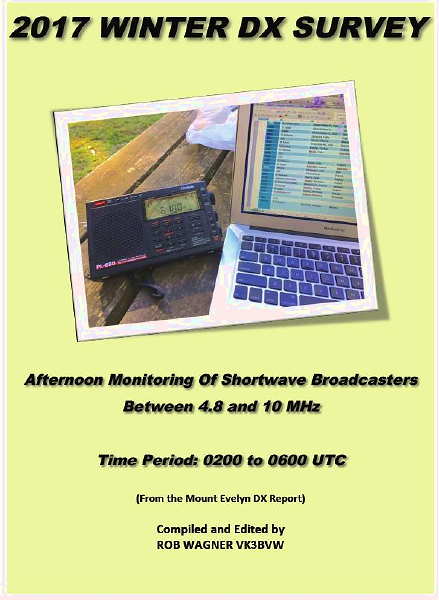 |
| courtesy: VK3BVW |
Every once in awhile I get the yen to tune through the international SW broadcast bands as my interest in good old, basic SWL'ing, is rekindled.
These bands are certainly quieter compared to when I first discovered the magic of radio and started DXing at age eleven using a lovely old all band cathedral-style GE set up in my attic-high radio shack ... no longer just a boring attic bedroom, but one with walls plastered with QSLs from all over the world.
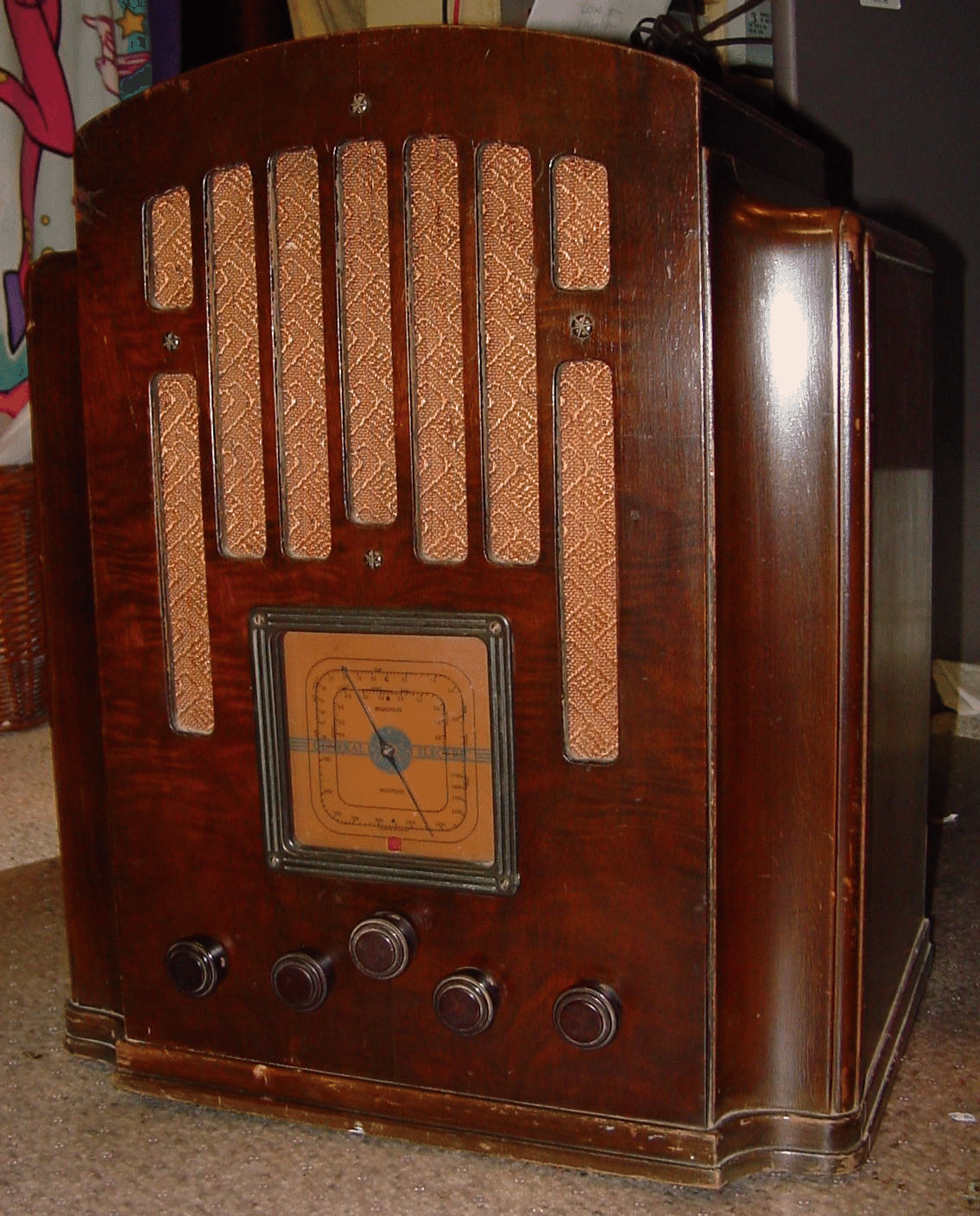 It was an amazing experience and one that obviously has left a lasting impression. There were hundreds and hundreds of stations on SW, throughout all of the HF bands but the highest I could tune was 19mc. on the old General Electric beauty ... who knows what was missed up higher as this was the peak of Cycle 19 and HF was on fire!
As the huge decline in international SW broadcasting over the past few years continues, I'm always pleasantly surprised to see that there are still a lot of nice DX targets to hunt for.
I was particularly excited to read Rob's (VK3BVW) just released blogspot, describing his fall listening project from down-under. Being the DX season down in Australia, Rob decided to do daily bandscans of the low HF international SW bands (4.8 - 10MHz) to see what popped-up from day to day, which was actually afternoon to afternoon, since his listening was done between noon and 4PM local time. The project may be viewed here along with a nice introductory video ... in all, a huge effort by Rob with a lot of helpful details to go along with the logs.
While there be sure to visit the rest of Rob's SW blog ... there's a lot of good stuff here to get your SWL juices flowing!
His survey results are very encouraging for those of us that may have thought that there is just not much to be heard when it comes to international SW broadcasting. As Rob points out, even though these logs reflect what was heard in Australia, most, if not all should be hearable in North America as well, even more so as we approach the DX season in North America.
So pull up your chair sometime after dark, grab a cup of your favorite beverage, and take a relaxing tune through the SW bands with Rob's list in hand ... see what you can find, and perhaps rekindle that early fascination in SW radio outside of the ham bands that may have hooked you many years ago. You may also find this broadcast frequency database helpful should you run across something unknown.
Steve McDonald, VE7SL, is a regular contributor to AmateurRadio.com and writes from British Columbia, Canada. Contact him at [email protected].
 Ham Radio Deluxe |
 W5SWL Electronics |
 Ham Radio Prep |
 KB3IFH QSL Cards  Hip Ham Shirts  HamRadioAuctions HamRadioAuctions Reliance Antennas Reliance Antennas Enigma Shop Enigma Shop |  morseDX  Ni4L Antennas  R&L Electronics R&L Electronics antennas.us antennas.us QRV QRV |
- Matt W1MST, Managing Editor
