 |
 Building For The BK Party?
 29 August 2017 | by
It's almost that time of the year when, once again, the '29ers start preparing for the winter Bruce Kelley 1929 CW Party. A recent posting on the Yahoo AWA (Builder's) Group by Lou, VE3AWA, reminded everyone that there were only 108 more sleeps before this year's Party.
In case you're not familiar with the 'BK', it's a winter CW event celebrating the early days of amateur radio.
Transmitters used for the event must be self-excited only ... no crystals are allowed ... and the tube(s) used must be those that were available in 1929 or earlier. It's an eye-opener to hear how the band must have sounded in the early days of amateur radio CW... even better if you're making those beautiful sounds yourself.
The 'BK' usually spawns a flurry of construction, so if you think it is something that might interest you, you have until December to get ready! Unfortunately many aspiring '29ers always leave it too late and inevitably run out of time before any last glitches can be overcome.
For many builders of '29-style gear, especially transmitters, the two-weekend December event is the highlight of the year as it gives them the opportunity to get on the air with their early-style rigs and work as many other '29ers as they can.
Every year there are numerous transcontinental CW contacts made with the simple, usually single-tube, self-excited oscillators that look as if they would have difficulty just being heard across town! Tuning in to the BK Party may be the closest thing you can find to a 'time machine' these days, as a small section of the CW bands (160-40m) take on the same sounds you would have heard when tuning across these bands in the late '20s.
When I first listened to a BK Party several years ago, I was surprised at the wide range of signal quality coming from these faithfully reproduced exhalers, running the gamut from the 'almost Collins-like' MOPAs to the unique sounding raw-AC notes coming from some of the one-lungers.
Most of the stations I have worked in past BK events were running less than 10W input yet, even with the terrible conditions experienced in the last two events, their signals were making it across the continent on the low bands ... and all were having a great time doing it!
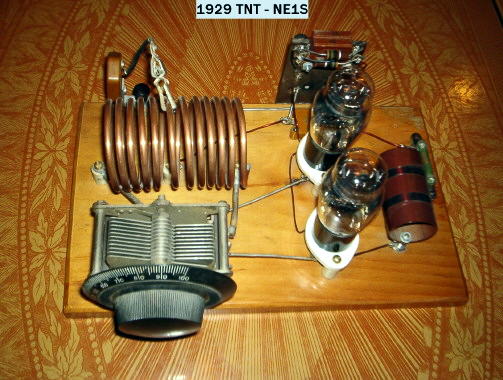
Larry's (NE1S) TNT makes it back to the west coast every year in the BK Party.

Shown above is a fine little TNT built by Kevin, WB2QMY, in New York. It uses a very affordable UX-201A triode, originally manufactured in 1925 for radio receivers. Although Kevin's TNT puts out barely 2 watts on 80m CW, we had no trouble working each other in the BK QSO Party. If you build it, they will come!
If you've ever entertained thoughts of wanting to participate in the '29 QSO Party, this late-summer 'heads-up', could be just what you need to make it happen ... there is still plenty of time to put something together for this year's event. Here is the specific information for this year's BK Party.
There is plenty of information available right here on my blog that will answer many of your initial concerns surrounding tubes, circuits and components:
An Introduction To Building ... '29-Style
'29-Style Transmitters ... What To Build? - Part 1
'29-Style Transmitters ... What To Build? - Part 2
As well, my own website contains several detailed construction procedures on various transmitter styles used back in the day ... and an inspirational 'Gallery of '29-Style Transmitters' from other builders. In addition, there is a lot more '29-specific information in this blog, all of which can be found here, for several nights of bedtime reading!
Should you decide to take on a simple transmitter for this year's party (and there are dozens of participants hoping that you will), here are a few things to keep in mind:
You don't need much power to make contacts ... just a few watts will do it. If your antenna system is efficient and you can hear reasonably well, expect to work '29ers all across the continent.
Your transmitter does not have to 'look pretty'! You can breadboard up something with modern components and as long as the tube-year qualifies, you're good to go. Too many get bogged-down with making a showpiece ... that can always come later.
I, and others, have found Hartley oscillators to be the easiest to get going and often produce the best notes. Although the power limit this year has been increased to 25 watts DC input, just 2 or 3 watts coming from a simple Hartley will guarantee you a ticket on the BK time machine.
A wonderful source of advice, inspiration and even help with parts, can be had by joining the AWA (Builders) Group.
For now, I'll tempt you with the basic information regarding the QSO Party as published by the 'BK' sponsor...the AWA.
The Bruce Kelly 1929 QSO Party is a yearly AWA sponsored event where participants build their own transmitters using the designs, techniques, and tubes that were available in 1929 and earlier, and then put those classic transmitters on the air and try to contact as many other 1929 stations as possible. Since they use early designs, it is a cacophony of whooping, chirping, buzzing, clicking, drifting, swishing, swaying, warbling, and other interesting signals. This is what ham radio sounded like in 1929 and for two weekends in December its 1929 again on the ham bands.
Input Power: Transmitters are limited to a power INPUT of 25 watts or less.
Frequencies: The QSO Party typically operates between 1800 to 1810 Kcs, 3550 to 3580 Kcs , 7100 to 7125 Kcs, plus or minus depending on QRM. 40 meter activity is up significantly because it offers both night time AND daytime propagation!
Presently, a large percentage of the activity is from Minnesota and points eastward ... the west is poorly represented for some reason but activity out this way has been slowly increasing over the past few years.
You don't need much in the way of power ... every year I work several eastern 'BK' stations that are running just 2 or 3 watts, usually using receiver tubes pressed into RF oscillator service ... much like the original 'boys of '29' probably had to do.
With the solar cycle winding-down and the expected return of undisturbed great winter conditions, this year's BK Party should be better than ever ... especially with even more new clunkers chirping away in the night.
Should you join the fun, there will be many '29ers looking for you I can guarantee!
 |
| courtesy:VE3AWA |
Steve McDonald, VE7SL, is a regular contributor to AmateurRadio.com and writes from British Columbia, Canada. Contact him at [email protected].
LHS Episode #197: Dark Star
 In Episode 197 of Linux in the Ham Shack, the hosts discuss the influx of Chinese ham radio equipment and its effect on the hobby, Elmering, the solar eclipse (of course), project maintainers in open source, systemd, CloudLog, a GitHub dive (again) and much more. We also have an interview with Brian, N4AE, on youth in the hobby. We also address our upcoming hiatus from October 2, 2017 to January 8, 2018. Please send us feedback on what you'd like to see in the show as we retool it for a new round of 100 episodes.
73 de The LHS Crew
Russ Woodman, K5TUX, co-hosts the Linux in the Ham Shack podcast which is available for download in both MP3 and OGG audio format. Contact him at [email protected].
868MHz LoRa HAB Tracking Success
868MHz ISM devices are available but are not as widely used. Back in December I posted about trying to track a flight by HAB Enthusiast Dave Akerman who is experimenting using LoRa devices on this band. I had limited success receiving that flight and another ones so when I saw that Dave was planning another flight today using 868MHz LoRa I had a rethink on how to approach tracking it.
The antenna I used was a collinear one built from cheap satellite coax, similar to that I built for ADB-S however rather than having a long coax run to the LoRa gateway I opted to put the Raspberry Pi up on the pole at the base of the antenna to limit any loss.
The antenna can be seen connected to the Raspberry Pi and LoRa add on board, the Pi has a WiFi dongle.

The antenna was inserted into a piece of conduit to keep it upright and it and the Pi were strapped to a 5m painters pole (using a plastic lid as an insulator)

A USB power pack was also strapped to the pole to keep the Pi powered, hopefully you can see it in the photo below.

The pole was put up and was about the same height as my normal dual band collinear

Well it all worked extremely well, and got a lot of decodes as can be seen by the pie-chart generated by the habitat.habhub.org system, the third best receiver only bettered by Dave himself (M0RPI) and a station nearer to the flight path.

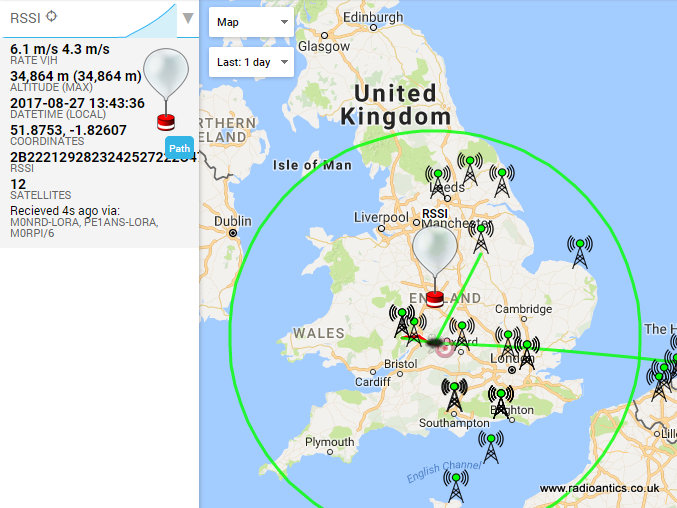
The Pi was connected to my network via WiFi and controlled by a Putty console on my shack PC
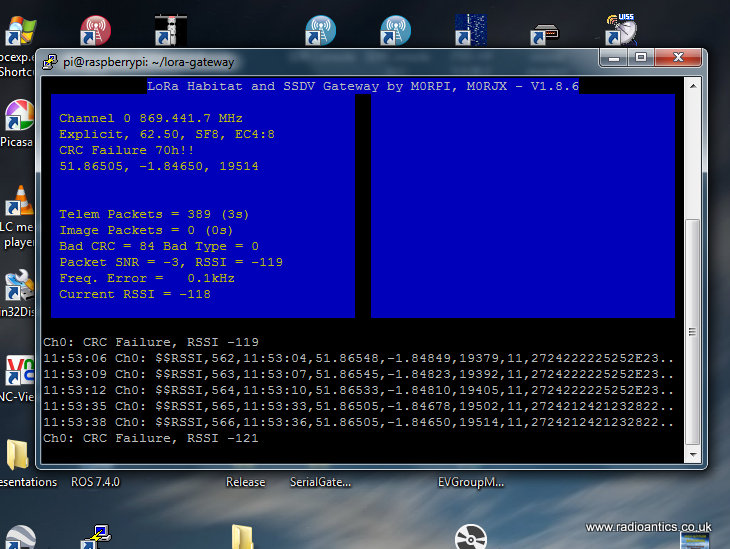
It was a useful experiment and I am thinking of installing a dedicated mast mounted LoRa receiver with 868 and 434MHz antennas (and possibly pre-amps and filters) following this result.
Andrew Garratt, MØNRD, is a regular contributor to AmateurRadio.com and writes from East Midlands, England. Contact him at [email protected].
Ham College 32
Ham College episode 32 is now available for download.
General Amateur Radio Exam part 3. More on the band plans. Series and parallel capacitors.
01:14:17
George Thomas, W5JDX, is co-host of AmateurLogic.TV, an original amateur radio video program hosted by George Thomas (W5JDX), Tommy Martin (N5ZNO), Peter Berrett (VK3PB), and Emile Diodene (KE5QKR). Contact him at [email protected].
Amateur Radio Weekly – Issue 170

Hurricane Harvey: How to monitor Watch Net via shortwave radio
The Hurricane Watch Net is a group of amateur radio operators who are trained and organized “to provide essential communications support to the National Hurricane Center during times of Hurricane emergencies.”
SWLing Post
Solar Eclipse QSO Party a hit, science conclusions await analysis
While logs are still coming in, the preliminary participation numbers look good.
ARRL
Ham operator rescues epileptic girl on remote campsite
Ham was able to direct paramedics to the area after one of the camping party used a radio set to call for help as there was no mobile phone signal.
BBC News
N9EWO Review : Icom IC-R8600
In our view this is the best receiver Icom has produced to date.
N9EWO
The future of Amateur Radio is not in the numbers
Stop hawking EMCOMM. Forget about Morse Code.
Off Grid Ham
RAC Canada 150 Award
Celebrating Canada’s 150th Birthday.
RAC
Make great circle maps from any location in the world
Good looking maps in the azimuthal equidistant projection
SM3GSJ
A great way to make quick and easy knobs
All you need is some casting resin, a silicone mold intended for candy, and some socket head bolts.
Hack A Day
Video
Digital mode FT-8 with light bulb antenna
750 Miles.
W6LG
Amateur Radio Weekly is curated by Cale Mooth K4HCK. Sign up free to receive ham radio's most relevant news, projects, technology and events by e-mail each week at http://www.hamweekly.com.
Remote Operations – ETH083

In this episode we talk with Ria Jairam, N2RJ, again. I had Ria on my podcast back in episode 76 where we talked about Software Defined Radios. This time around, we talk about Remote Operations.
Remote operations has come a long way in the past 20 years or so. I have heard about people having a remote site 10-15 years ago, but their setups is a lot harder to make. Now, you can do it with just a Radio and an internet connection. Well you might need some wires and stuff too but…

Ria was kind enough to let me use her station last week remotely. Ria lives in New Jersy and I live in Texas. While I was using it I made my first HF contact in probably 15 years to a gentleman in TN and another one from IL. So basically I was talking from Texas to New Jersey to Tennessee and Illinois.
Technology has advanced so far and makes working remotely a lot easier. I recently listened to an episode of the Hamradio 360: Workbench podcast where George was talking with Michael VA3MW about his setup. The reason that he did remote operations was because he lived in the city and his noise floor was way up, but he had another piece of property, a family cabin if I’m not mistaken, that he setup his station at and was able to connect remotely to it from his home.
The reasons for operating a station remotely are vast.
- You live in an HOA or another antenna restricted location.
- You live in a retirement home but you still want to make those DX contacts.
- You live somewhere that has a high noise floor and you couldn’t make a contact even if you had an awesome setup
- Maybe you can’t afford a $1000+ HF setup, you can RENT the use of a remote station.
Listen to the episode and check out the show notes
Curtis Mohr, K5CLM, is the author/owner of Everything Ham Radio Blog and Youtube channel. Contact him at [email protected].
Hunting For NDBs In CLE 222
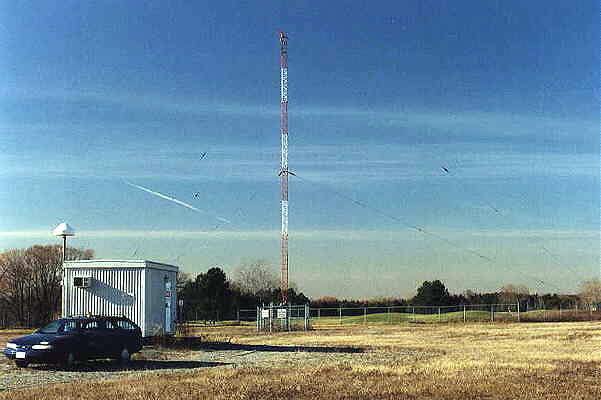 |
| HM - 221 kHz Hamilton, Ontario |
This coming weekend will see another CLE challenge. This time the hunting grounds will be all inclusive: 190-1740 kHz. As well, there are two options, HOME and DX as explained below.
For those unfamiliar with this monthly activity, a 'CLE' is a 'Co-ordinated Listening Event', as NDB DXers around the world focus their listening time (usually) on one small slice of the NDB spectrum.
Summertime CLEs can often be challenging, not because of poor propagation but more likely, summer lightning storms ... hopefully it will be quiet for your location.
When tuning for NDBs, put your receiver in the CW mode and listen for the NDB's CW identifier, repeated every few seconds. Listen for U.S. NDB identifiers approximately 1 kHz higher or lower than the published transmitted frequency since these beacons are modulated with a 1020 Hz tone approximately.
For example, 'AA' (Fargo - ND) transmits on 365 kHz and its upper sideband CW identifier is tuned at 366.025 kHz while its lower sideband CW ident can be tuned at 363.946 kHz. Its USB tone is actually 1025 Hz while its LSB tone is 1054 Hz.
Often, one sideband will be much stronger than the other so if you don't hear the first one, try listening on the other sideband.
Canadian NDBs normally have an USB tone only, usually very close to 400 Hz. They also have a long dash (keydown) following the CW identifier.
All NDBs heard in North America will be listed in the RNA database (updated daily) while those heard in Europe may be found in the REU database. Beacons heard outside of these regions will be found in the RWW database.
From CLE organizer Brian Keyte, G3SIA, comes the usual 'heads-up':
Hi all
Our 222nd Co-ordinated Listening Event, 'DX and HOME', starts on Friday
and runs for an extra day. First-time CLE logs will also be very welcome
of course.
Days: Friday 25th August - TUESDAY 29th August
Times: Midday on Friday to Midday on Tuesday, your LOCAL time
QRG: Normal LF/MF frequencies (190 - 1740 kHz)
NDBs: Normal DX and 'HOME' ones (not DGPS, Navtex or Amateur)
There are two parts (you can listen for either or both of them):
DX:
Please try to log NDBs that are over 2,000 km / 1,250 miles from you.
(If you don't have details of the distances of NDBs from you, please see
the end of this email)
HOME:
If you have any, please log the NDBs in YOUR OWN radio country.
For listeners in AUS, CAN and USA, that means your State or Province.
Our full list of radio countries can be found at:
http://www.ndblist.info/ndbinfo/countrylist.pdf
(If you also mention any of your home regulars NOT heard, it will help
others to know about NDBs, maybe DX to them, that may not be active)
Please post your CLE log to the List in a plain text email if possible,
with 'CLE222' at the start of its title and showing on each log line:
The full Date ( e.g. 2017-08-25 or just the day number 25 )
UTC (the day changes at 00:00 UTC).
kHz - the nominal published frequency
The Call Ident.
Please put those four main log items FIRST, with any other optional
details such as location and distance LATER in the same line.
Your log will be more interesting if you keep the two parts, DX and HOME,
separate in it. Any UNIDs that you come across will also be of interest -
in a separate, third, part of your log please.
If you send interim logs, please make sure that you also send a 'Final' log
showing ALL your loggings for the CLE.
I will send the usual 'Any More Logs?' email at about 17:00 UTC on
WEDNESDAY so you can check that your log has been found OK.
Do make sure that your Final log has arrived on the list by 08:00 UTC
on Friday 1st September at the very latest.
Joachim hopes to complete the combined results on the Saturday.
Good listening
Brian
----------------------------------------------------------
From: Brian Keyte G3SIA ndbcle'at'gmail.com
Location: Surrey, SE England (CLE coordinator)
----------------------------------------------------------
(If you wish you could use a remote receiver for your loggings,
stating its location and owner - with permission if required.
A remote listener may NOT also use another receiver, whether
local or remote, to obtain further loggings for the same CLE.
The HOME radio country and the distances would be based on
where the receiving equipment is located)
DISTANCES TO NDBs FROM YOUR LOCATION
The Great Circle program GcmWin by SM3GSJ can produce a nice great circle
map centred on your location - see http://www.qsl.net/sm3gsj/
Users of Michael's NDB Handbooks will already have their distances and
bearings to the NDBs.
Alex's WWSU program has a facility to create a map showing the areas
inside the 2000 km circle.
To create this,
click on 'Tools'
click on 'Station Radar'
select Range from “2000” to “10000” km
select “show NDB stations”
click on “Generate Image”
click on “Save To File”
That will create a text-file containing information on the selected NDBs.
The REU/RNA/RWW Database provides a powerful way of finding which
NDBs to search for:
1) Go to the signals screen using -
http://www.classaxe.com/dx/ndb/reu?mode=signals
If you are in North America, replace the reu above with rna
If you are not in Europe or North America, replace the reu with rww
2) On the Range line, put your *Locator in the 'From GSQ' box (e.g. mine
is IO91tg) The DX fields become enabled when a GSQ is entered.
3) Enter 2000 in the first DX field, leave the second blank and leave the
units as 'km' (or use 1250 and 'miles', if you prefer)
4) Select 'Only Active' and press 'Go'.
Now you only see NDBs that are over 2000 km from you.
Change 'Show' in the top line to 'All Results'.
The other fields are also active - e.g. you could enter specific States or
Countries in the Location line to limit the search to the NDBs there.
And/or you could click on 'Map', then on 'Go' and uncheck 'Clustering'
*If you do not know your Locator you can quickly find it from your
Latitude/Longitude (and vice versa) by using:
wingrid.exe V4.1 - freeware from W4SM
These listening events serve several purposes. They:
- determine, worldwide, which beacons are actually in service and on-the-air so the online database can be kept up-to-date
- determine, worldwide, which beacons are out-of-service or have gone silent since the last CLE covering this range
- will indicate the state of propagation conditions at the various participant locations
- will give you an indication of how well your LF/MF receiving system is working
- give participants a fun yet challenging activity to keep their listening skills honed
Final details can be found at the NDB List website, and worldwide results, for every participant, will be posted there a few days after the event. If you are a member of the ndblist Group, results will also be e-mailed and posted there.
The very active Yahoo ndblist Group is a great place to learn more about the 'Art of NDB DXing' or to meet other listeners in your region. There is a lot of good information available there and new members are always very welcome. As well, you can follow the results of other CLE participants from night to night as propagation is always an active topic of discussion.
If you are contemplating getting started on 630m, listening for NDBs is an excellent way to test out your receive capabilities as there are several NDBs located near this part of the spectrum.
You need not be an ndblist member to participate in the CLEs and all reports, no matter how small, are of much value to the organizers.
'First-time' logs are always VERY welcome!
Reports may be sent to the ndblist or e-mailed to either myself or CLE co-ordinator, Brian Keyte (G3SIA), whose address appears above.
Please ... give the CLE a try ... then let us know what NDB's can be heard from your location! Your report can then be added to the worldwide database to help keep it up-to-date.
Good hunting!
Steve McDonald, VE7SL, is a regular contributor to AmateurRadio.com and writes from British Columbia, Canada. Contact him at [email protected].
 Ham Radio Deluxe |
 W5SWL Electronics |
 Ham Radio Prep |
 KB3IFH QSL Cards  Hip Ham Shirts  HamRadioAuctions HamRadioAuctions Reliance Antennas Reliance Antennas Enigma Shop Enigma Shop |  morseDX  Ni4L Antennas  R&L Electronics R&L Electronics antennas.us antennas.us QRV QRV |
- Matt W1MST, Managing Editor
