 |
 BSD in the Ham Shack Episode 1
 15 December 2017 | by
  Our good buddy and co-host-on-hiatus Rich, KD0RG, is supplementing our vacation with some content for your ear holes! This is the first installment of his series, BSD in the Ham Shack. We're sure it's great. Have a listen!
73 de The LHS Crew
Russ Woodman, K5TUX, co-hosts the Linux in the Ham Shack podcast which is available for download in both MP3 and OGG audio format. Contact him at [email protected].
ICOM IC7300 – Time for a price drop?
 Much to my surprise the price has still to fall, although there are “cracks”: some are now offering the rig with free gifts.
Personally, I can wait. It is a good rig, but to my mind, the dealers have had a very good time and very good profits.
Now is the time to drop the price. Sub £1000 (~$1,300) please – soon.

Roger Lapthorn, G3XBM, is a regular contributor to AmateurRadio.com and writes from Cambridge, England.
International System of Units (SI) Checklist
 Metrology is the science of measurement. The International System of Units, also called SI, consists of standards which result from meticulous negotiations among international metrologists. The purpose of the International System of Units is to communicate quantitative information clearly across languages and cultures.
This check-list summarizes the most important elements of those standards. For more detail, you may wish to download the PDF document NIST Special Publication 811, 2008 Edition, by Ambler Thompson and Barry N. Taylor: Guide for the Use of the International System of Units (SI). A relevant Wikipedia article is also useful. The Bureau International des Poids et Mesures (BIPM) also publishes useful information in French and English.
Here is a simple checklist to help you use SI correctly:
- Except for degrees Celsius, SI units like microfarads and millivolts are always written in lower case and are almost always pluralized. (See below for exceptions to the usual pluralizing standard.) Because of their phonetics, some SI units like megahertz are written the same in singular and plural.
- SI symbols like kHz and µV are written in lower case or UPPER CASE Latin or Greek characters or in combinations. SI symbols are the most universal parts of SI, and are never pluralized.
- Be careful with UPPER and lower case: UPPER CASE M is the SI symbol for the mega- prefix; lower case m is the symbol for meters or metres as well as the milli- prefix; lower case Greek µ is the symbol for the micro- prefix. With the advent of computer word processors, using u as a substitute for µ is an obsolete practice. Lower-case italic m represents mass. UPPER CASE K is the SI symbol for thermodynamic temperature in kelvins and lower case k is the SI symbol for the kilo- prefix. One should not be used in place of the other.
- With three exceptions, SI values and SI symbols are always separated with spaces and never with anything else. Those exceptions are the symbols for angular degrees, minutes and seconds. The 100 m dash and a 10 A fuse are correct expressions. It is also correct to write: The summit of 6190 m Denali in Alaska is located at 63°04’08.7”N 151°00’25.5”W.
- When used in an adjectival sense in English, SI values and spelled-out SI units are separated with hyphens and are not pluralized: the 100-meter dash and a 10-ampere fuse are correct expressions. When accompanying values of exactly 1 or -1, SI units are not pluralized.
- Abbreviations do not exist in SI. Instead of abbreviations like amps and secs, use SI symbols like A and s or fully spelled-out SI units like amperes and seconds. Note that the symbol for the time unit minutes is min, which is not an abbreviation, and therefore it is not pluralized and it is not followed by a period.
- Never use SI prefixes in isolation. Avoid using expressions like 10 kilos of flour or 5 K run; use 10 kilograms of flour or 10 kg of flour or 5-kilometer run or 5 km run instead.
- Except at the end of a sentence, an SI symbol is never followed by a dot or period. To avoid confusion, try not to end sentences with SI symbols if possible.
- Fractional SI values are decimalized and preceded with a zero or other integers: 0.529 µm or 0.529 micrometers.
- Since either a dot or a comma may be used in SI as a decimal marker, the comma should never be employed as a separator for long integers or long fractions. Segment values with five digits or more utilizing spaces or half spaces. Using a word-processor, create a half space by changing the font size of a regular space to about half the value of the rest of the text. The speed of light, whose symbol is italic c [see footnote 1] is 299 792 458 m/s or 299 792.458 km/s or 299.792 458 Mm/s when written in SI. The speed of light may also be written as 299 792,458 km/s or 299,792 458 Mm/s without any change in meaning.
- SI symbols should never include suffixes. Instead of 115 VAC, write AC 115 V or 115 volts alternating current in correct SI.
- Avoid orphaned values. Instead of 9-15 volts or 9-15 V, write 9 volts to 15 volts or 9 V to 15 V in SI.
- SI dates are rendered with numerals in descending order. The origin of what became the International System of Units began in Paris on 1875-05-20 with an international treaty. SI time is reckoned in the 24-hour system, often with the time zone specified: 1445 UTC or 0657 EST.
- SI standards have changed over time. Avoid obsolete expressions. The old degrees kelvin should be kelvins (symbol K). The obsolete mhos should be siemens (symbol S), which is followed by an s in both singular and plural unit forms. The old cubic centimeters unit is still commonly used in medicine, but milliliters or millilitres (symbol mL) [see footnote 2] should be used instead. The obsolete microns unit is now micrometers or micrometres (symbol µm). Multiple prefixes like µµ or micromicro- are no longer allowed in SI. Use the pico- unit prefix or the p- symbol prefix instead. An acceptable SI substitute for the obsolete parts per million (ppm), parts per billion (ppb) has not yet been developed. If international metrologists eventually agree on an SI unit and symbol for nominal-scale entities, then fractional prefixes combined with that unit or symbol will do a good job of carrying out that proportional function.
¹ Quantities to be measured and their symbols are written in italics: current and inductance are examples. Think of e=mc² and I=E/R.
² Although lower-case l may be used as a symbol for liters of litres, that character may be mistaken for the numeral 1, so most writers prefer the upper case L for that symbol.
J. Bruce Prior, N7RR, is a special contributor to AmateurRadio.com and writes from Washington, USA. Contact him at [email protected].
The Spectrum Monitor — December, 2017
 Stories you’ll find in our December, 2017 issue:
The Beginning of Sports Broadcasting and Radio’s First Sportscasters
By John Schneider W9FGH
Despite its great advantage of immediacy, radio did not become a dominant news medium until the start of World War II. Throughout the 1920s and 30s, newspaper owners were successful in keeping the press news agencies from selling their services to broadcasters, and radio remained a secondary source for news. But, the reporting of sporting events was another story. Sports and radio were a made for each other like ball in glove, and the country’s broadcasters were quick to capitalize on that advantage from the industry’s earliest years. John charts the rise of sports on American radio.
The Brief and Colorful History of Private US Shortwave Giants
By Richard Fisher KI6SN
In AM radio’s ever-evolving place in broadcasting history, there was a time when U.S.-based AM stations took to the shortwaves, either as standalone broadcasters or as an extension of their AM broadcast band partners. While their popularity soared in the 1970s and ’80s, many have vanished as others carry on.
Powerhouse American shortwave stations, including WRNO, WNYW, WBCQ, KUSW and KNLS, profiled here, had (or have) a substantial worldwide following on the high frequencies. In this 21st Century, many are gone or have changed formats from, say, popular music and news to Christian oratory or other programming. Richard looks back at some of these stations.
Meter Matters: Modern vs. Vintage Meters in Radio Restoration
By Rich Post KB8TAD
What happens when you calibrate that Hickok tube tester at those 150 and 130 voltage specifications or the bias voltages ignoring the line that calls for that ancient 1000 ohms-per-volt meter and just use a digital meter like my very-expensive-when-new Fluke 87 or that bargain Harbor Freight CenTech P37772 instead? Well, the calibration for your Hickok will be off. Those modern meters have a specified sensitivity of 10 megohms. Rich warns that not all that will be off as he examines the use of various meters in vintage radio technology.
TSM Reviews: Yaesu FT-70DR
By Cory GB Sickles WA3UVV
When an item is released that offers breakthrough technology or more features and benefits than previous models, the price is typically higher. When the price of an item is higher, many tend to hesitate in buying it. Further, economy of scale eventually kicks in, allowing a manufacturer to lower prices a bit, or produce and release additional models with many of the features of the premier version. The FT-70DR (FT-70DE in Europe) is the latest dual-band portable and takes its place in the market with a substantial entry-level feature set, as well as being the most inexpensive portable produced by the “traditional” amateur radio manufacturers—all for a street price of just under $200.
Scanning America
By Dan Veeneman
Interoperability Update; Orange County, Virginia
Federal Wavelengths
By Chris Parris
Urban Area Security Initiative (UASI)
Milcom
By Larry Van Horn N5FPW
Introduction to Military Monitoring: VHF Low Band—the Forgotten Military Band
Utility Planet
By Hugh Stegman NV6H
North Korea Resumes HF “Numbers” Broadcasts
Shortwave Utility Logs
Compiled by Hugh Stegman and Mike Chace-Ortiz
VHF and Above
By Joe Lynch N6CL
The Geminids and Ursids Meteor Showers
Digitally Speaking
Cory GB Sickles WA3UVV
System Fusion II
Amateur Radio Insights
By Kirk Kleinschmidt NT0Z
A Vertical in Hospice!
Radio 101
By Ken Reitz KS4ZR
AM Band DXing Circa 1964 and Now
Radio Propagation
By Tomas Hood NW7US
Heliophysics Research Reveals More About Substorm Mysteries
World of Shortwave Listening
By Rob Wagner VK3BVW
Making Shortwave Audio More Listenable
The Shortwave Listener
By Fred Waterer
2017 SW Review and New Programming
Amateur Radio Satellites
By Keith Baker KB1SF/VA3KSF
A Wealth of New Amateur Radio Satellites
The Longwave Zone
By Kevin O’Hern Carey WB2QMY
Primetime Arrives!
Adventures is Radio Restoration
By Rich Post KB8TAD
What’s an “Acoustic Labyrinth?” The Stromberg Carlson 240M
The Spectrum Monitor is available in PDF format which can be read on any desktop, laptop, iPad®, Kindle® Fire, or other device capable of opening a PDF file. Annual subscription is $24. Individual monthly issues are available for $3 each.
Ken Reitz, KS4ZR, is publisher and managing editor of The Spectrum Monitor. Contact him at [email protected].
uBITX now on back order.
Demand has just outstripped supply, by what the thinking was there was enough stock to last for 2 months?
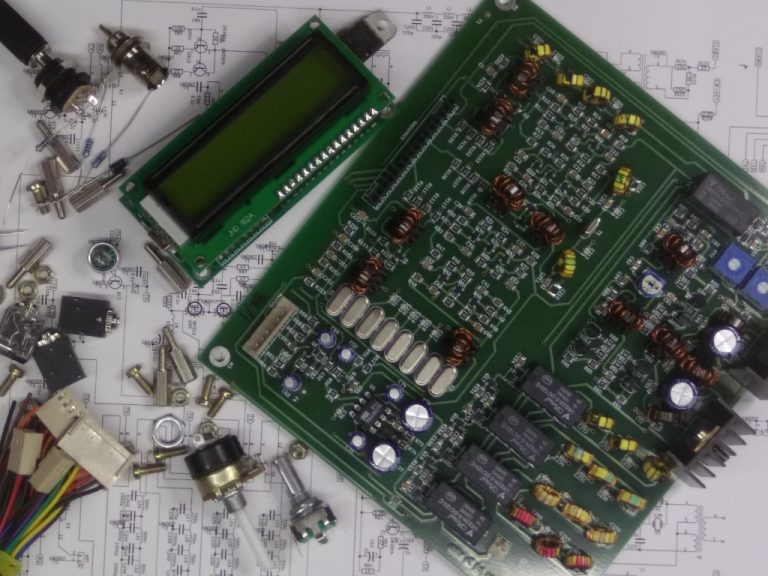
Anyone ordering the uBITX now, will not get shipped until after at least the 25th December. This is now being flagged up when you come to order.
Did the uBITX become more successful overnight than the ICOM IC-7300, did it sell more in it's first days of sale? Or does it say to the main three radio manufacturers, you missed a market for a plain no bells and whistles multiband radio that everyone can afford and muck into and understand?
One thing for certain Asharr Farhan has proved without a doubt that he has been the first to achieve and do this, putting into mass production a multiband rig at a price point that everyone can be part of and enjoy! I am sure as well as the uBITX there is a lot more to come from HF Signals in the future!
Well done VU2ESE!
Steve, G1KQH, is a regular contributor to AmateurRadio.com and writes from England. Contact him at [email protected].
The FA-VA4 Vector Antenna Analyzer (LF-100MHz)

For some time I had been considering the purchase of the MFJ259 antenna analyzer but after a little online sleuthing, came across this little beauty, the FA-VA4 Antenna Analyzer by Funk Amateur in Germany and available through their Box73 website here.
I liked the fact that the cost of the analyzer was about half that of anything else comparable ($140 US including shipping) and that it covered the new 2200 / 630m bands!
I think many amateurs planning on building a system for either of these new bands will find the very affordable FA-VA4 a handy piece of equipment when it comes to working on their LF / MF antenna since most available SWR meters do not cover these frequencies accurately.
Delivery time was fast and everything was very well packaged. The FA-VA4 comes in partial kit form and requires only a short amount of time to put together.
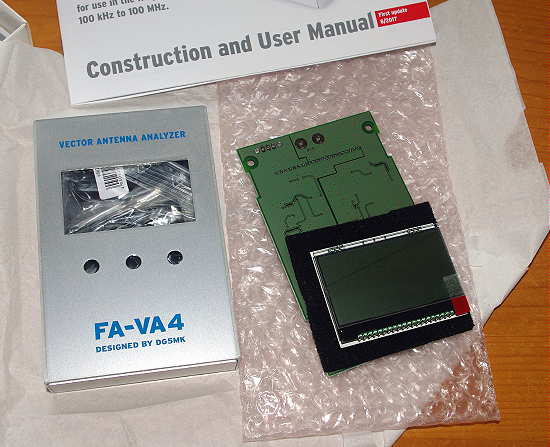
The necessary assembly consists of soldering pin strip connectors, switches, AA cell holders, and the BNC connector. All of the tricky SMD components have been pre-mounted ... total assembly time was less than 60 minutes and everything fired-up nicely, without problems, thanks to the well written instruction / user manual.

Included with the kit are three BNC connectors needed to calibrate the instrument for the highest accuracy. These consist of a 'Shorted' connector, an 'Open' connector and a 50 ohm 'Load' connector (SOL). A simple three-part calibration procedure for all frequencies takes about 15 minute to complete, while the instrument calibrates itself as it scans through all frequency ranges with each connector plugged into the output. Once this task is completed, the analyzer is ready for use.

If you're like me, I think the main use will be to check out and tweak some of your HF antennas using the SWR or Z sweep function. This allows you to set a desired 'center' frequency along with a + / - sweep range and have the display draw a nice plot of your system.
Had my 630m antenna not already been tuned and matched, I would have found the analyzer to be a great help but, thanks to my 'scopematch', that antenna has already been optimised.
All menu features and data entry is via three momentary-contact push switches. Although this might initially seem awkward, it is not, and operation is pretty intuitive.
The main modes of operation are:
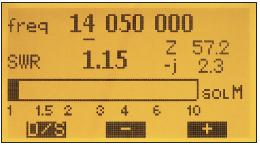
Single Frequency SWR Measurement
 |
| courtesy: http://www.box73.com/product/5 |
Single Frequency Impedance Measurement
 |
| courtesy: http://www.box73.com/product/5 |
Single SWR Measurement Run
 |
| courtesy: http://www.box73.com/product/5 |
Single Run For Impedance Measurement (Resistance and Reactance)
 |
| courtesy: http://www.box73.com/product/5 |
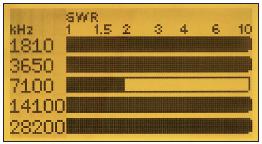
SWR Measurement On Five Frequencies (5 Band Measurement)
 |
| courtesy: http://www.box73.com/product/5 |
As well, all of the above can be viewed in a continuous 'cycle' mode, as inputs are changed and all screens can be saved for future reference.
Additional capabilities include use in an HF Signal Generator Mode (~ 1V square wave @50 ohms), the ability to measure C and L at a given frequency, as a 'dip meter' and to measure cable resonances and determine lengths.
The complete manual may also be downloaded from their website here.
I will soon put all of my antennas to the test and see what work might need to be done to optimize them, particularly my HF half slopers, which, in spite of their great performance, have always proven a bit of a mystery when it comes to pruning them to resonance ... I rather suspect that the sloping wires are more of an impedance tuning stub than a radiator and that most radiation comes from the vertical support tower, not the sloping wire.
All-in-all, the FA-VA4 appears to offer very good value for the money and is a well built, quality test instrument. I think it will become a popular choice among hams, especially those on LF / MF. The only thing different that I would have liked, would be to have a UHF (SO 239) connector rather than a BNC on the output, since most amateurs are using these on their HF systems ... or, the inclusion of a BNC-to-UHF adapter.
If you already use this device, please feel free to add your comments below!
Steve McDonald, VE7SL, is a regular contributor to AmateurRadio.com and writes from British Columbia, Canada. Contact him at [email protected].
No love for CW in ARES / RACES
CW - emergency communication ?
Why no love for CW?
Operating CW in Emergencies
Richard Carpenter, AA4OO, is a regular contributor to AmateurRadio.com and writes from North Carolina, USA. Contact him at [email protected].
 Ham Radio Deluxe |
 W5SWL Electronics |
 Ham Radio Prep |
 KB3IFH QSL Cards  Hip Ham Shirts  HamRadioAuctions HamRadioAuctions Reliance Antennas Reliance Antennas Enigma Shop Enigma Shop |  morseDX  Ni4L Antennas  R&L Electronics R&L Electronics antennas.us antennas.us QRV QRV |
- Matt W1MST, Managing Editor
